Understanding Chronic Disease Management in Nursing
Chronic disease management is the long game of nursing practice. Unlike an acute episode with a clear beginning and end, a chronic condition asks a patient to make dozens of small decisions every day, often for the rest of their life, and it asks the nursing team to support that decision-making across visits, settings, and years rather than a single admission.
What Is Chronic Disease Management?
At its core, chronic disease management is a coordinated approach to caring for conditions that persist over time and typically cannot be cured, only controlled. It blends several distinct functions into one ongoing relationship:
- Monitoring: tracking symptoms, lab values, and functional status over months and years rather than a single encounter.
- Education: building the patient’s own understanding of their condition so they can act on it between visits.
- Coordination: connecting primary care, specialists, pharmacy, and community resources into one coherent plan.
- Behavior support: helping patients build and sustain habits around medication, diet, activity, and follow-up.
- Early intervention: catching small changes in condition before they become emergencies or hospitalizations.
Because none of these functions work in isolation, effective chronic disease management is less a single intervention and more a system of ongoing touchpoints, each one reinforcing the others.
The Role of Nurses in Managing Chronic Diseases
Nurses are frequently the most consistent point of contact a patient with a chronic condition has across the healthcare system. That continuity gives nurses a distinct set of responsibilities:
- Relationship building: patients are more likely to disclose real barriers, missed doses, or symptoms to a nurse they trust and see repeatedly.
- Translating a care plan into daily life: converting a physician’s orders into something a patient can realistically follow at home.
- Symptom triage: helping patients decide when a change warrants a call, a visit, or an emergency room trip.
- Advocacy: flagging when a treatment plan is not working for a patient’s actual circumstances, whether that’s cost, transportation, or health literacy.
- Continuity across settings: following a patient’s story from hospital to clinic to home rather than treating each encounter as isolated.
Common Chronic Diseases Managed by Nurses
While chronic disease management principles are broadly similar, the specific clinical demands vary by condition. Nurses regularly manage:
- Diabetes, requiring ongoing glucose monitoring, medication timing, and diet and activity coaching.
- Hypertension and cardiovascular disease, where adherence to daily medication is the single largest lever on long-term risk.
- Heart failure, which demands close attention to weight, fluid status, and early warning signs of decompensation.
- Chronic obstructive pulmonary disease (COPD), where inhaler technique and early recognition of exacerbations directly affect quality of life.
- Chronic kidney disease, which requires careful tracking of lab trends and coordination with nephrology over years.
- Atrial fibrillation and other conditions requiring anticoagulation, where the margin between too little and too much medication carries real risk.
Most patients living with a chronic illness are not managing just one of these conditions in isolation. It’s common for a single patient to carry two or three diagnoses at once, each with its own medications, monitoring schedule, and warning signs, which is exactly why coordinated nursing care matters more than any single disease-specific protocol.
Why Evidence-Based Nursing Matters in Chronic Disease Care
Chronic disease management has a long history of practice built on habit rather than evidence, and closing that gap is where nursing research earns its keep. Evidence-based approaches matter for a few concrete reasons:
- Outcomes at scale: small differences in adherence or education compound over years, so what works needs to be based on data, not tradition.
- Resource allocation: health systems increasingly fund chronic disease programs based on demonstrated outcomes, not intuition.
- Patient trust: recommendations grounded in current research carry more weight when a nurse can explain why a strategy works.
- Consistency across a large workforce: shared, evidence-based protocols reduce the wide variation that otherwise appears across different clinicians and settings.
Broader clinical literature on nurse-led interventions in chronic disease management continues to build the case that structured, nurse-driven programs measurably improve outcomes compared to usual care, which is the throughline connecting every section of this guide.
Patient Education and Self-Management Strategies
Promoting Patient Self-Management
Self-management is the daily work a patient does between visits, and it is where most chronic disease outcomes are actually decided. Nurses support it by:
- Setting collaborative goals rather than issuing instructions, so patients own the plan instead of merely receiving it.
- Breaking large changes into small, achievable steps a patient can realistically sustain.
- Teaching practical skills, such as glucose monitoring or inhaler technique, with hands-on demonstration rather than verbal instruction alone.
- Following up consistently, so a plan made in a single visit doesn’t quietly fall apart a few weeks later.
- Normalizing setbacks, framing a missed dose or a bad week as information to adjust the plan rather than a failure.
Structured education programs formalize much of this work. Our review of nurse-led diabetes self-management education programs and their effect on glycemic control shows how a defined curriculum, delivered consistently, outperforms ad hoc advice given during routine visits.
Health Literacy and Patient Education
Health literacy, a patient’s ability to find, understand, and act on health information, is frequently the hidden variable behind a treatment plan that isn’t working. Supporting it requires:
- Plain-language explanations that avoid clinical jargon without oversimplifying the underlying condition.
- Teach-back techniques, asking patients to explain a plan in their own words to confirm real understanding.
- Visual aids and written materials that reinforce verbal instructions, especially for complex medication schedules.
- Screening for literacy gaps early, rather than assuming comprehension based on a patient’s confidence or demeanor.
- Cultural and language-appropriate materials that meet patients where they actually are.
Our study on the impact of health literacy interventions on chronic disease self-management among adult patients details which of these approaches produce measurable gains in comprehension and adherence.
Motivational Interviewing in Chronic Disease Care
Motivational interviewing is a communication style built around drawing out a patient’s own reasons for change rather than supplying reasons on their behalf. In chronic disease care, it shows up as:
- Open-ended questions that surface a patient’s own ambivalence about a behavior, rather than lecturing them past it.
- Reflective listening, repeating back what a patient says to help them hear and examine their own reasoning.
- Avoiding the “righting reflex,” the instinct to immediately correct or advise, which tends to trigger resistance rather than change.
- Rolling with resistance instead of arguing against it, which keeps the conversation collaborative rather than adversarial.
- Affirming small steps, reinforcing any movement toward a healthier behavior, however incomplete.
Our research on nurse-led motivational interviewing for improving health outcomes in type 2 diabetes demonstrates how this approach outperforms directive counseling for many patients.
Overcoming Barriers to Long-Term Self-Care
The first month after a diagnosis is rarely the hardest part; the second year usually is, once the novelty of a new plan wears off and daily life crowds back in. Long-term self-care erodes for reasons that have little to do with a patient’s willingness. Common barriers, and the responses that help, include:
- Competing conditions: a patient managing three or four chronic diagnoses at once faces a genuinely higher cognitive and logistical load, which nurses can ease through simplified, consolidated care plans.
- Cost and access: medication or supply expenses that quietly go unmentioned unless a nurse asks directly.
- Fatigue with the healthcare system itself, sometimes called “diagnosis burnout,” which benefits from consistent, low-pressure check-ins rather than added demands.
- Low confidence in one’s own ability to manage a condition, which structured tools can help measure and address directly.
Our qualitative work on barriers to self-management among patients with multiple chronic conditions, paired with our analysis of the effectiveness of patient activation measures in predicting chronic disease self-management success, gives nurses a clearer way to identify which patients need the most support before a plan quietly fails.
Nursing Interventions That Improve Chronic Disease Outcomes
Medication Adherence Strategies
Medication adherence is one of the most heavily studied, and most stubbornly difficult, problems in chronic disease care. Practical strategies include:
- Simplifying regimens wherever possible, reducing pill burden and dosing frequency.
- Aligning medication timing with existing daily habits, such as a routine meal or bedtime.
- Addressing side effects proactively, since undiscussed side effects are one of the most common reasons patients quietly stop a medication.
- Using pillboxes, reminders, and refill synchronization to reduce the logistical burden of daily adherence.
- Reassessing adherence at every visit, using open, non-judgmental questions rather than assuming compliance.
Adherence conversations tend to go further when a nurse assumes there’s a reasonable explanation for a missed dose, rather than treating the gap as a lapse in discipline. Cost, confusion, and side effects are far more common culprits than simple forgetfulness.
Our review of nursing interventions to improve medication adherence in patients with hypertension and our analysis of nursing strategies for improving adherence to anticoagulation therapy in atrial fibrillation patients both dig into where these strategies have the largest measurable effect, particularly for medications where a missed or doubled dose carries real clinical risk.
Nurse Case Management
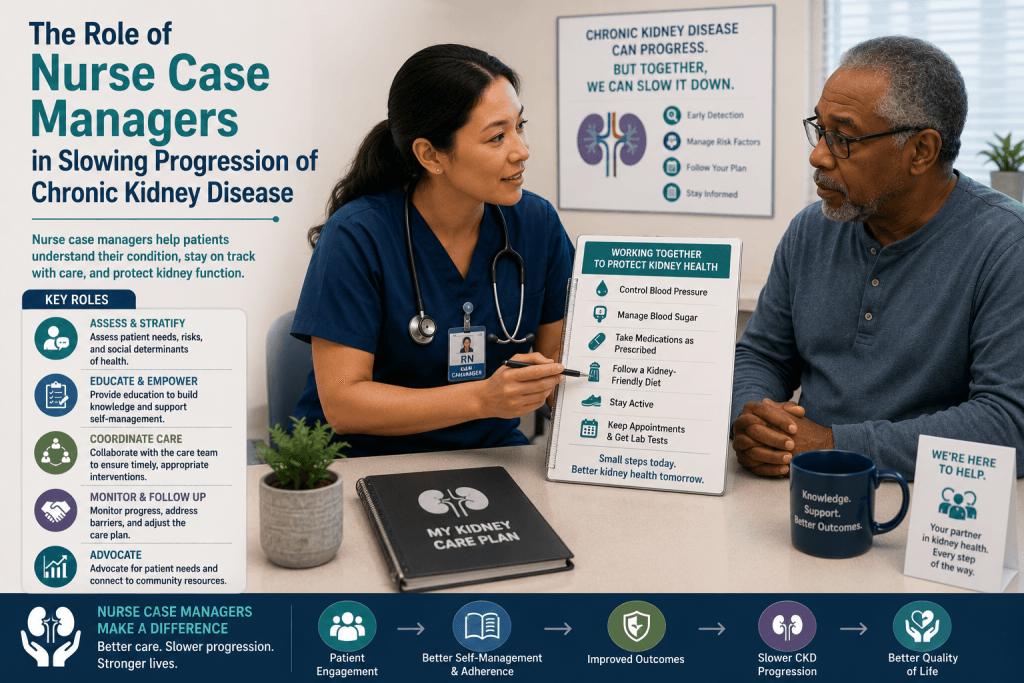
Case management assigns a single nurse to coordinate a patient’s care across specialists, tests, and time, which matters most for conditions that progress slowly and quietly. Its core functions include:
- Longitudinal tracking of lab trends and disease progression across multiple providers.
- Proactive outreach before a scheduled visit, rather than waiting for a patient to report a problem.
- Coordinating referrals so specialty care happens at the right time, not after a preventable decline.
- Serving as a single point of contact, reducing the confusion patients often feel when managing several specialists at once.
Our study on the role of nurse case managers in slowing progression of chronic kidney disease shows how this model changes outcomes in a condition where early intervention has an outsized long-term effect.
Collaborative Care Models
No single clinician can carry chronic disease management alone, which is why the strongest programs are built around shared responsibility. Effective collaborative models depend on:
- Clear role definition, so nurses, physicians, pharmacists, and dietitians each know exactly what they own.
- Shared documentation that keeps every member of the team working from the same current picture.
- Regular case conferences for complex patients whose needs cross multiple disciplines.
- Protocols that let nurses act within a defined scope without waiting on a physician for every routine adjustment.
The strength of a collaborative model shows up most clearly when a patient’s condition changes suddenly. A team that already shares documentation and a clear division of responsibility can respond within a day; a fragmented one often takes weeks to even notice.
Group-Based Chronic Disease Management
Group visits bring several patients with similar conditions together for a shared appointment, combining clinical care with peer support. Their benefits include:
- Peer accountability, which often sustains behavior change more effectively than one-on-one advice alone.
- Efficient use of clinician time, allowing more thorough education than a typical individual visit permits.
- Normalizing the condition, reducing the isolation many patients feel managing a chronic illness alone.
- Shared problem-solving, where patients often surface practical tips that a clinician wouldn’t think to offer.
Our research on nurse-led group visits for chronic disease management in primary care settings examines where this model performs best compared to traditional one-on-one care.
Technology and Care Coordination in Chronic Disease Management
Telehealth and Remote Patient Monitoring
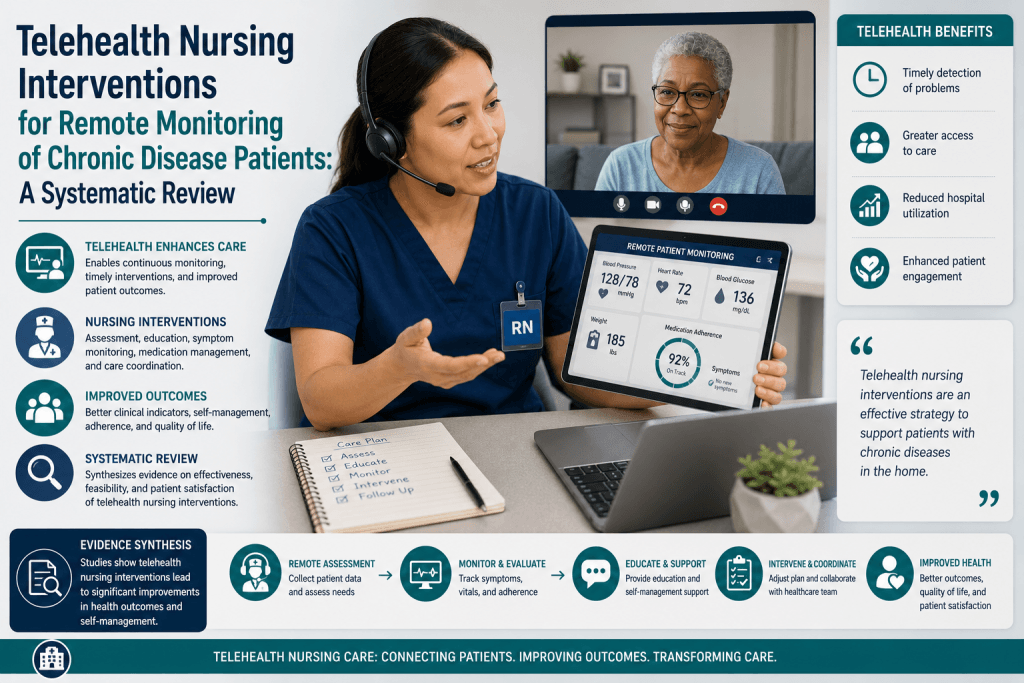
Remote monitoring extends a nurse’s awareness of a patient’s condition into the time between visits, which is precisely when most chronic disease complications begin. Its practical applications include:
- Daily weight and symptom tracking for heart failure patients, flagging fluid retention before it becomes an emergency.
- Remote glucose monitoring, allowing timely medication adjustments without an in-person visit.
- Video visits for patients with transportation or mobility barriers that would otherwise delay care.
- Automated alerts that route concerning readings directly to a nurse for same-day follow-up.
- Reduced burden on patients, particularly those managing multiple conditions who benefit from fewer in-person trips.
Our review of telehealth nursing interventions for remote monitoring of chronic disease patients looks at where this technology produces the clearest outcome improvements, and where it still depends heavily on a nurse’s judgment behind the screen.
Transitional Care After Hospital Discharge
The period right after a hospital stay is one of the highest-risk windows in chronic disease management, when a patient returns home with a new or adjusted plan and no one watching closely. Transitional care nursing addresses this through:
- Discharge education that confirms a patient truly understands their new medications and follow-up plan before leaving.
- Timely follow-up calls or visits, typically within the first 48 to 72 hours after discharge.
- Medication reconciliation, catching discrepancies between hospital and home medication lists.
- Home environment assessment, identifying practical barriers a hospital stay wouldn’t reveal.
Our study on the effectiveness of transitional care nursing programs in reducing hospital readmissions among patients with chronic diseases quantifies just how much this window matters.
Preventing Hospital Readmissions
Readmission prevention is where several strands of chronic disease management converge: education, coordination, and timely follow-up all have to work together. Key levers include:
- Structured discharge protocols that standardize what every patient receives before leaving, rather than leaving it to individual judgment.
- Clear red-flag instructions, telling patients exactly what symptoms should prompt an immediate call.
- Scheduled follow-up appointments booked before discharge, not left for the patient to arrange.
- Risk stratification, directing the most intensive follow-up resources toward the patients most likely to bounce back.
Our analysis of the impact of nurse-driven discharge education on 30-day readmission rates in heart failure patients shows how much of this outcome is determined in the final hour before a patient walks out the door.
Coordinating Long-Term Care Across Healthcare Settings
Chronic disease rarely stays inside one setting; a single patient may move between hospital, clinic, specialist offices, and home over the course of a year. Coordinating that journey requires:
- Shared electronic records that follow the patient rather than staying siloed within one system.
- A named care coordinator who patients and providers alike know how to reach.
- Standardized handoff communication whenever a patient moves between settings.
- Community resource connections, linking patients to social services, transportation, or home health when clinical care alone isn’t enough.
Patients rarely experience these settings as distinct systems the way an organizational chart might suggest. To them, it’s one continuous relationship with their own health, and the coordination work happening quietly behind the scenes is what keeps that experience from feeling disjointed.
Improving Healthcare Outcomes Through Evidence-Based Chronic Disease Management
Improving Quality of Life
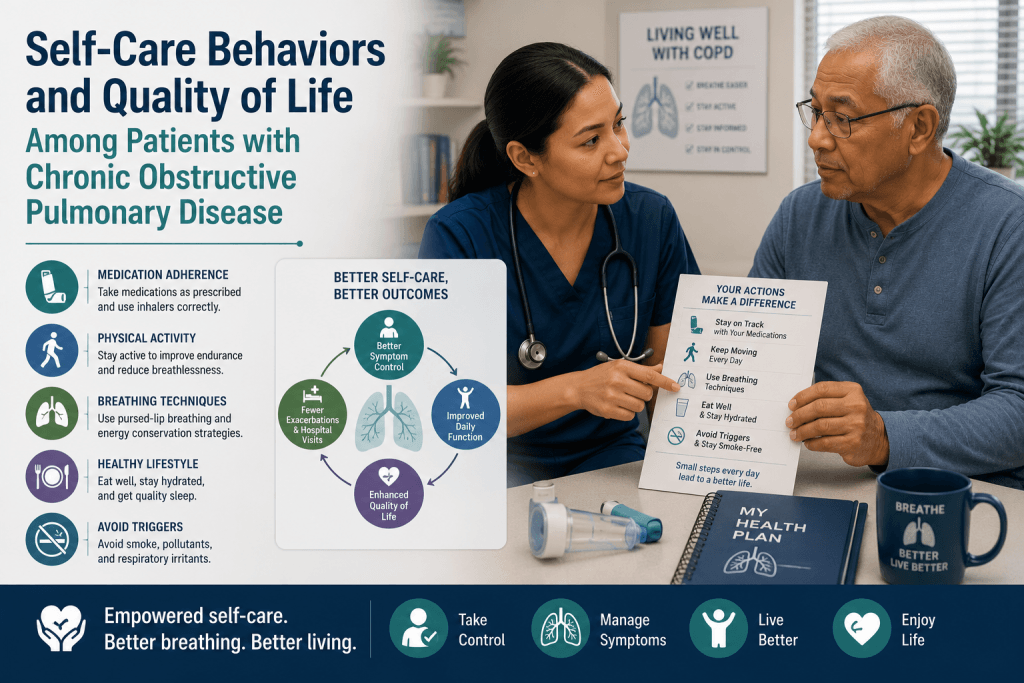
Clinical metrics only tell part of the story; how a patient actually experiences daily life with a chronic condition is its own outcome worth measuring. Nursing care shapes quality of life through:
- Symptom control, reducing the day-to-day burden a condition places on a patient’s routine.
- Preserved independence, supporting a patient’s ability to manage their own care rather than becoming dependent on others.
- Emotional and psychological support, acknowledging that a chronic diagnosis carries a real mental health toll.
- Realistic goal-setting, anchored in what actually matters to the patient rather than a generic clinical target.
Two patients with identical lab values can have very different quality of life depending on how much a condition limits what they can still do, which is why nurses often ask about function, not just numbers, when they check in.
Our study on self-care behaviors and quality of life among patients with chronic obstructive pulmonary disease shows how closely these two measures move together in practice.
Reducing Healthcare Costs
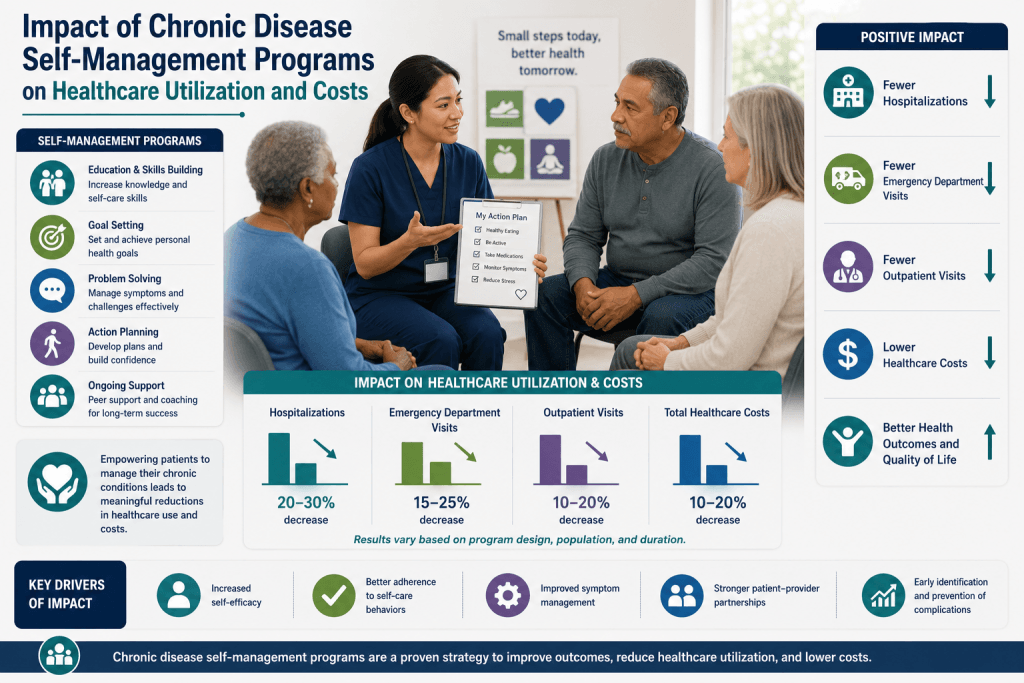
Well-designed chronic disease management is also, quite directly, a cost story: preventing one hospitalization can offset the cost of months of outpatient support. Cost-related benefits include:
- Fewer emergency department visits when patients have a clear plan for managing symptom flares at home.
- Reduced hospitalization rates tied to earlier intervention and better self-management.
- Lower long-term costs from slowing disease progression rather than only treating acute complications.
- More efficient use of clinician time, since patients who understand their condition require less crisis-driven care.
Our research on the impact of chronic disease self-management programs on healthcare utilization and costs lays out the economic case alongside the clinical one.
Measuring Patient Outcomes
None of these gains are visible without consistent measurement. Nursing teams typically track:
- Clinical markers, such as HbA1c, blood pressure, and weight trends over time.
- Adherence rates to medication and follow-up appointments.
- Hospitalization and readmission rates specific to the managed condition.
- Patient-reported outcomes, including quality of life and self-management confidence.
- Program engagement, tracking whether patients actually participate in the education and coordination offered to them.
These indicators matter most when they’re reviewed regularly and used to adjust a program, rather than collected and set aside. A metric that never changes anyone’s care plan is just a number sitting in a spreadsheet; the value only appears once a nursing team acts on what the data is actually showing.
Future Directions in Chronic Disease Nursing Research
Chronic disease management continues to evolve alongside data and technology. Emerging directions include:
- Predictive analytics that flag a patient likely to decompensate before symptoms become obvious.
- Wearable monitoring devices that extend the reach of remote monitoring beyond scheduled check-ins.
- Personalized education tailored to a patient’s literacy level, culture, and specific barriers rather than a one-size-fits-all curriculum.
- Stronger integration between digital tools and human follow-up, since technology alone rarely changes behavior without a nurse relationship behind it.
Whatever tools emerge, the throughline stays the same: a patient managing a chronic condition needs a consistent, trusted relationship far more than any single new device or protocol.
Chronic disease management isn’t a single visit or a single intervention. It’s the accumulated weight of every check-in, every piece of plain-language education, and every follow-up call that happens long after the appointment ends.
Chronic Disease Management Journal Article Examples
Browse the full library of journal article examples referenced throughout this guide, organized by clinical focus.
- Telehealth nursing interventions for remote monitoring of chronic disease patients
- Impact of chronic disease self-management programs on healthcare utilization and costs
- Nurse-led group visits for chronic disease management in primary care settings
- Effectiveness of transitional care nursing programs in reducing hospital readmissions among patients with chronic diseases