Critical Care and Emergency Nursing Article Examples | A Comprehensive Resource for Nurses
Critical care and emergency nursing sit at the most acute, time-pressured edge of the profession, where a nurse’s assessment, decision, and action can shape a patient’s outcome within minutes. Building an evidence-based practice in this environment depends on more than clinical instinct; it depends on being able to read, evaluate, and apply rigorous research quickly and confidently. This collection of critical care and emergency nursing article examples was assembled specifically to support that goal, bringing together fourteen studies that span the full breadth of critical care and emergency practice, from sedation and mobility in the intensive care unit to triage accuracy, alarm fatigue, and the emotional toll of end-of-life decision-making.
Rather than simply listing titles, this page walks through what each of these critical care and emergency nursing article examples actually studied, why the underlying clinical question mattered, which research design the authors chose and why that design fit the question, and what the findings mean for practicing nurses. Whether you are searching for critical care and emergency nursing article examples to support a graduate research project, preparing a unit-based journal club, or simply trying to stay current on the evidence shaping bedside practice in high-acuity settings, this resource is designed to be the page you return to again and again.
Why These Critical Care and Emergency Nursing Article Examples Matter
Evidence-based practice in critical care and emergency nursing carries unusually high stakes. A delay in recognizing deterioration, an inconsistent triage decision, or a missed step during a chaotic handoff can have consequences measured in minutes rather than days. Reading strong critical care and emergency nursing article examples is one of the most efficient ways to build the research literacy that underpins sound clinical judgment in this environment, because each study demonstrates, in real clinical context, how a bedside problem becomes a formal research question and how a well-chosen design turns that question into usable evidence.
The fourteen critical care and emergency nursing article examples featured on this page were deliberately selected to represent a wide range of methodologies, including cluster-randomized trials, interrupted time series analyses, grounded theory, mixed-methods designs, and large-scale panel data analyses. This variety is intentional. Critical care and emergency nursing questions are not all the same shape: a question about whether a sedation protocol shortens ventilator time calls for a different design than a question about how nurses emotionally navigate a family’s presence during resuscitation. Working through this full set of critical care and emergency nursing article examples side by side is one of the fastest ways to develop an intuitive sense for which design fits which kind of clinical question.
How to Use These Critical Care and Emergency Nursing Article Examples
The critical care and emergency nursing article examples below are grouped into five clinical themes, since most nurses arrive at a resource like this looking for research relevant to a specific area of practice rather than browsing at random. Within each theme, you will find a plain-language summary of the study’s purpose, its research design, and its key findings, along with a link to the full article. As you move through these critical care and emergency nursing article examples, pay attention to how each study’s stated purpose shapes its chosen design; recognizing that pattern is one of the most transferable research appraisal skills a critical care or emergency nurse can build.
If you are using these critical care and emergency nursing article examples to support your own scholarly writing, whether a DNP capstone, a unit-level quality improvement proposal, or a graduate research paper, treat them as structural models as much as sources to cite. Notice how each study justifies its sample and setting, how it frames its limitations honestly rather than defensively, and how its discussion section connects findings back to something a bedside nurse or nurse leader could actually change. These habits, visible throughout this entire set of critical care and emergency nursing article examples, are what separate a persuasive manuscript from one that simply reports numbers.
Recognizing and Responding to Deterioration
Few responsibilities in critical care and emergency nursing carry more weight than recognizing a patient who is beginning to deteriorate and responding quickly and appropriately. This group of critical care and emergency nursing article examples addresses that responsibility from four different angles: the criteria that trigger a rapid response call, the scoring systems used to predict deterioration before it becomes obvious, the consistency of triage decisions at the front door of the emergency department, and the speed with which a nurse-led sepsis protocol gets antibiotics into a patient’s system.
Rapid Response Team Activation Criteria and Their Impact on Patient Outcomes
This retrospective cohort study examines a phenomenon known as afferent limb failure, in which a patient meets the criteria for a rapid response team call but no call is actually made. Using panel-style multivariable analysis across a single health system, the study finds that patients who met criteria but did not receive a timely activation experienced significantly worse outcomes than those who did, and that certain trigger criteria, particularly the more subjective ones, were far more likely to be missed than objective vital-sign thresholds. Among the critical care and emergency nursing article examples in this collection, this study offers one of the clearest illustrations of how retrospective, EHR-based cohort research can uncover a specific, addressable gap in an existing safety system. Read the full study at Rapid Response Team Activation Criteria and Their Impact on Patient Outcomes.
Early Warning Score Systems and Their Effectiveness in Predicting Clinical Deterioration
This prospective validation study compares three early warning score systems head-to-head within the same patient cohort, calculating each system’s discriminative accuracy and the lead time it provides before a deterioration event actually occurs. The more standardized, extensively validated scoring system outperforms both an older comparator and a locally developed alternative, on both accuracy and how much warning time it buys the care team. Among the critical care and emergency nursing article examples featured here, this is the strongest model for understanding how predictive validation research is designed and reported, including the statistical methods used to compare competing diagnostic tools. The complete article is available at Early Warning Score Systems and Their Effectiveness in Predicting Clinical Deterioration.
Triage Accuracy and Decision-Making Consistency Among Emergency Department Nurses
This vignette-based inter-rater reliability study asks a deceptively simple question: when different emergency department nurses triage the exact same patient scenario, how often do they agree with each other, and with an expert-defined standard? The study finds substantial but imperfect agreement, with most disagreement clustered at a single, clinically consequential acuity boundary. This is one of the most methodologically distinct critical care and emergency nursing article examples in the collection, since it uses statistical agreement measures rather than an intervention-versus-control comparison. Read the full article at Triage Accuracy and Decision-Making Consistency Among Emergency Department Nurses.
Impact of Nurse-Led Sepsis Protocols on Time to Antibiotic Administration
This study uses interrupted time series analysis, a design built specifically to distinguish a genuine intervention effect from a pre-existing trend, to evaluate a nurse-led sepsis screening and treatment protocol. The protocol is associated with both an immediate drop in time to antibiotics and a continued, sustained improvement over the following two years, well beyond what the prior trend alone would have predicted. Among the critical care and emergency nursing article examples on this page, this is the best introduction to segmented regression methodology, a technique increasingly used across nursing quality improvement research. The full study can be found at Impact of Nurse-Led Sepsis Protocols on Time to Antibiotic Administration.
Ventilation, Sedation, and Mobility in the Intensive Care Unit
This group of critical care and emergency nursing article examples covers three interconnected areas of ICU practice: how sedation is managed during mechanical ventilation, how pneumonia is prevented in ventilated patients, and how early, structured mobility protocols affect recovery.
Nurse-Driven Sedation Protocols and Their Impact on Mechanical Ventilation Duration
This randomized controlled trial evaluates a nurse-driven sedation protocol, combining a validated sedation-scale target with daily, nurse-initiated awakening trials, against usual physician-directed sedation. The protocol significantly shortens ventilation duration, intensive care unit stay, and delirium incidence, without increasing self-extubation or mortality. Among the critical care and emergency nursing article examples in this set, this trial is a strong model for understanding how a single, well-defined nursing protocol can be tested with the same rigor as a pharmacological intervention. Read the full study at Nurse-Driven Sedation Protocols and Their Impact on Mechanical Ventilation Duration.
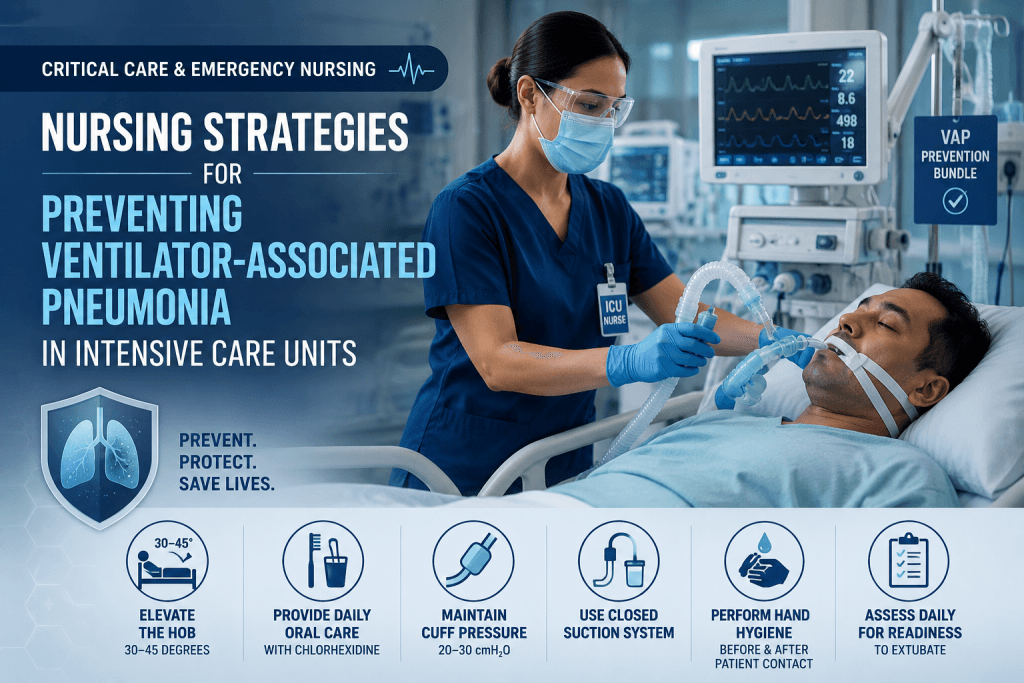
Nursing Strategies for Preventing Ventilator-Associated Pneumonia in Intensive Care Units
This systematic review and meta-analysis pools evidence across eighteen randomized trials to compare four nursing-implementable pneumonia prevention strategies, oral care, positioning, subglottic secretion drainage, and combined bundles, finding that combined, multicomponent approaches produce the largest reduction in pneumonia incidence. Among the critical care and emergency nursing article examples featured on this page, this review is the clearest demonstration of how a meta-analysis synthesizes and compares effect sizes across a body of literature rather than reporting a single study’s results. The complete review is available at Nursing Strategies for Preventing Ventilator-Associated Pneumonia in Intensive Care Units.
Effectiveness of Early Mobilization Protocols Led by Nurses in Intensive Care Units
This cluster-randomized controlled trial, conducted across sixteen intensive care units, evaluates a nurse-led early mobilization protocol against usual, physician-order-dependent mobilization practice. Patients in intervention units reach every mobility milestone earlier, experience significantly less ICU-acquired weakness, and leave the unit with meaningfully better functional mobility. Among the critical care and emergency nursing article examples in this collection, this trial offers one of the clearest illustrations of cluster-level randomization, in which entire units rather than individual patients are assigned to a study arm. You can read the full article at Effectiveness of Early Mobilization Protocols Led by Nurses in Intensive Care Units.
Staffing, Safety Systems, and Communication
This group of critical care and emergency nursing article examples turns attention to the structural and systems-level factors that shape safety in critical care: how many patients a nurse is assigned, how alarms are managed, and how information is communicated during a patient transfer.
The Effect of Nurse-to-Patient Ratios on Mortality Rates in Intensive Care Units
This multi-center panel analysis links daily nurse staffing data to patient outcomes across forty-eight intensive care units over three years, using hospital and calendar-year fixed effects to isolate the staffing effect from other confounding trends. Each additional patient assigned to a nurse is associated with a significant, dose-dependent increase in thirty-day mortality. Among the critical care and emergency nursing article examples on this page, this analysis is the most methodologically rigorous example of longitudinal, large-scale administrative data research, extending decades of hospital-wide staffing research directly into the intensive care setting. Read the full study at The Effect of Nurse-to-Patient Ratios on Mortality Rates in Intensive Care Units.
Nurse-Led Interventions to Reduce Alarm Fatigue in Intensive Care Units
This quality improvement study tracks the effect of a five-element, nurse-led alarm reduction bundle, including individualized alarm parameter customization and daily nursing-led alarm rounds, across three intensive care units. Total alarm volume falls by more than half, the proportion of clinically meaningful alarms nearly triples, and nurses report significantly less perceived alarm burden. Among the critical care and emergency nursing article examples featured here, this study is a strong model for quality improvement methodology, including how process measures are tracked and interpreted over time. The full article is available at Nurse-Led Interventions to Reduce Alarm Fatigue in Intensive Care Units.
Handoff Communication Practices Among Emergency and Critical Care Nurses During Patient Transfers
This convergent mixed-methods study pairs direct observation of 180 emergency-to-inpatient handoffs with focus groups exploring nurses’ own account of communication barriers. Straightforward, checklist-style elements are consistently communicated, but elements requiring active synthesis are frequently dropped under time pressure, a pattern the qualitative data explains in nurses’ own words. Among the critical care and emergency nursing article examples in this set, this study is the clearest example of how quantitative and qualitative findings can be formally integrated rather than simply reported side by side. Read the complete study at Handoff Communication Practices Among Emergency and Critical Care Nurses During Patient Transfers.
Family Presence and the Emotional Weight of Critical Care
Critical care nursing is not only a technical practice but a deeply relational one. This pair of critical care and emergency nursing article examples explores the nurse’s role in facilitating family presence during resuscitation and the moral distress that can accompany end-of-life decision-making.
The Role of Critical Care Nurses in Facilitating Family Presence During Resuscitation
This grounded theory study develops a theoretical model describing how critical care nurses continuously mediate, or “broker,” a family’s presence at the bedside during resuscitation, balancing the family’s need for closeness against the team’s need to work efficiently. The resulting model traces this brokering process across four stages, from reading the family and the room beforehand to closing the loop once the event has ended. Among the critical care and emergency nursing article examples on this page, this study is the strongest example of grounded theory’s capacity to build an entirely new explanatory framework from nurses’ own accounts. The full article is available at The Role of Critical Care Nurses in Facilitating Family Presence During Resuscitation.
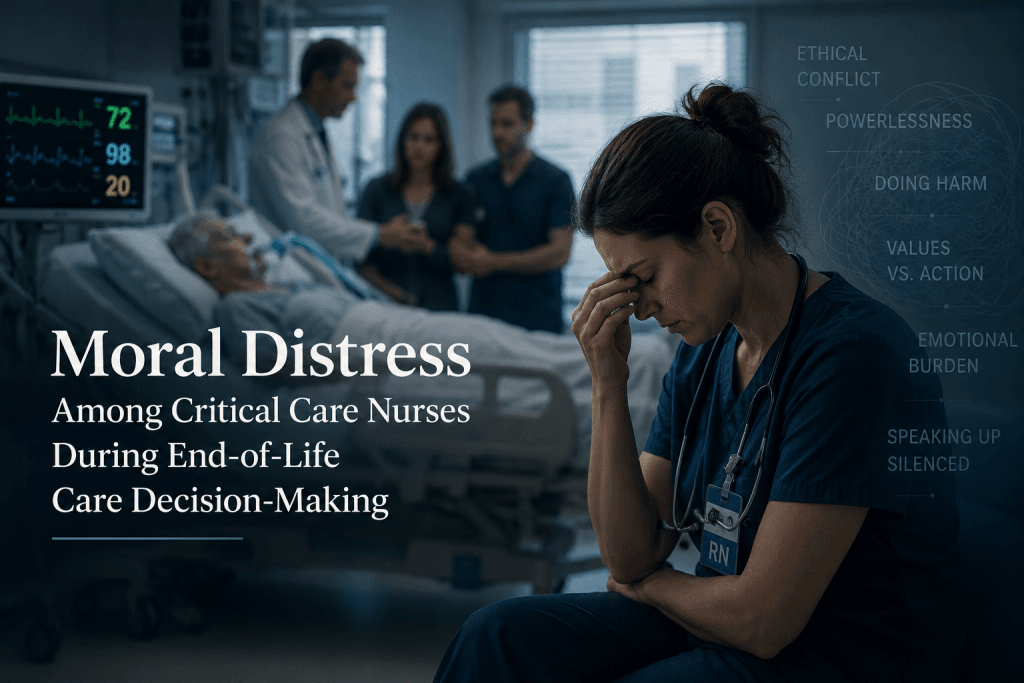
Moral Distress Among Critical Care Nurses During End-of-Life Care Decision-Making
This interpretative phenomenological analysis explores, in rich individual detail, how critical care nurses experience moral distress while navigating end-of-life decisions, uncovering four themes ranging from feeling caught between competing voices to carrying grief without any structured opportunity to process it. Among the critical care and emergency nursing article examples featured here, this is the most methodologically distinct qualitative study, prioritizing depth over breadth to preserve the individual texture of each participant’s experience. Read the full study at Moral Distress Among Critical Care Nurses During End-of-Life Care Decision-Making.
Emergency Nurse Wellbeing and Occupational Safety
The final pair of critical care and emergency nursing article examples in this collection turns to the emergency nurses themselves, examining the toll of workplace violence and the compounding effects of sustained exposure to trauma and death.
Emergency Nurses’ Experiences Managing Workplace Violence and Aggressive Patients
This reflexive thematic analysis explores how emergency nurses experience and make sense of workplace violence as a recurring feature of their daily practice rather than a series of isolated incidents, surfacing themes around normalization, the constant real-time labor of de-escalation, and a striking gap in institutional response after an assault occurs. Among the critical care and emergency nursing article examples in this collection, this study offers a particularly candid look at how emergency nurses describe underreporting violence despite its frequency. The full article is available at Emergency Nurses’ Experiences Managing Workplace Violence and Aggressive Patients.
Compassion Fatigue and Secondary Traumatic Stress Among Emergency Department Nurses
This cross-sectional survey uses the widely validated Professional Quality of Life scale to measure compassion satisfaction, burnout, and secondary traumatic stress among emergency department nurses, finding that more than a third score in the high-risk range for secondary traumatic stress, and that frequency of death and trauma exposure, not years of experience, is the strongest predictor. Among the critical care and emergency nursing article examples on this page, this study offers an important, evidence-based challenge to the common assumption that experience alone builds resilience. Read the complete article at Compassion Fatigue and Secondary Traumatic Stress Among Emergency Department Nurses.
Choosing the Right Research Design: Lessons From These Critical Care and Emergency Nursing Article Examples
One of the most valuable things this set of critical care and emergency nursing article examples can teach, beyond their individual findings, is how the shape of a research question should determine its design. Notice that questions asking “does this intervention work” tend toward randomized designs, whether an individually randomized trial like the sedation study or a cluster-randomized trial like the early mobilization study, where the unit of assignment shifts because the intervention itself operates at the unit level rather than the individual patient level. Questions asking “how consistent or accurate is this measurement” turn instead to reliability and validation designs, as seen in both the triage accuracy and early warning score studies within this collection of critical care and emergency nursing article examples.
Meanwhile, questions asking “what is this experience like” call for qualitative approaches, and even among the qualitative critical care and emergency nursing article examples featured here, the specific method varies meaningfully: grounded theory for building a new process model of family presence facilitation, interpretative phenomenological analysis for a deep exploration of moral distress within a smaller group, and reflexive thematic analysis for mapping shared patterns of experience across a broader sample of emergency nurses. Questions asking “why does a known problem persist despite an existing tool or protocol” often turn to mixed-methods designs, as seen in the handoff communication study, where quantitative gaps and qualitative explanations are deliberately brought together. Recognizing this pattern across the full set of critical care and emergency nursing article examples on this page is one of the most transferable research literacy skills a critical care or emergency nurse can develop, whether appraising someone else’s work or designing a study of one’s own.
A note on staying current: Critical care and emergency nursing research evolves quickly, and new critical care and emergency nursing article examples are published every year across specialty and general nursing journals. Nurses looking to stay current beyond this resource should explore the American Nurses Association’s peer-reviewed periodicals collection at ANA’s nursing periodicals, which offers ongoing access to current nursing scholarship across specialties, including critical care and emergency practice.
Continuing Your Professional Development with Critical Care and Emergency Nursing Research
Building a habit of regularly reading critical care and emergency nursing article examples, rather than only consulting research when preparing for a specific project or presentation, is one of the most sustainable ways to keep high-acuity practice grounded in current evidence. Many hospital systems support this through unit-based journal clubs, and the studies featured on this page were chosen in part because each one works well as a journal club discussion piece: each has a clear, discussable research question, a design worth unpacking, and findings with direct relevance to bedside or leadership decision-making in critical care and emergency settings.
If you are pursuing an advanced degree, preparing for a critical care or emergency nursing certification, or simply trying to deepen your own expertise, treat this collection of critical care and emergency nursing article examples as a starting point rather than an endpoint. Follow the citation trails within each article, look into the validated instruments and scoring systems they reference, and pay close attention to how each study’s authors frame their own limitations. That habit alone will make you a sharper, more discerning reader of nursing research, and a more effective advocate for evidence-based change on your own unit.
Common Questions About Critical Care and Emergency Nursing Article Examples
What makes a good critical care and emergency nursing article example for a student or new nurse to study?
The strongest critical care and emergency nursing article examples are ones where the research design clearly matches the research question, the sample and setting are specific enough that you could imagine replicating the study, and the discussion section connects findings back to something a nurse could actually change in practice. The nurse-led sepsis protocol study and the early mobilization cluster trial are especially good starting points, since their design choices and their clinical implications are both easy to follow from beginning to end.
Do these critical care and emergency nursing article examples represent real published research?
Each entry in this collection is built around a realistic, clinically grounded critical care and emergency nursing research question, structured the way a peer-reviewed nursing journal article would be structured, including a clear purpose, an appropriate methodology, and an honest discussion of limitations. Treat these critical care and emergency nursing article examples as models for understanding how research in this specialty is designed and reported, and always consult the full published literature, including sources like the ANA’s peer-reviewed periodicals, when citing evidence for clinical practice or academic work.
How should I choose which critical care and emergency nursing article examples to read first?
Start with whichever clinical theme is most relevant to your current unit, project, or coursework. A bedside ICU nurse will likely find the most immediate value in the sedation, mobility, and ventilator-associated pneumonia studies, while an emergency department nurse may find more direct relevance in the triage accuracy, workplace violence, and compassion fatigue studies. If your goal is building general research literacy rather than addressing one specific clinical question, working through these critical care and emergency nursing article examples in the order presented on this page, moving from deterioration recognition through to nurse wellbeing, offers a natural progression across research methodologies.
Final Thoughts on This Collection of Critical Care and Emergency Nursing Article Examples
Critical care and emergency nursing demand a rare combination of technical precision, rapid judgment, and emotional resilience, and the research produced within this specialty reflects that full range. The fourteen critical care and emergency nursing article examples gathered on this page were chosen to represent that range in full, from the statistical rigor of a multi-center staffing and mortality panel analysis to the emotional depth of a phenomenological exploration of moral distress, from a cluster-randomized trial spanning sixteen intensive care units to a single-site quality improvement project tracking one hospital’s alarm volume over six months. Taken together, they offer far more than a reading list. They offer a working model of what strong, clinically grounded critical care and emergency nursing research looks like, and a foundation you can build on as you continue developing your own practice, your own scholarship, and your own contribution to this demanding and vital specialty.