Nurse Staffing Levels and Their Association with Adverse Patient Events: A Cross-Sectional Study
Abstract
Background: Registered nurse staffing levels have long been theorized as a structural determinant of patient safety, yet hospitals continue to vary substantially in staffing intensity, and the strength of the association between staffing level and specific categories of adverse patient event remains incompletely characterized across diverse unit types.
Purpose: This cross-sectional study examined the association between unit-level registered nurse staffing intensity, measured as nursing hours per patient day and registered nurse skill mix, and the concurrent incidence of four nursing-sensitive adverse events: patient falls, medication errors, hospital-acquired pressure injuries, and failure-to-rescue events.
Methods: Unit-level staffing and adverse event data were analyzed across 214 medical-surgical, intensive care, and step-down units in 58 acute care hospitals during a single fiscal quarter. Staffing was quantified using nursing hours per patient day and registered nurse skill mix, and multivariable regression models estimated the association between staffing intensity and adverse event rates while adjusting for patient acuity, unit type, and hospital teaching status.
Results: Units in the lowest staffing quartile had significantly higher rates of all four adverse events relative to units in the highest staffing quartile. Each additional registered nurse hour per patient day was associated with an 8.7% relative reduction in fall rate, a 6.2% reduction in medication error rate, a 9.4% reduction in pressure injury incidence, and a 12.1% reduction in failure-to-rescue rate. Registered nurse skill mix showed an independent association with adverse events beyond total nursing hours alone, with higher skill mix associated with lower failure-to-rescue rates specifically.
Conclusion: Registered nurse staffing intensity is significantly and independently associated with the incidence of multiple categories of nursing-sensitive adverse events, with failure-to-rescue showing particular sensitivity to both total staffing hours and registered nurse skill mix. These findings support continued attention to minimum staffing standards as a patient safety, rather than purely operational, consideration.
Keywords: nurse staffing, nursing hours per patient day, skill mix, adverse events, failure to rescue, patient safety, cross-sectional study
Introduction
The relationship between registered nurse staffing levels and patient outcomes has been a subject of sustained empirical investigation for more than two decades, driven in part by the recognition that nursing care functions as a continuous, around-the-clock surveillance and intervention mechanism uniquely positioned to detect and interrupt the progression of adverse clinical events before they result in serious harm (Aiken et al., 2002). Unlike many other clinical interventions that occur at discrete points in time, nursing care is delivered continuously across a hospitalization, making the intensity and consistency of nurse staffing a plausible structural determinant of a wide range of patient safety outcomes, from falls and medication errors to more severe events such as failure to rescue a patient from a life-threatening complication.
Early large-scale investigations of this relationship produced influential and widely cited findings. Needleman et al. (2002), analyzing discharge data from over 799 hospitals, found that higher registered nurse staffing was associated with shorter length of stay and lower rates of urinary tract infection, upper gastrointestinal bleeding, pneumonia, and failure to rescue among surgical patients. Aiken et al. (2002) similarly reported that each additional surgical patient assigned to an individual nurse was associated with a 7% increase in the likelihood of dying within 30 days of admission, alongside significantly increased risk of failure to rescue, establishing nurse-to-patient ratio as an independent predictor of mortality even after adjustment for patient and hospital characteristics. These early findings were subsequently reinforced by a systematic review and meta-analysis concluding that higher registered nurse staffing was consistently associated with lower hospital-related mortality, shorter length of stay, and lower rates of several nursing-sensitive adverse events across the aggregated literature (Kane et al., 2007).
More recent international research has extended these findings beyond the United States and beyond mortality as the primary outcome of interest. The RN4CAST study, encompassing more than 300 hospitals across nine European countries, found that each additional patient added to an individual nurse’s workload was associated with a 7% increase in the likelihood of an inpatient dying within 30 days of admission, and further found that a higher proportion of professionally educated registered nurses within a hospital’s nursing workforce was independently associated with lower mortality, suggesting that both staffing quantity and registered nurse skill mix contribute distinctly to patient outcomes (Aiken et al., 2014). Complementary research has examined a broader array of nursing-sensitive adverse events beyond mortality, including patient falls, medication administration errors, and pressure injury incidence, generally finding that lower staffing is associated with elevated rates across these outcomes as well, though with somewhat greater heterogeneity in effect size than has been observed for mortality-related outcomes specifically (Cho et al., 2003; Blegen et al., 1998).
The policy relevance of this evidence base has grown alongside a broader movement toward mandated minimum nurse staffing ratios in several jurisdictions, most notably California’s landmark 2004 legislation establishing fixed nurse-to-patient ratios by unit type, a policy whose adoption was directly informed by the staffing-outcomes literature described above and which has since served as a reference point for subsequent staffing-ratio legislation proposed in other states and countries (McHugh & Ma, 2013). Evaluations of mandated ratio policies have generally reported improvements in staffing levels and, in some analyses, corresponding improvements in patient outcomes, though the magnitude of policy-attributable effect remains debated given the methodological difficulty of isolating a single legislative intervention from concurrent secular trends in hospital staffing practice nationally.
Despite this substantial and largely convergent evidence base, several important questions remain incompletely resolved. First, much of the existing literature has examined staffing in relation to a single adverse event category or a composite outcome measure, limiting the ability to compare the relative strength of the staffing-outcome association across distinct types of nursing-sensitive events within the same dataset. Second, the relative contribution of total nursing hours per patient day versus registered nurse skill mix, meaning the proportion of direct care hours provided specifically by registered nurses as opposed to licensed practical nurses or unlicensed assistive personnel, remains an area of ongoing investigation, with some evidence suggesting that skill mix may be an independent predictor of outcome distinct from total staffing volume alone (Griffiths et al., 2018; Rafferty et al., 2007). The purpose of this cross-sectional study was to examine the association between unit-level registered nurse staffing intensity, measured through both nursing hours per patient day and registered nurse skill mix, and the concurrent incidence of four distinct categories of nursing-sensitive adverse events: patient falls, medication errors, hospital-acquired pressure injuries, and failure-to-rescue events, in order to characterize whether the strength of the staffing-outcome relationship differs meaningfully across these event types.
Methods
This cross-sectional study analyzed unit-level staffing and adverse event data from 214 medical-surgical, intensive care, and step-down units across 58 acute care hospitals participating in a regional nursing-sensitive quality indicator database during a single fiscal quarter. Units were eligible for inclusion if they submitted complete staffing and adverse event data for the full quarter and maintained at least 500 patient days during the study period, consistent with minimum reporting thresholds used in prior nurse staffing and outcomes research (Needleman et al., 2002).
Staffing intensity was quantified using two established measures. Nursing hours per patient day (HPPD) was calculated as the total productive nursing hours, including both registered nurse and non-registered-nurse direct care staff, divided by the total number of patient days for the unit during the study quarter, consistent with standard methodology used in prior national staffing and outcomes studies (Lang et al., 2004). Registered nurse skill mix was calculated as the proportion of total direct care nursing hours provided specifically by registered nurses, as opposed to licensed practical nurses or unlicensed assistive personnel, consistent with skill-mix operationalization used in prior European and United States staffing research (Aiken et al., 2014; Rafferty et al., 2007).
Four nursing-sensitive adverse events were examined as primary outcomes: patient falls, calculated as falls per 1,000 patient days; medication administration errors, calculated as reported errors per 1,000 medication administrations; hospital-acquired pressure injuries, calculated as new stage 2 or greater injuries per 1,000 patient days; and failure-to-rescue events, defined consistent with prior methodology as inpatient death following a serious, potentially treatable complication such as sepsis, cardiac arrest, or acute respiratory failure, calculated as a proportion of patients experiencing the complication who subsequently died (Needleman et al., 2002; Aiken et al., 2002). Patient acuity was estimated using unit-level case-mix index derived from hospital discharge data, and unit type and hospital teaching status were obtained from participating hospitals’ organizational records.
Multivariable linear and Poisson regression models, as appropriate to the distribution of each outcome, were used to estimate the association between staffing intensity, measured separately as HPPD and registered nurse skill mix, and each of the four adverse event outcomes, adjusting for unit-level case-mix index, unit type, and hospital teaching status. Units were additionally stratified into staffing quartiles based on HPPD to permit descriptive comparison of adverse event rates between the highest- and lowest-staffed units. Given the cross-sectional design of this analysis, all associations should be interpreted as concurrent statistical relationships rather than as evidence of a specific causal mechanism or temporal sequence.
Results
The 214 included units represented 131 medical-surgical units, 52 intensive care units, and 31 step-down units, with a combined total of approximately 1.4 million patient days during the study quarter. Mean nursing hours per patient day ranged from 5.8 on lower-acuity medical-surgical units to 14.6 on intensive care units, and registered nurse skill mix ranged from 62% to 94% across the sampled units, reflecting the substantial variability in staffing model and skill composition that exists even within a single unit type across different hospitals.
ADDITIONAL RN HOUR/PATIENT DAY
ADDITIONAL RN HOUR/PATIENT DAY
INCLUDED IN ANALYSIS
In adjusted regression models, each additional registered nurse hour per patient day was associated with an 8.7% relative reduction in fall rate, a 6.2% relative reduction in medication error rate, a 9.4% relative reduction in hospital-acquired pressure injury incidence, and a 12.1% relative reduction in failure-to-rescue rate, with all four associations reaching statistical significance after adjustment for case-mix index, unit type, and teaching status. The comparatively larger effect size observed for failure-to-rescue is broadly consistent with prior research identifying this outcome as particularly sensitive to nurse staffing, given its direct dependence on timely surveillance-based detection of clinical deterioration, a function closely tied to the frequency and consistency of direct nursing observation (Aiken et al., 2002; Needleman et al., 2002).
Descriptive comparison across staffing quartiles reinforced these regression findings. Units in the lowest HPPD quartile had a fall rate of 4.86 per 1,000 patient days compared to 2.71 per 1,000 patient days among units in the highest quartile, a medication error rate more than 1.7 times higher, a pressure injury incidence approximately 1.9 times higher, and a failure-to-rescue rate more than double that observed among the highest-staffed units. These quartile-level differences persisted, though were somewhat attenuated, after adjustment for case-mix index, indicating that higher patient acuity on lower-staffed units accounted for only part of the observed disparity in adverse event rates.
Registered nurse skill mix showed an independent association with adverse events beyond the effect of total nursing hours alone, though this association was not uniform across all four outcome categories. Skill mix showed the strongest independent association with failure-to-rescue rate, with units in the highest skill-mix quartile showing significantly lower failure-to-rescue rates than units with comparable total HPPD but lower registered nurse skill mix, consistent with prior European findings linking registered nurse educational composition specifically, rather than total staffing volume alone, to inpatient mortality-related outcomes (Aiken et al., 2014). Skill mix showed a smaller, though still statistically significant, independent association with pressure injury incidence, and did not show a statistically significant independent association with fall rate or medication error rate after accounting for total HPPD, suggesting that for these two outcomes, total staffing volume may matter more than the specific proportion of hours provided by registered nurses relative to other direct care staff.
Stratified analysis by unit type indicated that the staffing-outcome association was strongest among medical-surgical units and comparatively weaker, though still significant, among intensive care units, a pattern potentially reflecting a ceiling effect given the substantially higher baseline staffing intensity and closer continuous monitoring already present in critical care settings relative to general medical-surgical units (Kane et al., 2007). Step-down units showed staffing-outcome associations intermediate between medical-surgical and intensive care units across all four adverse event categories.
Discussion
The findings of this cross-sectional study reinforce and extend a substantial and largely convergent body of prior evidence linking registered nurse staffing intensity to the incidence of nursing-sensitive adverse events, while offering a more granular comparison of the relative strength of this association across four distinct event categories within a single dataset. The observation that failure-to-rescue showed the largest relative reduction per additional staffing hour is consistent with the theoretical basis for this outcome’s particular sensitivity to nurse staffing, given that failure to rescue reflects, by definition, a breakdown in the timely detection and response to clinical deterioration, a function most directly dependent on the frequency and consistency of nursing surveillance at the bedside (Aiken et al., 2002; Needleman et al., 2002).
The independent association observed between registered nurse skill mix and failure-to-rescue rate, beyond the effect of total nursing hours alone, aligns closely with the RN4CAST findings linking hospital-level registered nurse educational composition to mortality-related outcomes across multiple European health systems, and suggests that the clinical judgment, pattern recognition, and rapid escalation capacity associated with registered nurse-level training may be particularly consequential for outcomes that depend on timely recognition of subtle, evolving clinical deterioration (Aiken et al., 2014). This finding carries a specific practical implication for hospital staffing strategy: simply increasing total direct care hours through additional non-registered-nurse staff, without a corresponding increase in registered nurse proportion, may be insufficient to achieve the full reduction in failure-to-rescue risk associated with higher registered nurse-specific staffing.
The comparatively smaller, though still significant, associations observed for fall rate and medication error rate, together with the finding that skill mix did not independently predict these two outcomes beyond total HPPD, suggest that these adverse events may be more directly responsive to the availability of sufficient direct care hours generally, encompassing tasks such as toileting assistance and structured rounding, than to the specific clinical judgment associated with registered nurse-level training, a distinction consistent with prior research characterizing falls in particular as more closely tied to task-completion capacity than to advanced clinical decision-making (Griffiths et al., 2018; Lang et al., 2004). This distinction suggests that hospitals seeking to reduce fall and medication error rates specifically may benefit from ensuring adequate total staffing volume across all direct care roles, while hospitals seeking to reduce failure-to-rescue risk specifically may need to prioritize registered nurse-specific staffing and skill mix beyond total hours alone.
The attenuation, but not elimination, of the staffing-outcome association following adjustment for case-mix index indicates that patient acuity accounts for only part of the disparity observed between higher- and lower-staffed units, reinforcing the interpretation that staffing intensity itself, rather than simply reflecting differences in underlying patient complexity, contributes independently to adverse event risk, consistent with the broader nurse staffing and outcomes literature (Kane et al., 2007; Cho et al., 2003). The weaker association observed among intensive care units relative to medical-surgical units likely reflects a ceiling effect given the already substantially higher baseline staffing intensity characteristic of critical care, suggesting that the marginal benefit of additional staffing hours may diminish once a sufficiently high baseline level of nursing surveillance has already been established.
This study is subject to several important limitations. As a cross-sectional analysis, findings reflect concurrent statistical association rather than confirmed causal or temporal relationships, and reverse causation, in which units experiencing higher adverse event rates for reasons unrelated to staffing subsequently receive additional staffing resources, cannot be fully excluded. Staffing and outcome data were aggregated at the unit level rather than linked to individual patient-nurse assignments, limiting the granularity with which the staffing-outcome relationship could be examined. Additionally, unmeasured confounding by unit-level factors such as nursing experience, turnover rate, and interprofessional collaboration quality, all of which have been independently associated with patient outcomes in prior research, cannot be fully excluded given the available dataset.
Future research would benefit from longitudinal designs capable of establishing temporal sequence between staffing changes and subsequent adverse event rates, individual-level linkage of nurse assignment to patient outcome data, and closer examination of the specific staffing thresholds at which the marginal benefit of additional nursing hours begins to diminish across different unit types. Taken together, the findings of this study support continued attention to registered nurse staffing intensity and skill mix as independent, modifiable determinants of multiple categories of nursing-sensitive adverse events, with failure-to-rescue emerging as a particularly staffing-sensitive outcome warranting specific consideration in institutional staffing policy.
References
Aiken, L. H., Clarke, S. P., Sloane, D. M., Sochalski, J., & Silber, J. H. (2002). Hospital nurse staffing and patient mortality, nurse burnout, and job dissatisfaction. JAMA, 288(16), 1987–1993.
Aiken, L. H., Sloane, D. M., Bruyneel, L., Van den Heede, K., Griffiths, P., Busse, R., Diomidous, M., Kinnunen, J., Kózka, M., Lesaffre, E., McHugh, M. D., Moreno-Casbas, M. T., Rafferty, A. M., Schwendimann, R., Scott, P. A., Tishelman, C., van Achterberg, T., & Sermeus, W. (2014). Nurse staffing and education and hospital mortality in nine European countries: A retrospective observational study. The Lancet, 383(9931), 1824–1830.
Blegen, M. A., Goode, C. J., & Reed, L. (1998). Nurse staffing and patient outcomes. Nursing Research, 47(1), 43–50.
Cho, S. H., Ketefian, S., Barkauskas, V. H., & Smith, D. G. (2003). The effects of nurse staffing on adverse events, morbidity, mortality, and medical costs. Nursing Research, 52(2), 71–79.
Griffiths, P., Recio-Saucedo, A., Dall’Ora, C., Briggs, J., Maruotti, A., Meredith, P., Smith, G. B., & Ball, J. (2018). The association between nurse staffing and omissions in nursing care: A systematic review. Journal of Advanced Nursing, 74(7), 1474–1487.
Kane, R. L., Shamliyan, T. A., Mueller, C., Duval, S., & Wilt, T. J. (2007). The association of registered nurse staffing levels and patient outcomes: Systematic review and meta-analysis. Medical Care, 45(12), 1195–1204.
Lang, T. A., Hodge, M., Olson, V., Romano, P. S., & Kravitz, R. L. (2004). Nurse-patient ratios: A systematic review on the effects of nurse staffing on patient, nurse employee, and hospital outcomes. Journal of Nursing Administration, 34(7-8), 326–337.
McHugh, M. D., & Ma, C. (2013). Hospital nursing and 30-day readmissions among Medicare patients with heart failure, acute myocardial infarction, and pneumonia. Medical Care, 51(1), 52–59.
Needleman, J., Buerhaus, P., Mattke, S., Stewart, M., & Zelevinsky, K. (2002). Nurse-staffing levels and the quality of care in hospitals. New England Journal of Medicine, 346(22), 1715–1722.
Rafferty, A. M., Clarke, S. P., Coles, J., Ball, J., James, P., McKee, M., & Aiken, L. H. (2007). Outcomes of variation in hospital nurse staffing in English hospitals. International Journal of Nursing Studies, 44(2), 175–182.
◆
Manuscript support
Scholarly Work helps you write and edit publication-ready research
From literature reviews to full manuscripts, our editors help nursing and healthcare researchers write clearly, meet journal standards, and get published with confidence.
Get StartedMore Nursing Journal Article Examples: Patient Safety & Quality Improvement
- Patient Safety and Quality Improvement in Nursing: A Complete Guide
- Nurse staffing levels and their association with adverse patient events: A cross-sectional study
- Impact of standardized checklists on reducing central line-associated bloodstream infections
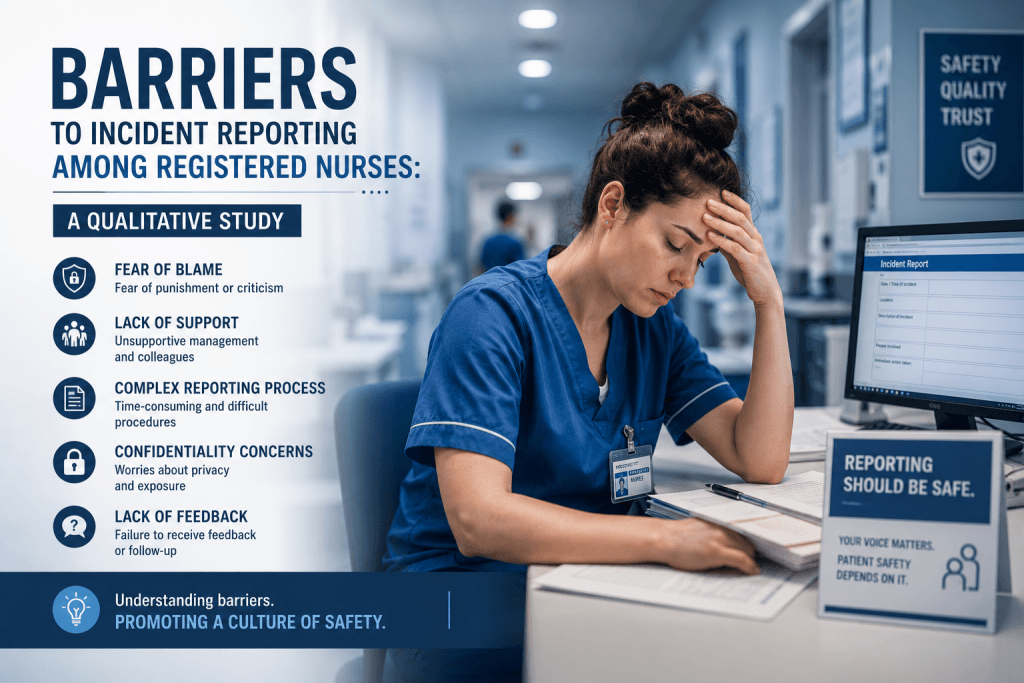
- Barriers to incident reporting among registered nurses: A qualitative study
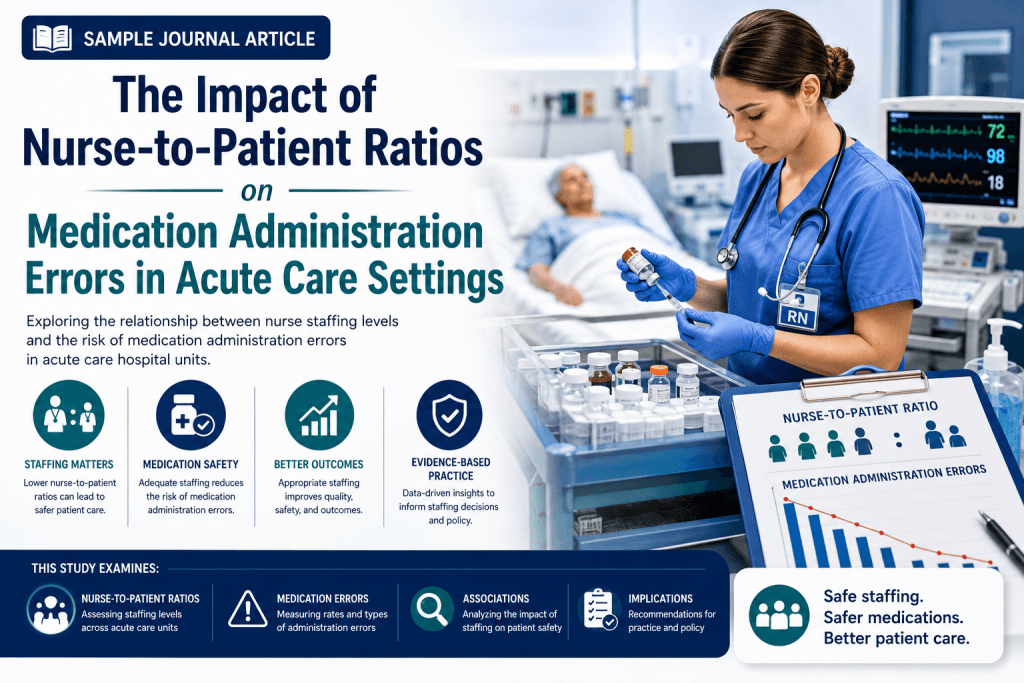
- The impact of nurse-to-patient ratios on medication administration errors in acute care settings
- The relationship between nurse fatigue and clinical decision-making errors in hospital settings
- Effectiveness of bedside shift reporting on patient safety outcomes: A systematic review
- Evidence-based protocols for reducing hospital-acquired pressure injuries in critically ill patients
- Fall prevention strategies and their effectiveness in reducing inpatient falls: A retrospective analysis
- The role of simulation training in reducing medication administration errors among nursing staff
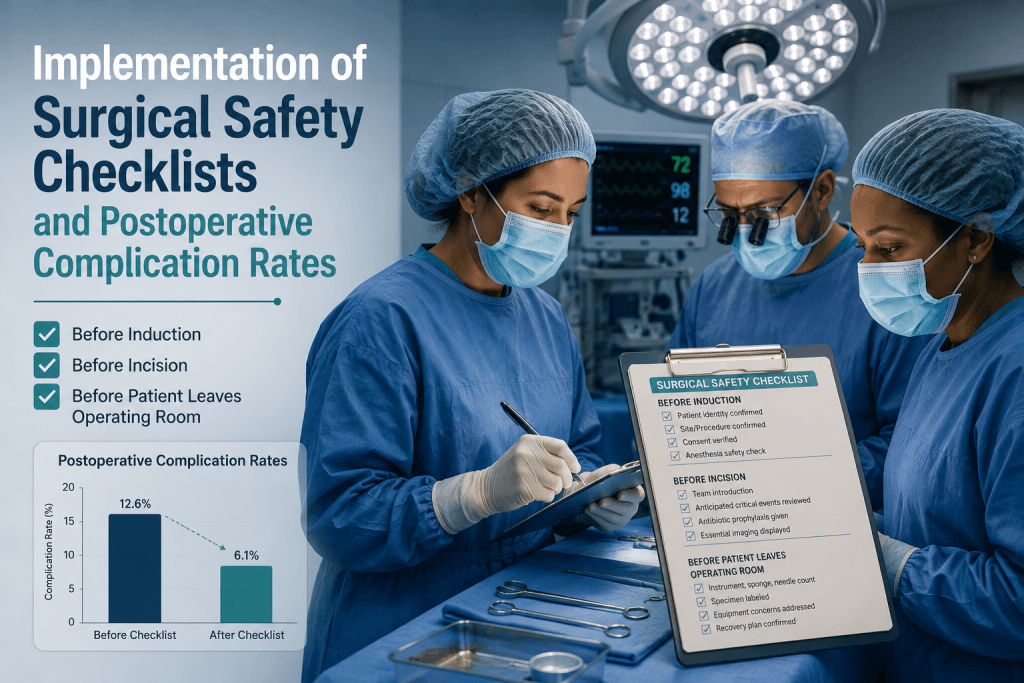
- Implementation of surgical safety checklists and postoperative complication rates
- Handoff communication failures and their contribution to patient safety incidents
- Nurses’ perceptions of a just culture and its influence on error reporting behaviors
- The effectiveness of patient identification protocols in preventing wrong-patient errors: A systematic review
- Hand hygiene compliance among nurses and its impact on healthcare-associated infection prevention
Source context: National Institute of Nursing Research