
What Is a Monograph?
If you have ever come across the term monograph in an academic setting and wondered exactly what it means, you are not alone. Many researchers, graduate students, and early-career academics encounter this word without a clear understanding of what it involves or why it matters.
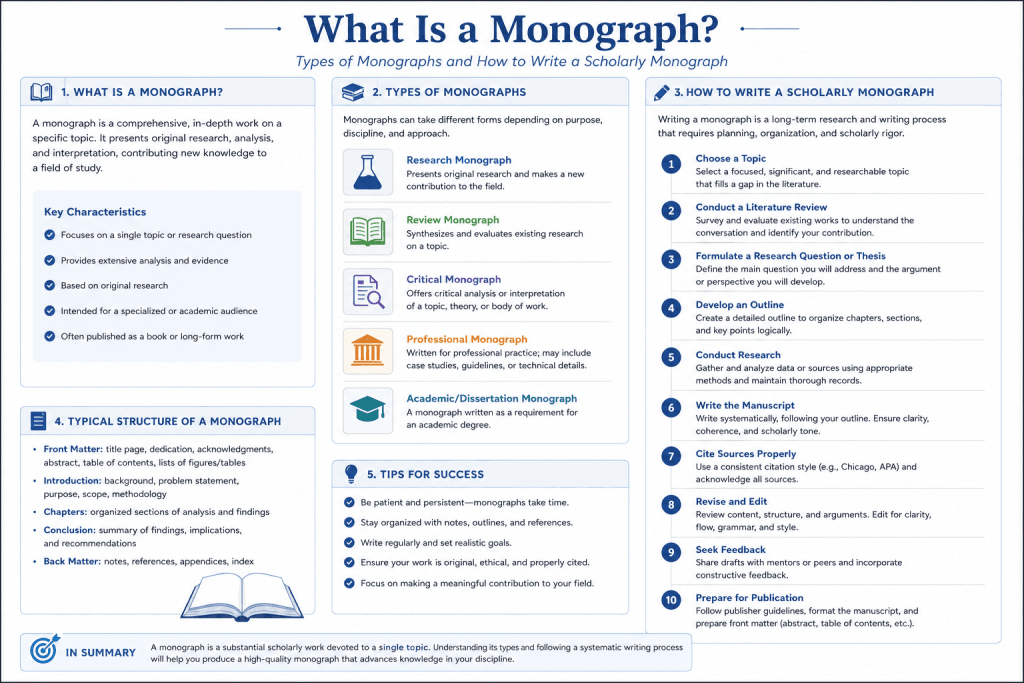
- A monograph is a highly focused, in-depth scholarly work dedicated to a single topic or issue. Unlike general academic writing that surveys broad fields, a monograph digs deep into one subject, exploring it thoroughly and with rigorous academic precision. It is one of the most respected forms of scholarly publishing because it demonstrates a researcher’s mastery of a particular area of study.
- The term monograph comes from the Greek words “mono” (meaning single) and “graph” (meaning writing). This etymology tells you everything you need to know about its purpose — it is a single, sustained piece of writing built around one central research question or theme, developed over many pages and often across individual chapters.
- A monograph is typically written by one author or a small team, and it is longer and more detailed than a journal article. Most monographs run well over one hundred pages, with many stretching into the hundreds. This length is necessary because the goal is not just to present research findings but to build a complete scholarly argument from the ground up.
- The purpose of a monograph is to make an original contribution to knowledge within a specific academic discipline. Whether in history, philosophy, biology, sociology, or literature, a monograph is expected to say something new — to advance the conversation in a field rather than simply summarize what others have already said.
- Monographs are commonly published by a university press or other reputable academic book publishers, giving them a level of credibility and peer review that validates their scholarly value. They are a cornerstone of academic publishing and remain essential reading in research libraries and graduate programs worldwide.
How Is a Monograph Different from a Journal Article or Other Scholarly Books?
Understanding the difference between a monograph and other forms of academic writing helps you make smarter decisions about how to present research and which format suits your work best.
Monograph vs. Journal Article
- A journal article is short, usually between 5,000 and 10,000 words, and is published in an academic journal alongside other articles on related or unrelated topics. It is designed to present a specific finding or argument quickly and efficiently.
- A monograph, by contrast, is a full-length book-style work that allows for extensive development of ideas, a thorough literature review, multiple lines of argument, and a much deeper exploration of the research question. Where a journal article might touch on a topic, a monograph immerses itself in it.
- The review process also differs significantly. Journal articles go through peer review before publication, typically taking months. A scholarly monograph also undergoes rigorous peer review, but the process is often longer and more involved because of the scope of the work.
- In terms of audience, a journal article targets specialists who are already familiar with the field, while a monograph, although still academic in nature, can sometimes reach a wider readership within the discipline and beyond.
Monograph vs. Edited Volume
- An edited volume is a collection of individual chapters written by different authors, all brought together under a single theme or topic and compiled by one or more editors. A monograph differs from this because it is typically written by one author and presents a single, unified argument from beginning to end.
- The coherence of a monograph is one of its greatest strengths. Because it comes from a single author’s perspective and research, the argument builds logically from chapter to chapter in a way that an edited volume, with its group of authors, often cannot replicate.
Monograph vs. Reference Book or Textbook
- Unlike a textbook, which is designed to teach established knowledge to students, a monograph is designed to present original research and contribute new ideas to a field. A textbook surveys; a monograph argues.
- A reference book organizes information for easy lookup, whereas a monograph structured around a central thesis takes the reader on a scholarly journey, building evidence and analysis as it progresses.
- A monograph also differs from a general academic book in its depth of focus. While an academic book might cover multiple related themes, a monograph stays tightly focused on a single subject, making it the definitive scholarly resource on that narrow topic.
Types of Monographs You Should Know Before You Write a Monograph
Before you begin to write a monograph, it helps to understand the different forms it can take. Not all monographs are the same, and knowing which type fits your research will help you plan and write more effectively.
1. Scholarly Monograph
- The scholarly monograph is the most common type found in academic publishing. It is a full-length, peer-reviewed work written by one author (or sometimes co-authors) that makes an original contribution to a specific academic discipline. It is typically published by a university press or a respected academic publisher.
- Scholarly monographs are the gold standard in humanities and social science fields, where demonstrating deep, sustained engagement with a topic is essential for academic advancement. In many disciplines, publishing a scholarly monograph is a key requirement for tenure and promotion.
- These works are grounded in extensive in-depth research, often drawing on primary sources, archival materials, fieldwork, or original data, and they engage seriously with existing scholarship through a thorough bibliography.
2. Scientific Monograph
- Scientific monographs are common in natural sciences, medicine, and engineering. They focus on a single subject within a scientific field and present comprehensive findings, methodologies, and analyses that go far beyond what a journal article can accommodate.
- Unlike a series of journal articles, a scientific monograph brings together years of research into one cohesive document, making it easier for other researchers to understand the full scope of the findings and their implications.
- These works often include detailed data, experimental results, and technical analysis, and they may serve as the definitive reference on a specific scientific question or phenomenon for years after publication.
3. Dissertation or Thesis Converted into a Monograph
- One of the most common pathways to publishing a monograph is converting a doctoral thesis into a monograph. Many early-career academics turn their PhD dissertation into their first book, revising it substantially to appeal to a broader scholarly audience rather than just a dissertation committee.
- The process of turning a thesis into a monograph involves significant rewriting. You need to shift from the highly formalized structure of a thesis to a more readable, argument-driven scholarly book. This often means cutting literature review sections, integrating footnotes, and sharpening the central argument.
- Many university presses specifically look for first monographs based on doctoral thesis research, making this one of the most important transitions a new academic can make in their scholarly career.
4. Open Access Monograph
- Open access monographs are becoming increasingly common in academic publishing. These works are made freely available online, removing the financial barriers that often prevent readers in developing countries or under-resourced institutions from accessing scholarly books.
- Open access does not mean lower quality. Open access monographs go through the same rigorous peer review process as traditionally published works. The difference lies in how they are distributed and funded, often through grants, institutional support, or author fees.
- The rise of open access monographs is reshaping scholarly publishing, making research more widely available and increasing the reach and impact of academic work across the globe.
5. Monograph as Part of a Book Series
- Some monographs are published as part of a book series, where each volume focuses on a different topic within a shared thematic or disciplinary framework. These series are typically managed by a series editor and published by a single academic press.
- Being included in a respected book series can significantly boost the visibility and credibility of your monograph, as it associates your work with other established scholars and signals to the academic community that your research meets a recognized standard.
How a Monograph Is Structured: Key Components to Include
Understanding how a monograph is structured before you begin writing will save you significant time and help you produce a more organized, compelling work.
1. Title and Prefatory Material
- The title of your monograph should be clear, specific, and reflective of your central argument or topic. Many monographs use a two-part title format — a creative or conceptual phrase followed by a descriptive subtitle that signals the scope and discipline of the work.
- Prefatory material includes a preface, acknowledgments, and sometimes a foreword. The preface explains the origins of your research and why you undertook it. Acknowledgments thank those who supported your work. These sections are brief but important for establishing your voice and context.
2. Introduction
- The introduction is one of the most critical parts of your monograph. It is where you present your research question, explain the significance of your topic, situate your work within existing scholarship, and outline the structure of the book.
- A strong introduction does more than summarize what follows. It makes the case for why your monograph matters — why this single topic deserves a full book-length treatment and what readers will gain from engaging with your argument.
3. Literature Review or Historiography
- Most scholarly monographs include an engagement with existing literature, either as a standalone section or woven throughout the introduction and individual chapters. This shows that your in-depth research is grounded in a thorough understanding of what has already been written.
- This section situates your monograph within your academic discipline, identifying gaps in the scholarship and explaining how your work fills them. It demonstrates that your contribution is genuinely new.
4. Core Chapters
- The body of your monograph is made up of individual chapters, each focused on a specific aspect of your central argument. These chapters should build on one another logically, with each one advancing the overall thesis rather than standing as isolated essays.
- Each chapter typically includes its own introduction and conclusion, as well as detailed analysis, evidence, and engagement with relevant sources. The chapters are where your sustained scholarly argument truly unfolds.
5. Conclusion
- The conclusion brings your argument full circle, summarizing your key findings, reflecting on their broader implications, and suggesting directions for future research. It should leave the reader with a clear sense of what your monograph has contributed to the field.
6. Bibliography
- A comprehensive bibliography is a non-negotiable component of any scholarly monograph. It lists every source you have cited, from primary documents to secondary scholarship, and signals the depth and rigor of your research and writing.
7. Index
- Most academic book publishers and university presses require an index, which allows readers to locate specific topics, names, and concepts within your work. A well-constructed index significantly improves the usability of your monograph as a scholarly reference.
How to Write a Monograph Step by Step
Knowing how to write a monograph effectively requires both strategic planning and sustained focus. Here is a practical, step-by-step guide to move you from idea to completed manuscript.
Step 1: Define Your Research Question
- Every monograph begins with a clearly articulated research question. This question should be specific enough to be addressed in depth but significant enough to warrant a full-length study. A vague or overly broad question will undermine the focus that makes a monograph powerful.
- Ask yourself what gap in the existing literature your work will fill. A strong research question is one that connects directly to unresolved debates or underexplored areas within your academic discipline.
Step 2: Conduct Thorough In-Depth Research
- Before you write a single chapter, immerse yourself in the scholarship surrounding your topic. Read widely across primary and secondary sources, consult research guides relevant to your field, and take organized, detailed notes.
- Identify the key arguments, methodologies, and sources that will form the backbone of your analysis. Your research and writing process should be iterative — as your argument evolves, your research will deepen and shift.
Step 3: Develop a Detailed Outline
- Once your research is well underway, draft a comprehensive outline for your monograph. This outline should include your introduction, all individual chapters, and your conclusion, with a brief note on the argument and evidence each section will present.
- A strong outline keeps your writing focused and ensures your argument progresses logically. It also makes it easier to identify gaps in your evidence or weaknesses in your structure before you are deep into the writing process.
Step 4: Write Chapter by Chapter
- Write your monograph in sections, focusing on one chapter at a time. Trying to write everything at once is overwhelming; breaking it into manageable pieces makes the project sustainable.
- Each chapter should open with a clear statement of its argument, develop that argument through evidence and analysis, and close by connecting back to the broader thesis. Treat each chapter as a self-contained but interconnected unit.
Step 5: Revise and Refine
- Revision is where a good monograph becomes a great one. After completing a draft, review your work for clarity of argument, consistency of voice, logical flow between chapters, and accuracy of citations and bibliography.
- Consider sharing your draft with trusted colleagues or mentors who can offer feedback on both the content and the writing. External perspectives often reveal weaknesses that are invisible to the author.
Step 6: Prepare Your Manuscript for Submission
- Before you publish a monograph, ensure your manuscript meets the specific formatting and style requirements of your target publisher. Different academic book publishers and university presses have different expectations regarding length, citation style, and structure.
How to Publish a Monograph: From Proposal to Final Submission
Once your manuscript is ready — or even while it is still in progress — understanding how to publish a monograph is essential for getting your work into the hands of readers.
Step 1: Write a Book Proposal
- The first step in the publication process is to write a book proposal. This document is your pitch to academic book publishers or a university press, and it needs to be compelling, clear, and comprehensive.
- A strong book proposal typically includes: an overview of the monograph and its central argument, a description of the target audience and its place within the academic discipline, a chapter-by-chapter outline, a discussion of competing or related scholarly books, and a sample chapter or excerpt.
- Writing a book proposal is an art in itself. Many publishers offer detailed submission guidelines, and some disciplines have resources and research guides specifically designed to help authors craft effective proposals.
Step 2: Identify the Right Publisher
- Not all publishers are right for every monograph. Research which university presses and academic book publishers specialize in your field. Look at where scholars in your discipline publish their monographs and consider which press aligns best with the scope and ambition of your work.
- Consider whether you want to pursue open access monograph publishing, which can expand your readership significantly, particularly if your work has relevance beyond a narrow specialist audience.
Step 3: Submit and Navigate Peer Review
- Once you submit your proposal or manuscript, expect a peer review process. Most reputable publishers send the work to two or more independent scholars in your field who assess its quality, originality, and contribution to the discipline.
- Peer review feedback can be invaluable, even when it is critical. Take the reviewers’ comments seriously and use them to strengthen your manuscript before final submission.
Step 4: Work With Your Editor
- If your monograph is accepted, you will be assigned an editor who will guide you through the production process. This includes finalizing your manuscript, addressing any remaining revisions, reviewing copy edits, and approving proofs.
- Be responsive and professional throughout this process. Academic publishing timelines can be long, and maintaining a good working relationship with your editor makes the process smoother for everyone involved.
Step 5: Final Submission and Publication
- Final submission involves delivering your complete, polished manuscript, including all individual chapters, bibliography, index, and any images or figures, in the format specified by your publisher.
- After acceptance, the journey from final manuscript to published monograph typically takes between one and two years, depending on the publisher and the complexity of the work. Once published, actively promote your monograph through academic networks, conferences, and social media to maximize its reach and impact.
Best Examples to Help You Write and Publish a Monograph with Confidence
Looking at successful examples of published monographs is one of the most effective ways to understand what a strong scholarly monograph looks like in practice. Here are key examples and what you can learn from each.
1. Discipline-Specific Scholarly Monographs
- In history, a landmark example is the type of deeply archival, single-authored work that focuses entirely on a narrow period or theme — such as a monograph examining a single decade of political change in a specific country. These works demonstrate how to use primary sources to build a sustained, original argument across many chapters.
- What to learn: Observe how the author structures individual chapters to build progressively on the central argument. Notice how each chapter connects back to the research question introduced in the opening of the book.
- In sociology and cultural studies, many celebrated monographs focus on a single community, institution, or phenomenon studied over years of fieldwork. These works show how in-depth research into a single subject can yield insights with broad theoretical implications.
- What to learn: Pay attention to how the author situates their work within existing scholarship without letting the literature review overwhelm the originality of their own analysis.
2. Converted Doctoral Thesis Monographs
- Many first books in academia began as a doctoral thesis, later transformed into a scholarly monograph for a wider audience. These examples are particularly instructive for graduate students and early-career researchers.
- What to learn: Compare published versions with the original thesis (where accessible) to see how authors restructure their argument, trim technical apparatus, and write more fluidly for a readership beyond their dissertation committee. Notice how the transformation makes the argument more accessible without sacrificing scholarly rigor.
- The most successful thesis-to-monograph conversions sharpen the central argument, reduce the defensive tone common in doctoral writing, and reframe the introduction to speak to a broader scholarly audience rather than just justifying methodology to an examining committee.
3. Open Access Monograph Examples
- Open access monographs published by platforms such as university-affiliated digital presses offer freely available examples of high-quality scholarly work. Exploring these can help you understand how contemporary academic publishing is evolving and how to write and publish a monograph in a way that maximizes its reach.
- What to learn: Look at how these authors handle the same structural elements — introduction, core chapters, bibliography, index — and how their writing remains rigorous while often being more accessible than traditionally published scholarly books.
4. Scientific Monographs
- Scientific monographs provide excellent models for researchers in STEM fields who need to present complex data and technical analysis within a cohesive, book-length argument. These works demonstrate how to present research that goes far beyond what a single journal article or even a series of articles can convey.
- What to learn: Study how authors of scientific monographs organize their methodology and results sections, and how they connect highly technical content to broader implications for the field. Notice how the bibliography reflects comprehensive engagement with the field’s literature.
5. Learning from Monographs in Your Own Field
- The most valuable examples are always those closest to your own research area. Identify five to ten of the most cited and respected monographs in your academic discipline and read them not just for content but for structure, style, and argument.
- Ask yourself: How does this author introduce their research question? How are the individual chapters organized? How does the conclusion connect back to the introduction? How does the bibliography reflect the scope of the research?
- Use research guides provided by academic libraries, many of which include curated lists of exemplary monographs in specific fields. These guides are excellent resources for understanding what excellent scholarly publishing looks like in your discipline.
- Pay attention to how these authors write. The best scholarly monographs are not dry or impenetrable — they are written with clarity, precision, and a consistent voice that carries the reader through complex ideas without losing them. Aim to write monographs that achieve the same balance of rigor and readability.
- Finally, remember that every published monograph began as an idea, a research question, and a commitment to sustained scholarly work. The authors whose single-authored books now fill library shelves started exactly where you are — with a topic they cared deeply about and the determination to explore it fully. Use their examples not to intimidate yourself but to inspire your own journey as you write and publish a monograph that makes a genuine contribution to your field.
- American College of Education (ACE) – Scholarly Writing Guide – https://ace.edu/blog/a-guide-to-scholarly-writing/
- George Washington University – Faculty Scholarly Publications – https://scholarship.law.gwu.edu/faculty_publications/73/
- Walden University Writing Center – Scholarly Writing Resources – https://academicguides.waldenu.edu/writingcenter/scholarly
- Florida State University College of Law – Scholarly Writing Guide – https://guides.law.fsu.edu/scholarlywriting