What Is the Peer Review Process and Why Does It Matter?
- The peer review process is one of the most important mechanisms in modern scientific communication. At its core, it is a system in which experts in the same field evaluate a manuscript before it is accepted and published in a scientific or academic journal.
- Before a piece of research becomes a published paper, it must pass through a structured editorial process in which qualified peer reviewers assess the work for accuracy, originality, methodological soundness, and relevance to the field.
- The history of peer review stretches back centuries, with early forms traceable to the Royal Society in the 17th century. Over time, the peer review system evolved into the cornerstone of academic publishing it is today, underpinning trust in peer review across disciplines.
- Scientific peer review serves as quality control in science. It exists to filter out research that is flawed, misleading, or simply not ready for publication, ensuring that what reaches the research community meets a high enough quality standard to be published.
- The peer review process matters because it protects the integrity of published research. Readers, policymakers, clinicians, and other scientists rely on peer-reviewed articles as credible sources of knowledge. Without it, the quality of published work would be impossible to verify.
- Peer review helps authors too. Even when a reviewer critique is difficult to receive, the feedback improves the quality of the manuscript significantly, helping the author strengthen their arguments, correct errors, and present their findings more clearly.
- In short, the process of peer review is what separates verified scientific findings from unvalidated claims — and it remains the gold standard across scientific journals worldwide.
What Are the Steps in the Peer Review Process?
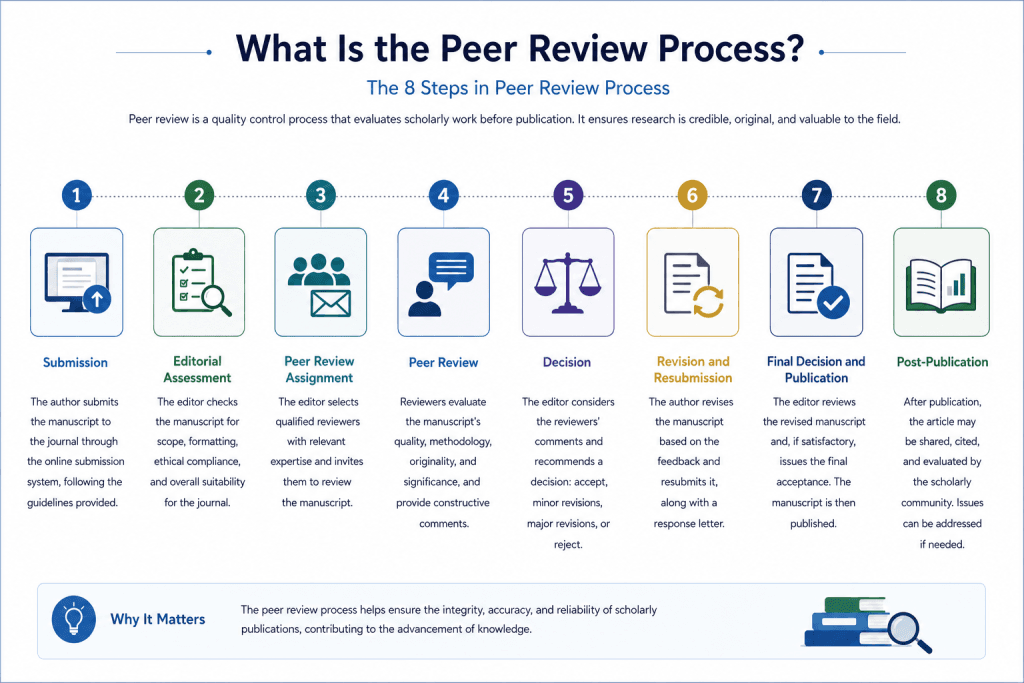
The peer review process follows a clear sequence of stages, from the moment an author submits their work to the point of publication and beyond. Here is a detailed breakdown of each step.
Step 1: Submission
- The process begins when an author submits their manuscript to an academic journal through an online submission portal. Most journals now use digital platforms that allow authors to upload their work, enter author details, suggest potential reviewers, and declare any conflicts of interest.
- At this stage, the author is typically asked to confirm that the manuscript has not been submitted elsewhere simultaneously, as most journals do not accept dual submissions. This is a standard ethical requirement across different journals.
- The editorial office receives the submission and logs it into the system. An automated confirmation is usually sent to the corresponding author, along with a manuscript reference number that can be used to track the submission’s progress.
- The manuscript is checked for basic requirements at this point — correct formatting, word count compliance, inclusion of all required sections such as abstract, introduction, methods section, results, discussion, and references.
- Some journals also require a cover letter in which the author summarises the significance of their work and explains why it is a good fit for that specific journal. A strong cover letter can influence whether the manuscript moves forward or is returned without review.
- It is worth noting that prior to publication, every manuscript goes through multiple stages of evaluation, and submission is simply the entry point into a much longer process.
Step 2: Editorial Assessment
- Once a manuscript is received, the editor-in-chief or a designated handling editor conducts an initial assessment. This is sometimes called a desk review, and it takes place before the work is ever sent to external peer reviewers.
- During this phase, the editor evaluates the article for scope fit — essentially asking whether the manuscript aligns with the aims and focus of the journal. If a paper on molecular biology is submitted to a journal focused on environmental science, it may be returned immediately regardless of its quality.
- The editor also considers whether the research is novel and whether it makes a meaningful contribution to knowledge in the field. Work that duplicates existing published research without adding new insight is likely to be declined at this stage.
- Editors may also assess the manuscript for obvious methodological or ethical issues before sending it out. If a study raises red flags around research ethics, data integrity, or participant consent, the editorial office may address these concerns before proceeding.
- If the manuscript does not meet the journal’s standards or scope, the editor may reject it outright at this stage. This is known as a desk rejection, and it can happen quickly — often within days. While it can be discouraging, a desk rejection allows authors to submit to a more appropriate journal without waiting weeks for a full peer review.
- If the manuscript passes initial scrutiny, the editor-in-chief or associate editor moves it forward to the peer review assignment stage.
Step 3: Peer Review Assignment
- In this step, the handling editor or associate editor identifies and invites appropriate peer reviewers. The goal is to find experts in the same field who have the knowledge and experience to evaluate the manuscript fairly and thoroughly.
- Reviewers are typically selected based on their publication history, subject matter expertise, and absence of any conflicts of interest with the authors or the research topic. Many journals use reviewer databases or academic platforms such as Web of Science or Scopus to locate suitable candidates.
- Most journals invite two to three reviewers per manuscript, though some — particularly in medical journals or highly specialised fields — may seek additional reviewer input to ensure a balanced evaluation.
- A reviewer may decline the invitation for several reasons: time constraints, lack of expertise in a specific area covered by the manuscript, or a conflict of interest. When this happens, the editor must identify and invite a replacement, which can add time to the process.
- Anonymity is a central feature of many peer review models. In the traditional double-blind format, neither the author nor the reviewer knows each other’s identity. In single-blind peer review, the reviewer knows who the author is, but the author does not know who is reviewing their work. Open peer review, a growing alternative in some open access journals, allows both parties to know each other’s identities, and in some cases, peer review reports are published alongside the paper.
- Once reviewers accept the invitation and are asked to review the manuscript, the peer review stage officially begins.
Step 4: Peer Review
- This is the heart of the peer review process. Each reviewer reads the paper carefully and evaluates it across several dimensions, including the strength of the hypothesis, the robustness of the methodology, the accuracy of the data analysis, the clarity of the writing, and the validity of the conclusions.
- Reviewers assess the manuscript against established standards for the discipline. In scientific journals, this means reviewing a paper for logical consistency, reproducibility, statistical soundness, and appropriate citation of existing literature.
- The reviewer will typically prepare a structured review report that includes a summary of the manuscript, a list of major concerns, a list of minor revisions, and an overall recommendation. Reviewer comments are directed to both the editor and the author, depending on the journal’s process.
- Major concerns might include fundamental flaws in the study design, insufficient sample sizes, unsupported claims, or inadequate discussion of limitations. Minor revisions often relate to clarity, grammar, referencing, or formatting issues.
- Reviewers may also flag ethical issues — for instance, if the study involved human subjects but lacks evidence of ethical approval, or if data appears to have been selectively reported.
- Peer reviewers may also suggest additional sources, recommend re-analysis of specific data points, or note where the methods section needs further explanation so the study could be replicated by other researchers.
- Once the review is complete, the reviewer submits their peer review report to the journal editor through the online submission system. Most journals set a deadline of two to four weeks for reviewers to complete their assessment, though timelines vary across different journals.
Step 5: Decision
- After receiving peer review reports from all assigned reviewers, the handling editor or associate editor reviews the feedback and makes a recommendation. The editor-in-chief then makes the final editorial decision, which typically falls into one of four categories.
- Accept as is: The manuscript is accepted for publication without any changes. This outcome is rare, particularly for first submissions.
- Minor revisions: The manuscript is of high enough quality to be published but requires small corrections or clarifications. The author is asked to address these changes and resubmit within a set timeframe, often two to four weeks.
- Major revisions: The manuscript shows promise but has significant issues that must be addressed before it can be reconsidered. The author will need to revise and resubmit, and the revised version may be sent back to the original reviewers for re-evaluation.
- Reject: The editor may reject the manuscript outright, either because it does not meet the journal’s quality standards, the research is not methodologically sound, or the topic is not a good fit for the journal’s readership. A rejection does not necessarily mean the research is without value — it may simply mean it belongs in a different publication.
- The editor communicates this decision to the author along with the reviewer comments, which the author can use to improve the quality of the manuscript before resubmitting to the same or a different journal.
Step 6: Revision and Resubmission
- When an author is asked to revise their manuscript, they must engage carefully and thoroughly with every piece of feedback provided in the reviewer comments. This stage is a critical part of the peer review process and should not be rushed.
- The author prepares a point-by-point response to each reviewer comment, explaining what changes were made and why, or justifying why certain suggestions were not adopted. This document is submitted alongside the revised manuscript.
- It is important to tell the editor clearly and respectfully when you disagree with a reviewer’s suggestion. If you believe a critique is based on a misunderstanding or conflicts with your methodology, explain your reasoning with supporting evidence.
- Reviewers and authors do not interact directly — all communication goes through the editorial office. This structure maintains the integrity of the peer-review process and ensures that responses are documented formally.
- The revised manuscript is then resubmitted through the online submission system and assigned back to the handling editor. Depending on the scope of the revisions, the editor may send the paper back to the original reviewers or make a decision independently.
- Major or minor revisions both require a thorough and respectful response. Even when asked to make only minor revisions, authors should treat the process seriously, as a poorly handled revision can lead to rejection at the next stage.
Step 7: Final Decision and Publication
- Once the revised manuscript is received, the editor evaluates whether the author has adequately addressed all reviewer concerns. If the changes are satisfactory, the manuscript moves toward acceptance and publication.
- After acceptance, the manuscript enters the production phase. It is copyedited, formatted according to the journal’s style, and proofread. The author may be asked to review and approve the final proofs before the paper goes live.
- Upon publication, the paper is assigned a DOI (Digital Object Identifier), which creates a permanent, citable reference that other researchers can use. The DOI is what allows a published paper to be located and referenced reliably across databases and platforms.
- Peer-reviewed articles published at this stage contribute directly to the body of scientific knowledge in their field and become part of the academic record.
- In open access journals, the published paper is made freely available to anyone online immediately upon publication, whereas subscription-based journals may restrict access to paying subscribers or institutions.
Step 8: Post-Publication
- The peer review process does not end at publication. Post-publication peer review is a growing practice in which the research community continues to evaluate and critique published research after it appears in a journal.
- Readers, researchers, and other experts may submit comments, corrections, or critiques through the journal’s platform or via academic discussion forums and pre-print servers.
- In some cases, post-publication review leads to corrections, errata notices, or in serious cases, retraction of the published paper if significant errors or ethical violations are discovered.
- Journals also track citations, allowing the research community to see how a paper’s findings are being used, challenged, or built upon over time. This ongoing scrutiny is what keeps published research accountable.
- The peer review system, even with its limitations, remains the most reliable mechanism for quality control in science, and post-publication engagement strengthens it further.
Key Players in the Peer Review Process: Editor, Reviewer, and Editorial Office
- Understanding who does what in the peer review process is essential for any researcher navigating scientific publishing for the first time. Each role carries distinct responsibilities, and the process works effectively only when all parties fulfil their function with integrity and diligence.
The Editor-in-Chief
- The editor-in-chief sits at the top of the editorial hierarchy. They are responsible for the overall direction, quality, and reputation of the journal. In most academic peer review systems, the editor-in-chief makes the final decision on whether a manuscript is accepted or rejected.
- They review the recommendations of associate editors and handling editors, consider the peer review reports, and weigh the overall merit of the manuscript against the journal’s standards.
- In some journals, particularly high-volume publications, the editor-in-chief delegates much of the day-to-day editorial process to associate editors, stepping in primarily for borderline or disputed decisions.
The Associate Editor and Handling Editor
- The associate editor, sometimes called the handling editor, manages the peer review process for individual manuscripts. Once the editor-in-chief determines that a manuscript is suitable for review, the associate editor takes over as the primary point of contact.
- They identify suitable peer reviewers, send out review invitations, monitor deadlines, follow up with reviewers who have not yet submitted their reports, and compile feedback for the author.
- When peer review reports come in, the associate editor evaluates the reviewer comments, considers whether the reviewers are in agreement or conflict, and makes a recommendation to the editor-in-chief.
- The handling editor also manages the revision process, determining whether a revised manuscript needs to go back to the original reviewers or whether the changes can be assessed internally.
The Editorial Office
- The editorial office provides the administrative infrastructure that keeps the peer review process running smoothly. Staff in the editorial office handle manuscript intake, manage the online submission system, communicate with authors and reviewers, and ensure that all administrative and compliance requirements are met.
- In large journals, the editorial office may include dedicated manuscript coordinators, production editors, and ethics officers. In smaller publications, a single managing editor may handle all of these functions.
- All communication between reviewers and authors passes through the editorial office, which helps preserve anonymity and ensures that all interactions are formally documented.
The Peer Reviewer
- The peer reviewer is an expert in the same field as the manuscript being reviewed. They are typically researchers or academics who volunteer their time — reviewing a paper is generally unpaid work, done as a professional contribution to the research community.
- Reviewers assess the manuscript for scientific rigour, logical coherence, clarity, and contribution to existing knowledge. Their peer review reports form the foundation of the editorial decision.
- Becoming a peer reviewer is a significant milestone in a researcher’s career. It indicates that you have reached a level of expertise where your judgment is trusted by journal editors. Many researchers are first invited to review after publishing in the field themselves.
- Peer reviewers may also recommend rejection, suggest additional experiments, or point the author toward relevant literature they may have overlooked. Their role is not to gatekeep, but to genuinely improve the quality of the paper before it enters the scientific record.
How to Prepare a Manuscript Before It Reaches the Peer Review Stage
- Preparation is everything. A well-prepared manuscript increases the likelihood of passing editorial assessment, receiving constructive rather than dismissive reviewer feedback, and ultimately being accepted for publication.
Understand the Journal’s Requirements
- Before submitting, read the author guidelines of your target journal carefully. Different journals have different formatting requirements, word limits, referencing styles, and ethical compliance standards. Submitting a manuscript that ignores these requirements signals a lack of attention to detail and may lead to immediate return by the editorial office.
- Consider the scope of the journal. Ensure that your research aligns with the topics the journal covers and the audience it serves. A mismatch between your research and the journal’s focus is one of the most common reasons for desk rejection.
Polish Every Section
- Every section of the manuscript — abstract, introduction, methods section, results, discussion, and conclusion — should be written clearly and concisely. Reviewers and editors read many papers, and a manuscript that communicates well is far easier to evaluate favourably.
- The methods section deserves particular attention. Peer reviewers assess whether your methodology is sound, transparent, and reproducible. If your methods are vague or incomplete, reviewers will flag it immediately, and it could result in a request for major revisions even if the rest of the paper is strong.
- Ensure that your data is presented accurately and that your conclusions are directly supported by your results. Overclaiming — drawing conclusions that go beyond what your data actually shows — is one of the most common critiques in peer review reports.
Conduct a Self-Review Before Submission
- Before you submit, read the paper as if you were a peer reviewer. Ask yourself whether the research question is clearly stated, whether the methodology is appropriate, and whether the conclusions are justified. Identify weaknesses in your argument and address them proactively.
- Have a colleague or co-author read the manuscript with fresh eyes. Internal feedback before submission can catch errors and unclear passages that the original authors have become blind to through familiarity.
- Check every reference for accuracy and ensure that your DOI links are functional. Reviewers and editors who encounter broken references or inaccurate citations may question the overall carefulness of your scholarship.
Prepare an Effective Cover Letter
- The cover letter is your first opportunity to communicate directly with the editor. Use it to summarise your research clearly, highlight its significance, and explain why it is appropriate for that journal. Keep it professional and concise — one page is generally sufficient.
- You may also use the cover letter to suggest potential peer reviewers or to flag any conflicts of interest. Journals also often allow authors to identify researchers they would prefer not to review their work, for legitimate reasons such as professional rivalry or previous collaboration.
How Reviewers Assess and Evaluate a Manuscript Step by Step
- Understanding how a reviewer approaches a manuscript can help authors write more effectively and respond more constructively to feedback. The peer review process follows a fairly consistent pattern, though the depth and style of assessment varies by reviewer and journal.
First Read: Orientation and Overall Impression
- When a reviewer receives a manuscript, they typically begin with a rapid first read to get an overall sense of the paper. At this stage, they are not scrutinising every detail — they are asking broad questions: Is the research question interesting and original? Does the paper appear to make a meaningful contribution? Is it written clearly enough to evaluate properly?
- If the manuscript is poorly written or the argument is immediately incoherent, a reviewer may note this in their report and recommend rejection based on the quality of the paper alone, prior to deep evaluation.
Detailed Evaluation
- The second read is far more thorough. The reviewer evaluates the article section by section, moving through the introduction, methods section, results, discussion, and conclusions with careful attention to detail.
- In the introduction, reviewers assess whether the research question is clearly defined, whether the existing literature is accurately and fairly represented, and whether the study’s rationale is well established.
- In the methods section, reviewers look for methodological rigour. Is the study design appropriate for the research question? Are the sample sizes adequate? Are the statistical methods correctly applied? Is the methodology described in enough detail for another researcher to replicate the study?
- In the results section, reviewers assess whether the data is presented clearly and whether the findings are accurately reported. They may check whether tables and figures are clear and whether the data supports the claims being made.
- In the discussion and conclusion, reviewers evaluate whether the authors have interpreted their findings correctly, whether limitations are honestly acknowledged, and whether the conclusions are proportionate to the evidence presented.
Writing the Review Report
- Once the reviewer has evaluated the manuscript in full, they write a peer review report. This typically includes a brief summary of what the manuscript does and what it argues, a list of major concerns that must be addressed, a list of minor revisions, and a recommendation to the editor.
- Reviewer comments should be specific, actionable, and respectful. A good reviewer aims to improve the quality of the manuscript, not simply to find fault. Reviewers may also note strengths in the paper — acknowledging what works well is part of a balanced and constructive review.
- The reviewer then submits their report through the journal’s online submission platform and the findings are passed to the handling editor for review.
How to Revise Your Manuscript and Respond to Reviewer Comments
- Receiving reviewer comments can feel daunting, particularly if the feedback is extensive or critical. But the revision stage is one of the most valuable parts of the peer review process — handled well, it almost always improves the quality of the manuscript significantly.
Read All Feedback Before Reacting
- When reviewer comments arrive, resist the urge to respond immediately. Read through all of the feedback fully and give yourself time to process it before you begin writing your response or making changes.
- Separate the reviewer comments into categories: those you agree with and will act on, those that require clarification or further thought, and those you respectfully disagree with. This will help you approach the revision methodically rather than reactively.
Prepare a Point-by-Point Response
- The standard format for responding to reviewer comments is a point-by-point document. This means addressing every single comment made by every reviewer, in order, without skipping anything.
- For each comment, clearly state what change was made and where in the manuscript it can be found. If you revised a paragraph in response to a critique, quote the new text in your response so the editor can see the change without searching through the entire document.
- If you disagree with a comment, explain your reasoning clearly and respectfully. You may tell the editor that you have considered the suggestion but believe the original approach is more appropriate, providing evidence or literature to support your position. Peer reviewers may sometimes misread a section, and a well-reasoned response can resolve the disagreement.
Revise the Manuscript Thoroughly
- When you revise your manuscript, do not limit yourself to only addressing the specific comments raised. Use the reviewer feedback as a prompt to re-read your entire paper with fresh eyes and make any additional improvements you identify.
- Pay close attention to the methods section, as this is frequently where reviewers identify weaknesses. If a reviewer asked for clarification on your methodology, consider whether other sections would benefit from similar improvements.
- Ensure that your revised manuscript is internally consistent. When you change one part of the paper, check whether corresponding sections need to be updated as well. For example, changes to the methods may require updates to the results or discussion.
Resubmit With Confidence
- Once your point-by-point response is complete and your manuscript has been revised, resubmit through the journal’s online submission system. Include a cover letter that briefly summarises the revisions made and thanks the reviewers for their feedback.
- A well-handled revision demonstrates professionalism and significantly increases the likelihood of acceptance. Editors notice when authors engage seriously with the peer review process, and it reflects well on the quality and credibility of the research.
How Editors Use Scientific Peer Review to Make the Final Decision
- The final decision in the peer review process rests with the editor — typically the editor-in-chief, guided by the recommendation of the handling editor or associate editor. Understanding how editors weigh up the available information can help authors better navigate the editorial process.
Reviewing the Peer Review Reports
- Once peer review reports are received, the handling editor reads them carefully. If the reviewers are broadly in agreement — for example, both recommending major revisions — the path forward is relatively straightforward. If reviewers are in conflict, the editor must exercise their own judgment.
- In cases of significant disagreement, the editor may seek an additional reviewer to provide a third perspective, or they may weigh the arguments made by each reviewer and make a judgment call based on their own expertise and knowledge in the field.
Weighing Quality and Fit
- Editors do not simply defer to reviewers. The editor’s role is to evaluate the article in the context of the journal’s standards, scope, and readership. A manuscript may receive a positive peer review but still be declined if it is not a strong enough fit for that journal’s audience.
- Editors may also factor in practical considerations such as publication queue length, thematic balance across upcoming issues, and strategic priorities for the journal’s direction.
Communicating the Decision
- Once a decision is reached, the editorial office communicates it to the corresponding author, along with the peer review reports. The decision letter explains the outcome clearly and, in most cases, provides guidance on what would need to change for the manuscript to be reconsidered — even in the case of rejection.
- If the manuscript is rejected, authors may ask the editor to reconsider, but appeals are generally only successful when the author can demonstrate that the reviewer comments were based on a misunderstanding or that the editorial process was not followed correctly.
- If accepted, the manuscript enters the production pipeline, and the author can look forward to seeing their work published as a peer-reviewed article in the journal.
The Bigger Picture
- The process of peer review ultimately relies on the collective expertise, integrity, and commitment of everyone involved — from the author who submits their best work, to the reviewer who gives honest and thorough feedback, to the editor who makes a fair and considered final decision.
- Scientific peer review is not perfect, and the research community continues to debate its limitations, from publication bias to reviewer fatigue. But the peer review process remains the most trusted and widely used system for quality control in science, and understanding how it works — from submission to final decision — is essential knowledge for every researcher who wants to contribute meaningfully to their field.
- American College of Education (ACE) – Scholarly Writing Guide – https://ace.edu/blog/a-guide-to-scholarly-writing/
- George Washington University – Faculty Scholarly Publications – https://scholarship.law.gwu.edu/faculty_publications/73/
- Walden University Writing Center – Scholarly Writing Resources – https://academicguides.waldenu.edu/writingcenter/scholarly
- Florida State University College of Law – Scholarly Writing Guide – https://guides.law.fsu.edu/scholarlywriting