What Are Scholarly Articles?
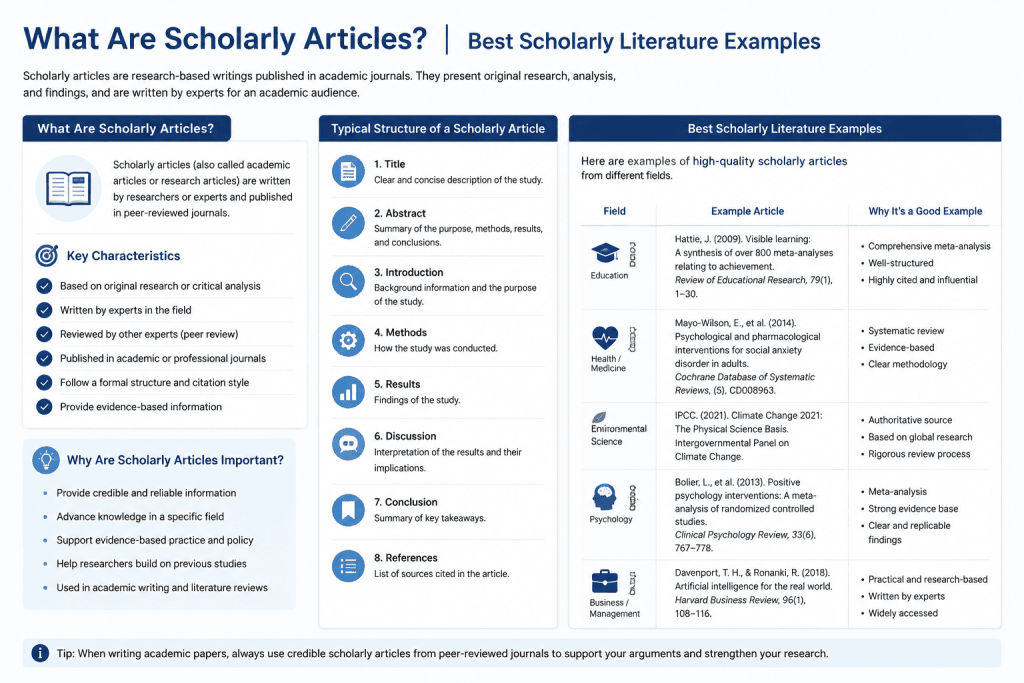
- Scholarly articles are pieces of writing created by experts in a specific field and intended primarily for other experts, researchers, and students working within that same discipline. When people ask “what are scholarly articles,” the simplest answer is this: they’re formal, research-based pieces of writing that share new findings, analyze existing knowledge, or advance a conversation happening within academia.
- Unlike a magazine feature or a news story, a scholarly article is written for other experts rather than for a casual reader. The tone is formal, the vocabulary is discipline-specific, and the goal is to contribute something meaningful to the existing knowledge in a field — whether that’s the social sciences, the life sciences, engineering, or the humanity-focused disciplines like philosophy and literature.
- Scholarly articles are published in scholarly journals, which are periodicals (often appearing quarterly or monthly) dedicated to a single discipline or a closely related group of disciplines. A scholarly journal might focus narrowly on something like cognitive psychology, or more broadly on biomedical and life sciences research.
- Most scholarly articles follow a structured, predictable format. You’ll typically find an abstract, an introduction, a methodology section, results, a discussion, and a reference list or works cited section at the end. This structure isn’t arbitrary — it allows other researchers to quickly evaluate the article’s credibility, replicate the study if needed, and trace the sources used.
- A defining feature of scholarly articles is that they cite their sources extensively. Every claim, statistic, or borrowed idea is backed by a citation, allowing readers to verify information and follow the trail of research back to its origin. This is part of what separates scholarly work from general-interest writing.
- Scholarly articles generally fall into a few categories: original research articles (sometimes called empirical studies), review articles that synthesize existing scholarly literature, theoretical articles, and case studies. Each type of scholarly article serves a different purpose, but all are grounded in rigorous analysis techniques and academic standards.
- You’ll find scholarly articles in academic databases, university libraries, and increasingly through open-access repositories online. They’re typically discovered through tools like Google Scholar, PubMed, JSTOR, Scopus, or Web of Science — all of which index scholarly journals and make it easier to search across disciplines.
- In short, when someone asks what a scholarly article is, the answer comes down to authorship, audience, and purpose: written by experts, written for other experts, and written to push forward existing knowledge in a discipline through original research or careful analysis.
Is Scholarly the Same Thing as Peer-Reviewed?
- This is one of the most common points of confusion for students and researchers alike, and it’s worth untangling clearly: scholarly and peer-reviewed are related, but they are not identical terms.
- “Scholarly” is a broad category. It refers to any piece of writing that’s research-based, written by an expert or scholar, intended for an academic audience, and grounded in existing knowledge within a discipline. A scholarly article doesn’t have to go through peer review to be considered scholarly — it just needs to meet the general standards of academic writing: formal tone, citations, methodology, and expert authorship.
- “Peer-reviewed,” on the other hand, refers to a specific process that a scholarly article may or may not go through before publication. The peer review process means that before an article is published, it’s evaluated by other experts in the same field — the author’s “peers” — who assess the quality, accuracy, methodology, and overall contribution of the work.
- Here’s the key relationship: all peer-reviewed articles are scholarly articles, but not all scholarly articles are peer-reviewed. Editorial pieces, conference papers, dissertations, and some scholarly journal content (like book reviews or opinion pieces written by experts) can be considered scholarly without having gone through formal peer review.
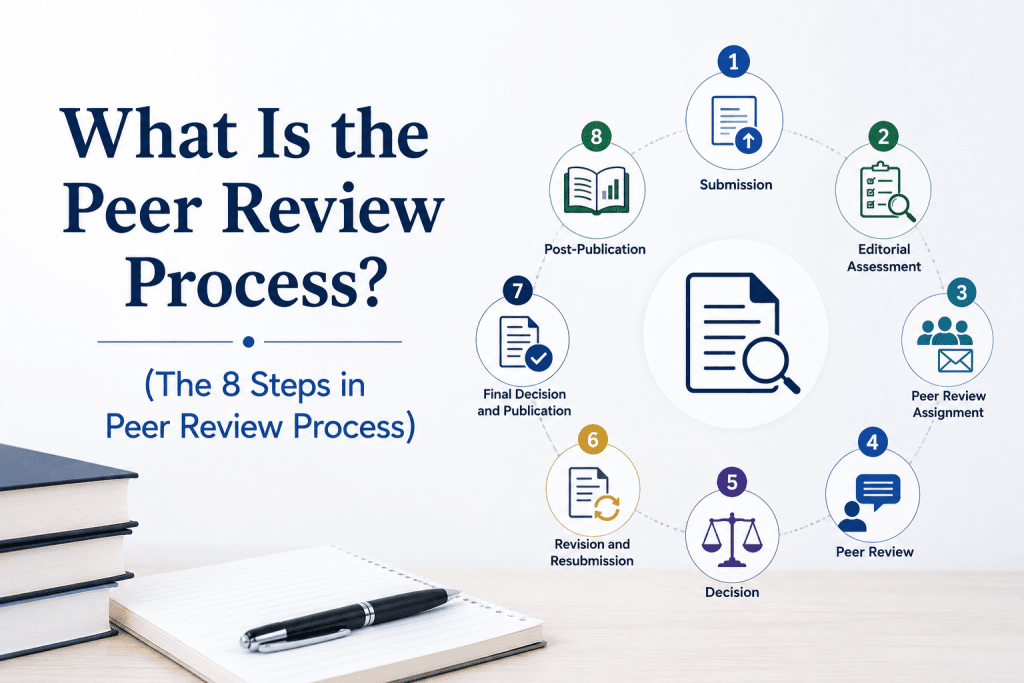
- So what actually happens during peer review? Typically:
- The author submits their article to a scholarly journal’s editorial team.
- The editor screens it for basic fit and quality, then sends it to two or three peer reviewers — other experts in the same discipline — who remain anonymous to the author (and vice versa, in a “double-blind” review).
- These peer reviewers evaluate the soundness of the methodology, the validity of the conclusions, the originality of the research question, and whether the article meaningfully adds to existing knowledge in the field.
- Reviewers send back feedback, which often requires a revision. The author may need to clarify their methodology, address gaps in their data, or strengthen their argument before resubmitting.
- Only after passing this peer-review process — sometimes after multiple rounds of revision — is the article accepted and scheduled for publication in the scholarly journal.
- This is why peer-reviewed articles carry extra weight in academia: they’ve been independently vetted by people qualified to catch errors, biases, or flawed methodology before the wider research community ever sees the work.
- Practically speaking, when professors ask students to find “peer-reviewed sources,” they’re asking for something more specific than “scholarly sources.” You can usually confirm peer-review status by checking a journal’s website directly, looking at a database’s filtering options (most academic databases, including Web of Science and Scopus, let you filter by peer-reviewed status), or asking a librarian — many university libraries maintain LibGuides that explain exactly which journals in a given discipline use peer review.
- The bottom line: scholarly is the umbrella term, and peer-reviewed describes one rigorous quality-control step that many — but not all — scholarly articles pass through before publication.
Examples of Types and Examples of Scholarly Articles
- Scholarly articles aren’t a single, uniform thing — they come in several distinct types, each serving a different role in the broader landscape of scholarly literature. Understanding these types of sources will help you pick the right kind of scholarly article for your research project.
1. Original Research Articles
- These are the backbone of scholarly literature. An original research article reports on a study the author(s) actually conducted — whether that’s a clinical trial in the biomedical and life sciences, a laboratory experiment in chemistry, or a survey-based study in the social sciences.
- These articles follow a strict format: abstract, introduction, literature review, methodology, results, discussion, and conclusion, followed by a reference list.
- Example: A study published in a nursing journal that tracks patient outcomes after a new treatment protocol, complete with sample size, statistical analysis, and a discussion of limitations and future research directions.
2. Review Articles
- Review articles (sometimes called literature reviews) don’t present new, original research. Instead, they synthesize and analyze existing scholarly literature on a topic, helping readers understand the current state of knowledge in a field.
- These are incredibly valuable starting points for any research project because they summarize dozens (sometimes hundreds) of other scholarly articles and point toward gaps that need further study.
- Example: A systematic review in Web of Science discipline-specific journals that examines twenty years of published in scholarly journals’ research on a particular medical intervention to determine overall effectiveness.
3. Theoretical Articles
- These articles build, critique, or refine theoretical frameworks within a discipline. Rather than collecting new data, the author draws on existing knowledge and logical argumentation to advance a new way of understanding a concept.
- Example: A philosophy journal article proposing a new ethical framework for evaluating artificial intelligence decision-making.
4. Case Studies
- A case study takes an in-depth look at one specific instance, patient, organization, or event, and analyzes it methodically. These are especially common in psychology, medicine, business, and education.
- Example: A psychology journal article that closely examines treatment outcomes for a single patient with a rare condition.
5. Methodological Articles
- These focus specifically on research methods themselves — introducing a new analysis technique, critiquing an existing methodology, or comparing different research approaches.
- Example: A statistics journal article proposing an improved analysis technique for handling missing data in longitudinal studies.
6. Conference Papers and Proceedings
- While not always peer-reviewed in the same rigorous way as scholarly journal articles, conference papers are still considered scholarly work because they’re written by experts, presented to other experts, and grounded in original research or theoretical development.
Where to find examples of each type:
- JSTOR is excellent for humanities and social sciences scholarly literature, including historical journal articles and reviews.
- PubMed and the National Library of Medicine’s databases are the go-to source for biomedical and life sciences original research and review articles.
- Scopus and Web of Science offer a comprehensive list of scholarly articles across nearly every discipline, with citation tracking built in.
- Elsevier and other major university presses and academic publishers maintain their own platforms where you can browse by journal, discipline, or keyword.
- Many institutional repositories — maintained by individual universities — also host open-access versions of faculty research, making it easier to find full text without hitting a paywall.
- Each type of scholarly article plays a distinct role in the research process: original research builds new knowledge, review articles consolidate it, theoretical articles reshape how we think about it, and case studies and methodological articles refine how we study it.
How to Identify a Scholarly Article? (4-Step Guide)
Telling a scholarly article apart from a popular magazine piece isn’t always obvious at first glance, especially when both appear in your search results. Here’s a simple four-step guide to help you confidently identify a scholarly article every time.
Step 1: Check the Author and Their Credentials
- Scholarly articles are always written by experts — usually professors, researchers, or professionals affiliated with a university, research institution, or hospital.
- Look for an author byline that includes credentials (PhD, MD, etc.) and an institutional affiliation, often listed directly under the title or in a footnote.
- Popular articles, by contrast, are often written by journalists or staff writers without listed academic credentials, and the author may not have specialized expertise in the topic.
- If you can’t find any author information at all, that’s a red flag that you’re not looking at a scholarly article.
Step 2: Examine the Structure and Format
- Scholarly articles follow a predictable format: an abstract summarizing the article, an introduction, a methodology section explaining exactly how the research was conducted, a results section, a discussion, and a reference list or works cited at the end.
- If the piece you’re looking at has none of these elements — no abstract, no methodology, no citations — it’s almost certainly not a scholarly article, regardless of how serious or informative it sounds.
- Scholarly articles also tend to be longer (often 10-30 pages) and contain charts, tables, or data visualizations that support the research question being explored.
- Popular and scholarly resources differ sharply here: a magazine article is typically short, lacks a formal structure, and rarely includes a dedicated methodology section.
Step 3: Look for Citations and a Reference List
- One of the clearest indicators of a scholarly article is extensive citation of other scholarly work throughout the text, with a full reference list (or works cited page) at the end.
- Every claim should be traceable to a source — this is what allows other researchers to verify findings, cite the article themselves, and trace the development of existing knowledge in the field.
- You can usually spot this quickly: scroll to the end of the article. If you see a multi-page list of citations formatted in APA, MLA, Chicago, or another academic style, you’re very likely looking at a scholarly article.
- A DOI (Digital Object Identifier) is another strong signal — most scholarly articles are assigned a permanent DOI that makes them easy to cite and locate, even if the journal’s website changes over time.
Step 4: Consider the Publisher and Journal
- Scholarly articles are published in scholarly journals — periodicals tied to academic publishers, professional associations, or university presses, and typically not sold on a regular newsstand.
- Search the journal’s name. If it’s indexed in major academic databases like Scopus, Web of Science, or PubMed, that’s a strong indicator of legitimacy.
- Check whether the journal describes itself as peer-reviewed on its journal’s website — most reputable scholarly journals are transparent about their peer-review process and editorial standards.
- Be cautious of “predatory journals” that mimic scholarly formatting without actually enforcing rigorous peer review — a quick search of the journal’s name alongside “predatory journal” can help you avoid these. If you’re ever unsure, a librarian at your university library can confirm a journal’s legitimacy in minutes.
- Following these four steps — checking the author, examining the structure, looking for citations, and considering the publisher — will make identifying a scholarly article second nature, even when you’re scanning through dozens of search results at once.
How to Search for Articles with Google Scholar (4-Step Guide)
Google Scholar is one of the most accessible tools for finding scholarly articles, partly because it’s free and partly because it casts a wide net across disciplines. Here’s a simple four-step guide to searching effectively.
Step 1: Start With a Focused Keyword Search
- Go to scholar.google.com and enter your research question or core keyword directly into the search bar — much like you would with a regular Google search, but more precise.
- Use specific, discipline-specific terminology rather than broad terms. Searching “scholarly articles” alone is too broad; searching something like “scholarly articles climate adaptation coastal cities” will return far more relevant results.
- Use quotation marks around exact phrases you want to appear together, and use the minus sign to exclude irrelevant terms (for example, “-thesis” if you want to exclude dissertations from your results).
- Google Scholar will return a mix of original research, review articles, books, and conference papers — so a more focused keyword search up front saves you significant time later.
Step 2: Use the Filtering and Sorting Tools
- On the left-hand sidebar, you can filter results by date range — useful if your research project requires the most current scholarly literature, or if you need older foundational work in a discipline.
- You can also toggle “Sort by relevance” versus “Sort by date” depending on whether you want the most-cited, most established scholarly work, or the newest contributions to the field.
- Look for the “Cited by” link beneath each result — this tells you how many other scholarly articles have cited that particular piece, which is a strong (though imperfect) indicator of its influence and credibility within the discipline.
- The “Related articles” link is also useful for discovering additional scholarly articles connected to your research question that you might not have found through your original keyword search.
Step 3: Access the Full Text
- Click the article title to see the source listing, but also check the right-hand side of the search result, where Google Scholar often displays a direct link (sometimes labeled “[PDF]”) to a free, full-text version.
- Many articles are behind a subscription or paywall through the publisher’s website (especially with major academic publishers like Elsevier), but Google Scholar frequently surfaces open-access versions hosted in institutional repositories, on the author’s personal page, or through preprint servers.
- If you’re affiliated with a university, log in through your university library’s proxy access first — this often unlocks full text that would otherwise sit behind a paywall, since your institutional subscription covers many major scholarly journals.
- If you still can’t access the full text, try searching for the article’s DOI directly in PubMed or your library’s database — sometimes a different access point will get you past the paywall.
Step 4: Set Up Alerts and Save Your Searches
- Once you’ve found a productive keyword search, click the envelope icon to create a Google Scholar alert — this will automatically email you when new scholarly articles matching your search terms are published, which is especially useful for ongoing research projects.
- Use the star icon next to each result to save articles to “My Library” within Google Scholar, creating a running, organized list you can return to later without having to repeat your search.
- You can also click on an author’s name to follow their future research, which is helpful if you’ve found a particularly relevant scholar whose existing knowledge and publishing history align closely with your topic.
- For citation purposes, click the quotation mark icon under any result to instantly generate a properly formatted citation in MLA, APA, or Chicago style — saving you the manual work of formatting your reference list by hand.
- While Google Scholar is a fantastic starting point, it’s worth cross-referencing your results with a dedicated academic database (like JSTOR, Scopus, or your university library’s discipline-specific database) since Google Scholar’s indexing isn’t always as comprehensive or precisely filtered as a true academic database.
The Importance of Scholarly Articles
- Scholarly articles serve as the foundation of how knowledge advances within every academic discipline, from the hard sciences to the humanity-centered fields. Without them, researchers would have no reliable, verified way to build on each other’s work.
- They preserve and extend existing knowledge. Every scholarly article — whether an original research piece or a review article — adds a documented, citable layer to what’s already known in a field, creating a continuous, traceable record of how understanding has evolved over time.
- They enforce accountability through methodology and peer review. Because scholarly articles require a detailed methodology section, and many go through a rigorous peer-review process, the information they contain has been scrutinized far more carefully than information found in popular media or casual online sources.
- They support evidence-based decision-making. Scholarly articles are why fields like medicine, public policy, psychology, and engineering can make informed, defensible decisions — practitioners rely on a body of peer-reviewed, citable scholarly literature rather than anecdote or opinion.
- They’re essential for students and academics completing any serious research project. Whether you’re writing a dissertation, a thesis, or a class paper, instructors typically expect you to draw from scholarly articles because they demonstrate that your argument is grounded in credible, expert-vetted information rather than casual online sources.
- They drive future research. Nearly every scholarly article ends with a discussion of limitations and a call for future research — this is one of the most valuable parts of scholarly literature, because it actively points the next generation of researchers toward unanswered questions and unexplored angles within a discipline.
- They make knowledge traceable and citable. Each scholarly article comes with a clear reference list, often a DOI, and detailed citation information, meaning anyone can trace a claim back to its original source — a level of transparency that’s rare in other forms of writing.
- They support specialization across nearly every field. Because scholarly journals are often discipline-specific (and sometimes hyper-specific within a discipline), scholarly articles allow extremely niche, technical knowledge to be documented and shared with the small community of experts who need it most — something a general-audience publication simply isn’t built to do.
- They’re increasingly accessible thanks to open-access publishing. While many articles are behind subscription paywalls, the growing open-access movement — supported by institutional repositories, preprint servers, and library initiatives — means that the importance of scholarly articles is matched by improving access to them, slowly closing the gap between expert knowledge and the public who might benefit from it.
- Ultimately, scholarly articles matter because they’re the mechanism by which careful, peer-reviewed, citable knowledge gets built, shared, and passed forward — one research question, one methodology, one review article at a time.
- American College of Education (ACE) – Scholarly Writing Guide – https://ace.edu/blog/a-guide-to-scholarly-writing/
- George Washington University – Faculty Scholarly Publications – https://scholarship.law.gwu.edu/faculty_publications/73/
- Walden University Writing Center – Scholarly Writing Resources – https://academicguides.waldenu.edu/writingcenter/scholarly
- Florida State University College of Law – Scholarly Writing Guide – https://guides.law.fsu.edu/scholarlywriting