What Is a Peer Reviewed Article?
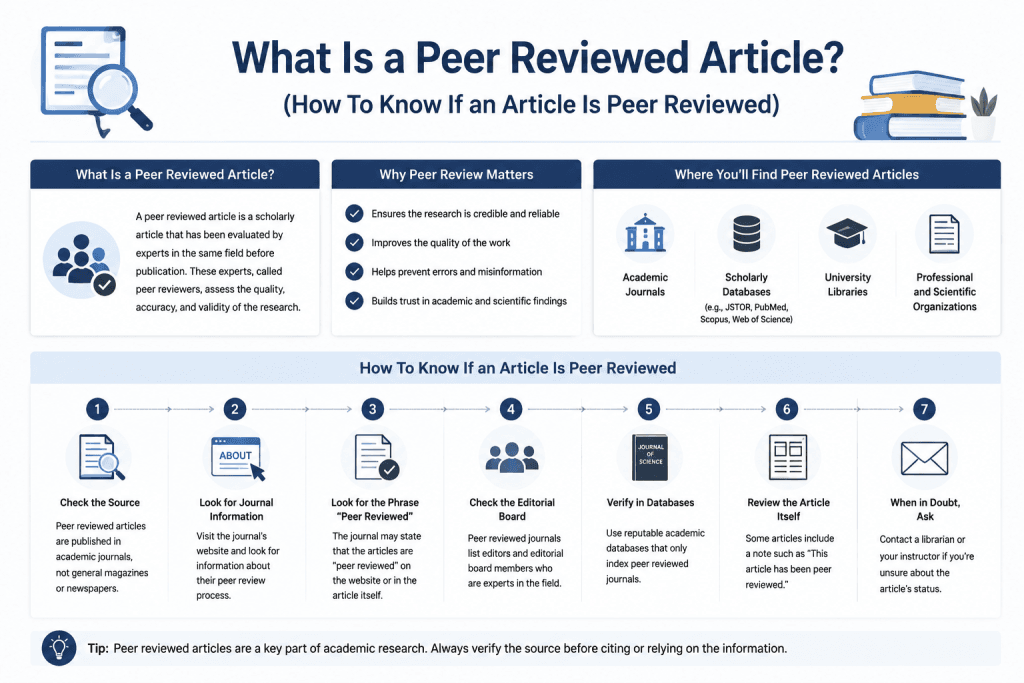
- A peer reviewed article is a piece of academic writing that has been evaluated by other experts in a particular field before it gets published. This process exists to check the quality, accuracy, and originality of the research before it ever reaches a reader.
- When people ask “what is a peer reviewed article,” they’re really asking how scholars and researchers police the quality of information that ends up in academic journals. The answer is simple: a panel of qualified experts, sometimes called referees, reads the article and decides whether it’s solid enough to publish.
- Peer reviewed articles are different from a typical magazine or newspaper piece. A journalist writing for a magazine doesn’t need their work checked by other journalists with PhDs in the subject matter. But an author submitting a research article to an academic journal does.
- Here’s a breakdown of what makes an article peer reviewed:
- Submission: An author submits their work to a journal.
- Editorial screening: An editorial team does an initial check to see if the article fits the journal’s scope.
- Expert review: The article gets sent to peers (other experts in the same academic discipline) for evaluation.
- Revision or rejection: Based on feedback, the author may need to revise the article, or it may be rejected entirely.
- Publication: Once approved, the article is published in the journal.
- Peer reviewed articles are considered some of the most reliable and trustworthy sources you can use for academic work. Because of the rigorous review process, the information has already been checked by people who know the subject inside and out.
- This is why peer reviewed articles are required reading for college papers, dissertations, and research projects. Professors trust this format because the content has been vetted, not just self-published.
- It’s worth noting that “peer reviewed” and “scholarly” sometimes get used interchangeably, but they aren’t always the same thing. We’ll cover that distinction in detail further down.
- For now, just remember: if an article is peer-reviewed, it means qualified experts in that academic discipline have reviewed it and given it their stamp of approval before publication.
Understanding The Peer Review Process
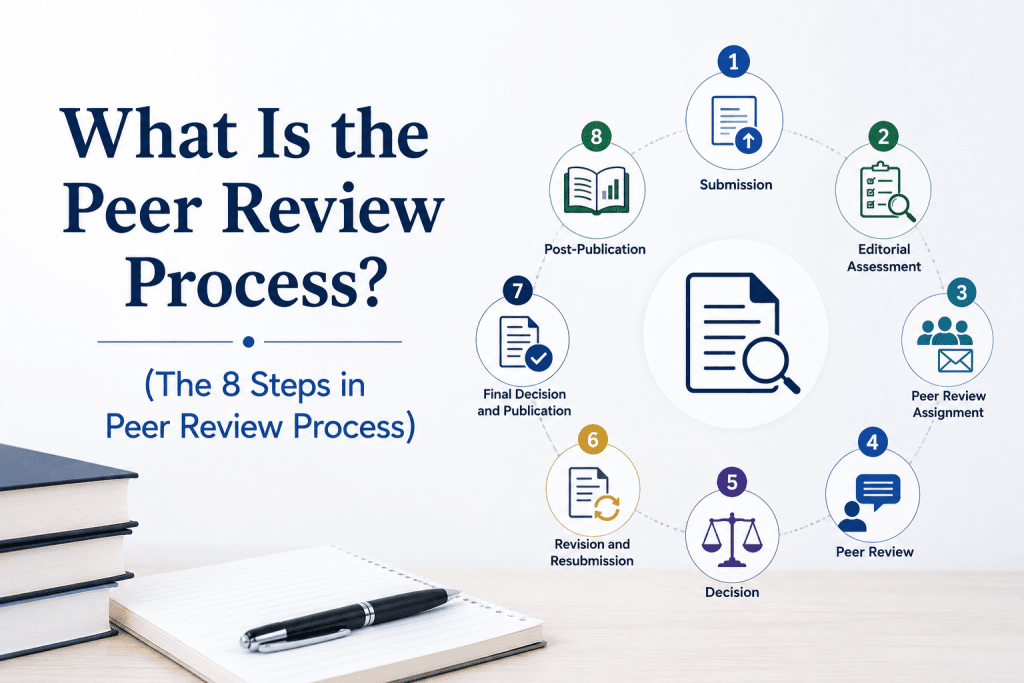
- The peer review process is the backbone of academic publishing. It’s the mechanism that separates a peer-reviewed journal article from something that was simply written and uploaded online with no oversight.
- Here’s how the peer review process typically works, step by step:
- Step 1 – Submission: A researcher or author submits their article to a journal for consideration.
- Step 2 – Initial editorial review: An editor checks whether the topic fits the journal and meets basic formatting and quality standards.
- Step 3 – Selection of referees: The editor sends the article to two or more experts (referees) in the same field who don’t know the author’s identity, and vice versa. This is called a “blind” review.
- Step 4 – Evaluation: Referees evaluate the research methods, data, conclusions, and overall contribution to the field.
- Step 5 – Feedback and decision: Referees recommend whether to accept, reject, or request revisions.
- Step 6 – Revisions: Most articles go through at least one round of revisions before being accepted.
- Step 7 – Final publication: Once the article passes review, it’s published in the journal.
- This review process can take anywhere from a few weeks to over a year, depending on the journal and the complexity of the research article.
- A few important things to know about how peer review works:
- Reviewers are typically unpaid volunteers who are experts in the same academic discipline as the author.
- The process is designed to catch errors, unsupported claims, or flawed research methods before publication.
- Some journals use single-blind review (where reviewers know the author’s identity but the author doesn’t know theirs), while others use double-blind review (where neither party knows the other).
- Why does this matter for your research? Because once you know if this article went through this kind of scrutiny, you can trust the findings far more than something pulled from a random website.
- The peer-review process isn’t perfect. Mistakes can slip through, and there have been cases of poor-quality work getting published. But overall, it remains the gold standard for verifying scholarly communication and ensuring credibility in academic publishing.
Academic Writing & Research Support
Need Help With Research Papers, Manuscripts, Editing, or Proofreading?
At Scholarly Work, we provide professional academic writing support for researchers, students, and professionals. From drafting manuscripts to refining final submissions, we ensure clarity, accuracy, and publication-ready quality.
Get Manuscript Writing Help
Peer-Reviewed Journal Vs. Scholarly Journal: What’s The Difference?
- This is one of the most common points of confusion for students and researchers: is a scholarly journal the same as a peer-reviewed journal? Not exactly, and understanding the difference will help you evaluate sources more accurately.
- What makes a journal “scholarly”?
- A scholarly journal is written by and for academics, researchers, and experts in a specific academic discipline.
- Scholarly articles typically include citations, a list of references or works cited, and an abstract summarizing the research.
- The tone is technical and assumes the reader has background knowledge in the subject.
- Scholarly journals are usually published by a university, academic society, or specialized academic publisher.
- What makes a journal “peer-reviewed”?
- A peer-reviewed journal specifically requires that articles go through the peer review process described earlier before publication.
- Not all scholarly journals are peer reviewed. Some scholarly publications include editorial review only, without sending the article out to external referees.
- A peer-reviewed journal article has the added credibility of having been checked by multiple outside experts, not just an internal editorial team.
- Key differences to remember:
- All peer-reviewed journals are scholarly, but not all scholarly journals are peer-reviewed.
- A scholarly article might still be high-quality and research-based, but without external peer review, it hasn’t had the same level of independent scrutiny.
- Peer-reviewed journal articles often include a note in the journal’s editorial policies, on the website, or in the database listing that confirms the peer review process was used.
- Other source types you might confuse with scholarly or peer-reviewed work:
- Magazine articles: Written for general audiences, not academic ones. No peer review involved.
- Newspaper articles: Focused on current events, written by journalists, not subject-matter referees.
- Book reviews: These evaluate a published book and are usually written by a single reviewer, not a panel of peers.
- Editorial pieces: Opinion-based content, often written by the journal’s own editorial staff, not independently reviewed.
- Letters to the editor: Reader responses or short commentary that typically skip the peer review process entirely.
- So when you’re trying to figure out if an article is scholarly versus peer reviewed, look beyond the academic tone. Check the journal’s specific policies. A scholarly journal article might still be a credible academic discipline source, but a peer reviewed journal article carries an extra layer of validation.
- Understanding this distinction matters because professors and researchers often require sources that are not just scholarly but specifically peer-reviewed, especially for original research papers, theses, and dissertations.
How To Know If an Article Is Peer Reviewed or Scholarly
- Figuring out how to know if this article is peer-reviewed or scholarly doesn’t have to be complicated. There are several reliable indicators you can check.
- Check the journal title and publisher
- Look up the journal name where the article was published. Reputable, well-known academic publishers are more likely to maintain peer review standards.
- Search the journal’s website directly. Most peer-reviewed journals state their peer review policies clearly, often in an “About” or “Editorial Policy” section.
- Look at the structure of the article
- A peer-reviewed research article typically includes an abstract, introduction, methodology, results, discussion, and a reference or citation list.
- If the article lacks a clear methodology section or citations, it may not be peer-reviewed, even if it appears in an academic-looking publication.
- Use library databases
- Most library databases (like JSTOR, EBSCOhost, or ProQuest) let you filter or limit your search specifically to peer-reviewed sources. This is one of the easiest ways to confirm an article’s status before you even open it.
- When using a database, look for a checkbox or filter labeled “peer reviewed” or “refereed” to limit the search results to verified sources.
- Check with a librarian
- If you’re unsure whether an article is peer-reviewed, ask a librarian. Librarians are trained to evaluate academic sources and can quickly tell you whether a specific journal title uses peer review.
- Many university library websites also have LibGuides (research guides) dedicated to explaining how to identify scholarly and peer-reviewed sources for a specific discipline.
- Watch out for predatory journals
- Be cautious of predatory journals that claim to be peer reviewed but skip the actual review process to publish articles quickly for a fee.
- Signs of a predatory publisher include vague editorial boards, no clear peer review process described, and pressure to pay before publication.
- Quick checklist to evaluate an article:
- Does the journal name appear in a recognized index or library database?
- Is there a visible peer review or editorial policy on the publisher’s website?
- Does the article include a methodology, citations, and an abstract?
- Are the authors identified as researchers or experts with academic affiliations?
- Is the journal indexed in a trusted academic database rather than a random website?
- If you can answer “yes” to most of these, you can feel confident that the article is peer-reviewed and suitable for academic use.
Academic Writing & Research Support
Need Help With Research Papers, Manuscripts, Editing, or Proofreading?
At Scholarly Work, we provide professional academic writing support for researchers, students, and professionals. From drafting manuscripts to refining final submissions, we ensure clarity, accuracy, and publication-ready quality.
Get Manuscript Writing Help
How To Search for Peer-Reviewed Journal Articles in A University Library
- Knowing how to search for peer-reviewed journal articles in a university library is a skill that will save you hours of frustration, especially when professors require sources that are specifically peer reviewed and not just scholarly or general academic content.
- Start at the university library’s website
- Most academic institutions, including state university systems, provide access to multiple library databases through their library’s homepage.
- Look for a search bar often labeled “library search,” “discovery search,” or simply “find articles.” This is usually the fastest way to find peer-reviewed and scholarly articles in one place.
- Use library databases instead of general search engines
- Skip typing your topic into a general search engine. Instead, go directly to subject-specific or multidisciplinary library databases like JSTOR, EBSCOhost, ProQuest, PubMed, or Web of Science.
- These databases are specifically built to index peer-reviewed journal articles, scholarly articles, and other academic publications, making it much easier to find peer-reviewed content quickly.
- Apply filters to limit your search
- Nearly every library database includes a filter option to limit the search results to peer reviewed sources only. Look for checkboxes labeled “peer-reviewed,” “refereed,” or “academic journals.”
- You can also filter by publication date, academic discipline, or document type (research article, review article, etc.) to narrow your search to peer reviewed articles relevant to your topic.
- Use LibGuides for subject-specific help
- Many university library websites maintain LibGuides, which are curated research guides built for specific academic disciplines (such as psychology, biology, history, or business).
- LibGuides often list the best databases for your subject, along with tips on how to search to peer-reviewed sources more efficiently within that discipline.
- Search using the right terminology
- Use specific academic terminology related to your topic rather than casual phrasing. For example, instead of searching “why do people get stressed,” try “psychological stress response cortisol.”
- Use Boolean operators (AND, OR, NOT) to combine keywords and refine your search results within the database.
- Check the journal title and citation information
- Once you find an article, check the journal title to confirm it’s a recognized, peer reviewed journal.
- Look at the citation details, including the author, publication date, and journal name, to verify it’s a credible, properly published research article.
- Ask a librarian for help
- If you’re stuck or unsure how to navigate a specific database, librarians are there to help. Most university libraries offer in-person help desks, chat services, or appointment-based consultations.
- A librarian can point you toward the best databases for your specific academic discipline and help you fine-tune your search to peer-reviewed, relevant sources.
- Step-by-step example search process:
- Step 1: Go to your university library’s website.
- Step 2: Choose a relevant library database (e.g., JSTOR for humanities, PubMed for medical research).
- Step 3: Enter your topic using clear academic terminology.
- Step 4: Apply the “peer-reviewed” filter.
- Step 5: Skim abstracts to find the most relevant peer reviewed articles.
- Step 6: Click into the full article and check the citation, methodology, and reference list to confirm authenticity.
- Step 7: Save or download the article, noting the citation details for your own works cited or reference list later.
- A few extra tips:
- Don’t rely solely on free, open web searches; many peer-reviewed journal articles are locked behind paywalls and are only accessible through your university library’s database subscriptions.
- If your library doesn’t have access to a specific peer reviewed article, ask about interlibrary loan services, which let you borrow or request access to articles from another library’s database.
- Save your search filters and terms so you can quickly return to a productive search to peer-reviewed sources later in your research process.
- Mastering this kind of academic search ability is incredibly valuable, not just for one assignment, but for any future academic discipline work, whether you’re an undergraduate, graduate researcher, or working professional doing ongoing scholarly communication research.
Related Topics and Common Questions About Peer Review
- To wrap things up, here are some related topics and common questions people often ask when researching peer reviewed articles, along with straightforward answers.
- Is a peer reviewed article the same as a research article?
- Not always. A research article reports original research, but it isn’t automatically peer-reviewed unless it was published in a peer-reviewed journal that uses the peer review process described earlier in this article.
- Can a peer reviewed article be wrong?
- Yes. Peer review reduces the likelihood of errors, but it doesn’t guarantee perfection. Even peer-reviewed journal articles can later be corrected, retracted, or challenged by other researchers as new evidence emerges.
- Do all academic disciplines use the same peer review process?
- No. The review process can vary slightly by academic discipline. For example, medical and scientific fields may require multiple rounds of data verification, while humanities fields may focus more on argument structure and source interpretation.
- What’s the difference between a peer reviewed article and a peer-reviewed journal?
- A peer-reviewed journal is the publication itself, while a peer reviewed article is the individual piece of content published within that journal. Not every single piece in a peer-reviewed journal (like an editorial or book review) is necessarily peer-reviewed itself.
- How do I cite a peer reviewed journal article?
- Citation format depends on the style guide required (APA, MLA, Chicago, etc.), but generally includes the author, publication date, article title, journal title, volume, issue number, and page numbers. Always double check your specific style guide’s requirements.
- Where can I find peer reviewed articles for free?
- Many peer reviewed articles are available for free through your university library’s database subscriptions. Outside of that, look for open-access journals, institutional repositories, or government-funded research databases.
- Why do professors require peer-reviewed sources?
- Professors want students to use reliable, vetted academic discipline information rather than opinion pieces or unchecked claims. A peer-reviewed source has already been evaluated by experts, which adds a layer of trust to your own research article or paper.
- What should I do if I’m unsure whether a source is peer reviewed?
- When in doubt, check the journal’s website, ask a librarian, or use a library database filter to confirm the peer-reviewed status before citing it in your work.
- Are conference papers peer-reviewed?
- Sometimes. Some academic conferences have their own peer review process for accepting papers, but the rigor can vary widely compared to an established peer-reviewed journal.
- What’s a quick way to remember the difference between scholarly and peer-reviewed?
- Think of “scholarly” as the broader academic category, and “peer-reviewed” as a specific, more rigorous subset within it. All peer-reviewed journal articles are scholarly, but not every scholarly article has gone through formal peer review.
- Understanding these related topics will help you feel more confident the next time you’re asked to find or evaluate a peer reviewed article for academic work. Whether you’re a student, researcher, or simply curious about scholarly communication, knowing how the peer review process works puts you in a much stronger position to evaluate the credibility of what you read.
References
- American College of Education (ACE) – Scholarly Writing Guide – https://ace.edu/blog/a-guide-to-scholarly-writing/
- George Washington University – Faculty Scholarly Publications – https://scholarship.law.gwu.edu/faculty_publications/73/
- Walden University Writing Center – Scholarly Writing Resources – https://academicguides.waldenu.edu/writingcenter/scholarly
- Florida State University College of Law – Scholarly Writing Guide – https://guides.law.fsu.edu/scholarlywriting