What Is a Scholarly Source? Definition and Key Characteristics of Scholarly Content
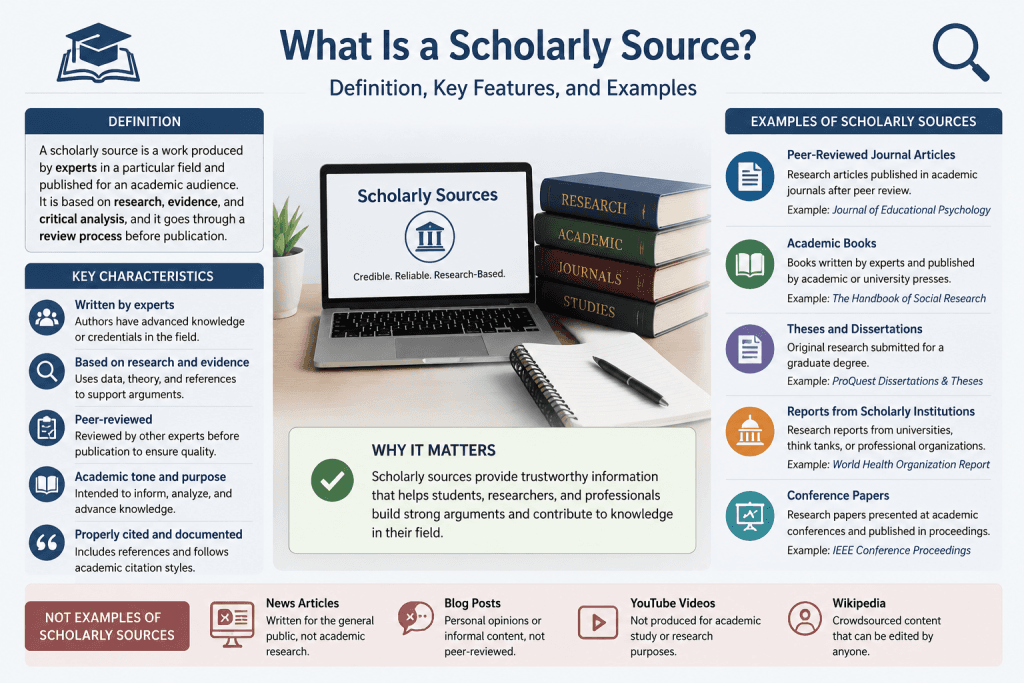
A scholarly source is a piece of written work created by an expert in a particular field and published to advance knowledge in that field. Whether you’re writing a research paper or just trying to verify a claim, knowing what makes a source scholarly is the first step toward producing credible work. Here are the key characteristics that define a scholarly source.
- Written by experts. A true scholarly source is written by experts — scholars, researchers, or professors with real credentials in their particular field. Unlike a casual blog post, a scholarly source is produced by someone with specialized knowledge, and their credential and university affiliation are usually listed so readers can verify expertise.
- Published in a peer-reviewed journal. Most scholarly materials appear in a scholarly journal that uses peer review before publication. Other experts evaluate the research, methods, and conclusions before the journal article is accepted. A source is scholarly largely because it survived this review process, not because it was simply submitted and printed.
- Includes a bibliography. Scholarly content always cites prior research. A detailed bibliography at the end of a scholarly article lets readers trace and verify every claim — something popular sources rarely offer.
- Uses formal, field-specific language. Because a scholarly source is written by and for fellow scholars, it uses precise, technical terminology rather than the simplified language of a newspaper or general magazine.
- Reports original research or analysis. A scholarly source typically presents original findings or in-depth analysis on a specific question within a particular field, contributing new knowledge that other scholars can build on.
- Published by an academic publisher. Many scholarly publications come from a university press or academic society rather than a commercial newspaper or press, since academic publishers prioritize accuracy over advertisement revenue. This is one more reason a scholarly source tends to carry more weight in serious research.
- Lacks advertisements. Unlike a popular source, a scholarly journal rarely contains advertisement content, which adds to its credibility as an unbiased scholarly publication.
Understanding these traits is essential before evaluating whether something you find — through a database, a university library, or a general search — actually qualifies as a scholarly source for your research.
How to Identify Whether a Source Is Scholarly or Not: Peer Review, Review Process, and Author Credibility
Knowing the definition of a scholarly source is one thing; actually evaluating a document to see if it’s a scholarly source is another. An instructor will often expect you to cite scholarly sources specifically, so it helps to have a clear method for checking whether a source is scholarly. Here’s how to identify a scholarly source using peer review, the review process, and author credibility.
- Check whether it went through peer review. The strongest signal that a source is scholarly is whether it was published in a peer-reviewed journal. Peer review means the article was sent to other experts in the same particular field, who scrutinized the methodology and conclusions before publication. Many academic databases let you filter results by “peer-reviewed” or “scholarly journal,” making it easier to confirm a source is scholarly. If you’re unsure, search the journal’s name directly — most scholarly publishers state their review process clearly online.
- Examine the review process itself. Beyond peer review specifically, look at the broader review process the publication follows. A scholarly journal will typically explain its editorial standards, how many reviewers assess each manuscript, and what revisions authors go through. If a publication is vague about its review process, that’s a sign the source may not be a true scholarly source.
- Investigate the author’s credentials. A genuine scholarly source clearly lists the author’s name, degree, and university affiliation. Search the author’s name to confirm they’re a recognized scholar in their particular field — most have a faculty page, other scholarly publications, or a research profile like Google Scholar you can use to verify credibility. If an article lists no author or no discoverable credential, it likely isn’t a scholarly source at all.
- Look at the publisher. Scholarly materials are usually released by a university press or professional academic association — not a general commercial press or newspaper. Search the publisher’s name; legitimate academic publishers have a long history of producing scholarly content and are indexed in major databases.
- Review the article’s structure. A scholarly article typically follows a standard structure: abstract, introduction, literature review, methodology, results, discussion, and bibliography. This formal structure is a strong indicator you’re looking at a genuine scholarly source — one more clue that the scholarly source in front of you meets academic standards — since a popular source almost never follows this format.
- Confirm citations and a bibliography exist. Every scholarly source includes in-text citations and a bibliography, letting you verify where the evidence originated. If a piece makes claims without citing supporting research, it’s unlikely to be a scholarly article, however authoritative it sounds.
- Use your university library and databases. One of the most reliable ways to confirm a source is scholarly is to search a university library system or academic database, since these are curated specifically to include scholarly journals and exclude purely commercial content. Many databases include built-in filters that isolate only peer-reviewed, scholarly source results.
- Check for objectivity and the absence of advertisement. A genuine scholarly source isn’t designed to sell anything. If a source is filled with advertisement banners or sponsored, promotional language, it was likely created for a popular audience rather than as a true scholarly source.
- Ask your instructor or a librarian when in doubt. If you’ve checked peer review, the review process, and author credentials and still aren’t sure, ask your instructor or a research librarian — they evaluate whether a source is scholarly for a living and can confirm quickly.
By systematically checking peer review status, the review process, and author credibility, you can confidently separate a true scholarly source from material that only looks authoritative on the surface.
Scholarly and Popular Sources: Key Differences Between Scholarly and Popular Content
Once you understand what makes a source scholarly, it’s much easier to spot the differences between scholarly and popular sources during research. Both serve real purposes, but a scholarly source and a popular source differ across several important dimensions, summarized below.
- Purpose and intent. A scholarly source is written to advance knowledge within a particular field or critically analyze existing research. A popular source — a newspaper article, magazine feature, or general website — is written to inform or entertain a broad, general audience. This difference in purpose shapes nearly everything else about scholarly and popular content.
- Authorship and expertise. A scholarly source is written by experts: scholars and professors with academic credentials directly tied to the topic. A popular source is typically written by journalists or staff writers who may lack specialized academic credentials in the subject. This doesn’t make a popular source inaccurate, but it carries less authority on technical, research-based questions than a scholarly source.
- Review process. This is one of the biggest differences between scholarly and popular sources. A scholarly source goes through a rigorous peer review process before appearing in a scholarly journal. A popular source goes through faster editorial review by an editor rather than subject experts, with far less scrutiny of methodology.
- Publisher type. Scholarly publications are typically released by a university press or academic society, while popular content comes from a commercial press or newspaper. University presses prioritize academic merit; commercial publishers prioritize readership and advertisement revenue.
- Use of citations. A scholarly source always includes a bibliography and in-text citations, letting readers verify every claim back to the original research. A popular source rarely includes formal citations, even when referencing an expert or study.
- Language and tone. Scholarly writing uses formal, technical, field-specific language for an audience of fellow scholars. Popular writing uses simplified, accessible language for a general, non-specialist reader. Heavy jargon and citations point to a scholarly source; a story-like or opinion-driven tone points to a popular source.
- Presence of advertisements. A popular source, including most magazines and newspapers, contains advertisements because its business model depends on advertisement revenue. A scholarly journal is largely free of advertisement content, since it’s funded through subscriptions or academic grants rather than commercial sponsorship.
- Length and depth. A scholarly article tends to be long and detailed, since it must explain methodology, data, and findings thoroughly. A popular article is typically shorter, designed to be read quickly.
- Where you find them. You’ll typically find a scholarly source in an academic database, a university library, or a dedicated scholarly publication, while a popular source appears in mainstream newspapers and consumer websites. When an instructor asks you to cite a scholarly source, a university library database is almost always the best starting point.
- Credibility and verification. Because of peer review, citation requirements, and expert authorship, a scholarly source generally carries higher credibility for academic research than a popular source. A popular source can still be credible for general information, but it isn’t held to the same evaluative standard, so it’s harder to verify independently.
- Audience. Scholarly content is written for other scholars and students engaged in serious study of a particular field. Popular content is written for the general public, with no assumption of specialized prior knowledge.
Understanding these differences between scholarly and popular sources helps you choose the right material for the task — citing a peer-reviewed, expert-authored scholarly source for academic research, or turning to a popular source when you simply want accessible, general information. Either way, knowing how to spot a true scholarly source will make your research stronger and easier to defend.
Example of a Scholarly Source: Peer-Reviewed Articles, Journals, and Research Publications Explained
Understanding what counts as a scholarly source becomes much easier once you can see real examples side by side. Below, we break down the most common types of scholarly materials you’ll encounter during academic research, along with what makes each one credible.
1. Peer-Reviewed Journal Articles
- A peer-reviewed journal article is widely considered the gold standard example of a scholarly source. Before publication, the manuscript goes through a peer review process, where other experts in the field read, critique, and assess the work.
- During this review process, a referee—typically another scholar with relevant credentials—evaluates the research methodology, data, and conclusions prior to publication. If the submission doesn’t meet rigorous academic standards, it gets sent back for revisions or rejected outright.
- These journal articles are published in a scholarly journal, which differs significantly from a general-interest magazine. A scholarly journal focuses on a particular field of study and is typically sponsored by a professional association, university press, or academic institution.
- You can usually tell a source is scholarly by checking for a list of references or bibliography at the end. Genuine academic research always shows its sources—this allows other scholars to verify claims and trace the validity of the findings.
2. Books and Monographs from University Presses
- Another strong example of a scholarly source is a book published by a university press, such as Oxford University Press or Yale University Press. These publishers have their own internal field review process, ensuring experts vet the manuscript before it reaches readers.
- Unlike a popular paperback, an academic book typically includes footnotes, citations, and a detailed bibliography, all of which help readers cite the original research accurately and evaluate the author’s credentials and affiliation.
- These books often undergo extensive book reviews in academic circles after publication, where other scholars assess the work’s contribution to knowledge in a particular field.
3. Academic Databases and Library Resources
- Your university library or OneSearch platform is one of the best places to find legitimate scholarly materials. These systems index thousands of peer-reviewed publications, making finding credible research far simpler than a general web search.
- JSTOR is one of the most well-known databases for scholarly articles, journals, and historical periodicals. It hosts digitized scholarly publication archives across nearly every field of study, from the humanities to the hard sciences.
- A librarian can help you navigate these databases, point you toward subject-specific directories, and teach you how to distinguish scholarly and popular sources quickly.
4. What Scholarly Sources Are Not: Popular Sources Compared
- It helps to understand the contrast between scholarly and popular sources. A popular source—like a newspaper, general magazine, or blog—is written for a broad audience, not experts in a particular field.
- Popular sources often contain advertisements, lack a bibliography, and are rarely fact-checked through a formal peer-review process. While a newspaper article might be timely and well-written, it isn’t subjected to the same rigorous scrutiny as an academic publication.
- A simple way to remember the difference: if it’s written by experts for other experts and published in a peer-reviewed journal, it’s scholarly. If it’s written by a journalist for the general public and includes advertisement banners, it’s likely a popular source.
5. Identifying Markers of a Scholarly Source
- Check the author’s credential—do they hold an advanced degree or affiliation with a university or research institution?
- Look for a list of references or bibliography—genuine scholarly articles always cite their sources.
- Notice the publisher—university press imprints and professional academic associations are strong indicators.
- See when it was last updated—academic research should reflect current field knowledge, though older foundational scholarly publication works remain valuable too.
- Confirm it appears in an academic database or serial index, not just a casual web search.
Why Scholarly Sources Matter in Academic Research
So why does it matter so much whether you’re using a scholarly source versus a popular source? The answer comes down to credibility, depth, and trust.
- They establish credibility for your work. When you cite a scholarly source, you’re telling your reader—whether that’s an instructor, committee, or fellow scholar—that your claims are backed by rigorous, expert-vetted research rather than casual opinion or unverified claims found online.
- They’ve already been vetted by experts. Every scholarly article has passed through peer review, meaning experts in the field scrutinized the methodology and findings before publication. This review process filters out weak arguments, faulty data, and unsupported conclusions, so you’re building your academic research on a more solid foundation.
- They support the integrity of your bibliography. A strong list of references built from scholarly materials shows your instructor or readers that you’ve engaged seriously with knowledge in a particular field, rather than relying on shallow, surface-level sources.
- They allow you to verify and trace information. Because scholarly publication always includes citations, you can verify claims, follow the trail of sources used, and confirm the validity of an argument. This transparency is something most popular sources simply don’t offer.
- They reflect specialized, field-specific knowledge. A scholarly source is written by scholars with real credentials and affiliation to academic institutions, meaning the content reflects deep expertise in a particular field—not a generalist’s take.
- They help you avoid relying on biased or commercial content. Many popular sources, especially those filled with advertisement content, have a financial or editorial incentive shaping their narrative. Scholarly journals and university press publications are driven by academic research standards, not ad revenue.
- They’re recognized and expected in academic settings. Most instructors explicitly require scholarly sources for academic research assignments. Understanding how to evaluate and find appropriate scholarly materials is a core skill for conducting successful coursework, theses, and dissertations.
- They connect you to a larger body of expert work. Every journal article exists within a broader conversation among experts in the field. By engaging with these scholarly publications, you join an ongoing academic dialogue, rather than relying on isolated, disconnected opinions.
- They’re easier to locate through trusted systems. Tools like your university library, OneSearch, and JSTOR are built specifically for finding legitimate scholarly articles and peer-reviewed journal content—saving you time compared to sifting through unreliable web results.
- They safeguard against misinformation. Because a scholarly source undergoes peer-review before reaching the public, it’s significantly less likely to contain factual errors, unsupported assumptions, or misleading claims compared to many casual online publications.
Ultimately, knowing how to evaluate, find, and apply a genuine scholarly source isn’t just an academic checkbox—it’s a skill that shapes the quality, credibility, and impact of everything you research and write going forward.
- American College of Education (ACE) – Scholarly Writing Guide – https://ace.edu/blog/a-guide-to-scholarly-writing/
- George Washington University – Faculty Scholarly Publications – https://scholarship.law.gwu.edu/faculty_publications/73/
- Walden University Writing Center – Scholarly Writing Resources – https://academicguides.waldenu.edu/writingcenter/scholarly
- Florida State University College of Law – Scholarly Writing Guide – https://guides.law.fsu.edu/scholarlywriting