Understanding APA Journal Article Citation Basics: Author, DOI & Reference List Essentials
Before you can write a correct APA journal article citation, it helps to understand the moving parts that make up the reference. Every APA journal article citation is built from a handful of core elements, and once you know how they fit together, the rest of this guide will feel much easier to apply.
- The author’s name comes first. In an APA journal article citation, the author’s name is always inverted — last name first, followed by initials. For example, a single author named Jamie Grady would appear as “Grady, J.” This format applies whether you’re citing one author or several. When there are two authors, join them with an ampersand (&) rather than the word “and” — for example, “Grady, J., & Her, M.” The ampersand is a small but important detail that APA style consistently requires in the reference list, even though you’d write “and” if referring to the same authors in your own sentence.
- Multiple authors follow specific rules. For a work with up to 20 authors, list every single author’s name in the reference, separated by commas, with an ampersand before the final name. If a source has 21 or more authors, APA 7 introduced a specific rule: list the first 19 authors, insert an ellipsis (…), and then add the final author’s name. This prevents references from becoming impossibly long while still crediting the lead contributors and the last author.
- The year of publication comes next, in parenthesis. Right after the author’s name, place the year of publication inside parenthesis, followed by a period — for example, “Grady, J. (2019).” If the source doesn’t have a clear year, APA allows “n.d.” (no date) in its place, though this is rare for scholarly, peer-reviewed journal articles.
- The title of the article uses sentence case. This is one of the most commonly misunderstood rules in APA journal article citation formatting. Only the first word of the article title, the first word after a colon, and any proper nouns are capitalized. Everything else stays lowercase. For example: “Emotions in storybooks: A comparison of storybooks that represent ethnic and racial groups in the United States.” Notice that only “Emotions,” “A” (after the colon), and “United States” (a proper noun) are capitalized.
- The journal name uses title case and italics. Unlike the article title, the name of the journal itself — the periodical — is capitalized in title case, meaning most major words are capitalized, and it’s italicized. For example, Psychology of Popular Media Culture is italicized with each major word capitalized.
- Volume number and issue number follow the journal name. The volume number is italicized, while the issue number (in parenthesis) is not. For example: Psychology of Popular Media Culture, 8(3). Here, “8” is the volume number and “3” is the issue number.
- Page numbers or a page range close out the print-style portion. After the issue number, add a comma and the page range, such as 207–217. This tells readers exactly where the article begins and ends within that issue.
- The DOI or URL comes at the end of the reference. If a digital object identifier is available, it should always be included at the end of the reference, formatted as a full URL: https://doi.org/10.1037/ppm0000185. If no DOI is available, a URL to the source may be used instead, though a DOI is always preferable when one exists.
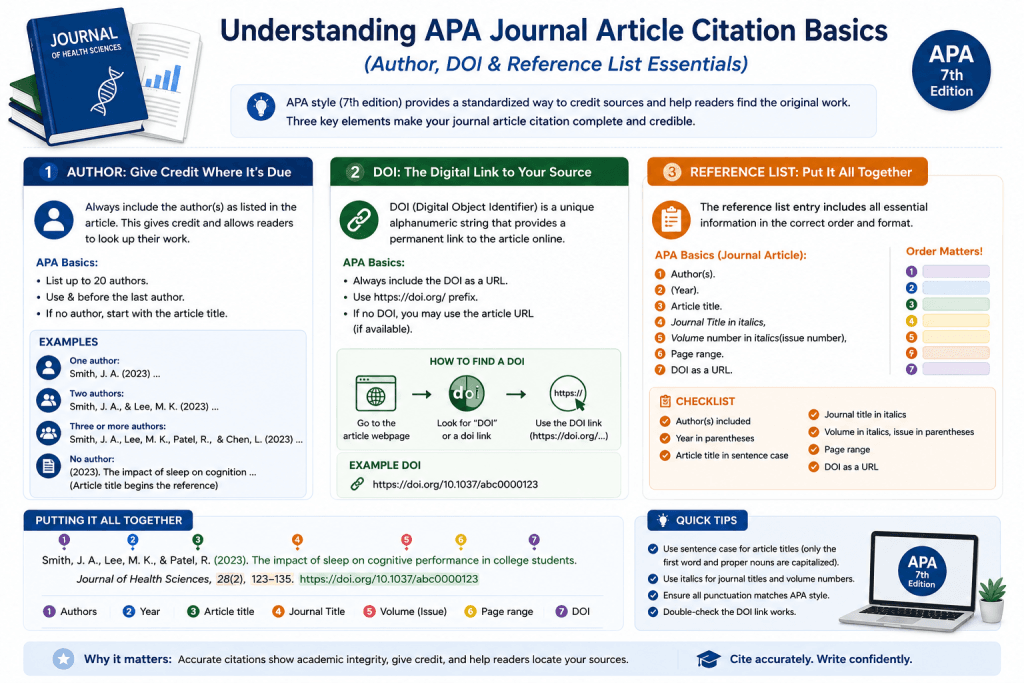
Putting it all together, a full APA journal article citation for the reference list looks like this:
Grady, J. S., Her, M., Moreno, G., Perez, C., & Yelinek, J. (2019). Emotions in storybooks: A comparison of storybooks that represent ethnic and racial groups in the United States. Psychology of Popular Media Culture, 8(3), 207–217. https://doi.org/10.1037/ppm0000185
In your paper’s in-text citation, this same source would appear simply as (Grady et al., 2019), since there are more than two authors. This is the heart of APA journal article citation: a consistent, author-year system in the text, paired with a complete, alphabetized reference list at the end of your paper. Once you’re comfortable with these essentials — author, year, article title, journal title, volume, issue, page numbers, and DOI — you’re ready to tackle more specific formatting situations, which we’ll cover next.
How to Format an APA Journal Article Citation for Print vs. Digital Sources
Many students assume that citing a print journal article and citing a digital or online journal article requires completely different formats. In reality, APA 7th edition simplified this considerably, and the difference is smaller than most guides suggest.
- Print journal article citations omit the DOI and URL entirely. If you’re working from a physical, bound issue of a journal — say, one you pulled from a library shelf — there’s no digital object identifier or URL to include. The reference simply ends after the page numbers. For example:
Bourne, V. J. (2017). Motor imagery experience and use in an everyday task. Laterality: Asymmetries of Body, Brain and Cognition, 22(3), 249–261.
- Digital and online journal article citations add a DOI at the end. When you access an article through a database, publisher website, or an online-only journal, you should always try to include the DOI. Under APA 7, dois are formatted as a full clickable URL starting with https://doi.org/, not the older “doi:” prefix used in APA 6. For example:
Grady, J. S., Her, M., Moreno, G., Perez, C., & Yelinek, J. (2019). Emotions in storybooks: A comparison of storybooks that represent ethnic and racial groups in the United States. Psychology of Popular Media Culture, 8(3), 207–217. https://doi.org/10.1037/ppm0000185
- If no DOI is available for an online source, use a URL instead. Not every online publication has been assigned a doi. In that case, employ the URL of the article, ideally one that links directly to where the article can be retrieved, rather than a generic homepage.
- Both formats share the exact same core structure. Author, year, article title, journal title, volume, issue, and page numbers remain identical whether you’re citing a print journal article or a digital one. The only variable is that final piece — the DOI or URL — which only applies to sources retrieved online.
- Database URLs are usually unnecessary. If an article was retrieved from a common academic database like JSTOR, ProQuest, or PsycINFO, you generally don’t need to include the database URL itself; a DOI resolves for readers regardless of which database they use to find it. We’ll expand on this database-specific rule in an upcoming section.
- Advance online publication versions need a slightly different note. If you’re citing an article that has been published online ahead of its official print issue, and it doesn’t yet have volume, issue, or page numbers assigned, add “Advance online publication” after the journal title, and still include the DOI if one has been issued.
Understanding this print-versus-digital distinction means you’ll never have to guess which format applies — the presence or absence of a DOI or URL is really the only thing that changes, and everything else about your APA journal article citation stays consistent across formats.
Academic Writing & Research Support Need Help With Research Papers, Manuscripts, Editing, or Proofreading? At Scholarly Work , we provide professional academic writing support for researchers, students, and professionals. From drafting manuscripts to refining final submissions, we ensure clarity, accuracy, and publication-ready quality. Get Manuscript Writing Help
APA Journal Article Citation with Article Numbers and Digital Object Identifiers (DOI)
As more journals move to online-only publication, many no longer assign traditional page ranges to their articles. Instead, they assign an article number. Knowing how to handle this in your APA journal article citation is essential for anyone working with modern, digital-first journals.
- Some online journals replace page numbers with an article number. Instead of a page range like 207–217, you might see “Article e0193972” or simply “Article 45” listed on the publisher’s site. When this happens, use the word “Article” followed by the number in place of the page range in your reference.
- Example of an article number citation:
Jerrentrup, A., Mueller, T., Glowalla, U., Herder, M., Henrichs, N., Neubauer, A., & Schaefer, J. R. (2018). Teaching medicine with the help of “Dr. House”. PLOS ONE, 13(3), Article e0193972. https://doi.org/10.1371/journal.pone.0193972
- Notice the format stays otherwise identical. The author’s name, year of publication, article title, journal name, volume, and issue number are formatted exactly the same as any standard APA journal article citation. Only the page-number slot is replaced with the article number.
- The DOI is still required whenever available. Article numbers don’t replace the need for a doi — they simply replace the page range. If the source has both an article number and a digital object identifier, include both, with the DOI at the very end of the reference, as always.
- What exactly is a DOI, and why does it matter? A digital object identifier (DOI) is a unique, permanent string assigned to a specific piece of scholarly work so that it can always be located online, even if the URL of the journal’s website changes over time. This is why the Publication Manual of the American Psychological Association insists that a DOI is preferable to a URL whenever one is available — dois don’t break the way regular urls sometimes do.
- Formatting rule for dois in APA 7. Always format the DOI as a full hyperlink starting with “https://doi.org/” followed by the unique identifier string, with no period at the end of the reference. For example: https://doi.org/10.1037/ppm0000185. Do not label it with “Retrieved from” or “doi:” — APA 7th edition dropped both of those older conventions used in the 6th edition.
- What if the DOI is available but very long or complex? Copy it exactly as published, even if it looks unusual; never shorten or alter a doi, since doing so will break the link and prevent the source from being located.
- When there’s no DOI or article number at all. Some older or smaller online journals may only provide a page range with no additional identifiers. In that case, simply omit the article number and DOI, and use the page range as you would for a standard print journal article citation.
Mastering the article-number and DOI conventions ensures that your APA journal article citation stays accurate and functional for anyone trying to retrieve the source — which is really the whole point of a well-formatted reference list.
Citing Scholarly Periodicals: APA Journal Article Citation Rules for Database Sources
Most researchers today retrieve scholarly periodicals through library databases rather than directly from a publisher’s website. This raises a common question: does the name of the database ever belong in your APA journal article citation?
- In most cases, you should omit the name of the database entirely. If you retrieved a scholarly journal article through a common academic database — such as EBSCOhost, JSTOR, ProQuest, or Google Scholar — APA 7 says you should not include the database name in your reference. Instead, simply include the DOI (or, if no DOI is available, a URL), since that link will resolve for readers regardless of which database they personally use to access it.
- Example of a standard database-retrieved citation:
Ahmann, E., Tuttle, L. J., Saviet, M., & Wright, S. D. (2018). A descriptive review of ADHD coaching research: Implications for college students. Journal of Postsecondary Education and Disability, 31(1), 17–39.
Notice that no database name appears anywhere in this reference — only the standard elements of author, year, title, journal, volume, issue, and page numbers.
- The exception: works of limited circulation. If the source is something not widely available outside of a specific proprietary database — for instance, certain monographs, unpublished dissertations, or archival materials found only through a specific research database — you should include the name of the database and, if relevant, a note on the location on the internet where it can be retrieved. This exception exists specifically for works of limited circulation that an average reader couldn’t locate any other way.
- Why this rule exists. The Publication Manual explains that most academic databases simply host copies of the same articles, meaning the DOI or publisher URL will get any reader to the same source. Since the goal of a reference is to help readers find and retrieve the work, adding a database name for a widely available source adds clutter without adding usefulness.
- Database-specific formatting for course guides and research guides. If your institution’s research guides recommend a specific citation format for internal use (for example, some library research guides suggest adding “Retrieved from [Database Name] database” for archival or limited-access material), always check your instructor’s or institution’s specific requirements, since research guides can sometimes layer extra formatting on top of standard apa style for local record-keeping purposes.
- Periodicals without a doi retrieved from a database. If the scholarly periodical you’re citing has no DOI and was retrieved from a database, and there’s no direct public URL for the article, it’s often acceptable to simply cite it as you would a print source, omitting a URL altogether — since a database-specific login-walled link isn’t retrievable by other readers anyway.
Getting comfortable with these database rules prevents one of the most common formatting slip-ups: unnecessarily piling database names onto an APA journal article citation when a clean DOI would do the job better and keep your reference list looking professional.
Academic Writing & Research Support Need Help With Research Papers, Manuscripts, Editing, or Proofreading? At Scholarly Work , we provide professional academic writing support for researchers, students, and professionals. From drafting manuscripts to refining final submissions, we ensure clarity, accuracy, and publication-ready quality. Get Manuscript Writing Help
APA Journal Article Citation vs. Encyclopedia and Other Reference Types
It’s easy to blur the line between citing a journal article and citing other reference works like encyclopedias, especially since both often appear in academic reference lists side by side. However, an APA journal article citation and an encyclopedia citation follow noticeably different structures.
- Journal articles are standalone works within a periodical. A journal article is written by one or more authors and published as a self-contained piece within a larger issue of an ongoing scholarly periodical. This is why the citation format includes a volume number, issue number, and page range — these numbers locate the article within the specific periodical, journal, or serial publication.
- Encyclopedia entries are typically shorter pieces within a larger reference work, often with an editor. Encyclopedia and dictionary entries are frequently unsigned or attributed to an organization, and they usually list an editor rather than a traditional list of authors. The word “In” is used to introduce the larger reference work that contains the entry.
- Example of an encyclopedia citation:
American Psychological Association. (2020). Anxiety. In APA dictionary of psychology. Retrieved March 4, 2020, from https://dictionary.apa.org/anxiety
- Example of an edited reference work with a named editor:
Zalta, E. N. (Ed.). (2020). Ethics. In The Stanford encyclopedia of philosophy.
Notice the abbreviation “(Ed.)” right after the editor’s name — this signals that the person named organized or edited the larger work, rather than authoring the specific entry themselves.
- The “In” structure doesn’t appear in journal article citations. A standard APA journal article citation never uses the word “In” before the periodical title, because the article and the journal are treated as two separate, freestanding entities — the article title is followed directly by the italicized journal title, volume, and issue.
- Encyclopedias sometimes require a retrieval date; journal articles almost never do. Because online encyclopedia and dictionary entries can be updated or revised after initial online publication, APA recommends including a retrieval date for pages that are likely to change over time. Journal articles, by contrast, are typically considered a fixed, final version once published, so no retrieval date is needed — the publication date of the article itself is sufficient.
- Volume and issue numbers rarely apply to encyclopedia entries. Since an encyclopedia entry belongs to a single, often multi-volume reference set rather than a periodical issued on a recurring schedule, you won’t see a volume(issue) structure like 8(3) in an encyclopedia citation the way you would in a journal article citation.
- Both reference types still follow author-date order and sentence case for titles. Whether you’re citing a scholarly journal article or an encyclopedia entry, the entry or article title is still written in sentence case, with only the first word, first word after a colon, and any proper nouns capitalized — this consistency is a hallmark of apa style generally.
- When a “reference work” cites multiple contributors under one umbrella. Multi-author encyclopedias or reference guides may list a general editor and no other author, while research guides and library databases might catalog the entry under the parent publication rather than an individual name. In these situations, treat the named editor or organization as you would an author in the reference list, and format accordingly.
Recognizing these differences means you’ll never mistakenly borrow the “In” structure or an editor’s parenthetical from an encyclopedia citation when what you’re really writing is a standard APA journal article citation, or vice versa — a mix-up that trips up even experienced writers.
Journal Articles
Want to go deeper on journal articles? Explore more guides from our Journal Articles collection below.
-
What Is a Scientific Journal?
-
How to Write a Journal Article
-
Journal vs. Article: What’s the Difference?
-
How to Find an Article’s Issue Number
-
Citing a Journal Article in Chicago Style
-
APA Journal Article Citation Guide
-
What Is an SCI Journal?
-
Scientific Journal Examples
-
Sample Journal Article
-
How to Write an Article Summary
-
Chemistry Journals for Short Articles & Notes
-
Publishing in Nurse Practitioner Journals
Common Mistakes to Avoid When Writing Your APA Journal Article Citation and Reference List
Even careful researchers make small, repeated errors when compiling an APA journal article citation. Below are the mistakes that show up most often, along with how to correct each one.
- Mistake: Capitalizing every word in the article title. Many writers instinctively apply title case to article titles out of habit from other citation styles. Remember: only the first word, the first word after a colon, and proper nouns are capitalized in the article title. “A Comparison Of Storybooks That Represent Ethnic Groups” is incorrect; “A comparison of storybooks that represent ethnic groups” is correct.
- Mistake: Forgetting to italicize the journal title and volume number. The title of the periodical and the volume number should both be italicized, while the issue number (in parenthesis) should not be. A common slip is italicizing the entire volume-issue-pages string, or italicizing nothing at all. Double-check that only the journal name and volume number appear in italics.
- Mistake: Using “and” instead of an ampersand in the reference list. While you’d write “and” between author names in the body of your paper, the reference list entry itself always uses an ampersand (&) before the final author’s name. Mixing these up is one of the most frequent errors students make.
- Mistake: Omitting the DOI when one is available. Some writers skip the DOI simply because they didn’t notice it on the database page. Always check the article’s landing page or database record specifically for a digital object identifier before assuming there isn’t one — a DOI is available for the vast majority of contemporary journal articles.
- Mistake: Using the old “doi:” prefix or “Retrieved from” wording. These conventions belonged to APA 6, not APA 7. The current Publication Manual (7th edition), published in 2019, requires the full https://doi.org/ hyperlink format instead, with no additional label in front of it.
- Mistake: Adding a period after the DOI or URL. Since the DOI or URL is a hyperlink, adding a period directly after it can break the link when copied and pasted. Always end the reference right after the URL string itself, without additional punctuation at the end of the reference.
- Mistake: Including the database name for a widely available article. As covered earlier, database names should be omitted for standard scholarly articles retrieved through common databases; reserve database names only for genuinely hard-to-find, limited-circulation works.
- Mistake: Misformatting multiple authors, especially with large author teams. Forgetting the ellipsis rule for 21 or more authors, or forgetting the ampersand before the final name in shorter author lists, are both extremely common. Review each author-list rule based on how many contributors the article actually has.
- Mistake: Confusing the volume number with the issue number. Remember that the volume number is italicized and stands alone, while the issue number is not italicized and sits inside parenthesis directly after the volume, with no space: 8(3), not 8 (3) or 8(3).
- Mistake: Forgetting page numbers or the page range for standard journal articles. If a print journal article citation is missing its page range altogether, the reference is incomplete. Always include the full page range (e.g., 207–217) unless the source instead uses an assigned article number.
- Mistake: Inconsistent in-text and reference list citations. Every source cited in-text using an author-year format must have a matching, complete entry in the reference list, and every reference list entry should be cited somewhere in the body of the paper. Cross-check these against each other before submitting your paper.
- Mistake: Alphabetizing the reference list incorrectly. The reference list should be organized alphabetically by the first author’s last name, not by title, and not in the order the sources were cited. This is a simple step that’s easy to forget after spending hours formatting individual citations.
- Mistake: Ignoring updated conventions between edition changes. Since APA style periodically updates its conventions, always confirm you’re following APA 7th edition rules specifically, rather than mixing older habits from APA 6 with newer requirements — checking your university’s research guides or the official Publication Manual can help you catch outdated habits before they cost you points.
By working through this checklist each time you compile a reference, you’ll catch the errors that most commonly undermine an otherwise well-researched paper — and you’ll produce a clean, accurate APA journal article citation and reference list that’s ready for submission.
- University of California, San Francisco (UCSF) – Scientific Writing and Scholarly Publishing: Article Writing – https://guides.ucsf.edu/writingpublishing/articles
- George Washington University – Writing and Publishing a Scientific Article Guide – https://libguides.gwu.edu/sciencepublishing
- University of North Carolina at Chapel Hill – Writing and Citing Resources: How to Write Scientific Papers – https://guides.lib.unc.edu/writing-citing
- University of Illinois at Chicago – Scientific Writing: Journal Articles Guide – https://researchguides.uic.edu/ScientificWriting/JournalArticles