What Are Conference Proceedings and How Do They Differ from Journal Papers?
- Conference proceedings are a collection of academic papers presented at a scholarly event — think of them as the official written record of a conference, capturing the research, debates, and findings shared during the event.
- More specifically, conference proceedings are a collection of individual papers submitted by researchers, scientists, or academics who presented their work at a symposium, workshop, or conference. These papers are compiled into a single proceedings volume, either in print or digital format, and made available to attendees and the wider academic community.
- What gets included in a proceedings volume?
- Abstracts and full-text versions of papers presented during the event
- Keynote addresses and invited lectures
- Reports of papers from panel discussions or working groups
- Supplementary materials such as datasets, figures, or methodology notes
- Conference proceedings serve as the official record of a conference — they document what was discussed, what was discovered, and what questions are still open in a particular field or discipline.
- How do conference proceedings differ from a journal paper?
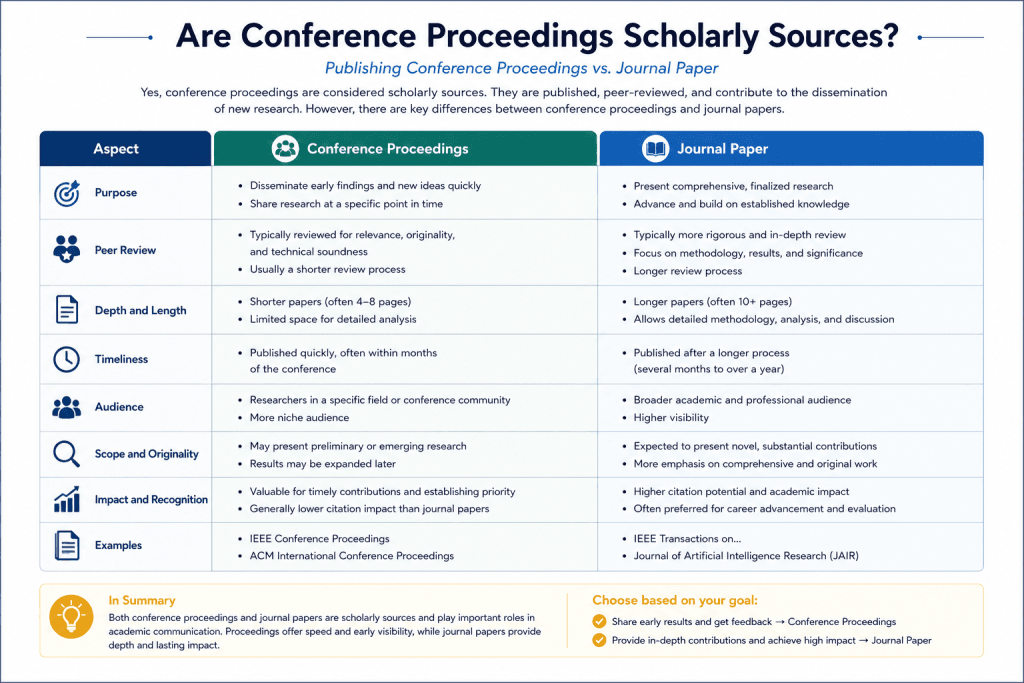
- Speed of publication: One of the most important distinctions is timing. Conference proceedings are typically published much faster than a traditional journal article. Once a conference paper is accepted, it can appear in the proceedings volume within weeks or months. A journal paper, by contrast, can take one to three years to move through the full publication process — including submission, peer review, revision, and final publication.
- Scope and length: A conference paper is usually shorter and more focused than a full journal article. Conference papers often present preliminary research findings or early-stage work, while journal publications tend to feature fully developed studies with extensive literature reviews, detailed methodology, and thorough analysis.
- Purpose and audience: A journal paper is written for a broad, ongoing readership in a particular field. A conference paper is often written for attendees of a specific event — researchers who are already immersed in the topic and interested in the latest developments before they are formally published elsewhere.
- Revision expectations: Journal articles go through multiple rounds of revision before final publication. Conference papers may receive lighter editorial feedback, and in some cases, are published in their submitted form with minimal changes.
- Why do researchers choose to publish in conference proceedings?
- To share preliminary research findings with peers before committing to a full journal submission
- To receive early feedback from specialists in their discipline
- To establish a timestamped record of their ideas, helping to protect intellectual priority
- To network with co-authors, collaborators, and editors in their field
- In disciplines like computer science and engineering, conference proceedings often carry prestige equal to — or even surpassing — that of journal publications. In these fields, top-tier conference proceedings are considered among the most important venues for dissemination of cutting-edge research.
Are Conference Proceedings Peer Reviewed? Understanding the Review Process
- A common question researchers ask is: are conference proceedings peer reviewed? The honest answer is — it depends. Not all conference proceedings go through the same rigorous review process, and understanding the differences is essential for both readers and authors.
- What is peer review in the context of conference papers?
- Peer review means that submitted papers are evaluated by independent experts — known as reviewers or peers — in the same discipline before being accepted for publication.
- In a conference setting, this review process is typically overseen by a program committee, which is made up of experienced researchers appointed by the conference organizers.
- Each submission is sent to two or more reviewers, who assess the paper’s originality, methodology, clarity, and contribution to the field.
- Types of review processes used in conference proceedings:
- Single-blind review: The reviewer knows who the authors are, but the authors do not know who reviewed their work. This is common in many conferences.
- Double-blind review: Neither the authors nor the reviewers know each other’s identities. This approach is considered more objective and is increasingly adopted by high-profile conferences.
- Open review: The review process is made transparent — reviewer comments and author responses may be publicly available. This model is gaining traction in fields focused on AI and open science.
- Light-touch or editorial review: Some smaller or newer conferences conduct only a basic editorial check, without rigorous peer evaluation. Proceedings from these events may be of variable quality.
- How does this compare to the peer review process for a journal paper?
- Journal peer review is generally more intensive. A journal article may go through one or more rounds of major and minor revisions, with detailed feedback from multiple reviewers and oversight from a senior editor.
- Conference peer review tends to be faster and may be less exhaustive, given the tight timelines of the publication process leading up to the event.
- That said, peer-reviewed conference proceedings from well-established events in competitive disciplines — especially in computer science — can be just as rigorous as any normal journal.
- How can you tell if a conference proceeding is peer reviewed?
- Check the conference website for details about the submission and review process
- Look for mentions of a program committee or editorial board
- See if the proceedings are indexed in reputable academic databases, which often require peer review as a condition of indexing
- Consult a librarian or your university library for guidance on evaluating the credibility of a specific proceedings volume
- What does this mean for researchers citing or using conference proceedings?
- Always verify the review status of a proceedings volume before citing it as a credible source in a literature review
- Peer-reviewed conference proceedings carry more academic weight than those that are not formally reviewed
- When in doubt, treat conference proceedings may be a useful starting point for finding sources — but always trace the research back to its most rigorous, fully peer-reviewed form
Academic Writing & Research Support
Need Help With Research Papers, Manuscripts, Editing, or Proofreading?
At Scholarly Work, we provide professional academic writing support for researchers, students, and professionals. From drafting manuscripts to refining final submissions, we ensure clarity, accuracy, and publication-ready quality.
Get Manuscript Writing Help
How to Find Conference Proceedings: Databases, Libraries, and Librarian Resources
- Knowing how to find conference proceedings is an essential skill for researchers, students, and academics conducting a literature review or exploring the latest work in a specific topic or discipline. Fortunately, a wide range of tools and resources exist to make this search more efficient.
- Why finding conference proceedings can be tricky:
- Unlike journal articles, conference proceedings are not always indexed in mainstream academic databases
- Proceedings may be distributed only to attendees, published on a conference website, or housed in a specialized repository
- Some older proceedings volumes exist only in print, held by specific university library collections
- The format and availability of conference proceedings may vary significantly by discipline and publisher
- Top databases for finding conference proceedings:
- IEEE Xplore — One of the most comprehensive repositories for conference papers in engineering, electronics, and computer science. IEEE Xplore indexes thousands of published proceedings and offers full text access to papers submitted at IEEE-affiliated events.
- ACM Digital Library — An essential resource for finding conference proceedings in computer science and information technology. The ACM Digital Library includes papers presented at ACM-sponsored conferences, many of which are among the most prestigious in the field.
- Scopus — A large, multidisciplinary database that indexes peer-reviewed conference proceedings across science, technology, medicine, social sciences, and the arts. Scopus allows users to filter specifically by document type to find conference proceedings.
- Web of Science — Another major cross-disciplinary database with a Conference Proceedings Citation Index (CPCI), which indexes papers presented at significant international events. Web of Science is particularly useful for citation tracking.
- Google Scholar — A free, accessible tool for locating conference papers and proceedings across all disciplines. While it lacks the filtering precision of subscription databases, it is an excellent starting point and can surface hard-to-find papers presented at smaller symposiums.
- DBLP — A specialized bibliography database focused on computer science. DBLP provides detailed records of conference papers and is especially useful for finding proceedings in AI, algorithms, and software engineering.
- arXiv — A popular open-access repository where researchers — especially in physics, mathematics, and computer science — upload preprints of papers before or after conference presentation. Many conference papers in AI are first publicly available here.
- SSRN (Social Science Research Network) — A repository frequently used in economics, law, and the social sciences to share working papers and conference submissions before formal publication elsewhere.
- Using your university library and librarians:
- Your university library is one of the most underutilized resources for finding conference proceedings, particularly for older or more obscure publications.
- Many university libraries subscribe to databases that provide access to published proceedings not freely available online.
- A librarian — especially a subject or research librarian — can be an invaluable guide. They can help you identify which databases are most relevant to your discipline, locate a specific proceedings volume, and navigate interlibrary loan systems if a paper is not directly available.
- Don’t overlook your library’s physical collection. Some proceedings volumes — particularly from older conferences or niche symposiums — exist only in print and are catalogued in the library’s holdings.
- Searching directly on conference websites:
- Many conferences publish their proceedings directly on their conference website, either freely or behind a registration wall.
- Searching for the name of a specific conference along with the year and “proceedings” is often the fastest way to find papers presented at that event.
- Some conferences also maintain archives of past proceedings going back many years, which can be invaluable for tracing the historical development of research in a particular field.
- Tips for an effective search:
- Use specific keywords combined with terms like “conference proceedings,” “symposium proceedings,” or “published proceedings” to narrow results
- Filter by year, discipline, and document type within databases to surface the most relevant papers
- When you find conference proceedings on an open-access platform, always verify the source — check whether the event was peer reviewed and whether the publisher is reputable
- Keep track of the proceedings volumes you consult, noting the editor, publisher, conference name, and year — all of which you will need if you intend to cite the source in your research
How to Publish and Submit a Conference Paper: From Submission to Print
- Publishing a conference paper involves a series of well-defined steps, from identifying the right event to receiving your final publication confirmation. Understanding this process helps authors submit stronger work, meet deadlines, and navigate the publication process with confidence.
- Step 1: Identify the right conference for your research
- Start by identifying conferences in your discipline that are well-regarded by your peers, co-authors, and institution.
- Look for events that align with your specific topic and research stage — some conferences are well suited to preliminary research findings, while others expect fully completed studies.
- Verify that the conference has a clear, transparent peer review process and is indexed in reputable databases. Check the conference website for information about the program committee, the editor, and the proceedings publisher.
- Be cautious of predatory conferences — events that charge high fees but offer little or no genuine peer review or dissemination value.
- Step 2: Review the author guidelines and submission requirements
- Every conference will publish detailed author guidelines specifying the format, length, and structure expected for submitted papers.
- Pay close attention to requirements around manuscript formatting, citation style, abstract length, figure quality, and word count.
- Review the conference’s permissions guidelines regarding copyright, open access, and publication elsewhere — particularly if you plan to submit an extended version of your conference paper to a journal later.
- Note the code of conduct and any ethical standards the conference expects authors to uphold, including requirements around authorship, data transparency, and conflict of interest disclosure.
- Step 3: Prepare your manuscript and abstract
- Draft your manuscript carefully, ensuring it clearly communicates your methodology, findings, and contribution to the field.
- Write a strong abstract — this is often the first thing a reviewer and attendee will read, and it needs to accurately summarize your work while making a compelling case for its relevance.
- If you have co-authors, establish authorship order and contributions early in the drafting process to avoid disputes later. Ensure all co-authors have reviewed and approved the final submission.
- Step 4: Submit your paper through the conference platform
- Most conferences manage papers submitted through dedicated online submission systems such as EasyChair, HotCRP, or Microsoft CMT.
- Upload your manuscript, abstract, and any supplementary materials according to the platform’s instructions.
- Make sure you submit before the deadline — many conference organizers do not grant extensions, and late submission may result in automatic rejection.
- Step 5: Navigate the peer review and revision process
- Once submitted, your conference paper enters the review process, where it is assessed by members of the program committee or external reviewers.
- If your paper is accepted with minor or major revisions, you will receive reviewer feedback. Take this feedback seriously — even in a conference setting, thoughtful revision strengthens your work and improves the quality of the final publication.
- Some conferences allow author rebuttals, where you can respond to reviewer concerns before a final decision is made.
- Step 6: Prepare your presentation and camera-ready paper
- Upon acceptance, you will typically be asked to submit a final, camera-ready version of your manuscript — a polished version that incorporates any revisions and meets the proceedings volume’s formatting requirements.
- Prepare your presentation for the event itself, whether that is a talk, poster session, or panel contribution.
- Attend the conference and present your work — this is a critical step, as many conferences require at least one author to present in order for the paper to appear in the published proceedings.
- Step 7: Publication in the proceedings volume
- Following the conference, the conference organizers and publisher compile all accepted and presented papers into the final proceedings volume.
- This volume is then published — either in print, digitally, or both — and submitted to academic databases for indexing.
- In some disciplines, top conference papers are invited to submit extended versions to special issues of journals, bridging the gap between conference proceedings and full journal publications.
Academic Writing & Research Support
Need Help With Research Papers, Manuscripts, Editing, or Proofreading?
At Scholarly Work, we provide professional academic writing support for researchers, students, and professionals. From drafting manuscripts to refining final submissions, we ensure clarity, accuracy, and publication-ready quality.
Get Manuscript Writing Help
How to Cite Conference Proceedings in Your Research
- Citing conference proceedings correctly is important for academic integrity, proper attribution, and allowing readers to locate your sources. The format for citing a conference paper differs from how you would cite a journal article, and the details required vary by citation style.
- Key information needed to cite a conference proceeding:
- Author name(s) and initials
- Title of the individual paper
- Name of the conference or symposium
- Year and location of the conference
- Editor(s) of the proceedings volume, if listed
- Publisher of the proceedings
- Page numbers of the paper within the proceedings volume
- DOI or URL, if available
- How to cite conference proceedings in common citation styles:
- APA (7th edition): Author, A. A., & Author, B. B. (Year). Title of paper. In C. C. Editor (Ed.), Title of proceedings (pp. xx–xx). Publisher. https://doi.org/xxxxx
- MLA (9th edition): Author Last, First. “Title of Paper.” Title of Conference Proceedings, edited by Editor Name, Publisher, Year, pp. xx–xx.
- Chicago (Notes-Bibliography): Author Last, First. “Title of Paper.” In Title of Proceedings, edited by Editor Name, xx–xx. City: Publisher, Year.
- IEEE: A. Author, “Title of paper,” in Proc. Conference Name, City, Year, pp. xx–xx.
- Practical tips for citing conference papers:
- Always check whether the conference proceeding has a DOI — this makes it easier for readers to locate the full text of your source.
- If you accessed the paper through a repository like IEEE Xplore or the ACM Digital Library, include that in your citation where the style requires it.
- When citing papers presented at a symposium or workshop that are not formally published in a proceedings volume, note that the work may be unpublished and treat it accordingly.
- Consult a librarian or your institution’s citation guide if you are unsure how to cite an unusual proceedings format — for instance, a conference proceedings published as a supplement to a journal or in a digital-only format.
Ethical Aspects of Publishing in Conference Proceedings vs. Journals
- The ethical aspects of publishing in academic venues — whether conference proceedings or journals — are a critical but often overlooked part of the scholarly publication process. Researchers have a responsibility to uphold ethical standards at every stage of their work, from initial submission to final dissemination.
- Dual submission and publication elsewhere:
- One of the most common ethical issues involves dual submission — submitting the same manuscript to a conference and a journal at the same time without disclosure.
- Most conferences and journals explicitly prohibit simultaneous submission. Submitting a paper to multiple venues concurrently — without informing the editors — is considered a serious breach of ethical standards.
- Conference proceedings may sometimes allow authors to submit extended versions of their conference papers to journals, but only if this is explicitly permitted and properly disclosed. The relationship between the conference paper and the journal article must be transparent and clearly acknowledged in the manuscript.
- Always review the permissions guidelines of both the conference and the journal before pursuing this path.
- Authorship and co-author responsibilities:
- Authorship disputes are a recurring ethical issue in academic publishing. All individuals listed as authors on a conference paper or journal article must have made a genuine intellectual contribution to the work.
- Guest authorship — listing someone as an author who did not meaningfully contribute — and ghost authorship — excluding someone who did contribute — are both violations of ethical standards recognized across disciplines.
- When working with co-authors, establish clear agreements about authorship order, contribution roles, and who will be the corresponding author early in the writing and submission process.
- If AI tools have been used in the drafting of a manuscript, many journals and conferences now require authors to disclose this. With the rapid growth of AI-assisted writing, many publishers and conference organizers are developing specific policies around AI use, and authors must stay informed and comply.
- Fabrication, falsification, and plagiarism:
- These are among the most serious ethical violations in academic publishing, and they apply equally to conference papers and journal papers.
- Plagiarism — presenting another researcher’s work, ideas, or language as your own — is unacceptable, whether in a manuscript submitted to a symposium or a full-length journal article.
- Self-plagiarism is also a concern. Reusing substantial portions of your own previously published work — whether from a journal publication or a published proceedings — without proper citation or disclosure is considered unethical.
- Fabricating data, manipulating figures, or misrepresenting methodology are violations that can result in retraction, reputational damage, and institutional consequences.
- Predatory conferences and journals:
- The growth of predatory publishing has introduced significant ethical challenges for researchers. Predatory conferences — like their journal equivalents — often charge high submission fees, promise fast publication, and conduct little or no genuine peer review.
- Publishing in a predatory conference not only wastes resources but also undermines the credibility of your research and contributes to the dissemination of unverified findings.
- Researchers have an ethical responsibility to carefully evaluate any conference or publisher before submitting their work. A credible event will have transparent reviewer processes, a reputable program committee, and clear indexing in recognized databases.
- Transparency in the review process:
- Authors should not attempt to game the review process — for instance, by suggesting reviewers who have conflicts of interest, or by attempting to identify and influence anonymous reviewers.
- Reviewers themselves have ethical obligations: to provide honest, constructive, and timely feedback; to declare conflicts of interest; and to keep the contents of submitted papers confidential until publication.
- Conference organizers and editors are responsible for maintaining a fair and rigorous editorial process, free from bias and commercial pressure.
- Sustainability and responsible publishing:
- An emerging ethical consideration in academic publishing is sustainability — the environmental and financial costs of large-scale conference events and their associated publications.
- Researchers, institutions, and publishers are increasingly considering the carbon footprint of international conferences, the accessibility of conference proceedings to researchers in under-resourced institutions, and the long-term preservation of published work in open repositories.
- Responsible publishing also means considering whether research findings — particularly preliminary research findings — are ready for public dissemination, and whether the chosen venue (conference proceedings or traditional journal) is the most appropriate for the maturity and impact of the work.
- The broader ethical framework:
- Most reputable conferences and journals operate under a formal code of conduct that outlines the expected behavior of authors, reviewers, and editors.
- Researchers should familiarize themselves with the ethical standards of their discipline — whether in computer science, the humanities, social sciences, or natural sciences — and adhere to these norms throughout the publication process.
- When in doubt, consult your institution’s research integrity office, a senior co-author, or a trusted librarian for guidance on navigating complex ethical situations in academic publishing.
References
- American College of Education (ACE) – Scholarly Writing Guide – https://ace.edu/blog/a-guide-to-scholarly-writing/
- George Washington University – Faculty Scholarly Publications – https://scholarship.law.gwu.edu/faculty_publications/73/
- Walden University Writing Center – Scholarly Writing Resources – https://academicguides.waldenu.edu/writingcenter/scholarly
- Florida State University College of Law – Scholarly Writing Guide – https://guides.law.fsu.edu/scholarlywriting