How to Tell if an Article is Peer-Reviewed or Not
If you’re working on a research paper, you’ve probably run into the question of how to tell if an article is peer-reviewed or not. It’s one of the most common roadblocks students and researchers face, and getting it wrong can cost you points on an assignment or credibility in a publication. Here’s what to look for:
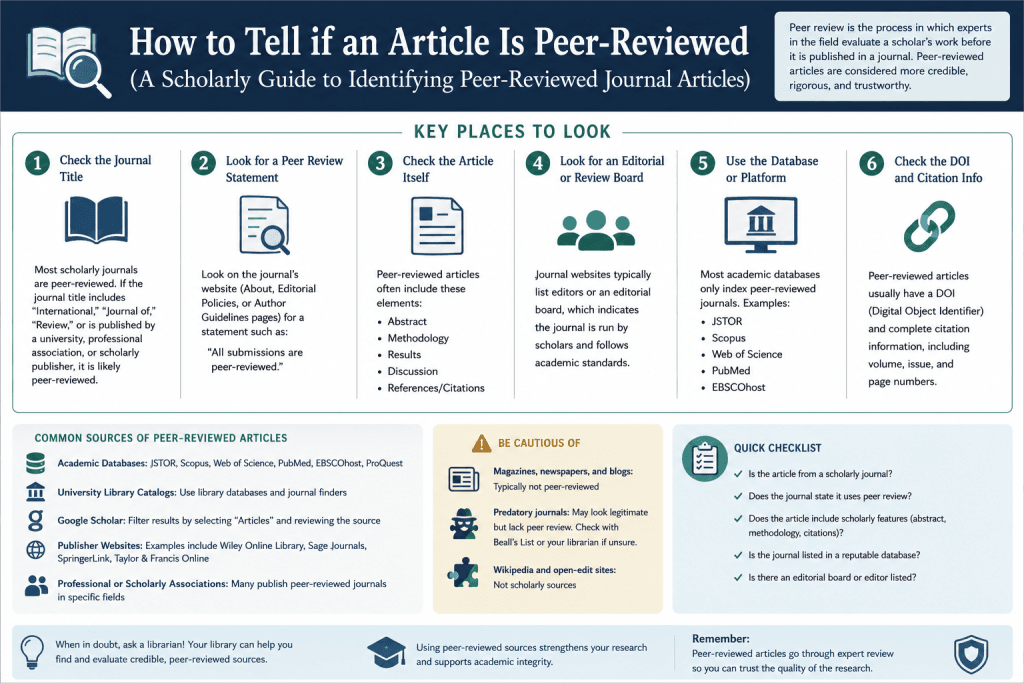
- Check for a formal review process. A peer-reviewed article has gone through a structured peer review, meaning outside experts (referees) in the same field evaluated the article before it was accepted for publication. If there’s no mention of a review process anywhere, that’s a red flag.
- Look at the journal itself, not just the article. The most reliable way to know if an article is peer-reviewed is to confirm that the journal is peer-reviewed. If the journal has an established peer-review process, articles published in it are almost always peer-reviewed too — with a few exceptions like editorials or letters to the editor, which we’ll cover shortly.
- Look for structure typical of scholarly writing. Peer-reviewed articles usually include an abstract, a literature review, a methodology section, results, discussion, and a reference list. This structure is a strong clue that the article is peer reviewed, since it reflects the academic rigor required by the review process.
- Check the author credentials. Peer-reviewed articles are written by experts — researchers, professors, or professionals with credentials in their discipline. If you can’t find an author, or the author has no visible academic or professional background, be cautious.
- Examine the length and depth. Peer-reviewed journal articles tend to be longer and more detailed than articles found on a general website. If the piece is short, opinion-based, or lacks citations, it likely wasn’t submitted through a formal review process.
- Use a library database. One of the easiest ways to tell if an article is peer-reviewed is to search for it in a library database, many of which let you filter results specifically for peer-reviewed content. This removes much of the guesswork.
- Cross-check with Ulrichsweb. This resource, which we’ll explore in detail later, is considered a gold standard for confirming whether a journal is peer reviewed.
Knowing how to tell if an article is peer-reviewed takes practice, but once you understand these markers, it becomes second nature. The goal is to evaluate each article using more than one method, since relying on a single clue can sometimes lead you astray.
Why Publishing in a Peer-Reviewed Journal Matters for Scholarly Research
Understanding how to tell if an article is peer-reviewed matters because peer-reviewed sources carry a level of trust that other publications simply don’t have. Here’s why publishing in — and citing from — a peer-reviewed journal is so important for scholarly research:
- It ensures quality control. Before an article is published, it’s evaluated by other experts in the discipline. These reviewers assess the research methodology, the validity of the data, and the overall contribution to the field. This peer-review process acts as a filter, catching errors, bias, or weak arguments before they reach a wider academic audience.
- It builds credibility for the author. When a researcher gets their work accepted into a peer-reviewed journal, it signals to the academic community that their research meets rigorous standards. This is especially important for academic careers, where publication record often influences hiring, tenure, and funding decisions.
- It protects the integrity of scholarly articles. Peer review isn’t just a formality — it’s a safeguard against misinformation. Since experts (referees) review submissions for accuracy and originality, readers can trust that peer-reviewed articles have been vetted more thoroughly than content published without editorial oversight.
- It supports evidence-based research. When you build an argument or thesis using peer-reviewed journal articles, you’re grounding your work in research that has already been scrutinized by professionals. This makes your own research stronger and more defensible.
- It distinguishes legitimate journals from predatory ones. Unfortunately, not every journal that claims to be “peer-reviewed” actually follows a legitimate review process. Some predatory journals charge authors a submission fee and publish almost anything without real editorial review. This is exactly why learning how to tell if an article is peer-reviewed — and verifying that a journal is legitimately peer reviewed — is such an essential research skill.
- It’s often required by instructors and institutions. Many professors specifically require peer-reviewed sources for assignments. If you submit an article that isn’t peer-reviewed when the assignment calls for one, it may not count, regardless of how relevant or well-written it is.
- It contributes to the broader academic conversation. Every peer-reviewed article that gets published adds to a growing body of scholarly work that other researchers can reference, challenge, or build upon. This is how academic disciplines evolve and advance over time.
In short, the peer-review process exists to protect the quality of academic and scholarly publishing. Whether you’re an author trying to publish or a student trying to find credible sources, understanding why peer review matters gives context to why so much effort goes into confirming an article is peer-reviewed before using it.
How to Identify a Peer-Reviewed Journal Article Using Library Databases
Your school or public library is one of the most reliable places to find peer-reviewed journal articles, and library databases make the identification process much easier than searching the open web. Here’s how to identify a peer-reviewed journal article using library databases, step by step:
- Start with your library’s database homepage. Most academic libraries provide access to databases like Academic Search Complete, EBSCO, ProQuest, or JSTOR. These databases are specifically built to house scholarly and peer-reviewed content, unlike a general search engine.
- Use the “peer-reviewed” or “scholarly” filter. This is the single most useful tool for identifying peer-reviewed journal articles. Most databases, including Academic Search Complete and EBSCO, give you the option to limit your search results using a checkbox labeled “Peer Reviewed” or “Scholarly (Peer Reviewed) Journals.” Simply checking this option will limit the search to publications that meet peer-review standards.
- Limit your search by publication type. In addition to the peer-reviewed filter, you can often limit your search further by selecting “journal article” as the publication type. This helps filter out book reviews, magazine content, and news articles that might otherwise appear in your results.
- Review the source information for each article. Once you’ve limited your search, click into an individual article and look at its source details. This section will usually state the journal name, publication date, and sometimes explicitly note that the source is peer-reviewed.
- Check the journal title independently. Even after filtering, it’s smart to double check the journal title against another resource (like Ulrichsweb, discussed next) since databases occasionally miscategorize a source, or a journal may publish a mix of peer-reviewed and non-peer-reviewed content, such as editorials or letters to the editor.
- Look at the article’s structure. A genuine peer-reviewed journal article will typically include a clear abstract, methodology, results, discussion, and reference list — hallmarks of the peer-review process at work.
- Ask a librarian for help. If you’re ever unsure, a librarian is one of the best resources available. Librarians are trained to help you navigate library databases and can quickly confirm whether an article is peer reviewed, saving you time and reducing the risk of using an unreliable source.
- Save your search settings. Many databases let you save your filters so that every future search automatically limits results to peer-reviewed, scholarly journal articles. This is a great time-saving option if you’ll be doing ongoing research in the same discipline.
- Cross-reference with the publisher’s website. If a database doesn’t clearly confirm peer-review status, visit the journal’s website directly. Most scholarly journals will explain their review process, submission guidelines, and editorial board on an “About” or “For Authors” page.
Library databases remain one of the most trustworthy resources for research precisely because they aggregate content from established, credible journals. Learning to use the built-in filters is the fastest and most reliable way to identify a peer-reviewed journal article without having to manually evaluate every single source.
Checking Ulrichsweb to Confirm If a Journal Is Peer-Reviewed
When you need a definitive answer for how to tell if an article is peer-reviewed, Ulrichsweb is one of the best resources available. This database is specifically designed to catalog information about periodicals, including whether a journal is peer reviewed. Here’s how to use it:
- What Ulrichsweb actually is. Ulrichsweb (formally known as Ulrich’s Periodicals Directory) is a comprehensive database that provides detailed information on journals, magazines, and other serial publications from around the world. It’s widely used by librarians, researchers, and publishers to verify publication details.
- Access Ulrichsweb through your library. Most academic and public libraries subscribe to Ulrichsweb, so check your library’s database list or ask a librarian for a direct link. If your library doesn’t subscribe, a librarian may still be able to help you verify a journal’s status through another resource.
- Search by journal title. Once you’re in Ulrichsweb, enter the journal title (not the article title) into the search bar. This will pull up the record for that specific journal is peer reviewed status is displayed clearly, so you’re not left guessing.
- Look for the “referee jersey” icon. Ulrichsweb uses a small icon that looks like a referee’s striped shirt next to journal titles that are peer-reviewed (sometimes labeled as “refereed”). This visual marker makes it incredibly easy to confirm at a glance whether a journal is peer-reviewed.
- Review the full journal record. Beyond the peer-review icon, the record will typically include the publisher, subject/discipline, publication frequency, and other identifying details. This gives you a fuller picture of the publication’s credibility and scope.
- Confirm the journal isn’t predatory. Since Ulrichsweb is a curated, professionally maintained resource, it’s a great tool for weeding out predatory or low-quality journals that falsely claim to be peer-reviewed. If a journal doesn’t appear in Ulrichsweb at all, that’s worth investigating further.
- Double check individual articles. Remember that confirming a journal is peer-reviewed doesn’t automatically mean every single article within it went through peer review. Some journals include non-peer-reviewed content like editorials, opinion pieces, or book reviews. Always check the article type when in doubt.
- Use Ulrichsweb alongside your library database. For the most accurate results, use Ulrichsweb to confirm the journal’s peer-review status, and use your library database’s built-in filters to confirm the individual article type. Together, these two resources give you a strong, evidence-based answer to the question of how to tell if an article is peer-reviewed.
- Keep a record for citations. If you’re compiling sources for a paper, it’s worth noting in your own reference notes which journals you’ve confirmed through Ulrichsweb. This makes it easier to defend your source choices if an instructor or reviewer asks about their credibility later.
Ulrichsweb remains one of the most authoritative tools for verifying publication details, and it takes much of the uncertainty out of determining whether a journal — and by extension, its articles — meets true academic and scholarly standards.
Other Ways to Tell If an Article Is Peer Reviewed Before You Search
Sometimes you’ll come across an article outside of a library database, whether through a general web search, a colleague’s recommendation, or a citation in another paper. In these cases, you’ll need other methods to tell if an article is peer reviewed before diving into a full search. Here’s what to check:
- Visit the journal’s website directly. Nearly every legitimate scholarly journal maintains a website that outlines its editorial policies. Look for an “About,” “Editorial Board,” or “For Authors” page, which should explain the journal’s review process in detail.
- Look for submission and review guidelines. Peer-reviewed journals typically publish detailed instructions for authors, covering how to submit a manuscript, what the review timeline looks like, and how referees are selected. If a website is vague about how articles get approved, that’s a warning sign.
- Check for an editorial board. A credible peer-reviewed journal will list its editor and editorial board members, usually with their academic credentials and institutional affiliations. A lack of transparency here often signals a lower-quality or non-peer-reviewed publication.
- Search for the journal’s impact factor or index. Reputable, peer-reviewed journals are often indexed in recognized databases, such as PubMed, Scopus, or Web of Science. If a journal isn’t indexed anywhere, it’s worth researching further before trusting its content.
- Read the article’s introduction and citations carefully. Peer-reviewed journal articles typically reference other scholarly, peer-reviewed sources extensively. A thin or inconsistent reference list can be a sign that the article didn’t go through a rigorous review process.
- Watch for red flags of predatory publishing. Predatory journals often mimic the appearance of legitimate ones but skip real peer review altogether. Warning signs include aggressive solicitation emails, unusually fast publication timelines, and unclear fee structures.
- Ask an expert or researcher in the field. If you’re still unsure, reach out to a professor, researcher, or subject-matter expert. They often know which journals in their discipline have strong reputations for rigorous peer review.
- Use citation-tracking resources. Tools that show how often an article has been cited by other scholarly articles can offer indirect evidence of credibility, since heavily cited peer-reviewed research tends to be trusted and referenced more often within academic circles.
These methods work well as a backup or supplement to database filters and Ulrichsweb, especially when you’re evaluating a single article you found outside of a structured search.
Best Resources and Search Tips for Finding Peer-Reviewed Journal Articles
Once you understand how to tell if an article is peer-reviewed, the next step is knowing where to search efficiently. Below are some of the best resources and practical search tips for finding peer-reviewed journal articles for your next research project:
- Start with your library’s database homepage. This should always be your first stop. Library databases are curated specifically for scholarly and peer-reviewed research, unlike general search engines that mix in commercial and non-academic content.
- Use Academic Search Complete. This is one of the most widely used databases in academic libraries, covering a broad range of disciplines. It offers a reliable “peer-reviewed” filter, making it a strong starting resource for almost any research topic.
- Try EBSCO’s specialized databases. EBSCO hosts a range of subject-specific databases beyond Academic Search Complete, so if your topic falls into a particular discipline (like psychology, business, or health sciences), search for the EBSCO database tailored to that field for more targeted, peer-reviewed journal article results.
- Always apply the peer-reviewed filter. Whichever database you use, look for the option to limit your search to peer-reviewed or scholarly sources. This single step saves an enormous amount of time by removing non-peer-reviewed sources like general news and magazine articles from your results.
- Narrow your search with keywords and Boolean operators. Use specific keywords related to your topic, and combine them using AND, OR, and NOT to refine your search results. For example, searching “climate change AND agriculture” will return more targeted, relevant scholarly articles than a broad, single-word search.
- Filter by publication date. If your research requires recent studies, use the date filter to limit the search to the last five or ten years. This ensures you’re working with current, relevant research rather than outdated studies.
- Check subject-specific databases for your discipline. Depending on your field, there may be a specialized database that indexes peer-reviewed journal articles more precisely than a general one. A librarian can help point you toward the right resource for your specific discipline.
- Cross-reference with Ulrichsweb. As covered earlier, Ulrichsweb remains one of the top resources for confirming whether a journal is peer-reviewed, especially when a database result seems unclear or when you’re evaluating a journal you haven’t used before.
- Don’t overlook Google Scholar. While not a traditional library database, Google Scholar indexes a large volume of scholarly articles, including many peer-reviewed journal articles. It’s a useful supplementary search tool, though you should still verify peer-review status through a database or Ulrichsweb, since Google Scholar doesn’t filter exclusively for peer-reviewed content.
- Read the abstract before committing to the full article. Once you’ve pulled a list of candidate articles, scan the abstracts first. This helps you quickly evaluate relevance and quality before investing time reading the full text.
- Take advantage of citation exports. Most databases let you export citations directly in APA, MLA, or Chicago format, which saves time when compiling your reference list for peer-reviewed sources.
- Consult a librarian for a research consultation. Many academic libraries offer one-on-one research help. A librarian can walk you through advanced search techniques, recommend discipline-specific databases, and help you evaluate whether a source is peer-reviewed.
- Bookmark reputable journal websites in your field. Over time, you’ll likely find a handful of scholarly journals that consistently publish strong, relevant peer-reviewed research in your discipline. Bookmarking these can speed up future research projects.
Finding peer-reviewed journal articles becomes much faster once you know which resources to rely on and how to apply search filters effectively. Between library databases, Ulrichsweb, and supplementary tools like Google Scholar, you have everything you need to confidently identify credible, peer-reviewed sources for your academic or professional work.
- American College of Education (ACE) – Scholarly Writing Guide – https://ace.edu/blog/a-guide-to-scholarly-writing/
- George Washington University – Faculty Scholarly Publications – https://scholarship.law.gwu.edu/faculty_publications/73/
- Walden University Writing Center – Scholarly Writing Resources – https://academicguides.waldenu.edu/writingcenter/scholarly
- Florida State University College of Law – Scholarly Writing Guide – https://guides.law.fsu.edu/scholarlywriting