Is Gov a Scholarly Source? How to Evaluate Government Information for Research
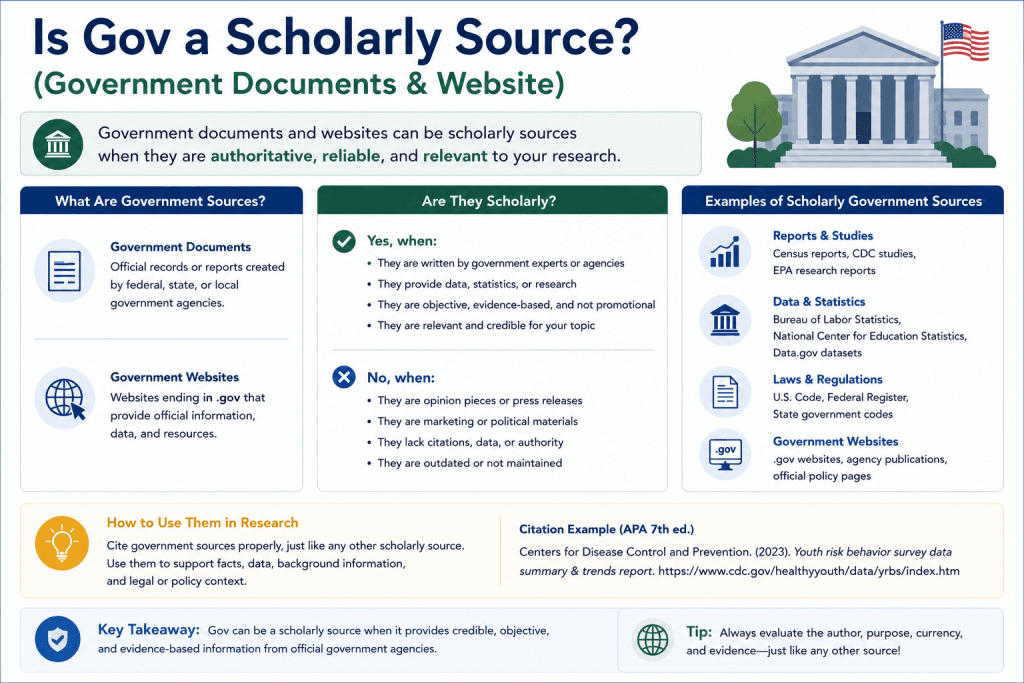
- The short answer: it depends on what you’re looking at. When students and researchers ask “is gov a scholarly source?”, they’re usually lumping together everything on a .gov domain — but government information comes in many different forms, and not all of it meets the same standard.
- Government documents can be considered a scholarly source in certain contexts. Congressional reports, technical reports from federal agencies, and data published by research service divisions like the Congressional Research Service often function as primary sources that scholars cite regularly in academic work.
- However, not everything on a government website is scholarly. A press release, a general informational page, or a blog post from an agency’s official website is not the same as a peer-reviewed journal article. So when someone asks “is gov a scholarly source,” the honest answer is: some of it, but you need to evaluate each document individually.
- Here’s how to evaluate whether a specific piece of government information qualifies:
- Check the author and agency. Is the report written or reviewed by subject-matter experts, Ph.D. researchers, or a recognized federal research service? Authoritative agencies like the National Institutes of Health or the Government Publishing Office tend to produce more reliable, citable material.
- Look for evidence of review. While government documents rarely go through formal peer review the way scholarly journal articles do, many go through rigorous internal review processes before publication, which adds a layer of credibility.
- Consider the purpose. Is the document meant to inform policy, report original research, or summarize data? Research reports and white papers produced by agencies are more likely to be treated as scholarly sources than administrative or promotional content.
- Check the currency and sourcing. Reputable sources cite their data and methodology. If a government report includes a bibliography or reference list, that’s a good sign it was built with academic rigor in mind.
- A librarian can help you make this call. If you’re unsure whether a specific government document is considered a scholarly source for your assignment, ask a librarian — they evaluate these distinctions every day and can point you toward the most trustworthy option in your subject area.
- Bottom line: Government documents and government information can absolutely support scholarship, but “is gov a scholarly source” isn’t a yes-or-no question — it’s a question you answer document by document.
- Quick self-check before you cite: ask who wrote it, whether it went through any form of review, and whether it presents original data or just general background. Running through this checklist is often the fastest way to answer “is gov a scholarly source” for the specific page or report in front of you.
- Remember that context changes the answer. A congressional research report on economic policy is far closer to a scholarly work than a general “About Us” page on an agency’s official website — so “is gov a scholarly source” really means “is this particular government document a scholarly source,” not the domain as a whole.
What Makes a Source Scholarly? Understanding Peer-Reviewed Journals vs. Government Documents
- A scholarly source generally has a few defining features, and understanding them is the first step in answering “is gov a scholarly source” for any assignment.
- Written by experts, for experts. Scholarly articles are typically authored by scholars, researchers, or Ph.D. candidates in a related field, and they cite other scholarly work extensively.
- Peer-reviewed. This is the gold standard. A scholarly journal article goes through peer review, meaning other experts in the field evaluate the research before publication. This peer review process is designed to catch errors, weak methodology, or unsupported claims.
- Published in a scholarly journal. Scholarly journal articles appear in specialized publications — not magazines, not general websites — that focus specifically on academic scholarship in a given discipline.
- Includes citations and a bibliography. A hallmark of scholarly work is a clear citation trail, showing exactly where information, data, and prior research came from.
- Now compare that to government documents. Government reports, congressional records, and agency publications are often factual, well-researched, and detailed — but they are not always peer-reviewed in the traditional academic sense.
- Many government reports go through internal review processes rather than the external, blind peer review used by scholarly journals.
- Government documents are frequently written by agency staff or subject experts, but the review comes from within the agency, not from an independent panel of peers.
- This doesn’t make them unreliable — it just means they occupy a different category than peer-reviewed literature.
- Why this distinction matters for your research:
- If your professor requires peer-reviewed sources specifically, a general government report may not count, even if it’s accurate and well-written.
- If your assignment allows primary and secondary sources broadly, government documents are often not just acceptable — they’re ideal, especially for topics involving policy, law, or public data.
- The takeaway: peer review is the defining line between a scholarly journal article and most government publications, which is why “is gov a scholarly source” really depends on the specific type of document and how your instructor defines “scholarly.”
- A helpful mental model: think of “scholarly” as a spectrum rather than a label. A peer-reviewed journal article sits at one end, general web content sits at the other, and most government documents fall somewhere in the middle — closer to scholarly work than a magazine article, but not quite matching the rigor of peer-reviewed literature. That’s the real answer to “is gov a scholarly source” for most day-to-day research needs.
Government Documents vs. Journal Articles: Comparing Reliability and Academic Value
- Both government documents and journal articles can be reputable sources — but they serve different roles in research. Understanding those roles helps answer “is gov a scholarly source” more precisely, and it’s one of the most common questions librarians field from students building a bibliography.
- Reliability of government documents:
- Government information is often considered highly trustworthy because it comes directly from an official website or agency with a legal or administrative responsibility to report facts accurately.
- Congressional reports, census data, and technical reports from federal agencies are primary sources — meaning they present original data, testimony, or findings rather than someone else’s interpretation of that data.
- Because agencies like the Library of Congress or the Congressional Research Service compile data using established government processes, this information is generally accurate and well-documented, even without formal peer review.
- The tradeoff: government reports can occasionally reflect administrative or political framing, so it’s worth evaluating the purpose of a report before citing it as a neutral fact.
- Reliability of journal articles:
- Scholarly journal articles undergo peer review, where independent experts evaluate methodology, evidence, and conclusions before publication.
- This peer review process is specifically designed to filter out weak research, making journal articles the standard for rigorous academic scholarship.
- Journal articles typically build on a body of existing scholarly work, citing prior studies and situating new findings within ongoing academic conversations.
- The tradeoff: journal articles can take months or years to publish, meaning very recent developments may not yet be reflected in peer-reviewed literature — this is where current government documents and government reports can actually be more up to date.
- Academic value: when each type of source shines:
- Use journal articles when: you need peer-reviewed analysis, theoretical frameworks, literature reviews, or evidence that has been independently verified by other scholars in the field.
- Use government documents when: you need primary source data, official statistics, legislative history, agency policy, or background information that hasn’t yet made its way into scholarly journal articles.
- Use both together when: you’re building a well-rounded research paper. A strong bibliography often blends peer-reviewed literature with authoritative government reports, giving your work both academic credibility and factual grounding.
- A practical comparison:
- A journal article on climate policy might analyze and critique a set of regulations.
- A government report on the same topic might be the original data, congressional testimony, or agency findings that the journal article is analyzing in the first place.
- In this way, government documents often serve as the primary source that scholarly work is built upon — which is part of why some instructors do accept them as citable, credible sources for research, even if they aren’t formally peer-reviewed.
- So, is gov a scholarly source when compared to a journal article? Not in the strict peer-reviewed sense, but in terms of reliability and academic value, well-sourced government documents frequently hold their own — especially for topics grounded in law, policy, statistics, or public administration.
- A note on academic value over time: as more agencies publish technical reports and research reports directly online, the line between government documents and scholarly work continues to blur. This is part of why so many students keep asking “is gov a scholarly source” — the honest answer keeps evolving as government publishing practices improve.
- Weighing reliability side by side:
- Journal articles win on independent verification and peer accountability.
- Government documents win on timeliness, direct access to primary data, and official authority.
- Neither format is inherently “better” — they simply answer different research needs, which is why a strong paper often draws on both.
Using ProQuest and Other Research Databases to Find Scholarly Sources
- If you’re searching for scholarly articles, journal articles, or credible government reports, research databases are your best starting point — far more reliable than a general web search bar, and often the quickest way to settle “is gov a scholarly source” for the results you find.
- Why use research databases instead of just Google?
- General search engines mix reputable sources with unreliable ones, and it can be hard to tell which is which.
- Research databases like ProQuest are curated collections that filter for scholarly journal articles, peer-reviewed literature, and other credible information resources.
- Databases often let you limit your search results specifically to peer-reviewed articles, which instantly narrows your results to material that meets the peer review standard.
- ProQuest: a go-to for academic research
- ProQuest provides access to a wealth of scholarly journals, dissertations, magazine articles, and even some government publications, all searchable from a single interface.
- You can use ProQuest’s advanced search to limit results by date, publication type, or subject, which is especially useful when narrowing down scholarly sources for a specific research question.
- ProQuest is a good place to start when you’re unsure where to search for information, since it aggregates so many different types of publications in one place.
- Other research databases worth knowing:
- Google Scholar — free and broad, indexing scholarly articles, citations, and some government reports. Google Scholar may include both peer-reviewed and non-peer-reviewed material, so you still need to evaluate each result carefully.
- JSTOR — strong for humanities and social sciences, with deep archives of scholarly journal articles.
- EBSCOhost — widely available through academic libraries, covering multiple disciplines and offering options to limit searches to peer-reviewed journals only.
- GovInfo — a government-run database offering free online access to federal government publications, congressional records, and technical reports directly from the Government Publishing Office.
- Finding government information through official databases:
- GovInfo is available for free and provides access to congressional bills, federal regulations, and agency reports, all sourced directly from the U.S. government.
- The Library of Congress and Congressional Research Service also maintain searchable collections of government documents, useful for legislative history and policy background information.
- When searching a government website or database, use specific keyword combinations (agency name, report type, year) to get more precise information provided by the source.
- Tips for effective searching across research databases:
- Start broad, then narrow using filters for peer-reviewed status, publication date, and subject area.
- Use quotation marks around exact phrases in your keyword search to reduce irrelevant results.
- Cross-check unfamiliar sources: if a database result isn’t from a recognized scholarly journal or government agency, verify it before citing it in your bibliography.
- When in doubt, ask a librarian — many academic libraries offer research consultations to help you navigate ProQuest and other research databases more efficiently.
- The bottom line: whether you’re hunting for scholarly journal articles or trying to determine whether specific government information qualifies as a scholarly source, research databases like ProQuest, Google Scholar, and GovInfo give you a far more reliable and efficient search bar than a general internet search ever could.
- A useful habit: every time you pull a result from a research database, pause and ask “is gov a scholarly source” for this particular document before adding it to your bibliography. Databases make searching easier, but they don’t replace your own evaluation of each source.
When to Cite Government Agency Information: Tips from Librarians
- Librarians are one of the best resources when you’re unsure whether to cite a government document as a scholarly source. Since “is gov a scholarly source” is one of the top questions asked at reference desks, here are their most common recommendations:
- Cite government agency information when:
- You need official statistics, census data, or legislative records — these are primary sources that carry strong authority precisely because they come from the U.S. government or a specific federal agency.
- You’re writing about policy, law, or public administration, where congressional records, agency reports, and technical reports are often the most authoritative sources available.
- Your assignment explicitly allows primary and secondary sources, not just peer-reviewed journal articles.
- The information provided by the agency is unique — meaning it isn’t available through a peer-reviewed publication, and the government source is the original data or reporting.
- Be cautious about citing when:
- Your professor specifically requires peer-reviewed sources only — in that case, general agency web pages or informational content likely won’t count, even if it’s factual.
- The content is promotional, administrative, or lacks clear sourcing — not all pages on an official website are research-grade.
- The government report is old and a more current version or peer-reviewed analysis exists.
- Librarian-recommended best practices for citation:
- Always identify the specific agency, office, or division that authored the document (for example, the Office of the Secretary or a specific research service) — this adds credibility and precision to your citation.
- Include the publication date and access date, since government reports and web content can be updated or removed. Using an archive tool like the Wayback Machine can help you preserve a snapshot of the page you cited.
- Follow your citation style’s specific format for government documents — APA, MLA, and Chicago each have distinct rules for citing congressional reports, agency publications, and .gov web content.
- When citing a .gov website generally, distinguish between a formal report or technical publication and a general informational page, since only the former is typically treated as a legitimate research source.
- Ask a librarian if you’re stuck. Academic librarians evaluate scholarly sources, government publications, and research databases as part of their daily work, and most offer free consultations. If you’re asking “is gov a scholarly source” for a specific citation, a quick conversation with a librarian can save you from citing something your professor won’t accept — or missing out on a genuinely authoritative source.
- In short: government agency information is citable and often highly credible, but knowing when and how to cite it correctly is what separates a strong bibliography from a shaky one.
- Librarian tip: many academic libraries keep subject guides that answer “is gov a scholarly source” for specific disciplines, whether you’re researching public health, environmental policy, or economics. These guides are often faster than searching from scratch and reflect a librarian’s professional judgment about which government sources hold up in academic work.
Common Questions About Government Documents as Scholarly Sources
Is gov a scholarly source for academic research? This is the question most students start with, and the answer is: it depends on the type of publication. Government documents can be considered a scholarly source when they present original research, data, or agency findings. Congressional reports, technical reports, and agency research are often treated as reputable, citable primary sources, while general informational pages on a government website usually are not — so “is gov a scholarly source” ultimately comes down to the specific document you’re evaluating.
Is a .gov website automatically peer-reviewed? No. A .gov domain indicates the site is run by a government agency, not that its content has gone through peer review. Some government reports go through rigorous internal review processes, but this differs from the independent, external peer review used by scholarly journals.
Can I cite a government report instead of a journal article? Yes, in many cases. If your assignment allows primary and secondary sources, government reports, congressional records, and agency publications are often excellent, authoritative choices — especially for topics involving law, policy, or official statistics.
Is gov a scholarly source for every single agency publication? No. Not every publication on a government website meets scholarly standards — routine press releases and administrative pages typically don’t, while data-driven technical reports and congressional research often do.
What’s the difference between a government document and a scholarly journal article? A scholarly journal article goes through formal peer review by independent experts and is published in a scholarly journal. A government document is typically produced and reviewed internally by an agency and published on an official website or through the Government Publishing Office, without the same external peer review process.
Are government documents considered primary sources? Yes. Government documents, including congressional testimony, agency data, and technical reports, are generally classified as primary sources because they present original information, data, or firsthand accounts rather than analysis of someone else’s work.
Where can I find reputable government publications for research? GovInfo, maintained by the Government Publishing Office, is available for free online and offers direct access to federal legislative information, congressional records, and agency reports. The Library of Congress and Congressional Research Service are also excellent, trustworthy places to search for information.
Should I use ProQuest or Google Scholar to find government sources? Both can help. ProQuest provides access to a mix of scholarly journals and some government publications, while Google Scholar may surface government reports alongside peer-reviewed scholarly articles. For the most complete government collection, GovInfo is typically the most direct and reliable database.
How do I know if a government document is reliable enough to cite? Evaluate the agency behind it, check whether it includes a bibliography or clear data sourcing, confirm the publication date, and consider whether the document is a primary source or general informational content. When unsure, a librarian can help you evaluate the source and answer “is gov a scholarly source” for that specific report.
Do professors accept government documents as scholarly sources? It depends on the assignment. Some professors require strictly peer-reviewed journal articles, while others accept a broader mix of primary and secondary sources, including government reports. Because “is gov a scholarly source” can mean different things in different classes, always check your assignment guidelines, and when in doubt, ask your instructor or a librarian directly.
Is gov a scholarly source compared to magazine articles or general websites? Generally, yes — government documents tend to be more authoritative and factual than magazine articles or general websites, since they’re produced by agencies with official responsibility for the information. However, they still don’t carry the same peer-reviewed status as a scholarly journal article, so it’s best to treat them as strong primary sources rather than a full substitute for peer-reviewed literature. In short, is gov a scholarly source? Often yes for official reports and data, and rarely for general web pages.
- American College of Education (ACE) – Scholarly Writing Guide – https://ace.edu/blog/a-guide-to-scholarly-writing/
- George Washington University – Faculty Scholarly Publications – https://scholarship.law.gwu.edu/faculty_publications/73/
- Walden University Writing Center – Scholarly Writing Resources – https://academicguides.waldenu.edu/writingcenter/scholarly
- Florida State University College of Law – Scholarly Writing Guide – https://guides.law.fsu.edu/scholarlywriting