Is Book a Scholarly Source?
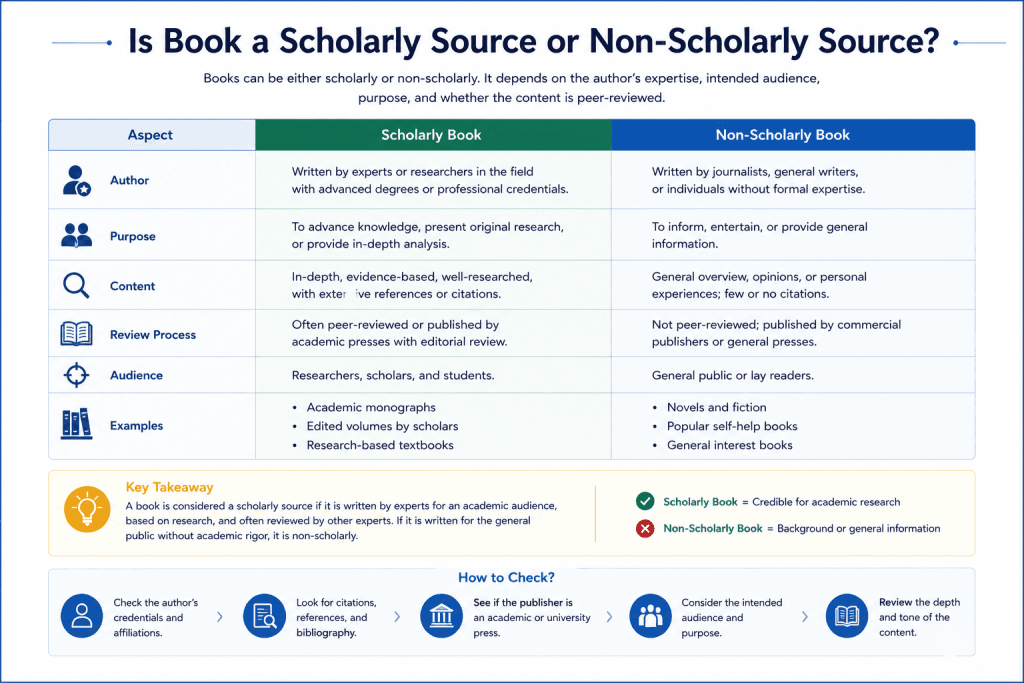
Anyone doing academic research eventually asks the same question: is book a scholarly source, or does it fall into the non-scholarly category? The answer isn’t a simple yes or no — it depends on several factors related to the publisher, the author’s credentials, and how the content was reviewed before publication.
Here’s what you need to know upfront:
- Not all books are automatically scholarly. A bestselling nonfiction title written for a general audience is very different from an academic book published by a university press. Both are “books,” but only one is likely a scholarly source.
- The format alone doesn’t determine scholarly status. People often assume that because something is bound and published as a book, it must be considered academic. This isn’t true — the same logic applies to journal articles, where a magazine article and a peer-reviewed journal article look similar on the surface but serve very different purposes.
- Context matters. Whether a book is scholarly often depends on the field of study, the assignment requirements, and how your professor or librarian defines “scholarly” for your specific course.
- Scholarly sources present original research or synthesize existing research using a rigorous, evidence-based approach. If a book is a scholarly source, it typically includes citations, a bibliography, and a peer review process behind its publication.
So, is book a scholarly source in your specific case? To answer that, you’ll need to look at a combination of signals rather than relying on a single indicator. Throughout this guide, we’ll break down exactly how to determine if a book is a scholarly source, what separates scholarly books from popular books, and how to identify scholarly books — including the trickier case of an edited book with multiple contributors.
By the end, you’ll have a clear, repeatable method for evaluating any title of the book you’re considering for your research, whether it’s for a college paper, a literature review, or a broader research project. Understanding is book a scholarly source isn’t just an academic technicality — it directly affects the credibility and accuracy of your work, especially when you’re expected to cite 3 scholarly sources or more in an assignment.
What Is a Scholarly Source?
Before diving deeper into whether a specific book is scholarly, it helps to define the term itself.
- A scholarly source is a publication written by experts in a specific field, intended primarily for an academic or professional audience — not for a general audience. This applies to books, scholarly journal articles, and other academic writing.
- Scholarly sources go through a formal peer review process, meaning other experts (often called referees) evaluate the work for accuracy, methodology, and originality before it’s published.
- Scholarly works typically include:
- A clear list of references or bibliography
- Citations to primary sources and other scholarly publications
- Author credentials, including advanced degrees and institutional affiliation
- Evidence of original research or a thorough literature review
- Scholarly sources are usually published by academic publishers, such as university presses, or through a peer-reviewed journal. This is different from trade publications, newspaper articles, or magazine articles, which are written for a general audience and don’t undergo the same editorial process.
- Key indicators that something is considered scholarly include the presence of footnotes, an abstract (common in journal articles), a methodology section, and language written for readers who are already familiar with the subject.
Understanding this baseline definition is essential before you can determine if a book is a scholarly source specifically. Books share many characteristics with scholarly journal articles, but because books are longer and more varied in purpose, evaluating whether a book is a scholarly source requires a slightly different checklist — which we’ll cover next.
Understanding Scholarly Books and Different Types of Books
To determine if a book is a scholarly source, it helps to first understand that not all books serve the same purpose. Different types of books exist along a spectrum, from purely academic to purely entertainment-focused, and knowing where a title falls on that spectrum is the first step.
Types of books you’ll typically encounter:
- Scholarly books (academic books): Written by experts, published by academic publishers like Oxford University Press or Cambridge University Press, and intended for researchers, students, and professionals. These present original research, synthesize existing scholarship, or offer in-depth analysis grounded in evidence.
- Trade books: Written for a general audience, often by journalists or popular authors. These are widely available in bookstores and are meant to inform or entertain rather than contribute new research to a field.
- Reference books: Encyclopedias, dictionaries, and handbooks. These summarize established knowledge but usually aren’t considered primary scholarly works themselves, though they can be useful starting points for research.
- Edited books: Collections of chapters written by different contributors, compiled and organized by one or more editors. These are common in academic publishing and can absolutely be scholarly, provided the contributors and editorial process meet scholarly standards.
- Textbooks: Designed for teaching. Some are scholarly (especially at the graduate level), while others are simplified for a general audience and may not include original research.
How to tell scholarly books apart from popular books:
- Publisher’s reputation matters enormously. A book published by a university press — such as Oxford University Press, Cambridge University Press, Wiley, or the University of North Carolina Press — has typically gone through an editorial and review process similar to peer review. This is one of the strongest signals that a book is a scholarly source.
- Look at the author’s credentials. Scholarly books are written by experts with advanced degrees and clear institutional affiliation, such as a university department or research institute. A general audience book might be written by a journalist, celebrity, or generalist without specialized academic training.
- Check the content of the book itself. Scholarly books include citations, footnotes, and a bibliography or list of references. Non-scholarly books rarely cite their sources in this level of detail.
- Consider the audience appropriateness. If the language is highly technical, assumes prior subject knowledge, and is written for other experts rather than casual readers, it’s likely a scholarly book. If it’s written for a general audience with accessible language and minimal jargon, it’s probably non-scholarly.
- Consider the purpose. Is book a scholarly source because it presents new findings or a rigorous analysis? Or is it summarizing existing knowledge for entertainment or general education? The former leans scholarly; the latter often doesn’t.
Recognizing these different types of books gives you the foundation needed to evaluate any specific title against scholarly standards, which we’ll explore further as we look at peer review and citation practices.
How Peer-Reviewed Work Sets Scholarly Books Apart
One of the biggest factors in determining is book a scholarly source is whether it went through any form of peer review — and this is where scholarly books and scholarly journal articles overlap significantly, even though the process looks a little different for each format.
How peer review works for scholarly journal articles:
- A researcher submits a manuscript to a scholarly journal or peer-reviewed journal.
- The journal editor sends the manuscript to other experts in the field — referees — who evaluate its methodology, originality, and accuracy.
- The article is revised based on feedback, and only published in academic journals once it meets scholarly standards.
- This process ensures that journal articles reflect rigorous scrutiny before reaching an academic audience.
How the equivalent process works for scholarly books:
- Books published by a university press go through a similar, though not identical, editorial process. Editors and external reviewers assess the manuscript for scholarly rigor before it’s published by academic presses.
- While the term “peer review” is used more loosely for books than for a peer-reviewed article, publication by an academic press (such as Oxford University Press or Cambridge University Press) is generally accepted as evidence that a book is a scholarly source.
- Editors often consult subject-matter experts to verify that the content of the book meets disciplinary standards, similar to how a scholarly journal article is vetted.
Key differences between scholarly books and non-scholarly sources:
- Non-scholarly sources, such as trade publications, newspaper articles, and magazine articles, don’t go through peer review. They’re written and edited quickly, often for timeliness rather than academic rigor.
- A non-scholarly source may still be well-researched and accurate, but it typically lacks the citation depth, methodological transparency, and expert vetting associated with scholarly journal articles or scholarly books.
- Popular books written for a general audience skip the rigorous editorial scrutiny that academic books undergo, which is why they aren’t typically accepted as scholarly sources in academic writing.
Why this matters for your research:
- If your assignment requires you to cite 3 scholarly sources, understanding the peer review process (or its book-publishing equivalent) helps you quickly filter out non-scholarly source options.
- A book is scholarly largely because of this vetting process — it signals that other experts have reviewed the work and vouched for its academic quality.
- When you’re unsure, checking whether a press is known for academic publishing (rather than commercial or general-interest publishing) is one of the fastest ways to confirm a book is a scholarly source.
Ultimately, peer review — or its editorial equivalent in book publishing — is one of the clearest dividing lines between scholarly works and non-scholarly source materials. It’s also a strong predictor of whether the content of the book will hold up to academic scrutiny in your own research and writing.
How to Determine If a Book Is a Scholarly Source: Cited Sources and Key Signs
Now that you understand the theory, let’s get practical. Here’s a step-by-step approach to determine if a book is a scholarly source, using concrete, checkable signs.
1. Check the publisher’s identity:
- Is the book published by a university press (Oxford University Press, Cambridge University Press, University of North Carolina Press) or a well-known academic publisher like Wiley?
- Academic publishers are far more likely to indicate a book is scholarly than a general commercial publisher.
2. Investigate the author’s credentials:
- Does the author hold advanced degrees relevant to the subject?
- Is there a clear institutional affiliation, such as a university or research center?
- Authors of scholarly books are typically recognized as an authority on the subject, often with a track record of academic journal articles or prior academic books.
3. Examine cited sources and the bibliography:
- Flip to the back of the book (or check the table of contents for a references section). Scholarly books include an extensive list of references or bibliography.
- Look through the book for footnotes or endnotes throughout the chapters — this is a strong sign of scholarly writing.
- A lack of cited sources is one of the clearest indicators that a book is not a scholarly source.
4. Review the content of the book:
- Does it present original research, new research, or a detailed literature review synthesizing prior scholarship?
- Is the writing style academic — precise, evidence-based, and written for readers already familiar with the topic — or is it written for a general audience with simplified explanations?
5. Look at the table of contents and structure:
- Scholarly books often include a structured breakdown by chapter, sometimes with subsections resembling those in academic journal articles (introduction, methodology, discussion, conclusion).
- Popular books are usually structured more loosely, prioritizing narrative flow over academic organization.
6. Consider the publication’s purpose and accuracy:
- Consider the quality of the writing and argumentation. Scholarly sources aim to advance knowledge in a field, not simply entertain or persuade a general readership.
- Consider accuracy by checking whether claims are supported by cited sources rather than presented as opinion or anecdote.
7. Watch for red flags that suggest a non-scholarly source:
- No citations or bibliography
- Author lacks relevant academic credentials
- Published by a commercial or general-interest publisher
- Written primarily for entertainment or a general audience
- Strong religious or political affiliation driving the content without balanced, evidence-based analysis
When you combine these checks, you get a much clearer answer to is book a scholarly source. No single factor is definitive on its own, but when several of these signs point in the same direction, you can be confident about the book’s classification — and confident in citing it appropriately in your academic writing.
How to Identify Scholarly Books, Including an Edited Book
Once you understand the general criteria, the next step is learning how to identify scholarly books efficiently — including trickier formats like an edited book, where multiple contributors are involved.
General strategies to identify scholarly books:
- Use your library’s database filters. Most academic library systems let you filter search results specifically for scholarly or peer-reviewed sources, which is one of the fastest ways to identify scholarly books and journal articles simultaneously.
- Ask a librarian. A librarian is trained to help you determine if a book is a scholarly source and can point you toward academic books relevant to your topic. This is especially useful if you’re new to a subject area and unsure which presses are considered academic.
- Check the publisher’s website. Publishers like Oxford University Press or Cambridge University Press typically identify their scholarly publication catalogs separately from general trade titles.
- Search for book reviews. Academic journals often publish book reviews evaluating whether a recently published title is considered scholarly and how it contributes to the field. Learning how to find book reviews in academic databases (like JSTOR or Project MUSE) can help confirm a book’s scholarly standing and reveal how other experts in the field have received it.
Evaluating an edited book specifically:
- Check the editor’s credentials, not just individual chapter authors. A reputable editor with academic affiliation lends credibility to the entire edited book.
- Look at each chapter individually. Since an edited book compiles work from multiple contributors, quality can vary slightly between chapters — but each chapter should still include its own citations and cited sources.
- Confirm the publisher. Edited books published by academic publishers or a university press are generally treated the same as single-author scholarly books.
- Check whether chapters function like standalone journal articles. Many edited books resemble a collection of scholarly journal articles, each with its own bibliography, making them just as citable as traditional academic books.
Quick checklist to identify scholarly books at a glance:
- Published by a university press or recognized academic publisher
- Author or editor has relevant advanced degrees and institutional affiliation
- Includes citations, footnotes, and a bibliography
- Presents original research or a rigorous literature review
- Written for an academic audience, not a general audience
- Positively reviewed in academic journals or referenced in other scholarly works
Final tip:
- When in doubt, cross-reference the book with academic journal articles on the same topic. If scholars regularly cite the book in their own peer-reviewed article bibliographies, that’s strong evidence the book is a scholarly source.
- Bookmark this evaluation process — since publishing standards and databases are updated periodically, revisiting these related topics (last updated periodically as academic publishing evolves) ensures your research methods stay current and reliable.
With these strategies, you should feel confident identifying scholarly books, edited books, and standalone academic titles for any research project — no more guessing whether a book is a scholarly source before you cite it.
- American College of Education (ACE) – Scholarly Writing Guide – https://ace.edu/blog/a-guide-to-scholarly-writing/
- George Washington University – Faculty Scholarly Publications – https://scholarship.law.gwu.edu/faculty_publications/73/
- Walden University Writing Center – Scholarly Writing Resources – https://academicguides.waldenu.edu/writingcenter/scholarly
- Florida State University College of Law – Scholarly Writing Guide – https://guides.law.fsu.edu/scholarlywriting