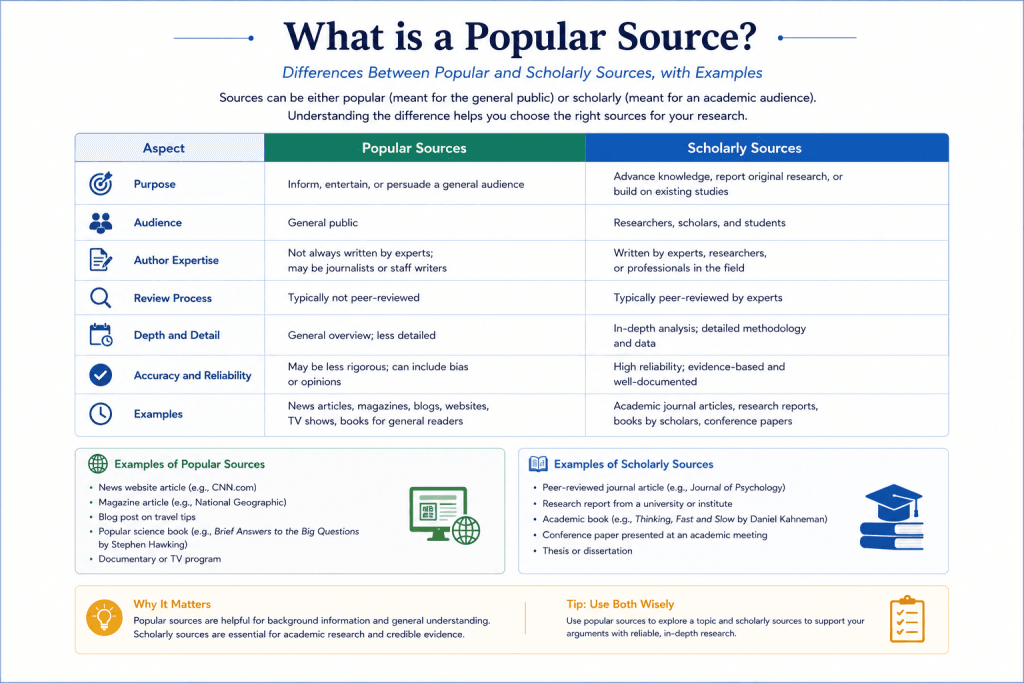
What Is a Popular Source?
- A popular source is any piece of content created for a general audience rather than for experts in a particular field. Think magazines and newspapers, websites, blogs, and general-interest publications you’d find at a newsstand or online news site.
- The main goal of a popular source is to inform, entertain, or update readers on current events, trends, or topics of general interest — not to present original research or advance academic knowledge.
- Popular articles are usually written by journalists or freelance writers, not by researchers or subject-matter experts. This means the writing style tends to be conversational, easy to read, and free of technical jargon.
- A key characteristic of popular sources is that they rarely go through a formal review process. Instead, an editor may check the piece for accuracy, tone, and readability before publication — but there’s no peer-review process involving outside experts.
- Popular sources typically don’t include a list of references or citation details the way academic work does. If a source is quoted, it’s usually mentioned briefly in the text rather than formally cited.
- Examples of a popular source include newspaper articles, popular magazines like Time or National Geographic, entertainment or lifestyle websites, and even some encyclopedia entries meant for a broad readership.
- You’ll also often see advertisement content mixed into a popular source, especially in publications like newspapers and magazines, which are commercially funded and rely on ads for revenue.
- Understanding what makes a popular source different from academic material is the first step toward figuring out the difference between popular and scholarly work — a distinction that matters a lot once you start doing serious research.
- Because a popular source is meant for quick consumption, articles are often shorter, punchier, and designed to hold a reader’s attention rather than walk through a detailed methodology or dataset.
- A journalist writing a popular source usually interviews a handful of people, pulls together publicly available information, and summarizes it in a way that’s easy to digest — very different from the months (or years) of work behind a scholarly research project.
- In short, a popular source is accessible, timely, and written for everyone — but it’s not the place to find in-depth research or peer-vetted findings.
What are the Differences Between Scholarly and Popular Sources?
Understanding the differences between popular and scholarly source material starts with looking at who writes them, who reviews them, and what purpose they serve. Here’s a breakdown of the popular and scholarly divide:
- Authorship: A scholarly source is written by experts — professors, researchers, and scientists — who have advanced degrees and specialized knowledge in a particular field. A popular source, on the other hand, is typically written by journalists or general staff writers who may not have subject-specific credentials.
- Purpose: Scholarly research aims to share original research, test hypotheses, or contribute new knowledge to an academic discipline. A popular source exists mainly to inform or entertain a broad audience about news and current events.
- Review process: This is one of the biggest markers when you’re trying to understand the difference between the two. A scholarly journal article goes through a peer-review process, where other experts (sometimes called a referee) evaluate the work before it’s published. A popular source usually just goes through a standard editorial check — not an academic review.
- Language and tone: Scholarly article writing tends to be formal, technical, and dense, using terminology specific to the field. A popular source is written in plain language meant for a general audience, without assuming prior expertise.
- Length and depth: A scholarly article is usually long and highly in-depth, often including detailed methodology, data, and analysis. Popular articles are shorter and provide more of a surface-level overview of a topic.
- References and citations: Peer-reviewed journal articles almost always include a list of references, allowing readers to trace the sources used. A popular source rarely cites sources formally, if at all.
- Publisher: A scholarly journal is typically published by an academic institution, professional association, or specialized publication house. A popular source is usually produced by commercial media companies.
- Visual presentation: Popular magazines and newspapers often feature glossy images, advertisement placements, and eye-catching headlines. A scholarly journal looks more plain, with charts, tables, and dense text blocks instead of decorative visuals.
- Timeliness vs. depth: Popular sources are fast — published daily or weekly — to keep up with news and current events. Scholarly sources take longer to produce because of the peer review process, but they offer far more in-depth research.
- Frequency of publication: A periodical in the popular category — like a weekly magazine or daily newspaper — comes out frequently to keep pace with the news cycle. A scholarly journal, by contrast, is often released quarterly, biannually, or annually, since each issue relies on articles that have passed through a lengthy peer review process.
- Depth of expertise required to read it: A scholarly article often assumes the reader already has background knowledge in the particular field, while a popular source is written so that a general audience, with no prior expertise, can follow along easily.
- Funding and motivation: Popular magazines and newspapers are commercial ventures, often relying on advertisement revenue and subscriptions. Scholarly research is typically funded by grants, universities, or research institutions, with far less emphasis on advertising or entertainment value.
Recognizing these differences between popular and academic material helps you decide which type of source fits your research needs, whether you’re writing a school paper or just trying to stay informed.
Is a Popular Source Peer Reviewed or Grey Literature?
- To put it simply: a popular source is not peer reviewed. Peer review is a formal review process where a manuscript is evaluated by other experts in the same particular field before it’s accepted for publication — and popular publications simply don’t follow this process.
- Instead, a popular source goes through basic editorial review, where an in-house editor checks for grammar, style, and general accuracy — a much lighter process than academic peer review.
- So where does a popular source fit in? Many popular sources actually fall into the category of grey literature. Grey literature refers to material produced outside traditional academic or commercial publishing channels — think government reports, conference papers, white papers, and yes, many types of journalism and popular writing.
- Grey literature isn’t necessarily low-quality; it’s just not formally peer-reviewed or published through a scholarly journal. It includes things like industry reports, conference proceedings, policy briefs, and popular commentary.
- It’s important to understand the difference between “not peer-reviewed” and “not credible.” A popular source can still be accurate and well-researched, even without going through the peer review process — it’s just not vetted by outside academic experts in the field.
- On the flip side, a peer-reviewed journal article — published in a refereed journal — has been scrutinized by a referee or panel of specialists before publication, making it a more rigorously validated source for scholarly research.
- If you’re doing academic work and your assignment specifically calls for peer-reviewed sources, a popular source or piece of grey literature typically won’t meet that requirement — you’ll need to look for a scholarly article from a peer-reviewed journal instead.
- When in doubt, check the publication’s own website or ask a librarian — most university libraries provide guides that clarify whether a given source counts as peer-reviewed, grey literature, or standard popular content.
- It also helps to remember that grey literature sits in a middle zone: it’s more specialized than a typical popular source aimed at a general audience, but it hasn’t gone through the same peer-review process as a scholarly article published in a refereed journal. Government agencies, think tanks, and professional associations are common producers of grey literature.
- If your professor or course guidelines ask specifically for peer-reviewed sources, always double-check the publication type before citing it — a quick search on your library’s database or a message to your librarian can save you from accidentally citing a popular source or grey literature piece when a peer-reviewed journal article was required.
Key Examples of Scholarly and Popular Sources
Seeing real examples side by side makes it much easier to understand the difference between scholarly and popular sources. Here’s a detailed breakdown:
Examples of Popular Sources:
- Newspapers: Publications like The New York Times or your local newspaper report on news and current events, politics, and community issues. They’re written by journalists and updated daily.
- Popular magazines: Titles like People, Time, or Sports Illustrated fall under popular magazines and newspapers, covering lifestyle, entertainment, and general interest stories in an accessible writing style.
- General websites and blogs: Many online publication sites and blogs offer commentary, tips, or news summaries without any formal review process.
- Opinion pieces: Opinion pieces and editorial columns share a writer’s personal viewpoint on current issues. These are common in newspaper and magazine sections and are considered scholarly only in rare cases where the author is also an academic expert writing for a general publication.
- Encyclopedia entries: A general encyclopedia, like a print or online reference work meant for broad audiences, offers quick overviews rather than in-depth research.
- Dictionary entries: A dictionary provides definitions and general language reference — useful for quick lookups but not a source of scholarly research.
- Trade publications: Industry-focused magazines that cover a specific profession or industry sit somewhere between popular and specialized writing. They’re more targeted than a typical popular source but still don’t undergo formal peer review.
- Product or service reviews: Consumer-focused review content, like a product review or restaurant write-up, is another everyday example of a popular source meant purely to inform a general audience’s purchasing or lifestyle decisions.
Examples of Scholarly Sources:
- Peer-reviewed journal articles: These are published in a scholarly journal or refereed journal after going through a rigorous peer-review process, where a referee evaluates the research methodology, findings, and conclusions.
- Academic books: Academic books are usually written by researchers or professors and published by university presses. They provide in-depth research and thorough analysis on a particular field.
- Conference papers and proceedings: Conference papers and conference proceedings are presented at academic conferences and often later published in scholarly journal collections. They share original research with experts in the field.
- Book reviews (scholarly): While book reviews appear in both popular and academic contexts, scholarly book reviews published in academic journals critically assess research contributions rather than just summarizing plot or content.
- Scientific studies: These are formal scholarly article publications detailing original research, methodology, and results, typically found through a research database.
- Government and institutional reports: Some formal, data-heavy reports from academic or research institutions can be considered scholarly, especially when authored by credentialed researchers and reviewed internally.
- Dissertations and theses: Graduate-level research projects, though not always published in a scholarly journal, are still considered scholarly because they undergo rigorous internal review by faculty committees and contribute original research to a particular field.
- Literature reviews: A scholarly review article synthesizes existing scholarly research on a topic, giving readers a comprehensive in-depth research summary without necessarily presenting brand-new data.
Comparing these examples side by side highlights the practical difference between popular and scholarly material — one is built for accessibility and speed, the other for depth and academic rigor. Whether you’re skimming a popular source for a quick update or digging into a scholarly journal for a research paper, knowing these real-world examples makes it much easier to categorize any publication you come across.
How to Tell If a Source Is Scholarly or Popular
If you’re ever unsure whether something counts as scholarly or popular, run through this checklist:
- Check the author’s credentials. A scholarly article is almost always written by experts with advanced degrees or professional research experience. If the author is a journalist or lacks listed academic credentials, you’re likely looking at a popular source.
- Look for citations and references. Peer-reviewed journal articles always include a list of references at the end. If the piece has no bibliography or footnotes, it’s probably a popular source.
- Examine the language. A scholarly journal uses technical, field-specific vocabulary meant for experts in the field. A popular source uses everyday language meant to be usually written to inform a general audience without assuming background knowledge.
- Check for a peer-review statement. Many databases and journal websites will explicitly state whether a journal is peer reviewed. Look for phrases like “refereed journal” or “peer-reviewed” in the publication’s description.
- Look at the layout and design. Scholarly journal articles are typically plain in appearance — dense text, tables, and graphs. Popular magazines and newspapers are visually engaging, with photos, colorful design, and advertisement placements throughout.
- Consider the publisher. A publication from a university press, professional academic association, or research institution is more likely to be scholarly. A publication from a commercial media company is more likely to be popular.
- Check the length and structure. Scholarly research articles follow a structured format — abstract, introduction, methodology, results, discussion, and conclusion. Popular articles don’t follow this rigid structure; they read more like a newspaper story or blog post.
- Use your library’s tools. Many university libraries subscribe to resources like ulrichsweb.com, which tells you definitively whether a periodical or journal is peer-reviewed, refereed, or intended for a general audience.
- Ask yourself: does it present original research? If a source describes new data, experiments, or findings the author personally conducted, it’s most likely scholarly research. If it’s summarizing, reporting, or commenting on events or existing information, it’s likely a popular source.
- When still unsure, ask a librarian. A librarian at your school or local library can quickly confirm whether a source is scholarly or popular and help you determine if it fits your assignment requirements.
- Check the abstract. Most scholarly article entries in a database begin with an abstract summarizing the study’s purpose, methods, and findings. A popular source almost never opens with a formal abstract.
- Notice the tone toward the reader. A scholarly journal speaks to fellow experts in the field, while a popular source speaks directly and conversationally to a general audience, often using “you” and simpler sentence structures.
- Look at where it was found. If you discovered the piece through a general web search or on a newspaper’s homepage, it’s very likely a popular source. If you found it through an academic database or your library’s catalog, it’s far more likely to be scholarly.
Where to Find Popular and Scholarly Sources
Knowing where to look makes the search for popular and scholarly sources much more efficient. Here’s where to find each type:
Finding Popular Sources:
- Newsstands and websites: Traditional newspaper and popular magazines and newspapers are available in print and online. Most major outlets also maintain up-to-date websites for news and current events.
- General search engines: A quick web search will surface plenty of popular source material, from news articles to blog posts and opinion commentary.
- Library databases for popular content: Yes, even your library — many university libraries subscribe to database platforms like EBSCO that include popular magazines and newspapers alongside academic material, making it easy to access both in one place.
- Public library resources: Local libraries often carry physical and digital subscriptions to well-known popular magazines and newspaper archives.
Finding Scholarly Sources:
- Academic databases: Platforms like EBSCO, JSTOR, and ProQuest are go-to resources for finding a peer-reviewed journal article, scholarly article, or conference proceedings. These databases allow you to filter results specifically for peer-reviewed sources.
- University libraries: Most university libraries provide access to subscription-based academic databases that aren’t available through a general search engine. This is often the fastest way to find legitimate scholarly research.
- Google Scholar: This free tool indexes scholarly article content, conference papers, and academic books, making it a solid starting point — though it’s still worth verifying peer-reviewed status through your library.
- Publisher and journal websites: Many scholarly journal publishers maintain their own websites where you can browse current and archived issues directly from the source publication.
- Ulrichsweb.com: As mentioned earlier, ulrichsweb.com is a valuable tool for verifying whether a periodical or serial publication is peer-reviewed, refereed, or intended for a general audience — extremely useful when you’re not sure of a journal’s status.
- Ask your librarian for guidance: A librarian’s expertise is invaluable here. They can point you toward the right database, help you use search filters effectively, and explain your library’s access to specific scholarly journal subscriptions.
- Interlibrary loan services: If your library doesn’t carry a specific scholarly journal or hard-to-find periodical, most university libraries offer interlibrary loan services that can request the material from another institution, sometimes delivering a digital copy of an entire serial within a day or two.
- Subject-specific databases: Beyond general platforms like EBSCO, many fields have their own specialized database — for example, PubMed for medical scholarly research or PsycINFO for psychology. A librarian can point you to the right one for your particular field.
Whether you need fast current events coverage or in-depth research for an academic project, knowing exactly where to search saves significant time and ensures you’re pulling from credible publication sources.
When to Use Each Type of Source (and When to Ask a Librarian)
Choosing between a popular source and a scholarly source comes down to your purpose, audience, and the depth of information you need.
- Use a popular source when:
- You want a quick overview of a topic without needing technical depth.
- You’re researching current events or breaking news that hasn’t yet made it into academic literature.
- You’re writing for a general audience and need accessible language and relatable examples.
- You want opinion pieces or expert commentary that reflects public discussion rather than formal original research.
- You need background information before diving into more in-depth research later.
- Use a scholarly source when:
- Your assignment or project specifically requires peer-reviewed sources or a peer-reviewed journal article.
- You need credible, vetted original research to support an academic argument or thesis.
- You’re exploring a particular field in depth and need detailed methodology, data, and analysis.
- You want information that has passed through a rigorous peer review process, ensuring it’s been checked by experts in the field.
- You’re citing sources in a scholarly research paper and need proper citation material with a full list of references.
- When it’s okay to mix both:
- Sometimes the best approach combines popular and scholarly material — using a popular source for context or current perspective, paired with a scholarly article for credible, research-backed support.
- Book reviews, whether popular or academic, can offer useful summary and critique when you’re evaluating whether a book fits your research needs.
- When to ask a librarian:
- If you’re not sure whether a journal is peer reviewed, a librarian can check instantly using tools like ulrichsweb.com or your library’s database subscriptions.
- If you’re overwhelmed by search results and can’t tell scholarly or popular apart, a librarian can walk you through filtering options in EBSCO or other academic databases.
- If your assignment guidelines are unclear about what counts as an acceptable source, a librarian can help you understand the difference and choose appropriately.
- If you need help locating a specific scholarly journal, conference proceedings, or hard-to-find periodical, your library’s staff have direct access to resources the general public often can’t find on their own.
- When you’re short on time: A popular source can give you a fast overview of a topic, while a scholarly article typically requires more time to read and digest given its in-depth research and technical detail — plan your research timeline accordingly.
- When accuracy and authority matter most: For high-stakes academic writing, always lean toward a scholarly journal or peer-reviewed journal article, since the peer review process provides an added layer of credibility that a standard popular source simply can’t match.
At the end of the day, both a popular source and a scholarly source have their place. Popular sources keep you informed and engaged with news and current events, while scholarly sources provide the in-depth research and academic rigor needed for serious study. Knowing when to reach for each — and knowing your library and librarian are there to help — makes navigating popular and scholarly sources far less overwhelming.
- American College of Education (ACE) – Scholarly Writing Guide – https://ace.edu/blog/a-guide-to-scholarly-writing/
- George Washington University – Faculty Scholarly Publications – https://scholarship.law.gwu.edu/faculty_publications/73/
- Walden University Writing Center – Scholarly Writing Resources – https://academicguides.waldenu.edu/writingcenter/scholarly
- Florida State University College of Law – Scholarly Writing Guide – https://guides.law.fsu.edu/scholarlywriting