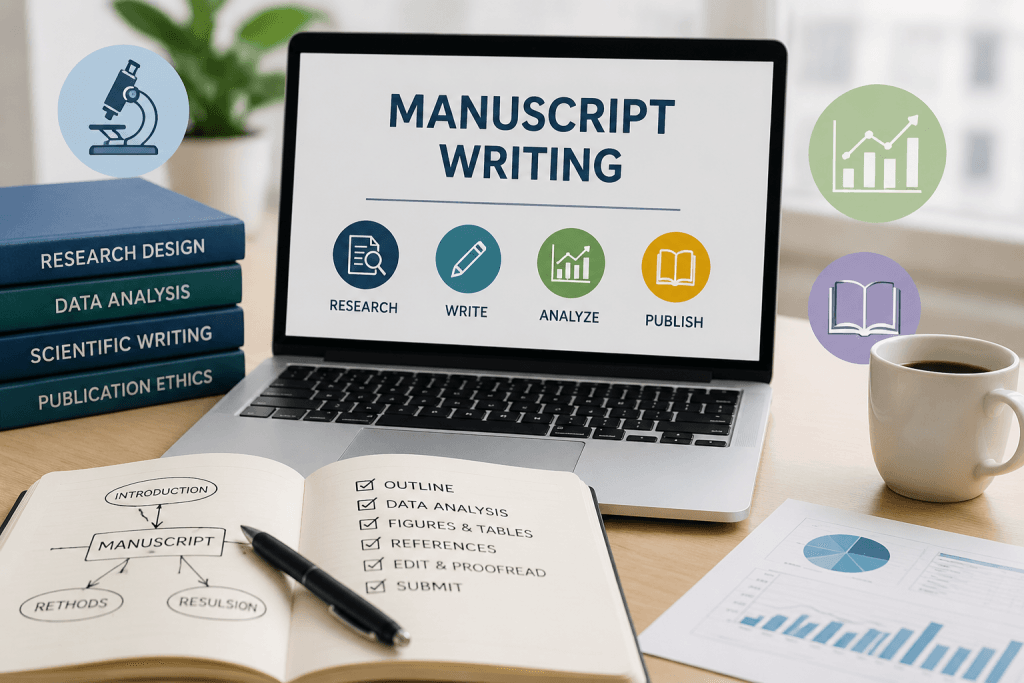
What Are Manuscript Examples and Why They Matter for Journal Submission?
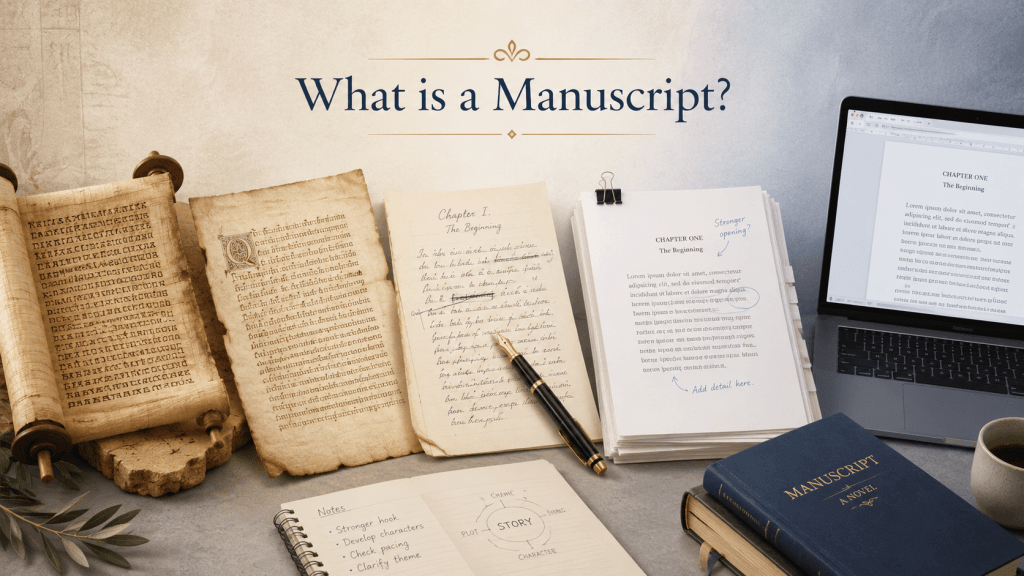
- Manuscript examples are sample documents — usually sourced from published papers, journal websites, or author resource pages — that show researchers exactly how a completed research manuscript should look before it goes out for review. They act as a visual and structural reference point, taking the guesswork out of formatting decisions that would otherwise eat up hours of an author’s time.
- When you’re preparing to submit a paper, it’s easy to underestimate how much journals actually care about presentation. A brilliant study can still get sent back for revisions — or even rejected — simply because the manuscript format doesn’t match the journal’s guidelines. This is exactly where manuscript examples earn their keep: they let you compare your own draft, section by section, against a document that has already passed editorial muster.
- Manuscript examples matter for several concrete reasons:
- They clarify expectations. Instead of reading twenty pages of dense author instructions, you can see the guideline applied in real form — headings, font, spacing, and citation style all in context.
- They reduce back-and-forth with editors. A manuscript that already mirrors an approved sample manuscript is less likely to bounce back for cosmetic corrections, saving weeks in the peer review timeline.
- They build author confidence, especially for first-time authors or those submitting to a journal outside their usual field, where formatting conventions may differ significantly.
- They standardize collaboration. When multiple co-authors are contributing text, figures, and tables, a shared sample manuscript keeps everyone’s formatting consistent.
- In short, manuscript examples aren’t just a nice-to-have — they’re a practical, time-saving resource that helps authors prepare a submission-ready research manuscript with fewer surprises along the way. Whether you’re a graduate student submitting your first paper or a seasoned researcher targeting a new journal, starting from a solid manuscript sample is one of the smartest steps you can take before you submit.
Key Sections of a Full Manuscript Explained with Manuscript Examples
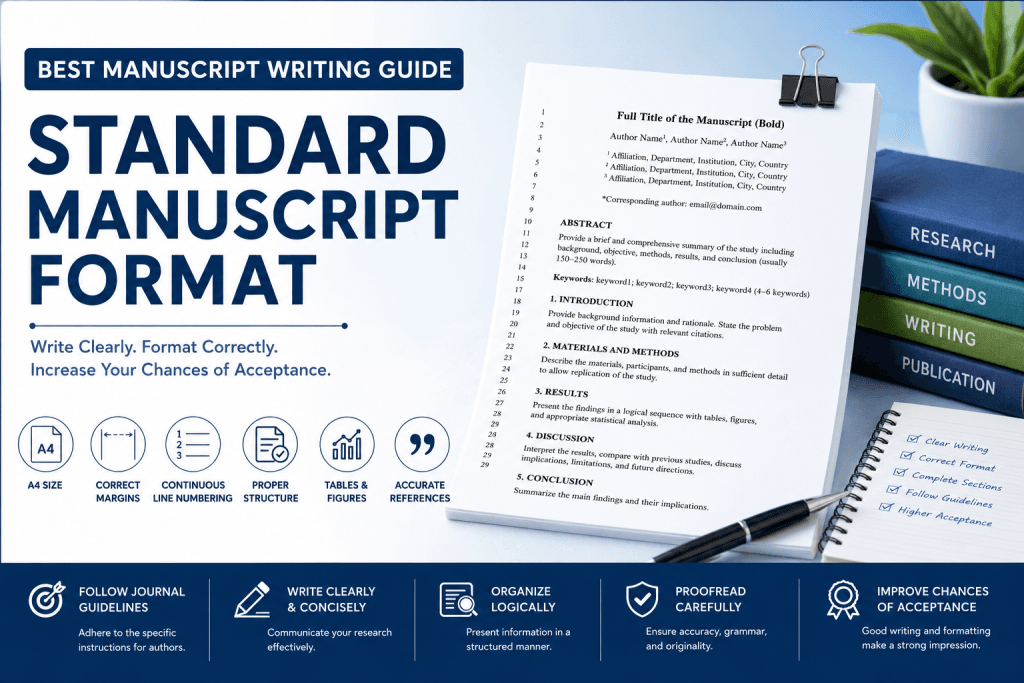
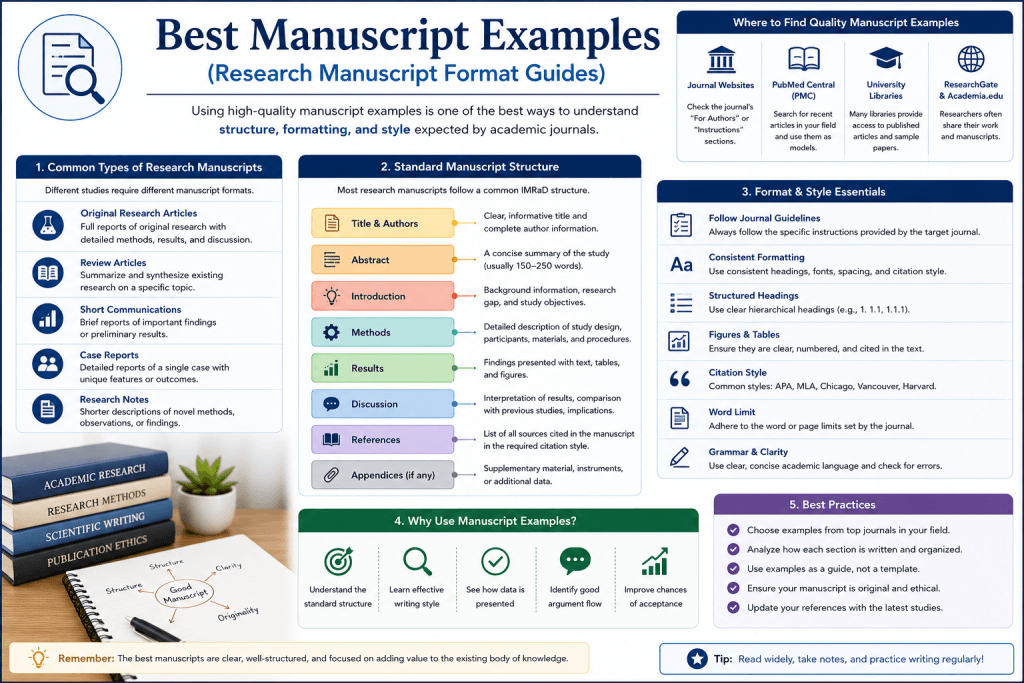
A full manuscript is built from distinct sections, each with its own purpose, tone, and formatting expectations. Reviewing manuscript examples side by side with your own document is the fastest way to understand how these sections should be structured and where common mistakes happen.
- Title Page
- The title page is the first thing an editor or reviewer sees, so it needs to be clean and complete. Manuscript examples typically show the full title, author names, institutional affiliation, corresponding author details, and sometimes a running head.
- Many journals specify a word limit for the title itself, along with rules about capitalization and punctuation. A good sample manuscript will demonstrate exactly how much detail belongs here versus what should be reserved for the abstract.
- Affiliation formatting varies widely between publishers — some want superscript numbers linking authors to institutions, others prefer footnotes. Checking manuscript examples from your target journal prevents a formatting mismatch at the very first page.
- Abstract
- The abstract is a compressed, standalone summary of the entire study, usually between 150–300 words depending on the journal’s guideline. Manuscript examples are especially useful here because abstracts differ in structure: some are a single flowing paragraph, others are a structured abstract with labeled subsections like Background, Methods, Results, and Conclusion.
- Reviewing a sample manuscript’s abstract also shows how keywords are typically placed directly beneath it, ready for indexing and search visibility.
- Introduction
- This section frames the research question, reviews relevant literature, and states the purpose of the study. A well-organized manuscript example shows how authors move from broad context to a specific, well-defined gap in existing research.
- Pay attention to paragraph length and citation density in sample manuscripts — introductions that pack in too many citations per sentence can feel cluttered, while too few can weaken the argument for why the study matters.
- Methods / Materials and Methods
- This section demands precision. Manuscript examples in this part of a paper typically use past tense, passive voice, and highly specific detail so that another researcher could replicate the study.
- Subsections are common here — participants, materials, procedure, data analysis — and a sample manuscript will usually show clear subheadings to organize each component logically.
- Results
- Results sections combine text, tables, and figures to present findings without interpretation. Manuscript examples reveal how authors reference each table or figure directly in the text (e.g., “as shown in Figure 2”) rather than repeating the data verbatim in paragraph form.
- This is one of the sections where formatting guidelines are strictest — journals often specify exact placement rules for tables or figures relative to their first mention in the text.
- Discussion
- The discussion interprets the results, compares them to existing literature, and acknowledges limitations. Manuscript examples show how authors typically end this section with implications for future research, setting up a natural bridge to the conclusion.
- Conclusion
- A conclusion should be concise — often just one paragraph — summarizing the study’s contribution without introducing new data. Sample manuscripts make it clear that this is not simply a repeat of the abstract, but a forward-looking synthesis.
- References
- Every full manuscript closes with a reference list formatted to a specific citation style (APA, Vancouver, Chicago, etc.). Manuscript examples are indispensable here because citation punctuation, italics, and ordering rules vary enormously between publishers.
- Supplementary Materials
- Many journals now allow or require supplementary files — raw data, extended tables, or additional figures — submitted separately from the main document. Manuscript examples often include a note on how these should be labeled and referenced within the main text.
Working through a complete manuscript sample from start to finish — rather than only skimming isolated sections — helps authors internalize how each part connects. It also reveals the subtle formatting guideline details, like consistent heading hierarchy and font choice, that tie the entire document together into a polished, submission-ready research manuscript.
Formatting Your Abstract, Introduction, and Reference Section with Manuscript Examples
Formatting isn’t just about aesthetics — it’s a functional part of how reviewers and editors process your paper quickly and fairly. Manuscript examples are the clearest way to see these rules applied consistently rather than trying to interpret them from a dense style guide alone.
- Abstract formatting
- Most journals specify a strict word count for the abstract, commonly 150–250 words, and manuscript examples make this limit tangible rather than abstract (no pun intended).
- Some publications require a structured abstract with bolded subheadings (Background, Aim, Methods, Results, Conclusion), while others want a single unbroken paragraph. Always check a current sample manuscript from your target journal, since these guidelines are updated periodically.
- Keywords are typically listed directly under the abstract, separated by commas, and limited to 4–8 terms. A well-chosen keyword list improves how easily your paper is discovered in databases, so this section deserves real thought rather than an afterthought.
- Font consistency matters even here — if the journal’s guideline specifies Times New Roman 12pt for body text, that typically extends to the abstract as well, unless otherwise noted.
- Introduction formatting
- The introduction is usually written in present tense when describing established knowledge, and past tense when referring to specific prior studies — a distinction that becomes obvious once you compare a few manuscript examples side by side.
- Paragraph structure matters: each paragraph should generally build one idea, moving the reader from general background toward the specific research gap your paper addresses.
- Citation style should match the journal’s specified format exactly — in-text numbered citations, author-date citations, or footnotes, depending on the guideline. Mixing styles is one of the most common reasons manuscripts get flagged during copy-editing.
- Indent the first line of each paragraph if the journal’s format calls for it; some publishers prefer block paragraphs with a line space instead, so don’t assume your default word processor settings are correct without checking a sample manuscript first.
- Reference section formatting
- This is the section where small mistakes multiply fastest, because reference lists often contain dozens or even hundreds of entries. Manuscript examples are extremely valuable here since they show the exact punctuation, italics, and ordering conventions the journal expects.
- Common citation styles include APA (author-date), Vancouver (numbered), and Chicago (notes-bibliography), and each has distinct rules for how journal titles, volume numbers, and page ranges are presented.
- Alphabetical versus order-of-appearance referencing depends entirely on the publication’s style — always confirm against a current guideline document or sample manuscript rather than relying on memory from a previous submission.
- Reference management software (like Zotero or EndNote) can auto-format citations, but it’s still worth manually spot-checking a few entries against a manuscript example, since citation styles are occasionally customized by individual journals.
- Pay attention to punctuation details: a period versus a comma after an author’s initials, or italicized versus non-italicized journal titles, can seem trivial but are exactly the kind of detail editors notice immediately.
Working from a well-chosen sample manuscript for each of these three sections — abstract, introduction, and references — helps you format your manuscript with confidence, rather than second-guessing every stylistic choice as you write.
Manuscript Example on the Effects of Short-Term Sleep Restrictions on Cognitive Performance
Running head: Sleep Restriction and Cognitive Performance
Effects of Short-Term Sleep Restriction on Cognitive Performance in Young Adults: A Randomized Controlled Study
¹ Department of Psychology, Riverbend University, Springfield, USA
² Department of Neuroscience, Harborview Institute, Portland, USA
Abstract
Background: Sleep restriction is common among young adults and is thought to impair cognitive functioning, yet the magnitude of these effects across different cognitive domains remains unclear.
Aim: This study examined the impact of one night of restricted sleep (4 hours) on attention, working memory, and reaction time in healthy young adults.
Methods: Forty participants (aged 18–25) were randomly assigned to a sleep-restricted group (4 hours of sleep) or a control group (8 hours of sleep). The following morning, participants completed a battery of cognitive tasks measuring sustained attention, working memory span, and simple reaction time.
Results: The sleep-restricted group showed significantly slower reaction times (p < .001) and reduced working memory span (p = .004) compared to the control group. No significant difference was found in sustained attention scores (p = .21).
Conclusion: A single night of sleep restriction selectively impairs reaction time and working memory, while sustained attention appears more resilient to short-term sleep loss. These findings have implications for occupational settings requiring rapid decision-making under sleep-deprived conditions.
Keywords: sleep restriction, cognitive performance, working memory, reaction time, young adults
1.Introduction
Sleep plays a central role in maintaining cognitive functioning, yet a substantial proportion of young adults regularly experience insufficient sleep due to academic demands, shift work, or lifestyle factors (Thompson & Ravi, 2019). Previous research has established a general link between reduced sleep duration and impaired cognitive performance, but findings remain inconsistent regarding which specific cognitive domains are most affected.
Several studies have suggested that attention-based tasks are particularly sensitive to sleep loss, given the reliance of sustained attention on prefrontal cortical regions that are known to be affected by sleep deprivation (Delgado et al., 2020). Other work has emphasized working memory as the primary domain impacted, arguing that the capacity to hold and manipulate information temporarily is disrupted even after modest sleep restriction (Nakamura & Osei, 2021). Reaction time has also been studied extensively, with most findings pointing toward a consistent slowing effect following reduced sleep (Farrow, 2018).
Despite this body of research, few studies have directly compared these three cognitive domains — attention, working memory, and reaction time — within a single controlled sample, making it difficult to determine whether sleep restriction affects all domains equally or disproportionately impairs specific cognitive functions. Understanding this distinction has practical significance, particularly for professions requiring rapid, accurate performance under conditions of reduced sleep, such as healthcare, transportation, and emergency services.
The present study addresses this gap by directly comparing sustained attention, working memory, and reaction time performance in a single sample of young adults following one night of sleep restriction, using a randomized controlled design. We hypothesized that reaction time and working memory would show significant impairment following sleep restriction, while sustained attention would show a comparatively smaller effect, consistent with mixed findings in prior literature.
2.Materials and Methods
2.1 Participants
Forty healthy young adults (22 female, 18 male; mean age = 21.4 years, SD = 1.8) were recruited from a university community through campus advertisements. Exclusion criteria included any diagnosed sleep disorder, current use of stimulant medication, and irregular sleep schedules (defined as habitual bedtime variation greater than two hours). All participants provided written informed consent, and the study protocol was approved by the university’s institutional ethics review board.
2.2 Design
A between-subjects randomized controlled design was used. Participants were randomly assigned to either the sleep-restricted condition (4 hours of time in bed) or the control condition (8 hours of time in bed), using a computer-generated randomization sequence.
2.3 Procedure
Participants in both groups slept at home, wearing a wrist actigraphy device to confirm compliance with assigned sleep duration. The sleep-restricted group was instructed to go to bed at 3:00 a.m. and rise at 7:00 a.m., while the control group followed their typical 8-hour schedule. All participants arrived at the laboratory by 9:00 a.m. the following morning to complete the cognitive test battery under standardized lighting and noise conditions.
2.4 Cognitive Measures
Sustained attention was measured using a 10-minute continuous performance task requiring participants to respond to target stimuli while withholding responses to non-targets. Working memory was assessed using a computerized digit span task, requiring participants to recall increasingly long sequences of digits in reverse order. Reaction time was measured using a simple visual reaction time task, in which participants responded as quickly as possible to a stimulus appearing at randomized intervals.
2.5 Statistical Analysis
Independent-samples t-tests were used to compare performance between the sleep-restricted and control groups on each cognitive measure. Statistical significance was set at p < .05. All analyses were conducted using standard statistical software.
3.Results
Table 1 summarizes the mean performance scores for both groups across all three cognitive measures.
Table 1. Mean (SD) performance scores by group
| Measure | Control (n = 20) | Sleep-Restricted (n = 20) | p-value |
|---|---|---|---|
| Reaction time (ms) | 312 (28) | 389 (34) | < .001 |
| Working memory span | 6.8 (1.1) | 5.6 (1.3) | .004 |
| Sustained attention (% correct) | 91.2 (4.5) | 88.7 (5.1) | .210 |
Note. Lower reaction time values indicate faster performance. Working memory span reflects maximum digit sequence recalled correctly.
As shown in Table 1, participants in the sleep-restricted group demonstrated significantly slower reaction times compared to the control group, t(38) = 7.92, p < .001. Working memory span was also significantly reduced in the sleep-restricted group relative to controls, t(38) = 3.12, p = .004. In contrast, sustained attention scores did not differ significantly between groups, t(38) = 1.28, p = .210, indicating that this domain was comparatively less affected by short-term sleep restriction.
(illustrative placeholder for formatting reference)
Figure 1. Distribution of reaction time scores (ms) for control and sleep-restricted groups, showing a rightward shift toward slower responses in the sleep-restricted condition.
4.Discussion
The present findings indicate that a single night of sleep restriction selectively impairs certain cognitive domains while leaving others comparatively intact. Specifically, reaction time and working memory were significantly impaired following sleep restriction, consistent with prior findings linking reduced sleep to slower processing speed and diminished working memory capacity (Nakamura & Osei, 2021; Farrow, 2018). Sustained attention, however, did not differ significantly between groups, suggesting this domain may be more resilient to acute sleep loss than previously assumed.
These results partially align with the theoretical framework proposed by Delgado et al. (2020), who suggested that attention-related deficits following sleep restriction may only emerge after more prolonged or repeated sleep loss, rather than a single night of restriction. Our findings extend this framework by demonstrating that reaction time and working memory, by contrast, appear vulnerable even after one night of reduced sleep, pointing to differing recovery thresholds across cognitive domains.
From a practical standpoint, these findings carry meaningful implications for professions requiring both rapid response and short-term memory retention under conditions of sleep loss, such as emergency medicine or aviation. Employers and policymakers in these fields may benefit from considering targeted interventions — such as structured napping protocols — that specifically address reaction time and working memory vulnerabilities rather than assuming uniform cognitive impairment across all domains.
This study has several limitations. First, the sample size, while adequate for detecting the observed effects, was relatively modest and may not generalize to older populations or individuals with pre-existing sleep irregularities. Second, only a single night of sleep restriction was examined; cumulative or chronic sleep restriction may produce different patterns of cognitive impairment, including in sustained attention. Third, cognitive testing was conducted only once, without a baseline measurement, meaning individual differences in cognitive ability could not be fully accounted for.
Future research should consider a within-subjects design with baseline testing, longer sleep restriction periods, and a broader range of cognitive measures to determine whether the domain-specific pattern observed here persists under more prolonged sleep loss conditions.
5.Conclusion
This study demonstrates that one night of sleep restriction selectively impairs reaction time and working memory while leaving sustained attention relatively unaffected in young adults. These findings suggest that cognitive domains do not respond uniformly to short-term sleep loss, and highlight reaction time and working memory as priority targets for intervention in settings where rapid, accurate performance is critical despite reduced sleep. Further research using extended sleep restriction periods and within-subjects designs is warranted to confirm and extend these findings.
·References
Delgado, R., Huang, F., & Voss, T. (2020). Prefrontal contributions to attentional decline under sleep deprivation. Journal of Cognitive Neuroscience Research, 34(2), 145–158.
Farrow, K. (2018). Reaction time as a marker of sleep-related cognitive impairment. Sleep and Behavioral Science Quarterly, 12(4), 301–312.
Nakamura, H., & Osei, D. (2021). Working memory vulnerability following acute sleep restriction: A meta-analytic review. Psychological Science and Sleep, 9(1), 22–41.
Thompson, L., & Ravi, S. (2019). Sleep habits and academic performance among university students. Journal of Student Health and Wellbeing, 7(3), 88–102.
Structuring Tables, Figures, and Descriptions in Research Paper with Manuscript Examples
Tables and figures often carry the most important evidence in a research paper, so getting their structure and presentation right is essential. Manuscript examples are particularly useful in this area because visual formatting conventions are harder to describe in words alone — seeing them in context makes the guideline click.
- General placement rules
- Some journals want tables and figures embedded directly within the text near their first mention; others require them placed at the end of the document, after the reference list. Manuscript examples make this distinction immediately obvious, and it’s one of the easiest things to get wrong if you skip checking it.
- Each table or figure should be numbered sequentially (Table 1, Table 2, Figure 1, Figure 2) and referenced explicitly in the body text — never left to “float” without a clear connection to the surrounding paragraph.
- Table structure
- A well-formatted table has a clear, concise title placed above it, along with column headers that are bolded or otherwise visually distinct from the data rows.
- Manuscript examples typically show minimal internal gridlines — many journals prefer horizontal lines only (top, header separator, bottom) rather than a fully gridded table, following a clean academic presentation style.
- Footnotes below a table should explain abbreviations, statistical notations (like p-values or asterisks), or data sources, formatted in a smaller font size than the main text.
- Keep font consistent with the rest of the document — if your manuscript format specifies Times New Roman or Calibri throughout, tables should follow the same font family, just often at a slightly reduced size for readability within cells.
- Figure structure
- Figures include graphs, charts, photographs, and diagrams, and their captions are placed below the image, unlike table titles, which sit above. This above/below distinction is one of the most consistent conventions you’ll see across manuscript examples from different journals.
- Captions should be a self-contained description — detailed enough that a reader could understand the figure’s content without flipping back to the main text. This means describing axes, units, sample size, and any statistical significance markers directly in the caption.
- Resolution and file format requirements are usually strict for graphical elements (commonly 300 DPI minimum, saved as TIFF, EPS, or high-quality JPEG). A sample manuscript or journal’s author guidelines document will specify these exact figure requirements.
- Color usage matters too — some journals charge extra for color figures in print, even if the online version displays in full color, so check the guideline carefully before finalizing your graphical presentation.
- Descriptions and cross-referencing
- Every table or figure needs a clear textual description in the results section that highlights the key takeaway, without simply repeating every number shown visually. This is a subtle skill that becomes much easier to learn by studying how sample manuscripts handle the same balance.
- Avoid duplicating data — if a number appears in a table, don’t also spell it out at length in a paragraph unless it’s the single most important finding worth emphasizing.
- Consistency in terminology between your table headers, figure captions, and body text descriptions is essential; reviewers notice when the same variable is labeled differently in different places.
Getting tables and figures right is often what separates a manuscript that sails through peer review from one that gets sent back for revisions. Studying a few strong manuscript examples from your target journal before finalizing your own tables or figures is one of the most efficient ways to avoid this kind of rejection risk.
Manuscript Examples for Authors: Instructions, Templates, and Resource Documents
Most journals publish a dedicated “Instructions for Authors” page, and pairing this with downloadable manuscript examples gives you the complete toolkit needed to prepare a submission-ready document.
- Author instruction pages
- These pages typically list every formatting requirement: font, spacing, margin size, word counts per section, citation style, and file format for submission. Reading this document alongside an actual sample manuscript helps you see the guideline applied in practice, rather than just described in text.
- Look for specific guidelines around manuscript length — many journals cap total word count or page count, and some have separate limits for research articles versus short communications or case reports.
- Downloadable templates
- Many journals and publishers provide a downloadable Word or LaTeX template pre-formatted with the correct heading styles, font (often Times New Roman 12pt, Arial 11pt, or Calibri 11pt depending on the publisher), and margin settings already applied.
- Using an official template saves significant time, since you can drop your text directly into the pre-built structure instead of manually adjusting font, spacing, and heading formatting from scratch.
- Templates often include placeholder text showing exactly how each section — abstract, introduction, methods, results — should be labeled and structured, functioning as a built-in manuscript example within the file itself.
- Resource documents and checklists
- Beyond templates, many publishers offer submission checklists confirming you’ve included a title page, conflict-of-interest statement, ethics approval details, and a complete reference list before you submit.
- Some journals also provide sample cover letters, which is a related but separate resource authors often overlook until the final stage of submission.
- Reporting guideline checklists (such as CONSORT for clinical trials or PRISMA for systematic reviews) are another category of resource document worth pairing with your manuscript examples, since these ensure your paper meets discipline-specific reporting standards.
- How to use these resources together
- Start with the author instructions to understand the rules, then open a sample manuscript to see those rules in action, and finally use the downloadable template as your working document. This three-part approach covers the guideline, the example, and the practical starting point all at once.
- Keep a folder of manuscript examples from journals you submit to regularly — over time, this becomes a personal reference library that speeds up formatting for every future submission.
- When instructions are ambiguous or seem outdated, it’s worth reaching out directly to the journal’s editorial office; a quick email often resolves formatting questions faster than guessing from an older sample manuscript.
Treating these resources as a connected set — instructions, templates, and examples — rather than isolated documents makes the entire preparation process faster and considerably less stressful, especially for authors preparing their first submission to a new journal.
Using Manuscript Examples for Permission Requests and Final Journal Submission
The final stretch before submission involves details that are easy to overlook after months of writing and revising — permissions, formatting checks, and the actual submission process itself. Manuscript examples remain useful right up to this last stage.
- Permission requests for reused material
- If your paper includes a figure, table, or substantial text passage from another published source, you’ll typically need written permission from the original publisher before you can include it in your manuscript.
- Manuscript examples that include reused material usually show a specific acknowledgment line beneath the table or figure (e.g., “Reproduced with permission from [Publisher], [Year]”), and matching this exact phrasing convention avoids delays during copy-editing.
- Start permission requests early — some publishers take several weeks to respond, and a missing permission can hold up your entire submission timeline even if every other part of the manuscript is ready.
- Keep a record of every permission granted, including the email or license confirmation, since journals may ask for this documentation during the review process or before final publication.
- Preparing for final submission
- Before you submit, run through your manuscript one more time against your target journal’s guideline, checking font, spacing, heading structure, and reference formatting one final time. Comparing against a recent sample manuscript at this stage catches small inconsistencies that are easy to miss after extended editing.
- Confirm that your title page includes all required author details, correct affiliation formatting, and a designated corresponding author with complete contact information.
- Double check that every table and figure is correctly numbered, captioned, and referenced in the text — this is one of the most common reasons manuscripts are returned before even reaching peer review.
- Make sure your manuscript matches the exact file format requested (commonly .docx or .pdf), since submission portals frequently reject files in the wrong format automatically, before an editor or agent even reviews the content.
- Submitting through the journal’s portal
- Most journals use an online submission system where you’ll upload your manuscript file, a separate title page, figures, tables, and a cover letter. Manuscript examples of a complete submission package help you understand exactly what’s expected in each upload field.
- You may be asked to suggest potential peer reviewers or list individuals to exclude from review — a step that’s easy to forget if you’re rushing through the final submission screens.
- Some systems require a structured summary of your study’s significance for editors, distinct from the abstract itself, so read each field description carefully rather than assuming it duplicates content you’ve already written elsewhere.
- After submission
- Once submitted, most journals send an acknowledgment email confirming receipt and estimated review timeline. Save this correspondence, along with your manuscript ID number, for future reference.
- If reviewers request revisions, you’ll often be asked to respond point-by-point to their comments alongside a revised manuscript — and reviewing revision-stage manuscript examples can help you understand how experienced authors typically structure a thorough, professional response letter.
- Even after acceptance, most journals send proofs for a final check before publication, giving you one last opportunity to confirm formatting, tables, figures, and references all appear correctly in the typeset version.
Treating permissions and final formatting checks with the same care as the writing itself is what separates a smooth submission from a stressful one. Leaning on well-chosen manuscript examples throughout this last stage helps ensure your paper reaches the editor’s desk — and eventually peer review — in the strongest possible shape.
- Purdue University Online Writing Lab (OWL) – Research and Manuscript Writing Resources – https://owl.purdue.edu/owl/research_and_citation/resources.html
- University of Washington Writing Center – Academic Writing and Research Papers Guide – https://www.writingcenter.uw.edu/
- Massachusetts Institute of Technology (MIT) Writing and Communication Center – Scientific and Academic Writing Support – https://writing.mit.edu/wcc