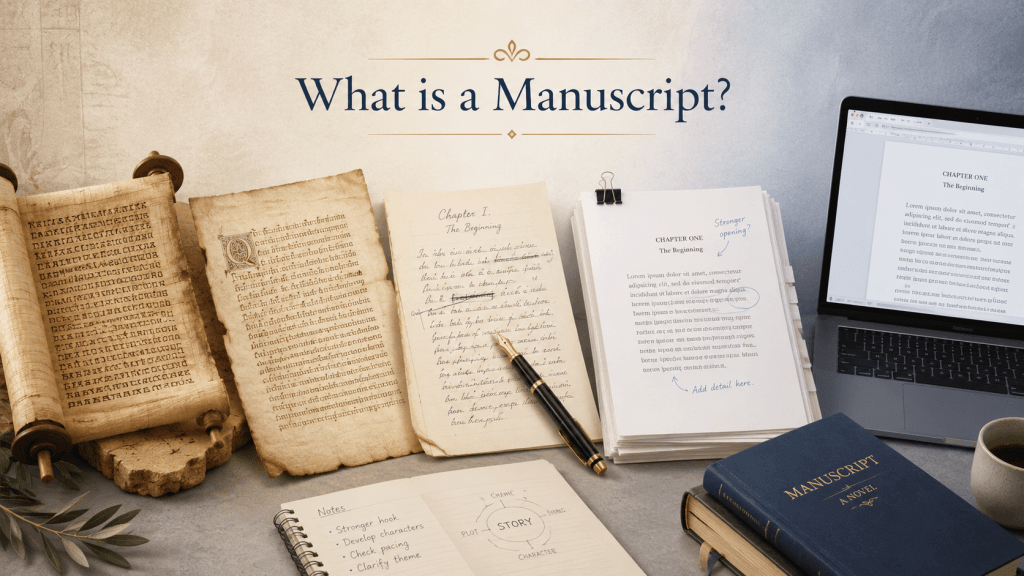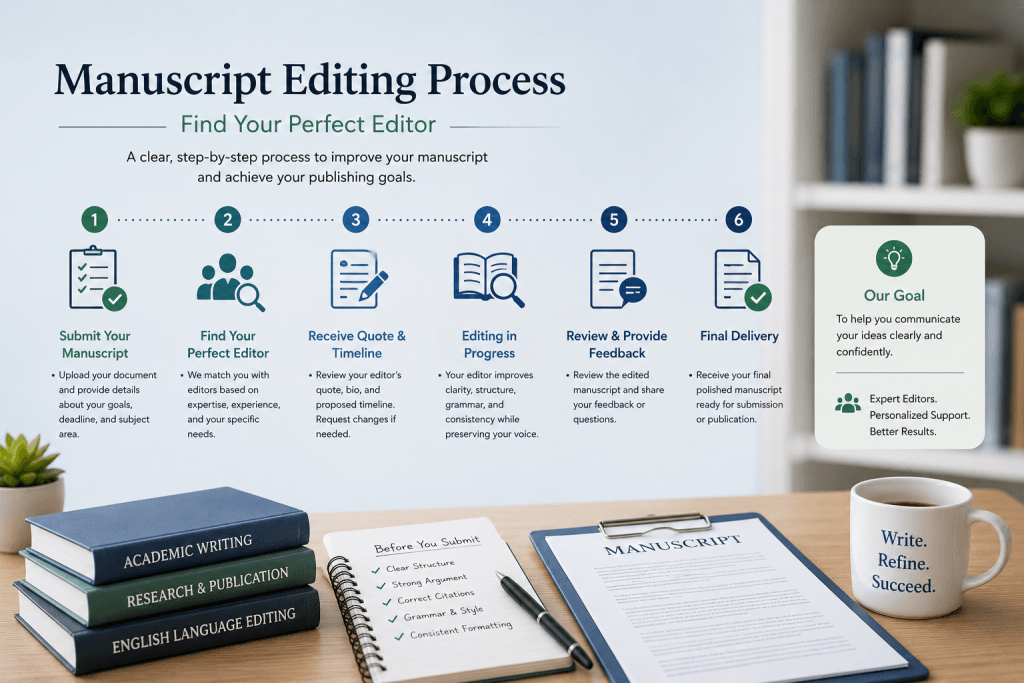
What is Manuscript Writing? Meaning, Purpose, and Importance
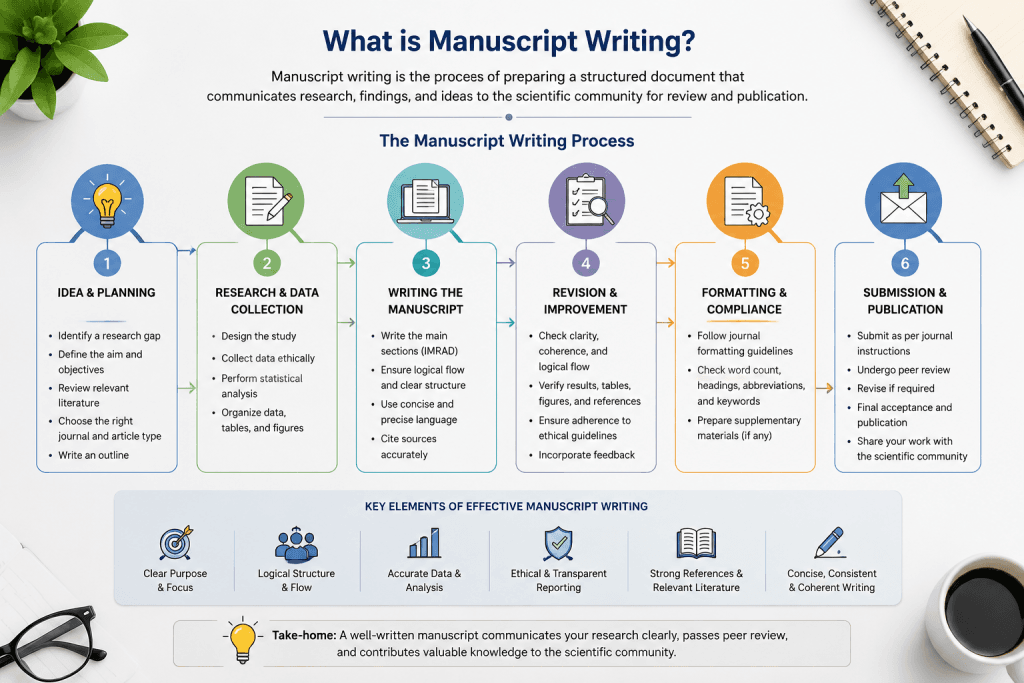
- Manuscript writing is the process of preparing a complete written document that presents research, ideas, findings, arguments, or scholarly knowledge in a clear and organised way.
- In research writing, a manuscript is usually written before it becomes a published article, scientific paper, book chapter, or nonfiction book. It is the version prepared for review, editing, submission, and possible publication.
- The main purpose of manuscript writing is to communicate knowledge to readers in a structured and credible manner. For researchers, this means helping the scientific community understand what was studied, how it was studied, what was found, and why the findings matter.
- A strong manuscript does more than report information. It explains the problem, reviews the relevant literature, describes the study design, presents the important results, and discusses the meaning of those findings in relation to the existing literature.
- Manuscript writing is important because it supports scientific communication. Without a clear manuscript, useful discoveries may remain hidden, misunderstood, or rejected during peer review.
- Good manuscript writing also increases the chances of publishing your work in a reputable scientific journal, including traditional and open access journals.
- An effective manuscript helps the reader follow the logical flow from the introduction to the conclusion. The reader should not struggle to understand the purpose, methods, findings, or take-home message.
- Another important purpose of manuscript writing is to make the study transparent. A well-written methods section allows other researchers to understand the research process and, where possible, be able to replicate the study.
- The manuscript writing process also helps authors refine their own thinking. As they write an outline, develop the first draft, revise the main text, and proofread, they often discover gaps, weak arguments, missing sources, or unclear explanations.
- In simple terms, manuscript writing turns research into a polished document that can be reviewed, understood, indexed, cited, and used by others.
Key Types of Manuscripts in Research Writing
- The types of manuscripts in research writing depend on the purpose of the work, the target journal, the discipline, and the nature of the evidence being presented.
- Understanding the main types of manuscripts helps authors choose the right format, follow the right structure, and meet the expectations of the publisher, publisher or editor, and reviewers.
1. Original Research Article
- An original article is one of the most common types of manuscripts in academic and scientific writing.
- It presents new research based on primary data, experiments, surveys, interviews, observations, clinical records, laboratory tests, or other forms of original evidence.
- This type of manuscript writing usually follows the IMRAD scheme, which includes the introduction, methods, results, and discussion.
- In an original research article, the introduction section explains the research problem, gap, purpose, and sometimes the hypothesis.
- The methods section describes the study design, participants, materials, procedures, ethical approval, and data analysis methods.
- The results section presents the findings clearly using text, tables and figures, and sometimes visualization tools such as charts or diagrams.
- The discussion section explains what the findings mean, how they compare with the existing literature, and what contribution they make to the field.
- This type of manuscript is common in health sciences, social sciences, education, business, and natural sciences.
Academic Writing & Research Support
Need Help With Research Papers, Manuscripts, Editing, or Proofreading?
At Scholarly Work, we provide professional academic writing support for researchers, students, and professionals. From drafting manuscripts to refining final submissions, we ensure clarity, accuracy, and publication-ready quality.
Get Manuscript Writing Help
2. Review Article
- A review article summarises, evaluates, and interprets existing studies on a particular topic.
- Unlike an original article, it may not present new primary data. Instead, it brings together published evidence to show what is already known, what is debated, and what gaps remain.
- In manuscript writing, review articles are useful because they help readers understand a broad topic without reading many individual studies.
- Common review manuscripts include narrative reviews, systematic reviews, scoping reviews, integrative reviews, and meta-analyses.
- A systematic review often follows strict formatting guidelines and reporting standards because it must explain the search strategy, inclusion criteria, exclusion criteria, screening process, and quality assessment.
- A review manuscript should have a clear heading structure, strong subheadings, and a proper flow of content and structure so the reader can follow the argument easily.
- The author should avoid simply listing studies. Instead, the manuscript should compare findings, identify patterns, explain contradictions, and present key points clearly.
3. Case Report or Case Study Manuscript
- A case report or case study manuscript presents a detailed analysis of a single case, patient, organisation, event, programme, or situation.
- This type of manuscript writing is common in medicine, nursing, psychology, business, education, and law.
- In the health sciences, a case report may describe a rare condition, unusual symptoms, new treatment response, or unexpected clinical outcome.
- The purpose is not always to prove a general rule. Instead, it provides useful insight that may guide future research, practice, or decision-making.
- A case manuscript normally includes background information, case presentation, assessment, intervention, outcome, and discussion.
- Authors must follow ethical guidelines, especially when the manuscript includes personal, clinical, or confidential information.
- The publisher or journal may require patient consent, anonymisation, and specific reporting standards before accepting the manuscript for review.
4. Short Communication or Brief Report
- A short communication is a concise manuscript that reports important findings in a shorter format.
- It is useful when the research findings are valuable but do not require a full-length research paper.
- This type of manuscript writing may include limited background, brief methods, focused results, and a short discussion.
- Authors must stay within the required word count, which is often lower than a full original article.
- Since space is limited, the writing must be concise, direct, and focused on the most important results.
- Short communications are often accepted when the findings are timely, novel, or important for a particular field.
5. Methodology Manuscript
- A methodology manuscript explains, tests, improves, or introduces a research method, tool, procedure, model, or analytical approach.
- This type of manuscript writing is useful when the main contribution is not only the findings but also the way the research was conducted.
- For example, a methodology manuscript may focus on a new data collection tool, a new laboratory technique, a new statistical analysis method, or an improved research framework.
- The methods section is usually the strongest and most detailed part of this manuscript.
- The author must explain the method clearly so that other researchers are able to replicate or adapt it.
6. Theoretical or Conceptual Manuscript
- A theoretical manuscript develops, challenges, compares, or extends theories and concepts.
- It is common in philosophy, education, social sciences, management, and humanities.
- This type of manuscript writing relies heavily on argument, interpretation, and engagement with relevant literature.
- The manuscript should not be vague or opinion-based. It should present a clear thesis, organised reasoning, and strong support from scholarly sources.
- A strong theoretical manuscript has a clear logical flow and a strong take-home contribution.
7. Technical Report or Research Report
- A technical report presents research findings, project outcomes, procedures, or recommendations for a specific audience.
- It may be written for institutions, companies, government bodies, funding agencies, or professional organisations.
- Compared to a scientific manuscript, a technical report may use a more practical format and may include more details about procedures, tools, limitations, and recommendations.
- However, good manuscript writing still matters because the report must be clear, credible, well-organised, and useful.
8. Book Manuscript or Nonfiction Book Manuscript
- A nonfiction book manuscript is longer than a journal article and may be written for academic, professional, or general readers.
- This type of manuscript writing requires strong planning because the author must organise chapters, sections, arguments, examples, and references.
- The idea of writing a book manuscript should begin with a clear audience, purpose, scope, and chapter outline.
- Authors should write an outline before drafting to ensure the manuscript flows from one chapter to another.
- Although a book manuscript may not follow the IMRAD scheme, it still needs a strong structure, clear subheadings, consistent formatting rules, and a strong conclusion.
Academic Writing & Research Support Need Help With Research Papers, Manuscripts, Editing, or Proofreading? At Scholarly Work , we provide professional academic writing support for researchers, students, and professionals. From drafting manuscripts to refining final submissions, we ensure clarity, accuracy, and publication-ready quality. Get Manuscript Writing Help
Manuscript Writing Format, Structure, and IMRAD Scheme
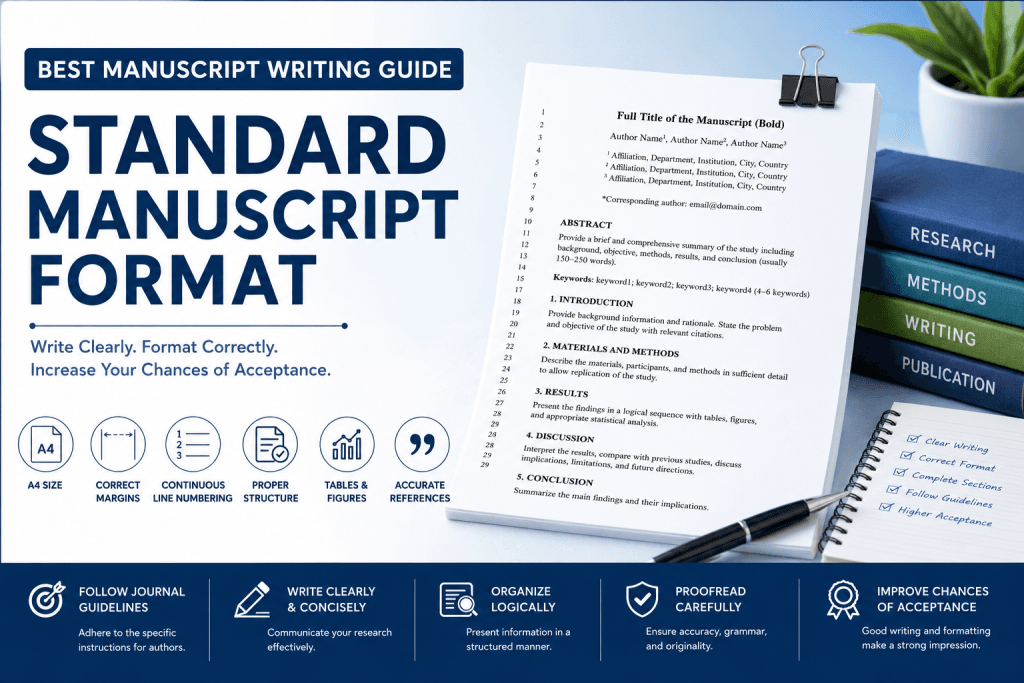
- A strong manuscript writing format makes the document easier to read, review, edit, and publish.
- Before writing your manuscript, always check the journal’s submission guidelines, instructions to authors, and specific guidelines.
- Every scientific journal has its own formatting rules, including requirements for title page, abstract, headings, reference style, figures, tables, word count, abbreviation use, and supplementary materials.
- Some publishers, such as Springer, Elsevier, Wiley, Taylor & Francis, and many open access publishers, provide detailed instructions to authors that authors must follow carefully.
- If you want to publish in a particular journal, never assume that one format works everywhere. You must format a manuscript according to that journal’s rules.
Common Manuscript Structure
- A standard research manuscript usually includes the following parts:
- Title and abstract
- The title should be clear, specific, and informative.
- The abstract should summarise the background, aim, methods, results, and conclusion.
- The abstract should include the main keyword or effective keywords naturally where appropriate.
- A good title and abstract improve discoverability, indexing, and reader interest.
- Keywords
- Keywords help databases, search engines, and journal platforms identify the topic of the manuscript.
- Effective keywords should reflect the main topic, method, population, field, and key concept.
- In manuscript writing, keywords should not be random. They should match the content and improve the visibility of the published article.
- Introduction section
- The introduction explains the background of the problem.
- It should identify the research gap and explain why the study is needed.
- It should review the relevant literature without becoming too long.
- It should end with the aim, objective, research question, or hypothesis.
- Methods section
- The methods section explains how the study was conducted.
- It should include the study design, setting, population, sample, instruments, procedures, ethical guidelines, and data analysis plan.
- In scientific manuscript writing, the methods must be detailed enough for readers to judge the quality of the research.
- A strong methods section helps other researchers become able to replicate the study.
- Results section
- The results section presents the findings without unnecessary interpretation.
- It should highlight important results in a clear and organised way.
- Tables and figures should support the text, not repeat every sentence.
- Statistical analysis should be reported accurately, including values such as means, standard deviations, confidence intervals, p-values, or effect sizes where relevant.
- Discussion section
- The discussion section explains the meaning of the findings.
- It should connect the results to the existing literature.
- It should explain whether the findings support or challenge earlier studies.
- It should also mention limitations, implications, recommendations, and future research.
- Conclusion
- The conclusion should present the take-home message.
- It should be concise and directly linked to the study aim.
- It should not introduce new results or unsupported claims.
- References
- References show the sources used in the manuscript.
- They must follow the required style of the publisher or editor.
- Common styles include APA, Vancouver, Harvard, Chicago, and journal-specific formats.
- Supplementary materials
- Supplementary materials may include extended tables, raw data, questionnaires, checklists, protocols, or additional figures.
- These materials support the main text without making the manuscript too long.
- Title and abstract
The IMRAD Scheme in Manuscript Writing
- The IMRAD scheme stands for Introduction, Methods, Results, and Discussion.
- It is widely used in scientific manuscript writing because it creates a clear and predictable structure.
- The IMRAD scheme helps the manuscript flows logically from the research problem to the final interpretation.
- Introduction: What is the problem?
- This section explains the background, gap, and purpose.
- It helps readers understand why the study matters.
- Methods: How was the study done?
- This section explains the study design, data collection, ethical guidelines, and data analysis.
- It allows readers and reviewers to judge reliability and validity.
- Results: What was found?
- This section presents the important results.
- It may include tables and figures for better visualization.
- Discussion: What do the findings mean?
- This section explains the findings, compares them with existing literature, and gives the take-home message.
How to Write a Manuscript in 4 Steps
- Step 1: Plan the manuscript before writing
- Start by understanding the target journal, audience, and purpose.
- Read the instructions to authors before beginning the first draft.
- Write an outline that includes each major section of your manuscript.
- Decide what belongs in the main text and what should go into supplementary materials.
- Clarify the central message so the manuscript writing process stays focused.
- Step 2: Draft the main sections
- Begin writing your manuscript using the correct structure.
- Many authors start with the methods section because the research process is already known.
- Then write the results section using clear text, tables and figures, and accurate statistical analysis.
- After that, write the introduction section and discussion section.
- Finish with the title and abstract once the full manuscript is clear.
- Step 3: Revise for logical flow and clarity
- Check whether the manuscript flows from one idea to the next.
- Make sure every heading and subheading supports the correct flow of content.
- Remove repeated points, unclear sentences, weak claims, and unnecessary details.
- Confirm that all aspects of the manuscript support the main purpose.
- Use concise wording so readers can understand the message quickly.
- Step 4: Format, proofread, and prepare for submission
- Format a manuscript according to the journal’s formatting guidelines.
- Check word count, references, abbreviation use, tables, figures, and ethical statements.
- Proofread the manuscript for grammar, punctuation, accuracy, and consistency.
- Review the submission guidelines before uploading the manuscript.
- Make sure the final file meets all requirements before entering the publication process.
General Tips, Best Practices, and Common Errors in Manuscript Writing
- The best manuscript writing begins with planning. Do not start writing manuscripts without knowing the target journal, article type, word count, and formatting guidelines.
- Always read the instructions to authors carefully. Many manuscripts are delayed or rejected because authors ignore basic submission guidelines.
- Keep the writing concise. A manuscript should be detailed enough to be useful but not overloaded with unnecessary background, repeated results, or long explanations.
- Maintain the correct flow of content and structure. A strong manuscript moves naturally from the introduction section to the methods section, results section, discussion section, and conclusion.
- Use clear headings and subheadings. These help readers, reviewers, and editors follow the manuscript writing process without confusion.
- Make sure every section of your manuscript has a clear purpose. The introduction should not report results. The results section should not become a discussion. The conclusion should not introduce new evidence.
- Use tables and figures wisely. They should make the important results easier to understand. They should not be used as decoration.
- Follow ethical guidelines. This includes proper citation, honest reporting, plagiarism avoidance, authorship transparency, conflict-of-interest statements, consent where required, and ethical approval for human or animal studies.
- Choose effective keywords. Good keywords support indexing and help readers find the published article online.
- Proofread before submission. Even strong research can appear weak if the manuscript has grammar errors, inconsistent formatting, unclear abbreviations, or missing references.
- Check all statistical analysis carefully. Common errors include reporting wrong values, using the wrong test, failing to explain the analysis method, or presenting results that do not match the study design.
- Avoid weak introductions. A poor introduction may be too broad, too long, outdated, or disconnected from the research question.
- Avoid an unclear methods section. Reviewers should understand exactly how the research was conducted.
- Avoid overclaiming in the discussion section. The interpretation should match the data and should not go beyond what the study can support.
- Avoid ignoring the target publisher or editor. Each publisher has specific guidelines, and authors to follow those rules improve their chances of moving smoothly through peer review.
- A final best practice in manuscript writing is to revise more than once. The first draft is rarely ready for submission.
- The strongest manuscript writing is clear, ethical, organised, evidence-based, and reader-focused.
- The final take-home message is simple: if you want to publish, write a manuscript that is structured properly, formatted correctly, supported by relevant literature, and prepared carefully for peer review.
References
- Purdue University Online Writing Lab (OWL) – Research and Manuscript Writing Resources – https://owl.purdue.edu/owl/research_and_citation/resources.html
- University of Washington Writing Center – Academic Writing and Research Papers Guide – https://www.writingcenter.uw.edu/
- Massachusetts Institute of Technology (MIT) Writing and Communication Center – Scientific and Academic Writing Support – https://writing.mit.edu/wcc