What Is a Manuscript? Manuscript Definition, Meaning, and Merriam-Webster Explanation
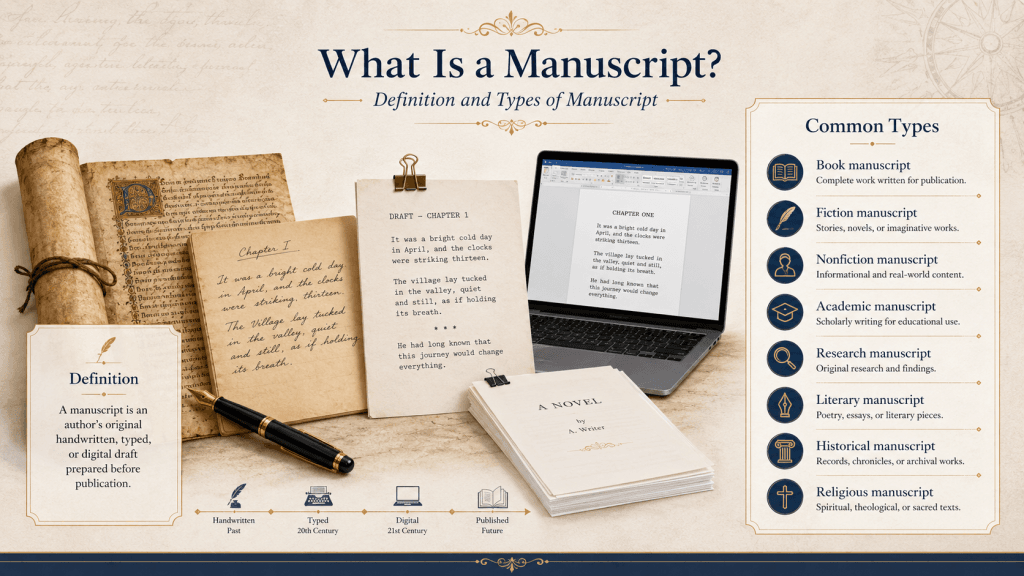
- A manuscript is a written, typed, or prepared document that contains a complete or developing piece of text before it becomes a final printed or published work.
- In a simple definition, a manuscript can be described as an author’s original written work before it goes through full editing, formatting, printing, or publication.
- The traditional manuscript definition comes from the idea of something written by hand. The word has roots in Latin, where manu means “by hand” and scriptus means “written.” This is why early manuscript materials were closely connected to the pen, the hand, and the act of writing.
- A handwritten document, a typed research paper, a draft of a book, a typescript, or an unpublished article may all be considered a manuscript depending on the context.
- Merriam-Webster explains manuscript as a noun referring to a written or typewritten composition or document, especially one that is different from a printed copy. It may also refer to a document that is submitted for publication.
- In publishing, a manuscript is usually the work an author prepares and sends to an editor, literary agent, journal, or publisher for review.
- A manuscript is not always handwritten today. Modern manuscripts are often created on computers, saved in digital format, and submitted online to journals, magazines, or publishing houses.
- The abbreviation MS is often used to refer to a manuscript. The plural form may be written as MSS, especially in libraries, archives, and a manuscript collection.
- A useful synonym for manuscript may be “draft,” “document,” “copy,” or “typescript,” although each word has a slightly different meaning.
- A manuscript may be unpublished, under review, accepted for publication, or prepared for print. Once it becomes a printed book with an ISBN, cover design, and final layout, it is no longer simply a manuscript; it becomes a published book.
Manuscript: From Scroll to Draft in Publishing History
- The history of the manuscript begins long before modern books, printers, or digital publishing systems existed.
- In ancient times, people wrote important records on materials such as papyrus, parchment, clay tablets, wood, palm leaves, metal plates, and animal skins.
- One of the earliest forms of the manuscript was the scroll. A scroll was a long sheet of writing material rolled from one end to the other. Ancient readers unrolled the scroll to read the text.
- Papyrus scrolls were common in ancient Egypt and other parts of the Mediterranean world. These scrolls helped preserve religious, legal, literary, and administrative writing.
- A parchment manuscript became important because parchment was stronger than papyrus and could last longer when properly stored.
- The codex later changed the way people used manuscripts. Unlike a scroll, a codex had pages bound together, making it closer to the modern type of book we know today.
- Many biblical manuscripts were written as scrolls or codices. The Dead Sea Scrolls, for example, are famous ancient religious manuscripts, with many texts written in Hebrew and related languages.
- Manuscripts were also central in Buddhist traditions. Some Buddhist scriptures were written on palm leaves and carefully preserved by religious communities.
- In the medieval period, manuscripts were often copied by a scribe. A scribe copied scripture, legal texts, poems, histories, and scholarly works by hand.
- These handwritten works were slow to produce, which made each manuscript valuable. A single manuscript could take months or even years to complete, especially if it included decoration, illustrations, or gold details.
- Some ancient writing survives on unusual materials such as copper or gold plates. However, not every ancient written object is considered a manuscript in the modern publishing sense. Some may be classified as inscriptions, tablets, religious records, or archaeological artifacts.
- For example, certain Etruscan and Mediterranean writing artifacts show how early cultures used different materials to preserve language, alphabet systems, and sacred records.
- In the Renaissance, especially in places such as Italy, the manuscript became closely connected to scholarship, art, literature, and humanist learning.
- The printing press changed manuscript history dramatically. Before printing, every copy had to be written by hand. After the printing press, a printer could produce multiple copies of the same text much faster.
- The invention of the typewriter later changed manuscript preparation again. A typewritten manuscript became easier to read, edit, copy, and submit.
- In the early modern period and beyond, authors prepared different versions of a manuscript before sending the final draft to a publisher.
- Today, a manuscript is usually a digital draft, but it still carries the same purpose: to preserve, develop, and submit an author’s work for review, editing, and possible publication.
Academic Writing & Research Support
Need Help With Research Papers, Manuscripts, Editing, or Proofreading?
At Scholarly Work, we provide professional academic writing support for researchers, students, and professionals. From drafting manuscripts to refining final submissions, we ensure clarity, accuracy, and publication-ready quality.
Get Manuscript Writing Help
Different Types of Manuscripts for Publishing
- There are different types of manuscripts in publishing, and each type has its own purpose, structure, audience, and format.
- Understanding each type of manuscript helps a writer know how to prepare, edit, and submit the work correctly.
1. Book Manuscript
- A book manuscript is a full draft of a book prepared by an author before it is published.
- This manuscript may be fiction, nonfiction, academic, religious, historical, or professional.
- A book manuscript usually includes a title page, table of contents, chapters, references if needed, and sometimes appendices.
- For a novel, the manuscript focuses on plot, characters, setting, dialogue, and literary style.
- For a nonfiction book, the manuscript may focus on argument, evidence, explanation, examples, and practical lessons.
- A book manuscript is often submitted to literary agents, independent publishers, or major publishing houses such as Random House and other commercial publishers.
- Before publication, the manuscript usually goes through developmental editing, copyediting, proofreading, formatting, cover design, printing, and ISBN assignment.
2. Fiction Manuscript
- A fiction manuscript is a literary draft that tells an imagined story.
- This type of manuscript may belong to a specific genre, such as romance, fantasy, thriller, mystery, science fiction, horror, historical fiction, or literary fiction.
- A fiction manuscript must usually have a strong opening, clear conflict, believable characters, smooth chapter flow, and satisfying resolution.
- The writer must also pay attention to grammar, dialogue, pacing, point of view, and emotional development.
- A fiction manuscript is considered strong when the story feels complete, polished, and ready for editorial review.
3. Nonfiction Manuscript
- A nonfiction manuscript presents real information, real events, research, personal experience, professional knowledge, or expert guidance.
- This manuscript may be a memoir, biography, self-help book, business book, educational guide, religious book, health book, or historical work.
- A nonfiction manuscript must be clear, organized, accurate, and useful to the reader.
- The author’s expertise matters because readers expect trustworthy information.
- This type of manuscript often requires strong chapter structure, examples, evidence, references, and a clear promise to the audience.
4. Academic Manuscript
- An academic manuscript is prepared for scholarly review and possible publication in a journal, edited book, or academic conference.
- This manuscript usually follows a strict format depending on the publisher, journal, or institution.
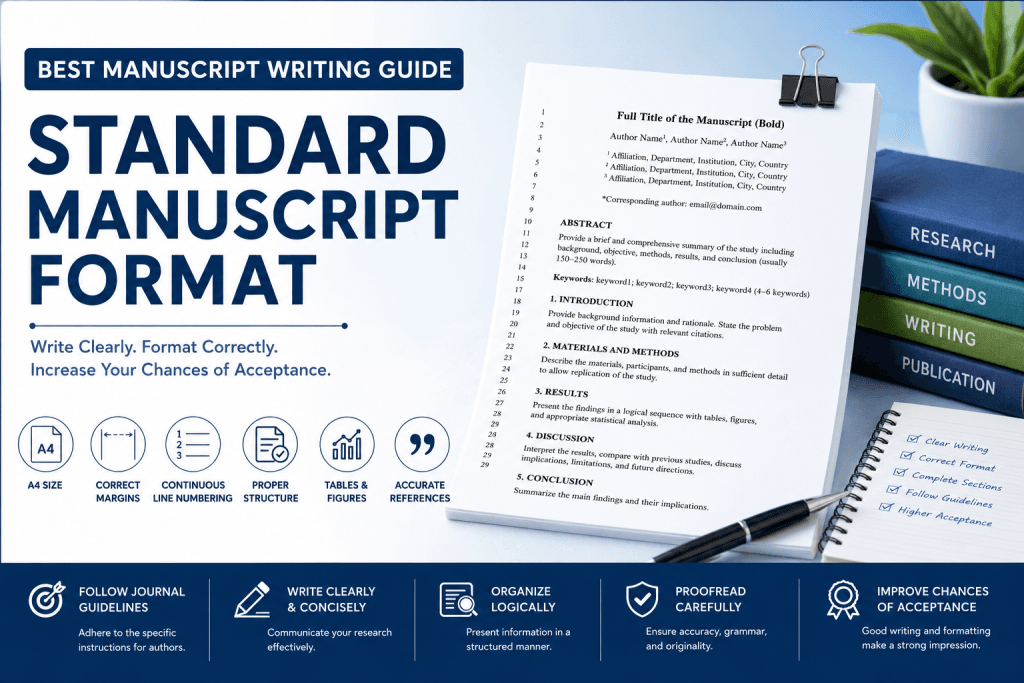
- Academic manuscripts may include an abstract, introduction, literature review, methods, results, discussion, conclusion, and references.
- The writer must follow the required style guide, such as APA, MLA, Chicago, Harvard, or Vancouver.
- An academic manuscript must be well-researched, properly cited, logically organized, and carefully edited before submission.
5. Research Manuscript
- A research manuscript reports original research findings.
- This manuscript is common in science, medicine, nursing, education, psychology, business, technology, and social sciences.
- A research manuscript usually explains the study problem, research gap, methods, data, findings, interpretation, and contribution.
- Many research manuscripts follow the IMRaD structure: Introduction, Methods, Results, and Discussion.
- Before a research manuscript is accepted, it usually goes through peer review, where experts evaluate the quality of the work.
6. Scientific Manuscript
- A scientific manuscript is a research-based document prepared for publication in a scientific journal.
- This manuscript must be precise, evidence-based, and written in a clear scientific style.
- It often includes tables, figures, statistical results, ethical approval details, limitations, and references.
- Scientific manuscripts must avoid unclear claims and unsupported conclusions.
- The editor and reviewers check whether the manuscript makes a meaningful contribution to the field.
7. Literary Manuscript
- A literary manuscript focuses on creative writing and artistic expression.
- It may include poetry, short stories, plays, essays, or experimental writing.
- A literary manuscript is judged not only by meaning but also by voice, rhythm, originality, imagery, and emotional impact.
- Literary publishers and magazines often look for a polished manuscript with a distinct style.
8. Edited Manuscript
- An edited manuscript is a draft that has already been reviewed and improved by an editor.
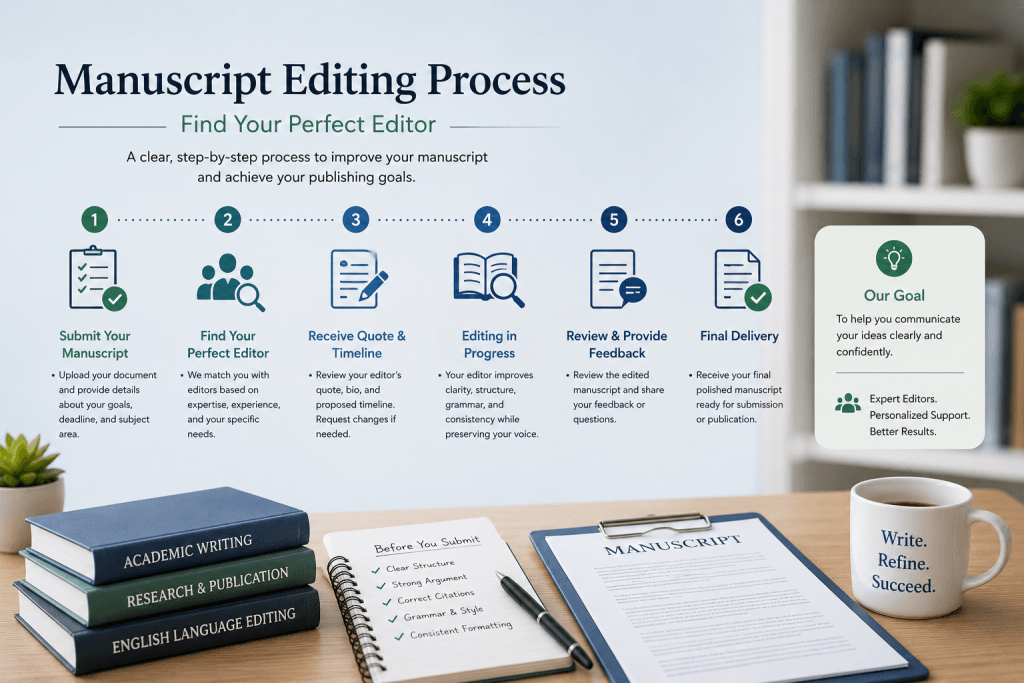
- The editor may correct grammar, improve sentence flow, remove repetition, strengthen structure, and ensure the manuscript fits the intended audience.
- This type of manuscript is closer to publication because it has moved beyond the rough draft stage.
- However, it may still require proofreading, formatting, or final publisher review.
9. Unpublished Manuscript
- An unpublished manuscript is a written work that has not yet been formally published.
- It may be complete or incomplete, polished or rough, handwritten or digital.
- Many authors have unpublished manuscripts stored as files, notebooks, printed drafts, or archived documents.
- An unpublished manuscript can still be valuable, especially if it shows the author’s creative process, original ideas, or early versions of a later published work.
Academic Writing & Research Support
Need Help With Research Papers, Manuscripts, Editing, or Proofreading?
At Scholarly Work, we provide professional academic writing support for researchers, students, and professionals. From drafting manuscripts to refining final submissions, we ensure clarity, accuracy, and publication-ready quality.
Get Manuscript Writing Help
10. Historical Manuscript
- A historical manuscript is an old written document preserved because of its cultural, religious, political, or literary importance.
- Historical manuscripts may include letters, diaries, scripture, legal records, maps, royal orders, poems, or early books.
- These manuscripts are often stored in archives, museums, libraries, universities, and private collections.
- A historical manuscript helps preserve the past because it shows how people wrote, thought, governed, worshipped, and communicated at a particular date.
11. Religious Manuscript
- A religious manuscript contains sacred texts, prayers, commentaries, sermons, or theological writings.
- Examples include biblical manuscripts, Buddhist palm-leaf manuscripts, Hebrew scripture manuscripts, Islamic manuscripts, and Christian medieval manuscripts.
- Religious manuscripts are important because they help preserve spiritual traditions and show how sacred texts were copied, translated, and transmitted.
- Some religious manuscripts have been found in caves, libraries, monasteries, and even a tomb or burial setting.
12. Publishing Manuscript
- A publishing manuscript is the version of the work prepared specifically for submission to a publisher, agent, journal, or magazine.
- This manuscript must follow submission guidelines carefully.
- A publisher may require a certain word count, font, margin size, chapter format, citation style, and file type.
- The manuscript should be edited before submission because publishing houses receive many documents and may reject poorly prepared work quickly.
How to Write an Outstanding Manuscript in 4 Easy Steps
Step 1: Plan the Manuscript Before You Start Writing
- Before you write a manuscript, begin with a clear plan.
- Decide the purpose of the manuscript. Ask yourself whether the manuscript is meant to inform, persuade, entertain, teach, document, or support publication.
- Identify the target reader. A manuscript for scholars will look different from a manuscript for general readers, students, professionals, or children.
- Choose the correct genre and type of book. A nonfiction manuscript needs a different structure from a literary novel, research article, or scientific manuscript.
- Create a clear outline. Break the manuscript into sections, chapters, headings, or research parts.
- Decide the main argument or central message. Every strong manuscript has a clear focus.
- Gather your sources, examples, data, notes, and references before drafting.
- Check the publisher’s or journal’s guidelines early. This helps you avoid formatting problems later.
- Planning saves time because it gives your manuscript direction before you begin writing full chapters.
Step 2: Write a Strong First Draft
- After planning, begin the first draft without expecting perfection.
- The goal of the first draft is to get the text onto the page.
- Write consistently and follow your outline, but allow room for new ideas.
- Start each chapter or section with a clear purpose.
- Use simple and direct language where possible. A manuscript becomes stronger when the reader can follow the message easily.
- Avoid adding too many ideas in one paragraph. Each paragraph should focus on one clear point.
- For academic and research manuscripts, support major claims with evidence.
- For fiction and literary manuscripts, focus on voice, character, scene development, and emotional movement.
- For nonfiction manuscripts, focus on clarity, practical value, examples, and logical flow.
- Do not stop too often to edit during the first draft. Heavy editing too early may slow the writing process.
- By the end of this step, you should have a complete manuscript that can be improved through revision.
Step 3: Edit the Manuscript for Structure, Style, and Grammar
- Once the draft is complete, begin the editing stage.
- First, review the structure. Check whether the manuscript has a clear beginning, middle, and ending.
- Make sure each chapter connects naturally to the next chapter.
- Remove repeated ideas, weak sections, unclear sentences, and unnecessary details.
- Improve the flow of the content so the reader can move smoothly from one point to another.
- Check grammar, spelling, punctuation, and sentence construction.
- Strengthen word choice and remove awkward phrases.
- Make sure the manuscript matches the expected format for the publisher, journal, or publishing platform.
- If the manuscript is academic, review citations, references, tables, figures, and ethical statements.
- If the manuscript is a book, check chapter titles, headings, paragraph length, and consistency.
- Consider working with a professional editor if the manuscript is intended for serious publication.
- A strong edit can turn a rough manuscript into a polished document ready for review.
Step 4: Format, Review, and Submit the Manuscript
- The final step is preparing the manuscript for submission.
- Carefully read the submission instructions from the publisher, journal, contest, magazine, or agent.
- Format the manuscript according to the required font, spacing, margins, file type, title page, and reference style.
- Check whether the publisher requires a synopsis, query letter, abstract, author bio, cover letter, or sample chapter.
- Review the manuscript one final time before sending it.
- Make sure the author’s name, title, chapter order, page numbers, and contact details are correct.
- For book publishing, confirm whether the publisher wants the full manuscript or only sample chapters.
- For journal publishing, make sure the manuscript follows the journal’s scope and author guidelines.
- Save a final copy for yourself before submission.
- Submit the manuscript through the correct platform or email address.
- After submission, be ready for feedback. A publisher, editor, or reviewer may request revisions before acceptance.
- An outstanding manuscript is not only written well; it is also planned, edited, formatted, and submitted professionally.
- Whether it began as a handwritten manuscript on parchment, a typewritten document, or a digital draft, the purpose remains the same: to preserve an author’s ideas and prepare them for readers.
References
- Purdue University Online Writing Lab (OWL) – Research and Manuscript Writing Resources – https://owl.purdue.edu/owl/research_and_citation/resources.html
- University of Washington Writing Center – Academic Writing and Research Papers Guide – https://www.writingcenter.uw.edu/
- Massachusetts Institute of Technology (MIT) Writing and Communication Center – Scientific and Academic Writing Support – https://writing.mit.edu/wcc