What Is a Scientific Manuscript and Why Its Structure Matters?
- A scientific manuscript is a formal written document that reports the methods, results, and conclusions of original research, submitted to a scientific journal for peer review and, if accepted, publication. Whether you’re preparing your first scientific manuscript or your fiftieth, understanding its anatomy is the foundation of successful academic writing.
- Unlike a general research paper or essay, a scientific manuscript follows a highly structured format that has been shaped by decades of academic and scientific literature conventions. This structured format exists for a reason:
- It allows reviewers and readers to quickly locate the information they need, whether that’s your study design, your key results, or your discussion section.
- It ensures reproducibility, so other researchers can replicate the study using the same methods section and sample size described.
- It creates consistency across a scientific journal or medical journal, making it easier for editors to evaluate submissions fairly.
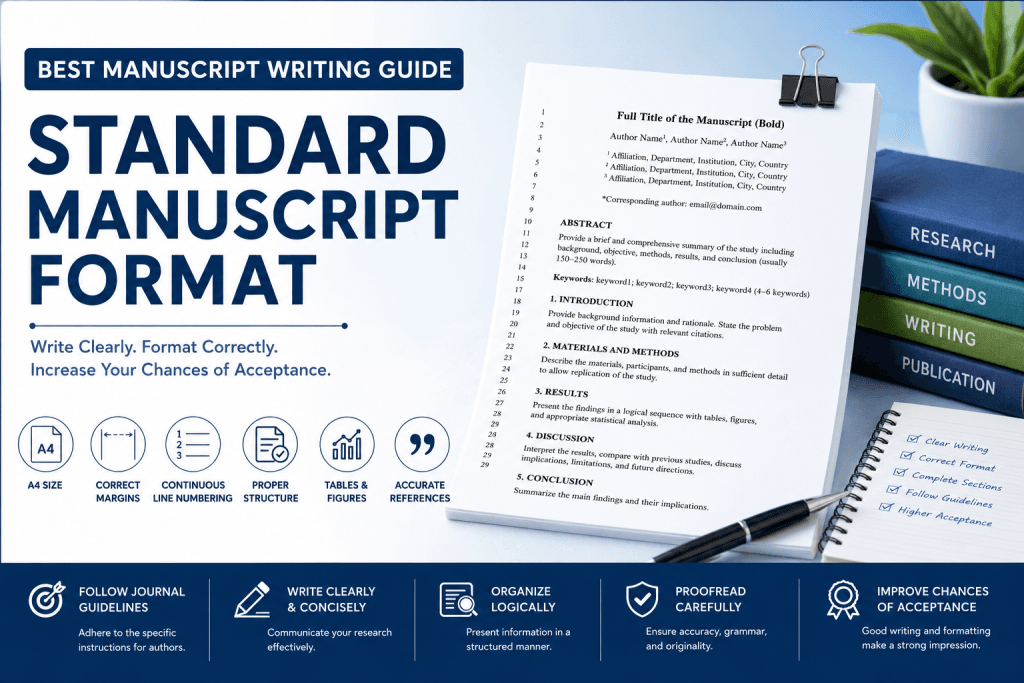
- The typical anatomy of a manuscript includes the title and abstract, introduction section, methods section, results section, discussion section, acknowledgement, author information, conflicts of interest, references, and supplementary materials. Each part of the manuscript serves a distinct purpose:
- The title and abstract provide a short description of the entire study, acting as the first impression for reviewers and readers alike.
- The introduction section builds the case for why the research matters by referencing existing literature and primary literature.
- The methods section explains exactly how the study was conducted, including study design, sample size, and statistical tests used.
- The results section presents your key results using tables and figures, without interpretation.
- The discussion section interprets those results, compares them to similar studies, and outlines strengths and limitations.
- Understanding why structure matters is essential before you even attempt to write a scientific manuscript. A well-organized scientific manuscript signals professionalism to reviewers and increases your odds of a smooth publication process. Poorly structured manuscripts, on the other hand, often get rejected before they even reach peer review, simply because the reviewer struggles to follow the logic or locate critical information.
- Learning to write a scientific manuscript is a skill that improves with practice, but knowing the structure from the outset saves enormous time and reduces the frustration that often accompanies a first scientific manuscript submission.
Writing a Scientific Manuscript in 5 Easy Steps
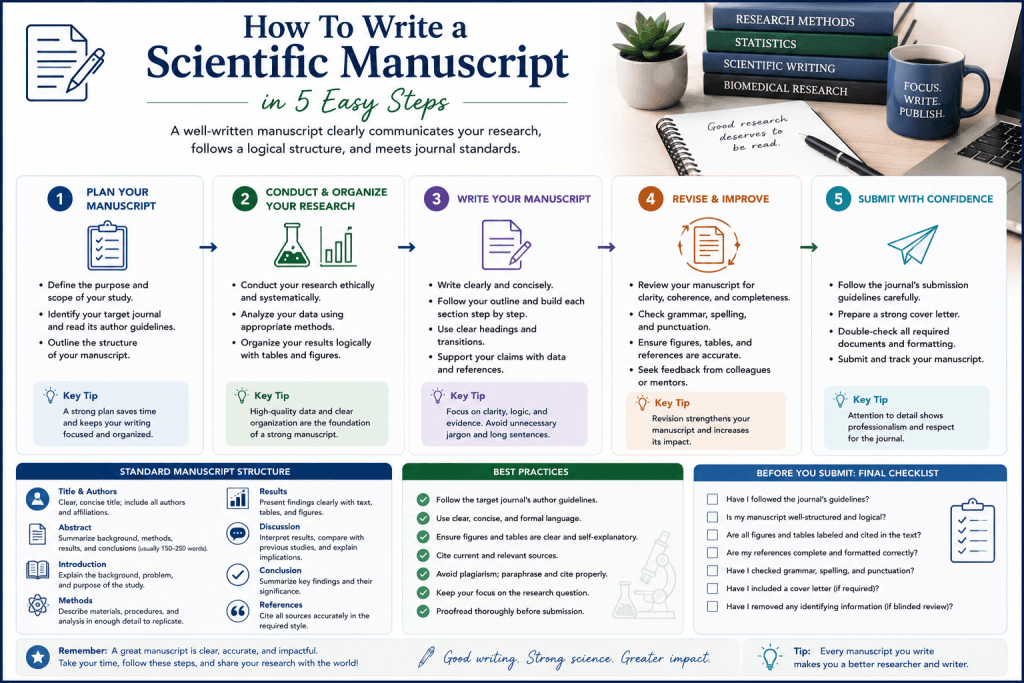
- Writing a scientific manuscript doesn’t have to feel overwhelming once you break it down into manageable stages. This guide to writing a scientific manuscript walks you through five easy steps: planning before you write, drafting the core sections, adding author information and conflicts of interest, preparing supplementary materials, and finally, reviewing and submitting your work.
- Whether you’re contributing original research to a Canadian journal, a clinical epidemiology publication, or a broader scientific journal, following this structured approach will help you produce a polished, submission-ready scientific manuscript every time.
Academic Writing & Research Support Need Help With Research Papers, Manuscripts, Editing, or Proofreading? At Scholarly Work , we provide professional academic writing support for researchers, students, and professionals. From drafting manuscripts to refining final submissions, we ensure clarity, accuracy, and publication-ready quality. Get Manuscript Writing Help
Step 1 – Planning Your Scientific Manuscript Before You Write
- Before you write a single word of your scientific manuscript, proper planning sets the tone for the entire manuscript writing process. Skipping this step is one of the most common reasons researchers struggle with their first scientific manuscript.
- Choose your target scientific journal early. Every scientific journal, whether it’s a Canadian journal, a title published by Springer Nature, or a journal indexed on PLOS, has its own formatting requirements, word limits, and article type categories. Selecting your journal before you write a scientific manuscript ensures you’re working within the correct structure from day one.
- Check whether the journal accepts original research, review articles, or systematic reviews, since this determines the expected format.
- Review a few recently published papers in that scientific journal to understand tone, length, and how figures and tables are typically presented.
- Understand your study design. Your study design (randomized controlled trial, cohort study, cross-sectional analysis, etc.) shapes how you’ll present your methods section and results section later. Knowing this early prevents restructuring your manuscript midway through writing.
- Gather your data and finalize your analysis. Data analysis should be complete, or nearly complete, before you begin drafting. This includes:
- Confirming your sample size is appropriate and clearly documented.
- Running and recording the statistical tests used, so you can reference them accurately in both the methods and results sections.
- Organizing raw data into clean tables and figures you can reference throughout the main text.
- Search the existing literature and primary literature thoroughly. A strong scientific manuscript demonstrates command of the scientific literature.
- Use databases like NCBI to identify key references relevant to your topic.
- Note where your research fits within existing literature, and identify the gap your study fills. This becomes the backbone of your introduction section later.
- Create an outline of your entire manuscript. Map out each section of the manuscript before writing, including:
- Title and abstract
- Introduction section
- Methods section
- Results section
- Discussion section
- Acknowledgement, author information, and conflicts of interest
- Supplementary materials
- Decide on abbreviation usage upfront. List every abbreviation you plan to use in your scientific manuscript and define each one the first time it appears. Consistency here prevents confusion for reviewers and readers.
- Draft a rough cover letter concept. While you’ll finalize your cover letter later, jotting early notes on why your original research matters to the journal’s subject areas helps clarify your manuscript’s core contribution from the very beginning.
- Set realistic timelines for each stage. Manuscript writing is rarely a one-sitting task. Block out dedicated time for drafting each section of the manuscript, from the introduction section through the discussion section, so the process doesn’t feel rushed as your submission deadline approaches.
- Taking the time to plan before writing a scientific manuscript pays off significantly. It reduces revisions, keeps your structure consistent, and ensures that when you sit down to write a scientific manuscript, you’re building on a solid foundation rather than guessing as you go.
Step 2 – Drafting the Core Sections of Your Manuscript
- With your planning complete, it’s time to actually draft the core sections of your scientific manuscript. This is where the bulk of your manuscript writing happens, and following a structured format keeps the process manageable.
- Writing the introduction section. The first paragraph of the introduction should establish the broader context of your topic within the scientific community.
- The second paragraph of the introduction should narrow the focus, referencing existing literature and primary literature to highlight the specific gap your study addresses.
- The final paragraph of the introduction section should clearly state your research question, hypothesis, or objective, giving reviewers a clear roadmap for what follows.
- Keep this section of the manuscript concise. A bloated introduction section is a common critique from reviewers.
- Writing the methods section. This section of the manuscript must be detailed enough that another researcher could replicate the study.
- Clearly describe your study design, participants or materials, sample size, and any tools or instruments used.
- Explain the statistical tests used for your data analysis, including software and version numbers where relevant.
- Use subheadings to break the methods section into digestible parts, such as “Participants,” “Procedure,” and “Statistical Analysis.”
- Writing the results section. Present your key results factually, without interpretation, saving analysis for the discussion section.
- Reference your tables and figures directly in the text, for example: “Table 1 summarizes baseline characteristics, while Figure 1 illustrates the primary outcome trend.”
- Include standard deviation and other relevant statistics alongside your findings to give reviewers and readers full context.
- Avoid redundancy between the text and your figures and tables; the text should highlight key results rather than repeat every number already visible in Figure 3 or Table 1.
- Writing the discussion section. This is where you interpret your results section findings.
- The first paragraph of the discussion should restate your key results in relation to your original research question.
- Middle paragraphs should compare your findings to similar studies within the existing literature, addressing whether your scientific manuscript supports, contradicts, or extends prior work.
- A dedicated paragraph of the discussion should honestly address strengths and limitations, which reviewers specifically look for.
- The last paragraph, often called the discussion and conclusion, should summarize the significance of your work and suggest future directions for the scientific community.
- Referencing figures and tables consistently. Throughout the main text, make sure every figure and table (Figure 1, Figure 3, Figure 5, Figure 6, Table 1, etc.) is cited at least once and appears in the order mentioned.
- Add citation throughout. Every claim referencing existing literature or primary literature needs proper citation, formatted according to your target scientific journal’s guidelines.
- Drafting the core sections of your scientific manuscript is often the most time-intensive part of writing a scientific manuscript, but breaking it into these structured components makes the workload far more approachable.
Step 3 – Adding Author Information, Acknowledgement, and Conflicts of Interest
- Once the main text of your scientific manuscript is drafted, it’s time to address the administrative but essential components: author information, acknowledgement, and conflicts of interest. These sections may seem secondary compared to your results section or discussion section, but skipping or rushing them can delay the entire publication process.
- Author information. This section of the manuscript identifies who contributed to the research and how.
- List all authors in the correct order, typically reflecting the level of contribution, with the corresponding author clearly marked.
- Include each author’s affiliation, such as their university or research institute, along with contact details for the corresponding author.
- Many journals, including those published by Springer and Springer Nature, require a contribution statement outlining each author’s specific role (e.g., data analysis, manuscript writing, study design).
- Double-check author information against your target scientific journal’s specific formatting guidelines, as requirements vary between a Canadian journal, a clinical epidemiology journal, and others.
- Acknowledgement section. This is where you recognize individuals or institutions who contributed to your original research but don’t meet the criteria for full authorship.
- Thank colleagues who assisted with data analysis, statistical tests used, or manuscript writing feedback.
- Acknowledge funding sources, grants, or your research institute, as many journals require this for transparency.
- Keep the acknowledgement section brief and professional; a few sentences are usually sufficient for this part of the manuscript.
- Conflicts of interest. Nearly every scientific journal, from PLOS to specialty medical journal publications, requires a clear conflicts of interest statement.
- Disclose any financial relationships, consulting roles, or personal relationships that could be perceived as influencing your original research.
- If there are no conflicts of interest, state this explicitly rather than omitting the section entirely, as reviewers and editors expect a clear statement either way.
- Being transparent about conflicts of interest protects your credibility within the scientific community and prevents complications later in the publication process.
- Consistency check. Before moving forward, review your author information, acknowledgement, and conflicts of interest sections together to ensure names, affiliations, and disclosures are consistent with the rest of your scientific manuscript.
- Why this step matters. Reviewers and editors take these sections seriously because they relate directly to research ethics and transparency. A scientific manuscript with incomplete or inconsistent author information, acknowledgement, or conflicts of interest sections can face delays, additional reviewer queries, or even rejection, regardless of how strong the original research itself is.
- Taking time to properly complete this part of the manuscript demonstrates professionalism and respect for the peer-reviewed process, both of which reflect well on you as a researcher within the broader scientific community.
Academic Writing & Research Support Need Help With Research Papers, Manuscripts, Editing, or Proofreading? At Scholarly Work , we provide professional academic writing support for researchers, students, and professionals. From drafting manuscripts to refining final submissions, we ensure clarity, accuracy, and publication-ready quality. Get Manuscript Writing Help
Step 4 – Preparing Supplementary Materials for Your Scientific Manuscript
- Many scientific manuscripts include supplementary materials, additional content that supports the main text without cluttering the core narrative of the results section or discussion section. Preparing supplementary materials properly is an often-overlooked but important part of manuscript writing.
- What counts as supplementary materials? These typically include:
- Extended datasets or raw data that support your data analysis but are too large or detailed for the main text.
- Additional figures and tables that provide supporting evidence but aren’t essential to the complete story told in the results section.
- Detailed protocols, questionnaires, or survey instruments used in your study design.
- Extra statistical tests used for sensitivity analyses or subgroup comparisons.
- Video content, code, or software scripts relevant to reproducibility, particularly common in journals affiliated with Springer Nature or PLOS.
- Why include supplementary materials at all?
- They keep your main text focused and readable, letting your results section highlight only the key results while supplementary materials hold supporting detail.
- They enhance transparency and allow other researchers to replicate the study more thoroughly.
- They satisfy growing expectations from the scientific community and many scientific journal editors for open, reproducible original research.
- Formatting supplementary materials correctly.
- Label each supplementary file clearly and reference it within the main text (e.g., “see Supplementary Table 2” or “additional analysis available in Supplementary Figure 3”).
- Follow your target journal’s specific guidelines, since a Canadian journal, a clinical epidemiology outlet, or a PLOS publication may each have different formatting expectations for supplementary materials.
- Avoid redundancy: don’t duplicate figures and tables already presented in the main text of your scientific manuscript within your supplementary materials.
- Licensing and reuse considerations. Many open-access journals, particularly those under PLOS, require content, including supplementary materials, to be shared under a Creative Commons Attribution 4.0 International license. Check your target journal’s policy so you can properly label ownership and reuse permissions for both your main text and supplementary materials.
- Common mistakes to avoid.
- Overloading supplementary materials with information that actually belongs in the results section or discussion section.
- Forgetting to cite supplementary materials within the main text, leaving reviewers confused about their relevance.
- Submitting supplementary files in inconsistent formats that don’t match journal submission guidelines.
- Organize supplementary materials logically. Number each supplementary file in the order it’s first mentioned in the main text, and include a short title or description for every item so reviewers and readers can navigate them without confusion. A disorganized set of supplementary materials can frustrate reviewers just as much as a disorganized results section.
- Well-prepared supplementary materials strengthen your scientific manuscript by demonstrating thoroughness and transparency, both qualities that reviewers and the broader scientific community value highly in original research.
Step 5 – Final Review and Submission of Your Scientific Manuscript
- After drafting your core sections, adding author information, acknowledgement, conflicts of interest, and supplementary materials, your scientific manuscript is almost ready for submission. This final step ensures everything comes together as a complete story before it reaches peer review.
- Conduct a thorough self-review.
- Read through your entire scientific manuscript from start to finish, checking that the introduction section, methods section, results section, and discussion section flow logically into one another.
- Verify that every abbreviation is defined at first use and used consistently throughout the main text.
- Confirm that every figure and table, from Figure 1 through Figure 6 and Table 1, is properly labeled, referenced, and free of redundancy with the surrounding text.
- Check citation accuracy and formatting.
- Ensure every claim referencing existing literature, primary literature, or key references includes proper citation formatted to your target scientific journal’s style guide.
- Cross-check your reference list against in-text citation to catch any missing or mismatched entries, a common mistake in a first scientific manuscript.
- Have colleagues review your manuscript.
- Ask experts in the field, ideally those familiar with your specific study design or subject areas, to review your scientific manuscript before submission.
- Colleague feedback often catches structural or clarity issues that you, as the author, may have missed after spending so long immersed in the manuscript writing process.
- Prepare your cover letter.
- Your cover letter should briefly summarize your original research, explain why it fits the scope of the target scientific journal, and highlight the significance of your key results.
- Mention the article type (original research, review article, etc.) and confirm there are no overlapping submissions elsewhere.
- Review journal-specific submission guidelines.
- Whether submitting to a Canadian journal, a clinical epidemiology publication, or a journal under Springer or Springer Nature, carefully follow formatting rules for the main text, figures and tables, and supplementary materials.
- Confirm licensing details, such as Creative Commons requirements, are correctly acknowledged if your work will be published as open access.
- Submit and prepare for peer review.
- Once submitted, your scientific manuscript enters the peer-reviewed process, where reviewers evaluate your study design, results section, discussion section, and overall contribution to the scientific literature.
- Be prepared to respond to reviewer comments professionally, revising sections of the manuscript as needed while maintaining the integrity of your original research.
- Format the main text according to journal templates. Many scientific journal websites, including those hosted through Springer Nature, provide downloadable templates that specify margins, font, and heading styles for the main text. Using these templates before final submission saves time during the editorial screening stage and reduces the chance of a desk rejection over formatting alone.
- Completing this final review and submission step transforms your scientific manuscript from a draft into a polished, submission-ready contribution to the scientific community. With careful planning, structured drafting, complete author information and disclosures, well-prepared supplementary materials, and a thorough final review, your scientific manuscript will be well-positioned to succeed in the competitive publication process.
References
- Purdue University Online Writing Lab (OWL) – Research and Manuscript Writing Resources – https://owl.purdue.edu/owl/research_and_citation/resources.html
- University of Washington Writing Center – Academic Writing and Research Papers Guide – https://www.writingcenter.uw.edu/
- Massachusetts Institute of Technology (MIT) Writing and Communication Center – Scientific and Academic Writing Support – https://writing.mit.edu/wcc