How to Find Issue Number of an Article: A Quick Overview
If you’ve ever stared at a journal article wondering where the issue number actually is, you’re not alone. Learning how to find issue number of an article is one of those small research skills that feels confusing at first but becomes second nature once you know where to look. This section gives you a fast, practical overview before we go deeper into the details.
This guide covers everything you need to know about how to find issue number of an article, from the fastest shortcuts to the more thorough research methods, so let’s break it down step by step.
- Start with the article itself. The fastest way to figure out how to find issue number of an article is to simply open the article and check the header or footer area near the article title. Publishers almost always print the volume and issue number somewhere on the first page of the article, usually right below or beside the journal title.
- Check the journal’s homepage. If the issue number isn’t obvious on the article itself, visit the journal’s official website. Every academic or peer-reviewed journal organizes its content by volume and issue, so browsing the journal’s archive page will show you exactly which issue your article belongs to.
- Use the database record. When you access an article through a library database (like JSTOR, EBSCO, or ProQuest), the citation information — including the volume, issue, and page numbers — is typically listed right next to the article title in the search results or on the article’s detail page.
- Look at the PDF cover page or footer. Many journal articles include a running header or footer on every page that repeats the journal title, volume number, issue number, and page range. This is a reliable shortcut when you’re already deep into reading and don’t want to scroll back to the first page.
- Search by DOI. If you have the DOI (Digital Object Identifier) of the article, you can paste it into a DOI resolver like doi.org, and it will take you directly to the publisher’s page, where the volume and issue number are always displayed near the top.
- Ask a librarian. If you’re still unsure how to find issue number of an article, academic librarians are trained specifically to help with citation information. Many university libraries also publish LibGuides — step-by-step guides — dedicated to citing journal articles correctly.
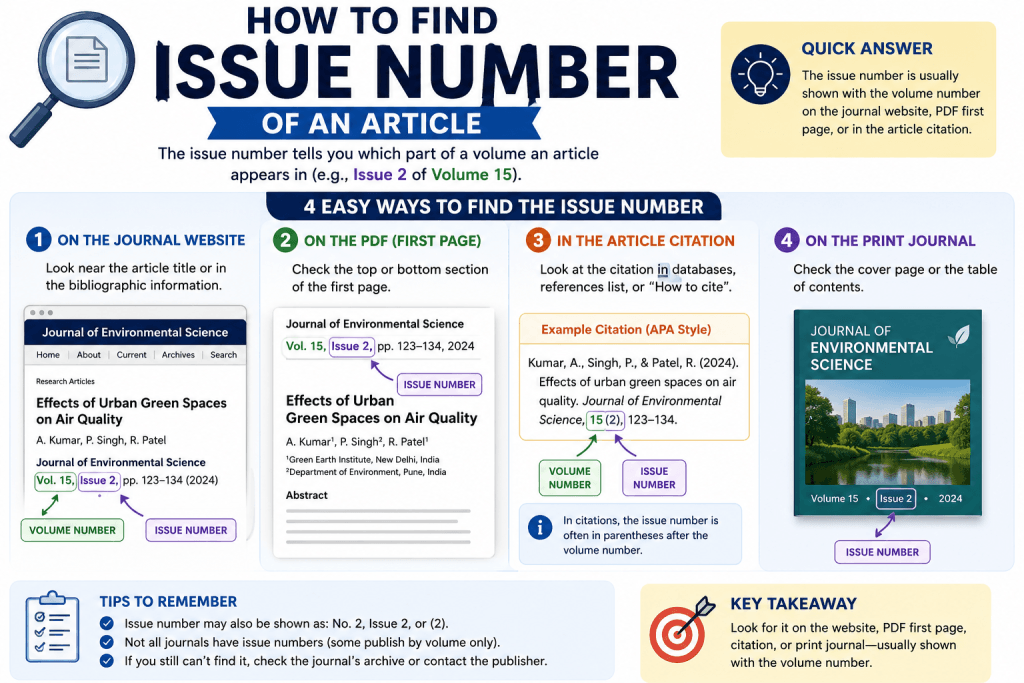
Here’s a simple example to make this concrete. Suppose you’re reading an article titled “Cognitive Load and Memory Retention in Adult Learners,” published in the Journal of Educational Psychology. At the top of the first page, you might see something like: Vol. 45, No. 3, pp. 210–225. In this example, “Vol. 45” is the volume number, and “No. 3” is the issue number. That’s it — you’ve just learned how to find issue number of an article in real time, using an actual citation format you’ll see constantly in academic work.
Why does this matter so much? Because when you cite a source in APA, MLA, or any other academic format, the volume and issue numbers are required elements of a complete and accurate reference. Missing this detail can make your citation incomplete, which is a common issue for students and researchers alike. Understanding how to find issue number of an article isn’t just a technical skill — it directly affects the credibility and accuracy of your academic writing.
It’s also worth noting that not every publication uses issue numbers the same way. Some journals are published continuously throughout the year without separate issues, while magazines and newspapers may use dates instead of issue numbers. So part of learning how to find issue number of an article is recognizing which type of resource you’re working with — an academic journal, a magazine, or a newspaper — since each has slightly different conventions for numbering.
As you move through this guide, you’ll find detailed examples, formatting tips, and troubleshooting advice for locating this information no matter where your article was published. Whether you’re a student citing sources for a research paper or a professional preparing a reference list, this guide will walk you through how to find issue number of an article step by step, using real examples along the way. By the end, how to find issue number of an article will feel like second nature rather than a confusing chore.
Understanding the Difference Between Volume and Issue Number in a Journal
Before you can master how to find issue number of an article, it helps to understand what volume and issue numbers actually represent. These two elements often appear together, but they mean different things. This distinction is the foundation of learning how to find issue number of an article correctly, so let’s slow down and look at each piece separately.
- Volume number explained. A volume typically represents one full year (or sometimes one full publishing cycle) of a journal. For example, if a journal has been publishing since 1980, and it releases one volume per year, then in 2024 it would likely be on Volume 44 or 45, depending on when it started.
- Issue number explained. Within each volume, journals release multiple issues throughout the year — monthly, quarterly, or biannually, depending on the publication. The issue number tells you which specific release, within that year’s volume, contains your article. So “Volume 45, Issue 3” means the third issue published within the 45th year of that journal’s existence.
- Why both numbers matter together. Volume and issue numbers work as a pair to pinpoint the exact publication your article came from. Citing only the volume number without the issue number (or vice versa) can make it difficult for readers to locate the same source, especially for older journals or ones where page numbering restarts with each issue.
- A simple example to clarify. Imagine the Journal of Marketing Research publishes six issues per year. An article that appears in the fourth release of 2023 might be cited as “Volume 60, Issue 4.” Here, the volume number (60) reflects the 60th year of publication, and the issue number (4) reflects that it’s the fourth issue released that year.
- Page numbering can be a clue. Some journals number pages continuously across an entire volume (so Issue 1 might end at page 150, and Issue 2 starts at page 151), while others restart page numbers at “1” for every new issue. If you notice the first page of the article starts at page 1, that’s often a sign the journal uses issue-specific pagination — which makes the issue number even more essential for locating and citing the source correctly.
- Not every publication uses this system. Magazines, newspapers, and some online-only journals may skip issue numbers entirely and use publication dates instead. This is another reason why understanding the type of source you’re working with is a key part of learning how to find issue number of an article accurately.
Understanding this distinction makes the rest of the process much easier. Once you know that the volume reflects the year (or cycle) and the issue reflects the specific release within that year, you’ll never confuse the two elements again — and you’ll be able to find the issue number of an article far more confidently, even in unfamiliar formats. This clarity is what makes how to find issue number of an article so much easier the second time around.
Academic Writing & Research Support Need Help With Research Papers, Manuscripts, Editing, or Proofreading? At Scholarly Work , we provide professional academic writing support for researchers, students, and professionals. From drafting manuscripts to refining final submissions, we ensure clarity, accuracy, and publication-ready quality. Get Manuscript Writing Help
Where to Locate the Issue Number on a Journal Article
Now that you understand what an issue number is, let’s talk specifically about where to physically find it. This is often the most practical part of learning how to find issue number of an article, especially when you’re working from a printed copy or a downloaded PDF. If you’ve been wondering how to find issue number of an article without flipping through the whole publication, these locations are your best starting points.
- Near the article title, at the top of the first page. In most academic journals, the volume and issue number are printed directly above or below the article title, often alongside the journal title and publication date. This is usually the very first place to check.
- In the running header or footer. Many journal articles include a repeating header or footer on every page that lists the journal title, volume, issue, and page range. If you flip to any page in the middle of the article, you’ll often see something like “Journal of Applied Psychology, Vol. 108, No. 2″ printed at the top or bottom of the page.
- On the article’s cover or first page of the PDF. If you downloaded the article as a PDF from a database or the publisher’s website, the cover page (if there is one) usually displays the full citation information, including volume and issue number, author’s name, article title, and page range.
- In the table of contents of the issue. If you have access to the full issue (not just the individual article), the table of contents page will list every article published in that issue, along with the issue number clearly stated at the top.
- On the journal’s website, next to the article listing. When browsing a journal’s website, each article is typically listed under its corresponding issue, so simply seeing where the article is categorized tells you the issue number instantly.
- A real example. Say you’re holding a printed copy of an article from Nature. At the top of the first page, you might see: “Nature, Vol. 621, Issue 7978, pp. 45–52.” Everything you need is right there — the journal title, volume number, issue number, and the first page of the article through to the last page.
- When the issue number is missing. Occasionally, especially with early access or “online first” articles, the issue number hasn’t been assigned yet because the article hasn’t been placed into a specific issue. In these cases, the article may only display a DOI and volume number until it’s formally issued, so checking back later or looking up the DOI is your best resource.
Knowing exactly where to look eliminates most of the guesswork. Once you’ve checked these five or six spots, you’ll have a reliable method for how to find issue number of an article regardless of the journal’s layout or formatting style. These simple checks are usually all it takes to answer how to find issue number of an article without needing outside help.
Using Library Databases and Online Resources to Find Volume or Issue Number
Sometimes the physical article isn’t in front of you, or the issue number simply isn’t printed clearly. This is where library databases and online resources become incredibly useful for figuring out how to find issue number of an article with confidence. These digital resources are often the quickest answer to how to find issue number of an article when the printed copy isn’t available.
- University library databases. Most academic libraries subscribe to databases like JSTOR, EBSCOhost, ProQuest, and Web of Science. When you search for an article title in these databases, the citation information — including the volume and issue number — is displayed directly in the search results, usually just below the article title and author’s name.
- Google Scholar. This free resource is one of the easiest places to locate citation information. Simply search the article title, and click the “Cite” button (shown as quotation marks) beneath the result. Google Scholar will generate a formatted citation in APA, MLA, or Chicago style, complete with the volume and issue number already filled in.
- The publisher’s website directly. If you know which journal published the article, going straight to the publisher’s website (like Elsevier, Springer, Wiley, or SAGE) and searching their archive is a highly reliable method. Publishers list every issue chronologically, so you can browse by year and issue to confirm the exact numbers.
- CrossRef and DOI lookup tools. If you have the DOI of the article, sites like crossref.org or doi.org will pull up the full citation information instantly, including the journal title, volume, issue number, publication date, and page range — no guesswork required.
- University LibGuides. Many university library websites publish LibGuides specifically about citing journal articles. These guides often include screenshots and annotated examples showing exactly where to locate the volume and issue number in different databases, making them a fantastic resource for students who are new to academic research.
- Citation management tools. Software like Zotero, Mendeley, and EndNote can automatically pull citation information — including volume and issue numbers — when you import an article using its DOI or URL. This is especially helpful when managing a large number of sources for a research paper.
- A worked example. Let’s say you’re trying to cite an article but only have the title: “Social Media Use and Adolescent Well-Being.” You search this title in Google Scholar, and among the results, you see: Journal of Youth and Adolescence, 2022, Vol. 51, Issue 6, pp. 1123–1140. Clicking “Cite” gives you a ready-made APA reference with the volume and issue number already included, saving you the trouble of digging through the original PDF.
- When online resources disagree. Occasionally, two databases might list slightly different information (for example, one might show an “early access” version without an issue number, while another shows the finalized issue). In these situations, always defer to the publisher’s official website, since it’s the original source and the most accurate resource for confirming publication details.
Using these online tools makes the entire process faster and far less frustrating. Instead of manually flipping through pages, you can rely on library databases and citation tools to instantly show you the answer to how to find issue number of an article, cutting your research and citation time significantly. Whether you use Google Scholar, a university database, or a DOI lookup tool, you now have several dependable resources for how to find issue number of an article whenever you need it.
Academic Writing & Research Support Need Help With Research Papers, Manuscripts, Editing, or Proofreading? At Scholarly Work , we provide professional academic writing support for researchers, students, and professionals. From drafting manuscripts to refining final submissions, we ensure clarity, accuracy, and publication-ready quality. Get Manuscript Writing Help
How to Format the Issue Number in an APA Citation or Reference
Once you’ve located the volume and issue number, the next step is formatting it correctly in your reference list. This is a crucial part of learning how to find issue number of an article, because locating the number is only half the job — citing it properly is what actually matters for academic integrity. Understanding how to find issue number of an article is not useful unless you also know how to present that number correctly in your citation.
- Basic APA format for journal articles. In APA 7th edition, the format looks like this: Author’s Last Name, First Initial. (Publication Year). Title of the article. Journal Title, Volume(Issue), first page–last page. DOI or URL.
- A full example. Here’s what a complete APA citation looks like: Smith, J. A. (2023). Cognitive load and memory retention in adult learners. Journal of Educational Psychology, 115(3), 210–225. https://doi.org/10.1037/edu0000123 Notice how the volume number (115) is italicized, while the issue number (3) is placed in parentheses right after it, not italicized.
- Why the issue number is in parentheses. This formatting convention helps readers instantly distinguish between the volume and issue number without confusion, since the volume is styled differently (italicized) than the issue.
- When there’s no issue number. If a journal doesn’t use issue numbers (some continuously paginated journals don’t), you simply omit it and format the citation as: Journal Title, Volume, first page–last page. There’s no need to include empty parentheses.
- In-text citations don’t need the issue number. A common point of confusion is thinking the issue number needs to appear in your in-text citation. In APA style, in-text citations only require the author’s last name and the publication date — for example, (Smith, 2023). The volume and issue number are reserved for the full reference list at the end of your paper.
- MLA format for comparison. If you’re using MLA instead of APA, the format differs slightly: Smith, John A. “Cognitive Load and Memory Retention in Adult Learners.” Journal of Educational Psychology, vol. 115, no. 3, 2023, pp. 210–225. In MLA, “vol.” and “no.” are spelled out, rather than using parentheses.
- A tip for accuracy. Always double-check that the volume and issue number you’re citing match the version of the article you actually read, especially if you accessed it through a database that might list an earlier “online first” version with different numbering.
Getting the formatting right isn’t complicated once you’ve seen a few examples side by side. The key is remembering that the volume number is italicized and the issue number follows immediately in parentheses — a small formatting detail, but one that citation guides and professors take seriously.
Journal Articles
Want to go deeper on journal articles? Explore more guides from our Journal Articles collection below.
-
What Is a Scientific Journal?
-
How to Write a Journal Article
-
Journal vs. Article: What’s the Difference?
-
How to Find an Article’s Issue Number
-
Citing a Journal Article in Chicago Style
-
APA Journal Article Citation Guide
-
What Is an SCI Journal?
-
Scientific Journal Examples
-
Sample Journal Article
-
How to Write an Article Summary
-
Chemistry Journals for Short Articles & Notes
-
Publishing in Nurse Practitioner Journals
Common Mistakes When Citing a Journal Article’s Issue Number
Even after you’ve learned how to find issue number of an article, it’s easy to make small errors when actually writing the citation. Here are the most common mistakes to watch for, along with guidance on how to avoid them. Knowing how to find issue number of an article is only useful if you also avoid these common slip-ups when applying that information.
- Confusing the volume number with the issue number. This is by far the most frequent mistake. Remember: the volume number reflects the year or overall publishing cycle (and is italicized in APA), while the issue number reflects the specific release within that year (and goes in parentheses). Mixing these up is a common issue that can make your reference list inaccurate.
- Leaving out the issue number entirely. Some students assume the volume number alone is sufficient, but for journals that use issue-specific pagination, omitting the issue number makes it much harder for a reader to locate the exact source. Always include both the volume and issue number whenever they’re available.
- Citing the wrong page range. Because the “first page of the article” often resets to page 1 within a new issue, it’s easy to accidentally grab page numbers from a different issue if you’re working from a photocopy or scanned PDF that doesn’t clearly show the article boundaries.
- Using database-generated citations without checking them. While Google Scholar and database “Cite” buttons are convenient, they aren’t always perfectly accurate. It’s a smart habit to double-check the generated citation information against the original journal article, particularly the volume and issue number, before adding it to your reference list.
- Forgetting to italicize the volume number. In APA format, the volume number must be italicized, while the issue number (in parentheses) is not. This is a small formatting detail, but professors and journal editors do notice when it’s inconsistent.
- Mixing citation styles. Sometimes writers accidentally blend APA and MLA formatting — for example, writing “vol. 115(3)” instead of choosing one consistent style. Always confirm which citation format your instructor or publisher requires, and apply it consistently throughout your reference list.
- Citing an “online first” version incorrectly. As mentioned earlier, some articles are published online before being assigned to a specific issue. If you cite the article using only the DOI and no issue number, but the article is later formally published with a volume and issue number, your citation may become outdated. It’s worth checking back closer to your submission date to confirm the article was published in its final issue.
- Not verifying the source type. Not every article is a peer-reviewed journal article — some come from magazines, newspapers, or trade publications, which follow different citation rules. Assuming every academic-looking article is a peer-reviewed journal article without verifying can lead to citing it in the wrong format entirely, and it can also change how you approach how to find issue number of an article in the first place.
- A helpful example of catching a mistake. Imagine you initially cited an article as: Smith, J. (2023). Journal of Educational Psychology, 115, 210–225 — leaving out the issue number. After going back to the database and checking the description of the article, you notice it actually belongs to Issue 3. The corrected citation, Smith, J. (2023). Journal of Educational Psychology, 115(3), 210–225, is now complete and accurate.
- Final tip. Whenever you’re unsure, cross-reference at least two resources — the original article and a database or citation tool — to confirm your volume and issue number match before finalizing your reference list. This simple habit prevents most of the common mistakes listed above and ensures your citation information is accurate and professional.
By avoiding these pitfalls, you’ll not only master how to find issue number of an article, but you’ll also produce cleaner, more credible reference lists that hold up to academic scrutiny — whether you’re citing a peer-reviewed journal, a database source, or an article accessed directly through a publisher. With this guide, how to find issue number of an article is no longer a mystery, and you now have every tool and example needed to get it right every time.
- University of California, San Francisco (UCSF) – Scientific Writing and Scholarly Publishing: Article Writing – https://guides.ucsf.edu/writingpublishing/articles
- George Washington University – Writing and Publishing a Scientific Article Guide – https://libguides.gwu.edu/sciencepublishing
- University of North Carolina at Chapel Hill – Writing and Citing Resources: How to Write Scientific Papers – https://guides.lib.unc.edu/writing-citing
- University of Illinois at Chicago – Scientific Writing: Journal Articles Guide – https://researchguides.uic.edu/ScientificWriting/JournalArticles