What Is a Scientific Journal? A Guide to Academic Journals
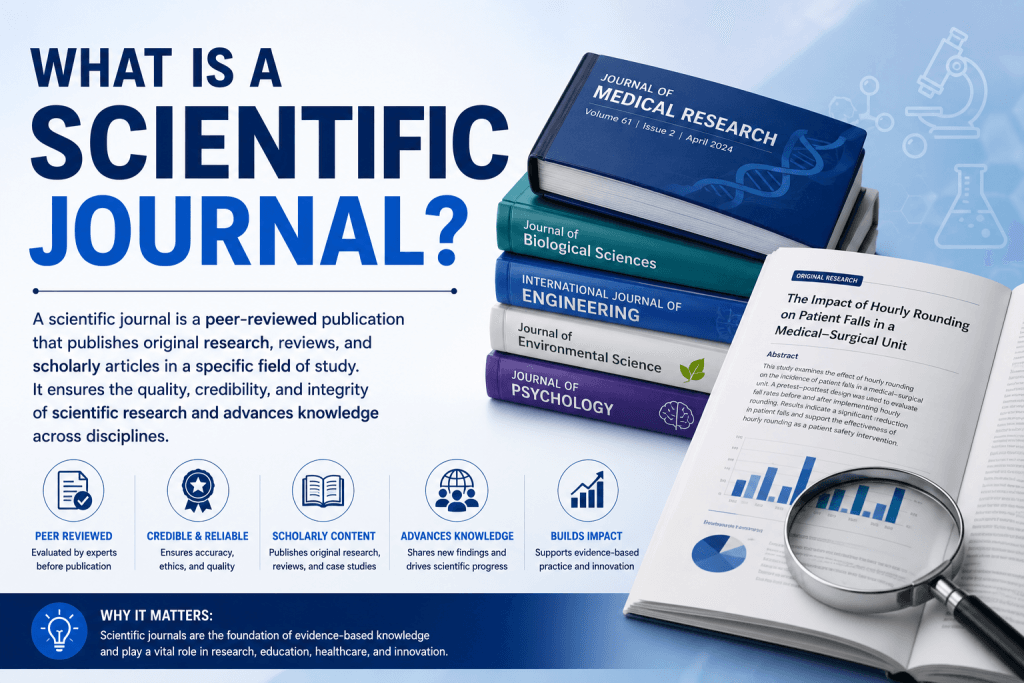
- A scientific journal is a scholarly journal that publishes research articles, reviews, and findings from a specific discipline or across multiple areas of science. Every academic journal exists to share new knowledge, examine existing theories, and document the advancement of science over time.
- Most scientific journals follow a consistent publication cycle — weekly, monthly, quarterly, or annual — where an editor and editorial board assess submissions before they reach print or digital databases.
- When researchers submit a study to a journal, it typically goes through peer review, meaning independent experts in the same discipline critically examine the article, methodology, and findings before publication is approved.
- Scientific journal examples exist across nearly every area of science, including medicine, psychology, environmental science, immunology, and molecular biology. Some are general in scope, publishing research articles from many disciplines, while others are highly specialized, covering a single field like cancer research or theoretical physics.
- Institutions such as a state university or organizations like the American Association for the Advancement of Science often publish or sponsor their own academic journal, lending credibility and a built-in network of scholars and reviewers.
- Understanding scientific journal examples helps researchers, students, and academics identify where to publish their own article, which journals align with their field, and how each publication’s editorial standards compare.
- This guide walks through scientific journal examples across medicine, psychology, and open access publishing, along with practical strategy for choosing the right one for your next submission.
Top Scientific Journal Examples in Medicine and Health Sciences
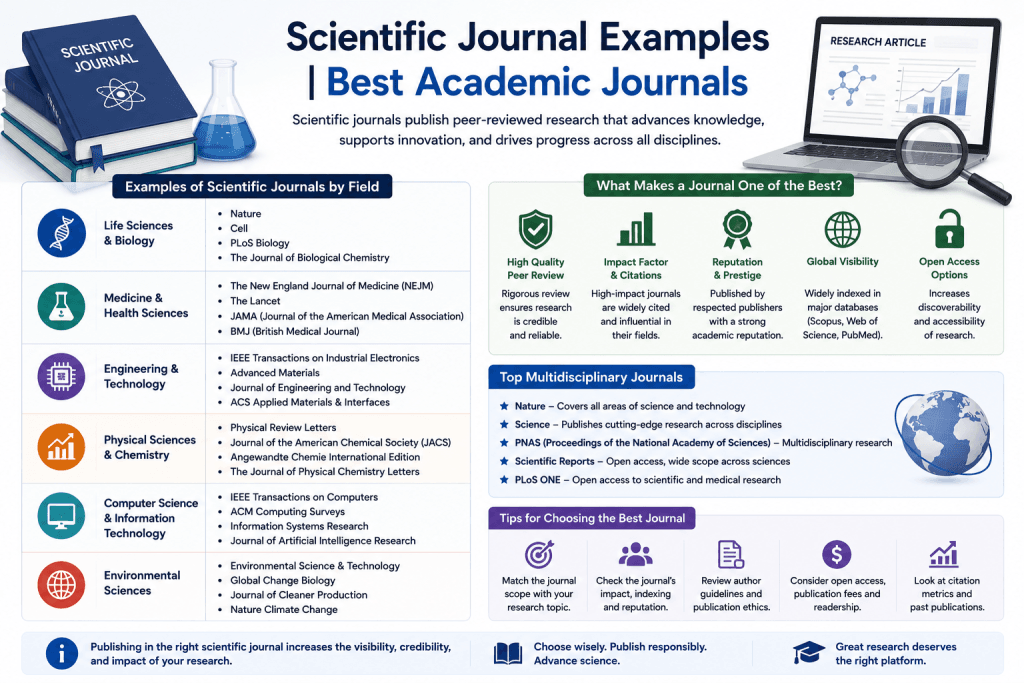
Medicine and public health remain among the most active areas of science for publication, and there is no shortage of respected scientific journal examples to study, cite, or submit to. Below are some of the most influential ones.
- The New England Journal of Medicine (NEJM) — Widely regarded as one of the top scientific journal examples in clinical medicine, NEJM publishes original research articles, reviews, and case studies covering nearly every medical discipline. Its editorial board is known for a highly competitive submission process, and the journal has a long-standing reputation for advancing evidence-based medicine through rigorous peer-reviewed research.
- The Lancet — Based in the United Kingdom, The Lancet is a weekly peer-reviewed journal covering global health, clinical medicine, and public health policy. It regularly publishes findings on infectious disease, cancer, immunology, and environmental health, making it one of the more comprehensive scientific journal examples for researchers examining large-scale health trends.
- JAMA (Journal of the American Medical Association) — JAMA is another leading academic journal in medicine, publishing research articles, editorial commentary, and clinical reviews. It’s especially useful for scholars studying public health policy, since it frequently features studies that examine healthcare systems, treatment outcomes, and medical ethics.
- BMJ (formerly the British Medical Journal) — BMJ is a well-established scientific journal known for publishing both original research and opinion pieces from physicians and public health experts. It also accepts letters and rapid responses, allowing for ongoing academic dialogue after an article’s publication.
- Cell — While Cell covers broader molecular and cellular biology, it’s frequently cited among scientific journal examples relevant to medicine because so much of modern treatment research begins at the molecular level. Its findings often influence downstream clinical research, particularly in cancer and immunology.
- Nature Medicine — A specialized offshoot of the Nature publishing group, Nature Medicine focuses on translational research — the kind that moves from laboratory studies to real-world clinical applications. It’s a strong scientific journal example for anyone investigating how basic science discoveries eventually shape patient care.
- Journal of Clinical Oncology — For researchers specifically focused on cancer, this is one of the most cited scientific journal examples in oncology. It publishes peer-reviewed studies on cancer treatment strategy, clinical trial outcomes, and emerging therapies, and it maintains a strong editorial board of practicing oncologists.
- The Journal of the American College of Cardiology (JACC) — This scientific journal example specializes in cardiovascular medicine, publishing research articles, case reviews, and proceedings from major cardiology conferences. It’s a go-to publication for scholars examining heart disease and related treatment strategy.
- PLOS Medicine — As one of the most cited open-access scientific journal examples in medicine, PLOS Medicine offers free access to its research articles, removing the pricing barriers that can restrict access to conventional, subscription-based medical journals. It covers a wide scope of public health topics and is a favorite among scholars who want their findings to reach a broader audience.
- American Journal of Public Health — Published by the American Public Health Association, this academic journal focuses specifically on public health research, from epidemiology to health policy. It’s particularly useful for scholars examining community health trends, environmental health risks, and healthcare access.
A few additional points worth noting about scientific journal examples in medicine and health sciences:
- Many of these journals maintain a rigorous peer-reviewed process, often requiring multiple rounds of revision before an article is accepted for publication. This can make the submission process lengthy, sometimes taking several months from initial submission to final publication.
- Some medical journals, like NEJM and The Lancet, also publish annual special issues or thematic collections that examine a single topic — such as a global pandemic or an emerging area of immunology — in significant depth.
- Editorial standards vary between publications. A general medical journal like JAMA may accept a broader scope of research articles, while a specialized publication like the Journal of Clinical Oncology restricts submissions to studies directly related to cancer research.
- Many of these scientific journal examples now offer hybrid publishing models, allowing authors to choose between traditional subscription-based publication and open-access publication (often for an additional fee), giving researchers flexibility depending on their funding and audience goals.
- For students and early-career researchers, studying how these journals structure their research articles — from abstract to discussion — is one of the best ways to learn academic writing conventions specific to medicine and health sciences.
Academic Writing & Research Support Need Help With Research Papers, Manuscripts, Editing, or Proofreading? At Scholarly Work , we provide professional academic writing support for researchers, students, and professionals. From drafting manuscripts to refining final submissions, we ensure clarity, accuracy, and publication-ready quality. Get Manuscript Writing Help
Best Scientific Journal Examples for Psychology Research and Publication
Psychology is a discipline that spans clinical practice, cognitive science, social behavior, and neuroscience, so it’s no surprise there’s a wide variety of scientific journal examples dedicated to the field. Here are some of the most respected options for researchers and scholars in psychology.
- Psychological Science — Published by the Association for Psychological Science, this is one of the leading scientific journal examples in the field, covering a broad scope of psychological research, from cognitive processes to social behavior. It’s known for publishing concise, high-impact research articles that examine cutting-edge findings.
- Journal of Personality and Social Psychology (JPSP) — This academic journal is considered a cornerstone publication in social and personality psychology. It publishes peer-reviewed studies on topics like identity, motivation, and interpersonal relationships, and its editorial board is composed of leading scholars in the discipline.
- American Psychologist — As the flagship journal of the American Psychological Association, American Psychologist publishes a mix of research articles, reviews, and opinion pieces covering the full scope of psychology as a discipline. It’s a strong scientific journal example for scholars wanting to reach a broad academic audience.
- Journal of Abnormal Psychology — This specialized journal focuses on psychopathology and clinical psychology, examining findings related to mental health disorders, diagnostic criteria, and treatment strategy. It’s frequently cited by clinicians and researchers studying abnormal behavior patterns.
- Developmental Psychology — This academic journal focuses specifically on human development across the lifespan, publishing studies that examine cognitive, social, and emotional growth from infancy through late adulthood. It’s a valuable scientific journal example for researchers in child psychology or gerontology.
- Cognitive Psychology — For scholars interested in memory, perception, and reasoning, this journal offers a deep, theoretical approach to understanding how the mind processes information. It regularly publishes research articles grounded in experimental methodology.
- Journal of Consulting and Clinical Psychology — This is a leading scientific journal for clinical psychologists, publishing peer-reviewed studies on therapeutic interventions, treatment outcomes, and diagnostic tools. It’s particularly relevant for practitioners looking to apply published findings directly to clinical settings.
- Frontiers in Psychology — Among open-access scientific journal examples in this field, Frontiers in Psychology publishes a high volume of research across nearly every psychology subfield. Its rapid review process makes it appealing to researchers who want their findings published and accessible more quickly than in some conventional academic journals.
A few important points to consider when evaluating scientific journal examples in psychology:
- Many psychology journals require authors to follow strict APA (American Psychological Association) formatting guidelines, which cover everything from citation style to how research articles should be structured.
- The scope of psychology journals varies considerably — some, like American Psychologist, cover the discipline broadly, while others, like the Journal of Abnormal Psychology, restrict submissions to a narrower research focus.
- Competitive acceptance rates are common among top-tier psychology journals. Publications like JPSP and Psychological Science often reject a significant percentage of submissions, so researchers should carefully assess whether their study aligns with a given journal’s editorial priorities before submitting.
- Open-access scientific journal examples like Frontiers in Psychology have grown in popularity because they remove pricing restrictions for readers, allowing findings to reach practitioners, students, and the public more easily.
- When choosing where to submit a psychology-related article, researchers should also consider a journal’s typical publication cycle — some operate on a rapid, rolling basis, while others follow a strict quarterly or annual schedule.
- Many psychology journals also publish book reviews and commentary pieces alongside original research articles, giving scholars additional venues to contribute to ongoing academic conversations without submitting a full empirical study.
Open Access Scientific Journal Examples Worth Publishing In
Open access publishing has reshaped how researchers share findings, removing pricing barriers and allowing anyone — not just those with institutional database access — to read published research articles. Below are some notable open-access scientific journal examples across different disciplines.
- PLOS ONE — One of the most well-known open-access scientific journal examples, PLOS ONE publishes research across all areas of science, from medicine to environmental studies. Rather than restricting submissions by novelty or perceived impact, it focuses on scientific rigor, meaning a wider range of peer-reviewed studies get published.
- Scientific Reports — Published by the Nature portfolio, Scientific Reports is a large, open-access scientific journal covering a broad scope of disciplines, including molecular biology, immunology, and climate science. It offers researchers the visibility of the Nature brand without the narrower acceptance criteria of Nature’s flagship journal.
- BMC (BioMed Central) journals — BMC operates a large network of open-access, peer-reviewed journals across medicine, biology, and environmental science. Each publication within the BMC network maintains its own editorial board and scope, making it a flexible option for researchers across many disciplines.
- Frontiers journals — Beyond Frontiers in Psychology, the Frontiers publisher operates open-access scientific journals across dozens of fields, including climate science, immunology, and molecular biology. Their rapid peer-review process has made them a popular choice for researchers looking to publish and share findings quickly.
- eLife — This is one of the more distinctive open-access scientific journal examples, focused on life sciences and biomedical research, with a mission to make cutting-edge science freely available. eLife has built a reputation for a transparent, efficient review process and a strong editorial board of active researchers.
- PeerJ — PeerJ offers open-access publication across biology, environmental science, and computer science, with a distinct pricing model that allows researchers to pay once for lifetime publishing privileges rather than per article.
- Journal of Open Source Software — For researchers in computational and theoretical fields, this niche open-access journal focuses specifically on peer-reviewing and publishing research software, filling a unique gap that conventional scientific journals often overlook.
A few additional considerations when evaluating open-access scientific journal examples:
- Open access doesn’t mean a lack of peer review — reputable open-access journals like PLOS ONE and eLife maintain the same rigorous editorial standards as traditional, subscription-based academic journals.
- Many open-access journals charge authors a publication fee (often called an article processing charge) instead of charging readers a subscription. This shifts the pricing model but still allows the study to reach a much broader audience upon publication.
- Researchers should be cautious of predatory journals that claim to be open access but skip meaningful peer review entirely, publishing almost any submission in exchange for a fee. Checking a journal’s editorial board, indexing in reputable databases, and publication history can help researchers avoid these low-quality outlets.
- Open-access scientific journal examples tend to have faster publication cycles compared to conventional journals, since many operate on a rolling submission basis rather than a strict quarterly or annual schedule.
- Institutions, including many university-affiliated presses, increasingly encourage or even require researchers to publish findings in open-access outlets, particularly when the underlying study was funded by public grants.
- For African researchers and scholars in other regions with limited access to expensive academic databases, open-access scientific journals have become an especially valuable resource, both for publishing their own findings and for reading existing research.
Academic Writing & Research Support Need Help With Research Papers, Manuscripts, Editing, or Proofreading? At Scholarly Work , we provide professional academic writing support for researchers, students, and professionals. From drafting manuscripts to refining final submissions, we ensure clarity, accuracy, and publication-ready quality. Get Manuscript Writing Help
Scientific Journal Examples: Peer-Reviewed vs. Non-Peer-Reviewed Publications
Not every academic journal follows the same review process, and understanding the difference between peer-reviewed and non-peer-reviewed scientific journal examples is essential for researchers deciding where to submit their article.
- What peer review means — Among peer-reviewed scientific journal examples, submitted research articles are sent to independent experts in the same discipline, who critically examine the study’s methodology, findings, and conclusions before publication is approved. This process is designed to catch errors, biases, or gaps in the research before it reaches a wider academic audience.
- Examples of peer-reviewed scientific journals — Publications like NEJM, The Lancet, JPSP, and PLOS ONE all follow strict peer-review protocols. An editor typically screens each submission first, then assigns it to two or more reviewers with relevant expertise, who assess the article and recommend acceptance, revision, or rejection.
- Examples of non-peer-reviewed publications — Trade magazines, some professional newsletters, and preprint servers like arXiv or bioRxiv are examples of publications that don’t undergo formal peer review before findings are shared. Preprints allow researchers to share their study quickly, often before submission to a peer-reviewed journal, so other scholars can examine and comment on the work early.
- Why the distinction matters — Peer-reviewed research articles generally carry more academic weight because the findings have already been scrutinized by experts in the field. Citing non-peer-reviewed sources in academic work can weaken an argument unless the source is clearly labeled as preliminary or theoretical.
- Editorial oversight differences — A peer-reviewed academic journal maintains an editorial board that oversees the review process and enforces the publication’s standards. Non-peer-reviewed outlets may have an editor, but the review process is often far less rigorous, sometimes limited to basic fact-checking rather than a full scientific assessment.
- Publication speed trade-offs — Non-peer-reviewed platforms typically publish findings much faster since they skip the lengthy review cycle. This makes them useful for sharing time-sensitive research, such as findings during a fast-moving public health crisis, though the lack of formal review means readers should treat the findings cautiously until they’re validated elsewhere.
- Hybrid formats — Some scientific journals include both peer-reviewed research articles and non-peer-reviewed content, such as editorial commentary, letters, or opinion pieces. It’s worth checking a specific article’s classification before citing it, since not everything published within a peer-reviewed journal has necessarily gone through the same review standard.
- How to verify peer-review status — Databases like PubMed, Web of Science, and Scopus typically indicate whether a given academic journal from our list of scientific journal examples is peer-reviewed. Checking a journal’s official website for its editorial policies and review process is another reliable way to confirm before submission or citation.
Additional points worth noting about peer-reviewed vs. non-peer-reviewed scientific journal examples:
- Peer review isn’t a perfect system — it can be slow, and reviewers occasionally miss errors or hold biases that affect which studies get published. Still, it remains the standard for credible science journals.
- Some fields, particularly in theoretical physics and computer science, rely heavily on preprint culture, where non-peer-reviewed papers circulate widely and get cited even before formal publication in a peer-reviewed journal.
- For students and early-career scholars, learning to distinguish between peer-reviewed and non-peer-reviewed scientific journal examples is a foundational academic skill, especially when conducting a literature review or survey of existing research.
Journal Articles
Want to go deeper on journal articles? Explore more guides from our Journal Articles collection below.
-
What Is a Scientific Journal?
-
How to Write a Journal Article
-
Journal vs. Article: What’s the Difference?
-
How to Find an Article’s Issue Number
-
Citing a Journal Article in Chicago Style
-
APA Journal Article Citation Guide
-
What Is an SCI Journal?
-
Scientific Journal Examples
-
Sample Journal Article
-
How to Write an Article Summary
-
Chemistry Journals for Short Articles & Notes
-
Publishing in Nurse Practitioner Journals
How to Choose Among Scientific Journal Examples: Editor Standards and Article Requirements
With so many scientific journal examples available across disciplines, choosing where to submit an article can feel overwhelming. Here’s a practical strategy for narrowing down the right academic journal for your research.
- Match the journal’s scope to your study — Before submitting, review the journal’s stated scope and recent issues to confirm it regularly publishes research in your specific area of science, whether that’s immunology, environmental policy, or cognitive psychology. Studying scientific journal examples closely in your own subfield is one of the best ways to spot this fit early. A mismatch in scope is one of the most common reasons for rapid rejection.
- Research the editorial board — A strong academic journal is backed by a credible editorial board made up of established scholars in the discipline. Look up the editors and reviewers associated with a journal; their expertise and research background can tell you a lot about the publication’s standards and areas of focus.
- Check the peer-review process and timeline — Some scientific journals promise a rapid review cycle, while others may take six months or longer to reach a decision. If timing matters for your research — for example, if you’re trying to publish before a conference or grant deadline — factor this into your decision.
- Compare acceptance rates — Highly competitive journals like NEJM or JPSP reject the majority of submissions, while others maintain a broader acceptance criteria. Understanding a journal’s competitive landscape can help you set realistic expectations and avoid unnecessary rejection cycles.
- Consider open access vs. subscription-based models — If reaching a broad, public audience matters for your findings, an open-access scientific journal may be the better fit. If prestige within a specific academic community is the priority, a well-established subscription journal might carry more weight, even with pricing restrictions for readers.
- Review formatting and submission requirements — Every academic journal has specific requirements for how a research article should be formatted, including citation style, word count, and required sections like an abstract, methodology, and discussion. Carefully reviewing a journal’s author guidelines before submission can prevent an easy, avoidable rejection.
- Assess the journal’s indexing and reputation — Confirm whether the scientific journal is indexed in reputable databases like PubMed, Scopus, or Web of Science. Indexing affects how easily other scholars can find and cite your work, which matters for the long-term impact of your publication.
- Look at the journal’s publication cycle — Quarterly and annual journals may have longer wait times between submission and final publication compared to those that publish continuously online. If timely publication matters, factor the journal’s typical cycle into your decision.
- Evaluate pricing and fees — Open-access journals often charge an article processing fee, while subscription-based journals may not charge the author directly but restrict access to readers. Understand the full cost structure, including any fees for color figures, page charges, or optional open-access upgrades within a traditionally subscription-based journal.
- Read a few recent research articles from the journal — Before submitting, read several recently published articles to get a feel for the journal’s tone, depth, and typical study design. This also helps confirm the publication is still active and maintaining consistent editorial standards.
A final few points to guide your decision-making process:
- Many researchers build a shortlist of three to five scientific journal examples that fit their study, ranking them from most to least competitive, so they have a clear submission strategy if their first choice results in rejection. Revisiting these scientific journal examples periodically, as your research interests evolve, also helps keep your submission strategy current.
- Academic advisors, mentors, and colleagues within your discipline can often provide valuable insight into which journals are most respected in a given subfield, since reputation isn’t always obvious from a journal’s website alone.
- Ultimately, the “best” scientific journal isn’t universal — it depends on your specific research area, your career stage, your timeline, and your goals for how widely you want the findings shared. Taking the time to properly assess your options before submission will save time and improve your chances of a successful publication.
- University of California, San Francisco (UCSF) – Scientific Writing and Scholarly Publishing: Article Writing – https://guides.ucsf.edu/writingpublishing/articles
- George Washington University – Writing and Publishing a Scientific Article Guide – https://libguides.gwu.edu/sciencepublishing
- University of North Carolina at Chapel Hill – Writing and Citing Resources: How to Write Scientific Papers – https://guides.lib.unc.edu/writing-citing
- University of Illinois at Chicago – Scientific Writing: Journal Articles Guide – https://researchguides.uic.edu/ScientificWriting/JournalArticles