
How to Publish Article on the Nurse Practitioner Nursing Journal: The Submission Process
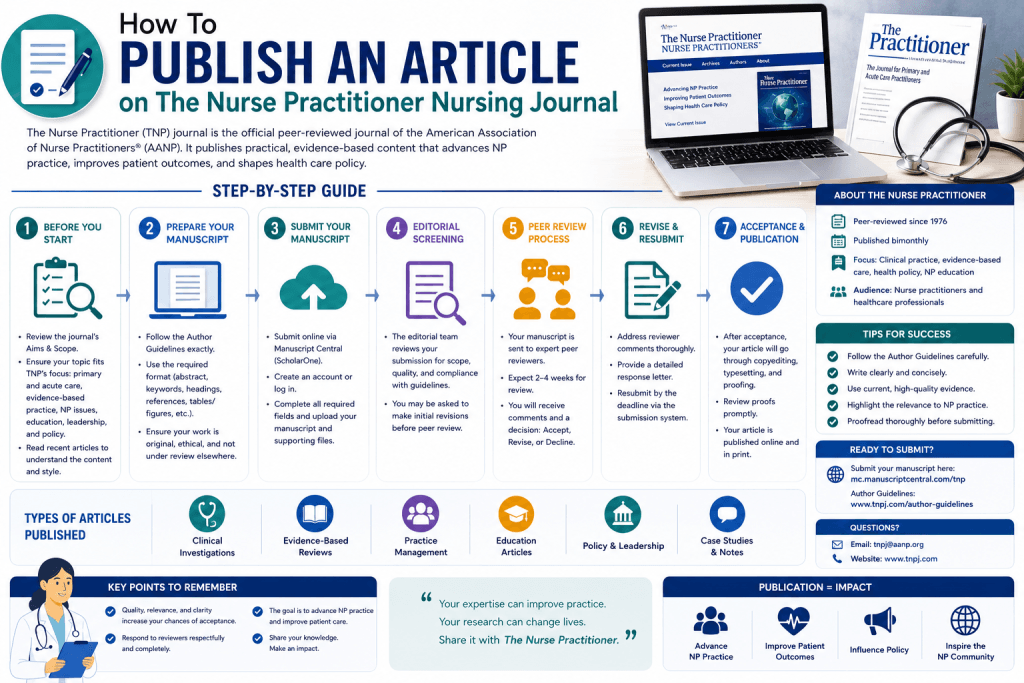
If you’ve been searching for a clear answer on how to publish article on the nurse practitioner nursing journal, the good news is that the process follows a predictable path once you understand each stage. Below is a detailed, point-by-point breakdown of what actually happens from the moment you have a manuscript idea to the moment you see your name in print.
- Step 1: Choose your target journal carefully. Before you even think about how to publish article on the nurse practitioner nursing journal, you need to confirm that JNP (The Journal for Nurse Practitioners) is the right home for your work. Ask yourself whether your topic fits the journal’s scope — clinical practice, evidence-based care, health policy, or professional development for nurse practitioners. For example, a manuscript on managing type 2 diabetes in primary care settings is a good match for your topic and audience, while a highly specialized surgical technique paper may be better suited to a different, more niche nursing journal.
- Step 2: Read the author guidelines from start to finish. Every nursing journal, including JNP, publishes a detailed set of author guidelines covering word counts, formatting, citation style, and submission requirements. For example, JNP typically requires manuscripts formatted in APA style, with a structured abstract, keywords, and references that follow the guidelines set out by the International Committee of Medical Journal Editors (also referred to as the Committee of Medical Journal Editors). Skipping this step is one of the most common reasons manuscripts are returned before they even reach peer review, so if you’re serious about learning how to publish article on the nurse practitioner nursing journal, treat the guidelines as your roadmap.
- Step 3: Prepare your manuscript and abstract. Your abstract is often the first — and sometimes only — part of your submission that catches an editor’s attention. A strong example would be an abstract for a clinical article on hypertension management that clearly states the purpose, methods, findings, and clinical implications in under 250 words. Whether you’re writing original research, a case study, or a clinical review, your abstract needs to summarize the “so what” for a broad audience of nurse practitioners. This is often the single most important paragraph in the entire process of how to publish article on the nurse practitioner nursing journal.
- Step 4: Write a compelling cover letter. When learning how to publish article on the nurse practitioner nursing journal, don’t underestimate the cover letter. This is where you explain why your manuscript is a good match for your topic and the journal’s readership. For example: “This manuscript presents original research on nurse-led interventions for chronic pain management and is intended for nurse practitioners working in outpatient primary care settings.” A clear, confident cover letter helps the editor quickly understand your submission’s value and speeds up the review process.
- Step 5: Submit through the journal’s online portal. Most nursing journals, including JNP, use an online manuscript submission system where you’ll upload your manuscript, abstract, cover letter, author information, and any supplementary files (tables, figures, or appendices). This is the literal moment you submit an article for publication, and it’s important to double-check that every file matches the required format before you hit submit. This step is the practical core of how to publish article on the nurse practitioner nursing journal — everything before it is preparation, and everything after it is review.
- Step 6: Confirm authorship and disclosures. Every author listed must have made a substantial contribution to the manuscript, consistent with authorship standards from the International Committee of Medical Journal Editors. For example, a manuscript with three co-authors — a nurse practitioner, a clinical researcher, and a nursing faculty member — must clearly outline each person’s contribution, whether that’s data collection, writing, or critical revision. Getting authorship right is a small but essential detail in how to publish article on the nurse practitioner nursing journal without delays.
- Step 7: Track your submission status. After you submit your manuscript, most portals allow you to log in and check where your article for publication stands — whether it’s “under review,” “with editor,” or “decision made.” Patience is key here, as the review process for a nursing journal like JNP can take several weeks to a few months. Understanding this timeline is a key part of learning how to publish article on the nurse practitioner nursing journal without becoming discouraged by the wait.
- Step 8: Respond promptly to editor communication. Once the journal editor or editorial board reaches out with questions, revision requests, or a final decision, respond as quickly and thoroughly as possible. Editors juggle many manuscripts at once, and a prompt, professional reply keeps your submission moving smoothly through the pipeline.
Understanding how to publish article on the nurse practitioner nursing journal isn’t just about hitting “submit” — it’s about following each of these steps carefully so your manuscript has the best possible chance of making it through peer review and into print.
Understanding The Nurse Practitioner (JNP) and Its Current Issue
- What JNP is. The Nurse Practitioner (JNP) is a peer-reviewed journal for nurse practitioners covering clinical practice, evidence-based research, and professional development topics relevant to NPs across specialties. It’s one of the most recognized publishing outlets for nurse practitioners in the United States, which is exactly why so many clinicians want to understand how to publish article on the nurse practitioner nursing journal in the first place.
- Why the current issue matters. Before you attempt to publish an article, it’s worth reviewing the current issue of JNP. This gives you a real-world example of the tone, structure, and topics the editorial board is currently prioritizing. For instance, a recent current issue might feature original research on telehealth adoption in rural primary care, alongside a clinical article on managing anxiety disorders in adult patients — both useful examples of what “publishable” looks like right now.
- How JNP fits into the broader nursing journal landscape. JNP sits alongside other respected journals of nursing, and its impact factor and indexing (including inclusion in major databases) make it an attractive target journal for nurse practitioners who want their research articles to reach a broad audience. Some nursing journals are open access journals, meaning readers can access content without a subscription; understanding whether JNP or your chosen journal for publication is open access can affect visibility and readership.
- Who publishes here. Contributors range from clinical NPs and nursing faculty to nurse researchers submitting original research, case reports, and evidence-based practice reviews. Reviewing back issues alongside the current issue gives new authors a realistic sense of what gets published and helps you decide if JNP is genuinely a good match for your topic before you begin the process of how to publish article on the nurse practitioner nursing journal. It’s a small research step that pays off enormously once you’re ready to submit.
Why Nurse Practitioners Should Consider Publishing an Article in a Nursing Journal
- Publishing builds professional credibility. Getting published in a respected nursing journal like JNP signals to your peers, employers, and the broader healthcare community that you’re actively contributing to the evidence base of nursing practice. For example, a nurse practitioner who publishes a clinical article on managing polypharmacy in older adults becomes a recognized voice on that topic within their specialty, which is one of the strongest reasons to learn how to publish article on the nurse practitioner nursing journal early in your career.
- It supports professional development. Writing for publication pushes you to research more deeply, think critically about clinical practice, and stay current with evidence-based standards. Many nurse practitioners find that the process of preparing a manuscript — from literature review to final approval — sharpens their clinical reasoning in ways that day-to-day practice alone doesn’t. This is one more reason learning how to publish article on the nurse practitioner nursing journal is worth the time investment.
- It contributes to the field of nursing practice. Every published article, whether it’s original research or a practical how-to guide for clinical care, adds to the collective knowledge nurse practitioners rely on. For example, an NP who publishes findings on improving medication adherence in diabetic patients gives other clinicians a tested, evidence-based approach they can apply in their own practice. This ripple effect is part of why so many NPs eventually ask how to publish article on the nurse practitioner nursing journal themselves.
- It can support career advancement. Many academic and clinical positions value published authors, particularly those who have contributed peer-reviewed research articles to respected nursing journals. Being listed as one of the published authors in JNP or a similar journal for nurse practitioners can strengthen a CV, support tenure applications, and open doors to speaking engagements or leadership roles — another compelling reason to master how to publish article on the nurse practitioner nursing journal early on.
- It connects you to a wider professional community. Publishing an article often leads to increased visibility within organizations like the American Association of Nurse Practitioners (AANP). The American Association actively promotes research and clinical scholarship among nurse practitioners, and being published can lead to invitations to present at conferences or contribute to future issues.
- It helps shape clinical practice standards. When nurse practitioners publish evidence-based clinical articles, they directly influence how nursing practice evolves. For example, an article proposing updated guidelines for wound care management, once peer-reviewed and published in the journal, can be cited by other clinicians and become part of standard practice recommendations.
- It’s more accessible than many NPs assume. A common misconception is that only researchers with years of experience can publish. In reality, JNP and similar journals welcome case studies, clinical reviews, and practice-based articles from NPs at all stages of their careers — you don’t need a research background to submit an article for publication, and once you understand how to publish article on the nurse practitioner nursing journal, the process becomes far less intimidating.
- It strengthens your writing and communication skills. Preparing a manuscript for a nursing journal forces you to organize your clinical thinking into a format that’s clear, evidence-based, and useful to a broad audience — a skill that carries over into patient education, staff training, and interdisciplinary collaboration.
Academic Writing & Research Support Need Help With Research Papers, Manuscripts, Editing, or Proofreading? At Scholarly Work , we provide professional academic writing support for researchers, students, and professionals. From drafting manuscripts to refining final submissions, we ensure clarity, accuracy, and publication-ready quality. Get Manuscript Writing Help
Reviewing the Author Guidelines Before You Submit
- Start with formatting requirements. Every nursing journal publishes specific author guidelines covering font, spacing, word count limits, and reference style. JNP, like most journals of nursing, typically requires APA formatting for citations and references — so double-check your citation style before you submit your manuscript. This step alone can make or break your attempt at how to publish article on the nurse practitioner nursing journal successfully.
- Understand the manuscript categories. Author guidelines usually break down acceptable submission types — original research, clinical articles, case studies, or literature reviews. For example, if you’re submitting a clinical article on hypertension screening protocols, you’ll want to confirm it fits within the journal’s defined category and word count range, which is often between 2,000 and 4,000 words. Confirming this upfront saves you from major rewrites later in your journey to how to publish article on the nurse practitioner nursing journal.
- Pay close attention to the abstract requirements. Most journals request a structured abstract with specific subheadings (such as Background, Methods, Results, and Conclusion for original research). An example structured abstract for a clinical article might include a brief background on the condition, the clinical approach used, outcomes observed, and practical implications for nurse practitioners — a template worth reusing every time you sit down to figure out how to publish article on the nurse practitioner nursing journal.
- Check citation and reference rules carefully. Author guidelines will specify how many references are allowed, how they should be formatted, and whether previously published data must be cited with permission. For example, if you’re referencing a study previously published in another nursing journal, you’ll need to cite it properly and, in some cases, secure permission to reproduce any figures or tables — a citation detail that trips up many first-time authors learning how to publish article on the nurse practitioner nursing journal.
- Review submission requirements for tables, figures, and supplementary files. Many journals request these as separate files rather than embedded in the manuscript body. Missing this small formatting detail is a common reason submissions get sent back before reaching the review process — another reminder that how to publish article on the nurse practitioner nursing journal successfully starts with the fine print.
- Look for information about open access options. Some journals offer an open access publishing route (sometimes for a fee), while others follow a traditional subscription model. If you’re deciding between a journal for publication with open access and a more traditional option, the author guidelines will typically outline whether you’d need to pay an article processing fee — a detail worth confirming early in your plan for how to publish article on the nurse practitioner nursing journal.
- Don’t skip the ethical and authorship disclosures. Author guidelines will require statements on conflicts of interest, funding sources, and authorship contributions, often aligned with standards from the International Committee of Medical Journal Editors. Taking the time to review these guidelines thoroughly before you submit an article saves significant back-and-forth later in the editorial process, and it’s one of the most overlooked parts of how to publish article on the nurse practitioner nursing journal for first-time authors.
What Happens After Submission: Working with the Editor
- Initial editorial screening. Once you submit your manuscript, the journal editor performs an initial review to confirm it fits the journal’s scope, meets basic formatting requirements, and aligns with the current issue’s editorial direction. For example, a manuscript on nurse-led chronic disease management is likely to pass this stage quickly if it’s clearly relevant to nurse practitioners and formatted correctly — proof that the fundamentals of how to publish article on the nurse practitioner nursing journal really do matter.
- Assignment to peer reviewers. If your manuscript passes the initial screening, the editor sends it into the peer review process, where two or three reviewers — often nurse practitioners, nursing faculty, or subject-matter experts — evaluate the manuscript’s quality, originality, and clinical relevance. This peer-reviewed process is a hallmark of a credible nursing journal and helps maintain the overall quality of published research articles, and it’s a stage every author encounters when figuring out how to publish article on the nurse practitioner nursing journal.
- Receiving reviewer feedback. After the review process, you’ll typically receive one of several decisions: accept, minor revision, major revision, or reject. For example, a reviewer might request that you strengthen your literature review, clarify your methodology, or provide more clinical context to support your conclusions. Handling this feedback gracefully is a core part of how to publish article on the nurse practitioner nursing journal successfully.
- Making revisions. If a revision is requested, you’ll work directly with the journal editor and reviewers to address their feedback point by point. A well-organized response letter — outlining exactly how each comment was addressed — makes the revision process smoother and shows the editorial board that you took their feedback seriously.
- Editorial board involvement. For some manuscripts, especially those involving significant clinical claims or original research, editorial board members may weigh in during the decision-making process to ensure the article meets the journal’s editorial standards before it moves toward final approval. This layer of oversight is part of what makes how to publish article on the nurse practitioner nursing journal a rigorous, credible process.
- Final approval and production. Once your revisions are accepted, the manuscript receives final approval and enters the production queue, where it’s copyedited, formatted, and scheduled for an upcoming issue. At this stage, you may be asked to review page proofs for accuracy before the article for publication goes to print or online release.
- Staying professional throughout. Whether your first submission is accepted, revised, or rejected, maintaining a professional, responsive relationship with the editor and editorial team improves your chances with future submissions. Many published authors say the biggest lesson they learned about how to publish article on the nurse practitioner nursing journal is that persistence and professionalism matter as much as the science itself.
Journal Articles
Want to go deeper on journal articles? Explore more guides from our Journal Articles collection below.
-
What Is a Scientific Journal?
-
How to Write a Journal Article
-
Journal vs. Article: What’s the Difference?
-
How to Find an Article’s Issue Number
-
Citing a Journal Article in Chicago Style
-
APA Journal Article Citation Guide
-
What Is an SCI Journal?
-
Scientific Journal Examples
-
Sample Journal Article
-
How to Write an Article Summary
-
Chemistry Journals for Short Articles & Notes
-
Publishing in Nurse Practitioner Journals
Examples of Clinical Articles and Nursing Practice Topics That Get Published
- Chronic disease management. Articles addressing evidence-based strategies for managing diabetes, hypertension, or heart failure in primary care are consistently published in journals for nurse practitioners. For example, a clinical article titled “Improving Glycemic Control Through Nurse Practitioner-Led Diabetes Management Programs” demonstrates both clinical relevance and a clear, practical application for readers, and it’s the kind of example worth studying if you’re still learning how to publish article on the nurse practitioner nursing journal.
- Mental and behavioral health. With growing demand for mental health services, clinical articles on screening, diagnosing, and managing anxiety, depression, or substance use disorders in primary care settings are frequently published. An example topic might be “Integrating Behavioral Health Screening Into Routine Primary Care Visits: A Practical Guide for Nurse Practitioners.”
- Women’s health and reproductive care. Topics such as contraceptive counseling, menopause management, or prenatal care protocols are common in nursing journals focused on nurse practitioners. For example, an article exploring updated evidence-based approaches to managing perimenopausal symptoms would likely be a good match for your topic if you specialize in women’s health, and it’s another solid example of how to publish article on the nurse practitioner nursing journal within a specialty niche.
- Pediatric and family care. Clinical articles covering childhood immunization schedules, developmental screening, or managing common pediatric illnesses in family practice settings are regularly featured. An example would be “Early Identification of Developmental Delays: A Nurse Practitioner’s Role in Pediatric Primary Care” — a strong illustration of how to publish article on the nurse practitioner nursing journal using everyday clinical observations.
- Geriatric and chronic pain management. Given the aging population, articles on polypharmacy, fall prevention, and chronic pain management in older adults are highly relevant. For example, “Reducing Polypharmacy Risks in Older Adults: Evidence-Based Recommendations for Nurse Practitioners” reflects a practical, clinically grounded submission and a strong example of how to publish article on the nurse practitioner nursing journal using a familiar clinical problem.
- Health policy and professional development. Not every published article needs to be a clinical case study. Topics exploring scope-of-practice legislation, telehealth policy, or professional development strategies for NPs are also strong candidates. For example, an article discussing how expanded scope-of-practice laws affect nurse practitioners’ autonomy in rural healthcare settings addresses both clinical practice and policy — a combination many editors find compelling.
- Case studies and clinical reviews. For NPs newer to writing for publication, a well-documented case study is often the most approachable format. For example, a case study detailing the diagnosis and management of an atypical presentation of a common condition — such as an unusual presentation of Lyme disease — gives readers a real-world, evidence-based example they can apply directly to their own clinical practice.
- Quality improvement projects. Many nursing journals also welcome articles describing quality improvement initiatives within a clinic or hospital system. For example, an article on “Reducing Emergency Department Readmissions Through Nurse Practitioner-Led Follow-Up Calls” combines original data with actionable takeaways, making it an excellent example for anyone still mapping out how to publish article on the nurse practitioner nursing journal for the first time.
Each of these examples reflects exactly the kind of content editors look for when evaluating whether a manuscript is publishable: clear clinical relevance, evidence-based reasoning, and practical value for a broad audience of nurse practitioners. Keep them in mind as a checklist the next time you sit down to plan how to publish article on the nurse practitioner nursing journal.
- University of California, San Francisco (UCSF) – Scientific Writing and Scholarly Publishing: Article Writing – https://guides.ucsf.edu/writingpublishing/articles
- George Washington University – Writing and Publishing a Scientific Article Guide – https://libguides.gwu.edu/sciencepublishing
- University of North Carolina at Chapel Hill – Writing and Citing Resources: How to Write Scientific Papers – https://guides.lib.unc.edu/writing-citing
- University of Illinois at Chicago – Scientific Writing: Journal Articles Guide – https://researchguides.uic.edu/ScientificWriting/JournalArticles