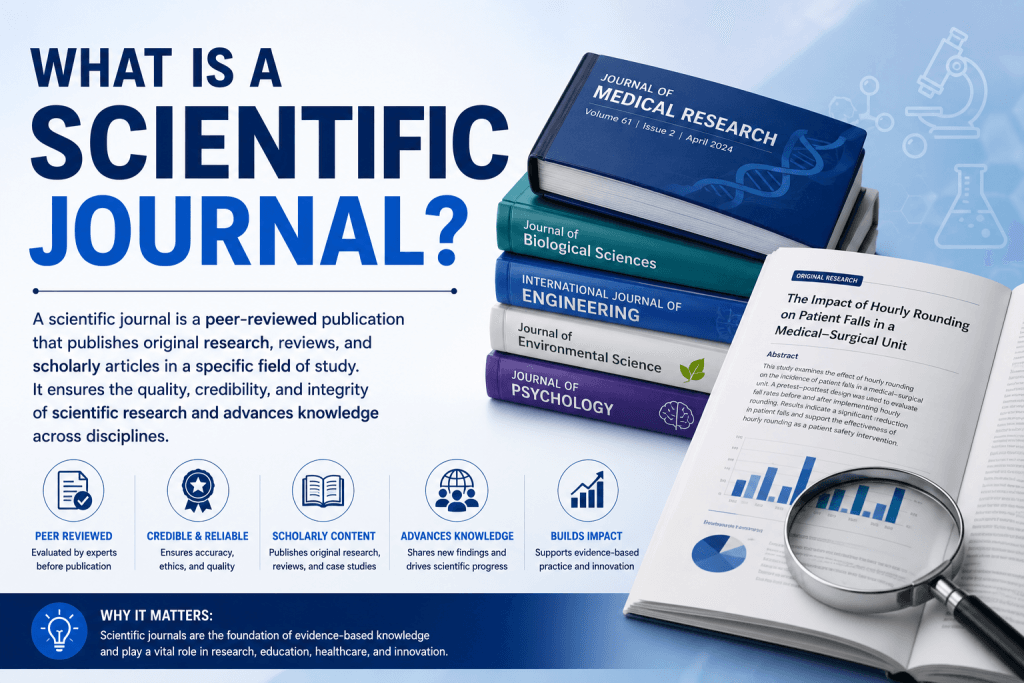
What Is an SCI Journal? Understanding the Science Citation Index
- The term “SCI journal” comes from the Science Citation Index (SCI) — a database created in 1964 by Dr. Eugene Garfield to track scholarly papers and the citations connecting them. It was one of the first tools that let researchers see not just what had been published, but who was citing whom.
- An SCI journal is a journal that appears in this citation index, meaning it has passed a strict quality and impact screening process. Being called an “SCI journal” has historically signaled that a title is trustworthy, peer-reviewed, and influential within its field.
- What made the original SCI different from a regular journal list:
- It didn’t just catalog journals — it mapped citation relationships between papers.
- It allowed researchers to trace how an idea evolved by following forward and backward citations.
- It became the foundation for modern citation analysis, including the journal impact factor.
- Example: A researcher publishing in a journal like The Lancet or the Journal of the American Chemical Society could use the SCI to see exactly how many times their paper was cited, and by which other papers — something no ordinary journal directory could offer at the time.
- Today, “SCI journal” is used as shorthand for a journal indexed in the modern, expanded version of this database — the Science Citation Index Expanded (SCIE) — which is maintained by Clarivate as part of the Web of Science platform.
- Why this matters for researchers: Universities, funding bodies, and tenure committees frequently require that a paper be “published in SCI journals” as proof of research quality. Understanding what that phrase actually means — and how it relates to SCIE — is essential before you start your journal selection process.
SCI Journal Vs. SCIE Indexed Journal: Key Differences Explained
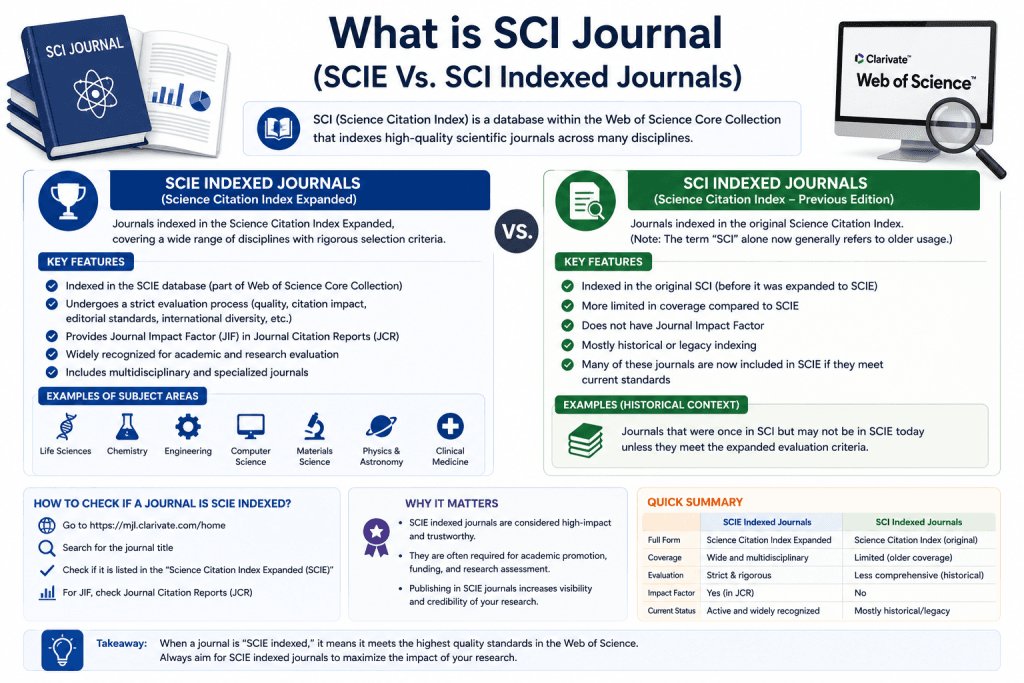
- The short answer: there is no longer a meaningful difference between an SCI journal and an SCIE indexed journal. In January 2020, Clarivate officially merged the original SCI list into the larger SCIE database. The standalone SCI list is no longer maintained, so every journal that once carried the “SCI” label is now simply part of SCIE.
- To understand why the difference between SCI and SCIE still confuses so many researchers, it helps to look at their history separately:
- SCI (Science Citation Index):
- Launched in 1964 by Eugene Garfield.
- A smaller, highly selective “core” collection containing only a few thousand of the most cited, most established scientific journals.
- Originally distributed on CD/DVD before moving online.
- Represented the most elite tier of scientific publishing at the time.
- SCIE (Science Citation Index Expanded):
- Introduced as a broader version of the SCI.
- Included every journal already in the SCI core list, plus thousands of additional peer-reviewed journals from emerging fields and different regions of the world.
- Now covers more than 9,200 notable and significant journals across 178 disciplines, dating back to 1900.
- Became available online in 1997, which is when it took on its current name.
- SCI (Science Citation Index):
- This is where the “difference between SCI and SCIE” debate came from: for years, both lists existed side by side. Because SCI was the smaller, older, more exclusive list, many researchers assumed SCI journals were automatically more prestigious than SCIE journals. That assumption is now outdated.
- What changed in 2020: Clarivate folded the SCI list into SCIE entirely. Practically, this means:
- The Web of Science search platform no longer lists a separate SCI database — only SCIE.
- Any official indexing report from a university or research institution will show “SCIE,” not “SCI.”
- When someone says their paper was “published in SCI journals” today, what they actually mean is that the journal is SCIE indexed.
- Example to make this concrete: Imagine two researchers in materials science submitting to journals in the same field — one to Advanced Materials and another to a mid-sized regional engineering journal. If both titles are currently listed in the SCIE database, both are, for all practical purposes, “SCI journals” today. Neither one holds a separate, higher-tier “SCI-only” status, because that separate tier no longer exists.
- So how should researchers evaluate an SCI-indexed journal now? Instead of asking “is this journal SCI or SCIE,” the more useful questions are:
- Is the journal currently listed in the Web of Science Core Collection under SCIE?
- What is its journal impact factor and quartile ranking (Q1–Q4) in the latest Journal Citation Reports?
- Is it appropriate for your subject area and target audience?
- A note on related indexes, since SCI and SCIE are often mentioned alongside them:
- Social Science Citation Index (SSCI) — the equivalent index for social science research.
- Arts & Humanities Citation Index (AHCI) — covers humanities and arts titles.
- Emerging Sources Citation Index (ESCI) — a broader, less exclusive index for newer journals that show promise but haven’t yet met the full impact criteria for SCIE, SSCI, or AHCI. Journals can move up from ESCI into SCIE (or down from SCIE into ESCI) depending on their performance.
- Key takeaway: the difference between SCI and SCIE is now historical, not functional. If a journal is SCIE indexed, it qualifies as an SCI journal in every practical sense — for publication requirements, grant applications, and academic evaluations.
Academic Writing & Research Support Need Help With Research Papers, Manuscripts, Editing, or Proofreading? At Scholarly Work , we provide professional academic writing support for researchers, students, and professionals. From drafting manuscripts to refining final submissions, we ensure clarity, accuracy, and publication-ready quality. Get Manuscript Writing Help
How Journal Impact Factor and Citation Indexes Define an SCI-Indexed Journal
- Being listed in a citation index is only half the story — what happens after listing is where the journal impact factor comes in. The journal impact factor (JIF) is the metric most people associate with the prestige of an SCI journal, and it’s calculated directly from data inside these citation indexes.
- How the journal impact factor is calculated:
- It measures the average number of citations received in a given year by papers published in that journal during the two preceding years.
- A journal with a JIF of 8, for example, means articles published in the prior two years were cited an average of eight times each.
- The JIF is published annually in the Journal Citation Reports (JCR), which is built using data drawn from SCIE, SSCI, and AHCI.
- Why citation indexes and impact factor are inseparable:
- Without a citation index tracking every reference between papers, there would be no reliable way to calculate how often a journal’s articles are cited.
- The SCI journal concept exists specifically because Garfield’s original citation index made this kind of citation impact measurement possible for the first time.
- Every SCI-indexed journal today has its impact factor recalculated yearly based on fresh citation data.
- What determines whether a journal is included in SCIE at all (and therefore eligible for a journal impact factor):
- Quality criteria — things like having a valid ISSN, a clear publisher name, functional editorial contact details, ethical publishing statements, and consistent publication timeliness.
- Impact criteria — comparative citation analysis, author citation history, editorial board citation history, and overall content significance.
- Journals must pass all quality checks before they’re even evaluated on impact, which is why some technically sound journals still don’t make it into SCIE — they simply haven’t built enough citation impact yet.
- Example: Compare a well-established journal like Cell, which has a very high impact factor because its papers are cited constantly across biology and medicine, to a newer, specialized regional journal that is SCIE indexed but has a modest impact factor because its niche subject area naturally generates fewer citations. Both are legitimate SCI journals — the impact factor simply reflects citation volume, not necessarily research quality.
- Practical implication for authors: when you’re doing journal selection, don’t treat the impact factor as the only signal of quality. A lower JIF in a highly specialized field can still represent a highly respected, rigorously peer-reviewed SCI journal — it’s simply operating in a smaller citation pool.
Web of Science and the Journal Selection Process for SCI Publication
- Web of Science is the platform, not the index itself. Clarivate’s Science Citation Index Expanded, Social Sciences Citation Index, Arts & Humanities Citation Index, and Emerging Sources Citation Index all live inside the Web of Science Core Collection — the umbrella database researchers search when they want to confirm a journal’s indexing status.
- How the Web of Science master journal list fits in:
- Clarivate maintains what’s often called the Web of Science Master Journal List (or the science master journal list), a searchable directory where you can type in a journal title and instantly see which index it belongs to.
- This is the single most reliable way to confirm whether a target journal is genuinely SCI indexed, rather than relying on a journal’s own website, which may display outdated or misleading badges.
- A common mistake authors make is trusting marketing language on a journal’s homepage instead of checking the Web of Science database directly.
- The journal selection process, step by step:
- Define your subject scope. Search the Web of Science Core Collection by discipline to generate a shortlist of relevant target journals.
- Check current indexing status. Confirm the journal is listed in SCIE (not just Web of Science broadly, since WoS also includes conference proceedings and book citation indexes that are separate from SCIE).
- Compare journal impact factor and quartile ranking. Use the Journal Citation Reports to see where the journal sits (Q1 being the top 25% in its category, Q4 the lowest).
- Review scope and audience fit. A high-impact journal outside your niche will likely reject your manuscript regardless of quality.
- Check peer review turnaround and publication services. Some SCI-indexed journals take many months to review; others offer faster tracks, which matters if you’re working against a grant or graduation deadline.
- Verify the journal hasn’t been recently de-listed. Clarivate periodically removes journals from SCIE for issues like excessive self-citation or predatory practices, so always check current status rather than a saved list from a few years ago.
- Example of journal selection in practice: A civil engineering researcher deciding between Journal of Cleaner Production and a newer open-access engineering title would use the Web of Science Master Journal List to confirm both are SCIE indexed, then compare their impact factors and quartile rankings in the JCR before deciding which one better matches their paper’s scope and their institution’s publication requirements.
- Why this matters beyond a single publication: many academic databases and journal indexing databases exist (Scopus being the other major one), but for institutions that specifically require Web of Science indexed journals, confirming SCIE status through the Web of Science database itself — rather than assuming based on a journal’s reputation — is the only way to avoid a paper being rejected during evaluation for not meeting sci indexing requirements.
- A quick distinction worth remembering: the Web of Science Core Collection is broader than SCIE alone. A journal can technically appear somewhere within Web of Science without being part of the SCIE index specifically — which is exactly why checking the precise index (SCIE, SSCI, AHCI, or ESCI) matters more than simply confirming “it’s in Web of Science.”
Academic Writing & Research Support Need Help With Research Papers, Manuscripts, Editing, or Proofreading? At Scholarly Work , we provide professional academic writing support for researchers, students, and professionals. From drafting manuscripts to refining final submissions, we ensure clarity, accuracy, and publication-ready quality. Get Manuscript Writing Help
Why Citation Rates Matter When Comparing SCI and SCIE Journals
- Citation rates are the real engine behind everything discussed so far. Impact factor, quartile ranking, and even a journal’s initial admission into SCIE all trace back to how frequently its published articles are cited by other researchers.
- What citation rates actually tell you:
- How visible and influential a journal’s research is within its field.
- Whether the journal’s editorial board and author base are producing work that other scientists build on.
- How quickly ideas published in that journal are being picked up, tested, or challenged elsewhere in the literature.
- How citation analysis differs across disciplines:
- Fast-moving fields like molecular biology or oncology naturally generate high citation rates because thousands of active researchers are publishing and referencing each other’s work constantly.
- Smaller or highly specialized fields — certain branches of mathematics, regional agricultural science, or niche engineering subfields — will always have lower citation rates simply because fewer people work in and cite that area.
- This is why comparing the raw impact factor of a general-science SCI journal to a specialized SCIE journal from a smaller field can be misleading. Quartile rankings exist precisely to correct for this, by comparing journals only to others in the same category.
- Example: A paper published in a high-impact journal like Nature will typically accumulate citations far faster than an equally rigorous paper published in a specialized regional agricultural science journal — not because the second paper is weaker, but because far fewer researchers work in that specific subfield to cite it.
- Why citation rates matter for your own career, not just journal rankings:
- Grant committees and hiring panels often look at how often your individual papers are cited, not just the journal’s overall impact factor.
- Publishing in a high-citation-impact SCI journal increases the statistical likelihood your paper will be discovered and cited, simply because more researchers browse that journal regularly.
- However, a well-targeted paper in a moderately-cited SCIE journal that exactly matches your niche audience can sometimes generate more relevant citations than the same paper buried in a huge, general-interest journal.
- Bottom line: when comparing SCI and SCIE journals — which, as established, are now functionally the same index — citation rates and citation impact should guide your decision more than the label itself. Look at how a journal performs relative to its direct peers, not against unrelated fields.
Journal Articles
Want to go deeper on journal articles? Explore more guides from our Journal Articles collection below.
-
What Is a Scientific Journal?
-
How to Write a Journal Article
-
Journal vs. Article: What’s the Difference?
-
How to Find an Article’s Issue Number
-
Citing a Journal Article in Chicago Style
-
APA Journal Article Citation Guide
-
What Is an SCI Journal?
-
Scientific Journal Examples
-
Sample Journal Article
-
How to Write an Article Summary
-
Chemistry Journals for Short Articles & Notes
-
Publishing in Nurse Practitioner Journals
Getting Published in SCI Journals: Regional Journals Vs. Global SCI Journal Standards
- Not every solid journal makes it into SCIE, and that doesn’t automatically make it a poor choice. Many strong regional journals operate at a high academic standard without (yet) meeting the citation impact thresholds Clarivate requires for SCIE inclusion.
- Where regional journals typically sit in the indexing hierarchy:
- Many begin in the Emerging Sources Citation Index (ESCI), which has looser impact requirements but still enforces the same core quality criteria (peer review, ethical standards, editorial transparency).
- As a regional journal builds citation history and demonstrates consistent quality, it can be promoted into SCIE — at which point it becomes, by definition, an SCI journal.
- Conversely, established SCIE journals that see declining citation performance or quality issues can be moved down into ESCI during Clarivate’s annual re-evaluations.
- Global SCI journal standards vs. regional journal realities — key differences:
- Audience reach:
- Global SCI journals: read and cited by researchers across dozens of countries, often across multiple related disciplines.
- Regional journals: often serve a more localized research community, which can mean faster relevance for local case studies but a smaller citing audience overall.
- Review rigor:
- Both are expected to conduct genuine peer review, but globally established SCI journals typically have larger, more experienced editorial boards and more standardized review processes.
- Regional journals may offer faster turnaround, which matters for early-career researchers or time-sensitive publications.
- Publication requirements:
- Institutions in many countries specifically require that a paper be “published in SCI journals” for degree completion, promotion, or grant reporting — a regional journal not yet indexed in SCIE typically won’t satisfy that requirement, even if the research is high quality.
- Always confirm your specific institutional requirement — some accept ESCI or Scopus-indexed journals as equivalent, while others strictly require SCIE.
- Audience reach:
- Practical guidance for choosing between the two:
- If your institution mandates SCI journal publication for graduation or promotion, verify current SCIE status on the Web of Science Master Journal List before submitting — don’t rely on a journal’s self-description.
- If your research has strong local or regional relevance (a case study tied to a specific country’s agricultural practices, for example), a well-regarded regional or ESCI-listed journal may actually reach the audience that matters most, even if it lacks SCIE status today.
- If your goal is maximum international citation impact and career visibility, prioritize target journals with strong quartile rankings within your specific subject category, not just journals with the highest raw impact factor.
- Example: A public health researcher studying a disease pattern specific to a particular region might publish initial findings in a respected regional journal to reach local health authorities quickly, then follow up with a broader comparative study submitted to a globally recognized, SCIE-indexed SCI journal to reach the wider international research community. Both publication paths serve different, legitimate goals — the key is matching the journal to the purpose of the paper, not simply chasing the highest impact factor available.
- Final thought: whether you’re aiming for a global SCI journal or building a track record through respected regional journals first, the fundamentals stay the same — verify indexing status directly through Web of Science, understand what your specific institution or funder actually requires, and choose your target journal based on where your research will have the most genuine impact.
- In short: an SCI journal is no longer a separate, more exclusive tier than an SCIE indexed journal — it’s simply the modern shorthand for a journal that has earned its place in Clarivate’s SCIE database. Once you understand that, journal selection becomes less about chasing a label and more about matching your research to the right audience, the right citation impact, and the right publication requirements for your career stage.
- University of California, San Francisco (UCSF) – Scientific Writing and Scholarly Publishing: Article Writing – https://guides.ucsf.edu/writingpublishing/articles
- George Washington University – Writing and Publishing a Scientific Article Guide – https://libguides.gwu.edu/sciencepublishing
- University of North Carolina at Chapel Hill – Writing and Citing Resources: How to Write Scientific Papers – https://guides.lib.unc.edu/writing-citing
- University of Illinois at Chicago – Scientific Writing: Journal Articles Guide – https://researchguides.uic.edu/ScientificWriting/JournalArticles