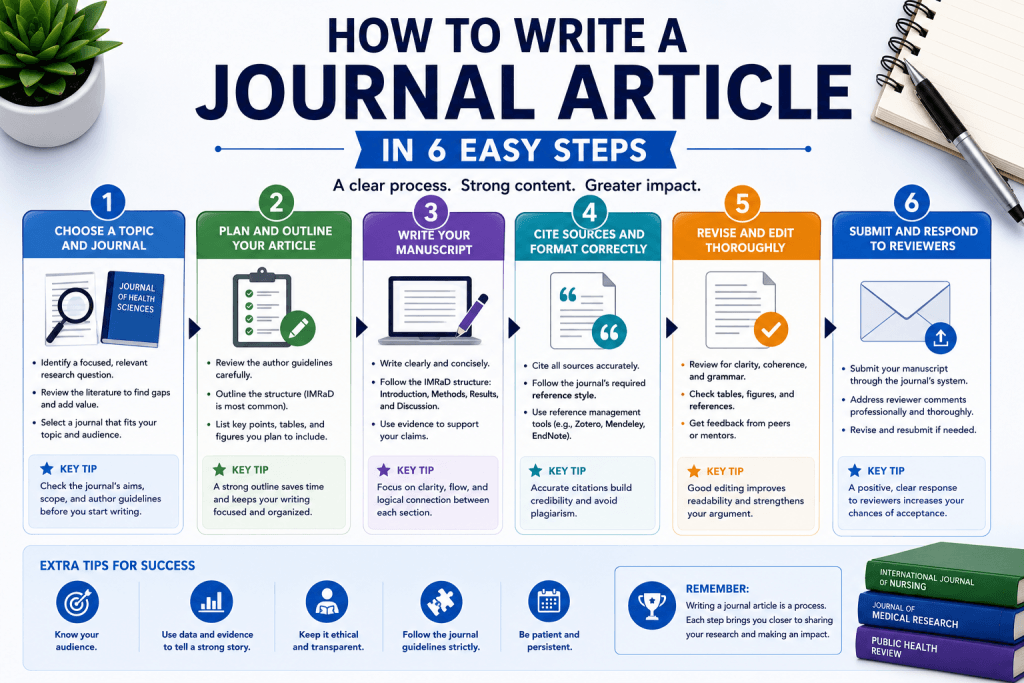
How to Write a Journal Article in 6 Easy Steps
Learning how to write a journal article can feel overwhelming at first, especially if you’re an early career researcher staring at a blank page for the first time. But when you break the writing process down into manageable stages, the whole thing becomes a lot less intimidating. Here are the six steps you need to follow when you sit down to write a journal article, from that first spark of an idea to the moment you hit submit.
1. Choose your target journal early
- The first step in how to write a journal article is deciding on your target journal before you even start writing. This single decision shapes almost everything else about your manuscript, including its length, tone, structure, and formatting.
- For example, if you’re writing about a new drug trial, a journal like The Lancet will expect a very different structure and level of statistical detail than a smaller, more general medical journal.
- Choosing your target journal early also means you can get familiar with the journal’s aims, scope, and readership before you write a single word, which saves you from a painful restructuring exercise later.
2. Define your research question and hypothesis
- Every strong journal article starts with a clear research question. This is the question your entire paper is trying to answer, and it should be specific, focused, and answerable within the scope of your study.
- From your research question, you can develop your hypothesis, which is your predicted answer based on existing theory or preliminary evidence.
- Example: if your research question is “Does remote work improve employee productivity in tech companies?” your hypothesis might be “Employees working remotely at least three days a week show a measurable increase in weekly output compared to fully office-based employees.”
- A clear hypothesis gives your writing direction and helps you decide what to include and what to leave out.
3. Conduct your literature review as part of how to write a journal article
- Part of knowing how to write a journal article is understanding that a thorough literature review shows the editor and readers you understand the existing scholarly conversation around your topic, and that your research findings add something new to it.
- As you read, keep notes on recurring themes, gaps in the research, and any conflicting findings, since these will help you frame your own contribution.
- Example: if you’re researching social media’s effect on teenage mental health, your literature review might reveal that most existing studies focus on Instagram, leaving a gap around TikTok, which your paper could fill.
4. Create a detailed outline
- A key part of how to write a journal article efficiently is building a detailed outline before you start writing the paper itself, once you know how to structure a journal article for your chosen publication.
- Your outline should map out your abstract, introduction, methodology, results, discussion, and conclusion, along with rough word counts for each section.
- This step alone can cut your writing time in half, because you’re no longer staring at a blank page wondering what comes next.
5. Write the paper section by section
- Now comes the actual writing process. When learning how to write a journal article, many early career researchers assume they need to write a journal article from start to finish in order, but that’s rarely how experienced academics work.
- Instead, write the sections you find easiest first, often the methodology or results, and save the abstract and introduction for last, once you know exactly what your paper argues.
- Keep your target audience in mind throughout. A qualitative study written for a niche subject-area journal reads very differently from a quantitative paper aimed at a broad, interdisciplinary readership.
6. Revise, format, and prepare for submission
- The final step in how to write a journal article is revision. Read through your manuscript for clarity, concise language, and logical flow, then format it according to your target journal’s specific requirements.
- Double-check your citations, your reference list, and any journal-specific formatting rules, such as word limits, heading styles, or acronym use.
- Once you’re confident in your manuscript, prepare your cover letter and submit your journal article through the journal’s official submission portal.
Following these six steps on how to write a journal article won’t guarantee instant acceptance, but they will give your paper the rigor, structure, and clarity that editors and peer reviewers expect from a well-prepared academic journal article.
Getting Familiar with the Journal Before You Write
Before you start writing, it pays to get familiar with the journal you’re hoping to publish in. Skipping this step is one of the most common mistakes early career researchers make when figuring out how to write a journal article, and it often leads to desk rejections before a manuscript ever reaches peer review.
- Read recent issues. This is one of the simplest ways to learn how to write a journal article that fits your target journal’s expectations. Spend time reading several recent issues of your target journal. Pay attention to the kind of research questions the journal favors, the typical structure of published articles, and the tone of the writing. If the journal consistently publishes quantitative studies with heavy statistical analysis, a purely theoretical paper may not be the right fit.
- Check the aims and scope. Every peer-reviewed journal publishes an aims and scope statement, usually on its website. This tells you exactly what subject area the journal covers and who its readership is. For example, a journal focused on clinical psychology won’t be the right home for a paper on organizational behavior, even if there’s some overlap.
- Study the author guidelines closely. This is one of the most overlooked steps in how to write a journal article. Every journal has specific requirements around formatting, word count, citation style, and structure. Some journals want APA citations, others prefer Vancouver or Harvard style. Some cap abstracts at 150 words, others allow 300. Missing these specific requirements is an easy way to get your manuscript sent back before it’s even reviewed.
- Understand the peer review process. Different journals run different types of peer review, including single-blind, double-blind, and open peer review. Knowing which process your target journal uses helps you prepare your manuscript correctly, for example by removing identifying information from the main body if the journal requires blind review.
- Look at the editorial board and readership. The editor and editorial board often specialize in particular subfields, and understanding their expertise can help you frame your paper’s rationale in a way that resonates with them. Similarly, understanding the journal’s readership, whether that’s specialists, general academics, or practitioners, helps you decide how much background explanation to include.
- Consider the journal’s impact and relevance. Look at how often the journal is cited, how quickly it publishes, and whether it aligns with your career goals, particularly if you’re a PhD student or postdoc thinking about co-authorship and future collaboration.
- Note templates and sample papers. Many journals provide a template or sample paper showing exactly how a manuscript should be formatted. Using this template from the start of your writing process saves significant time during revision.
Getting familiar with the journal before you start writing isn’t just a box-ticking exercise. When you’re figuring out how to write a journal article, this step directly shapes how you frame your research question, structure your argument, and communicate your research findings, ultimately increasing your chances of a smoother peer review process and eventual publication.
Academic Writing & Research Support Need Help With Research Papers, Manuscripts, Editing, or Proofreading? At Scholarly Work , we provide professional academic writing support for researchers, students, and professionals. From drafting manuscripts to refining final submissions, we ensure clarity, accuracy, and publication-ready quality. Get Manuscript Writing Help
How to Structure a Journal Article: Format and Structure Basics
Understanding how to structure a journal article is one of the most important parts of learning how to write a journal article, because even brilliant research can get rejected if it’s poorly organized. Most peer-reviewed journal articles follow a fairly standard format, often referred to by the acronym IMRaD: Introduction, Methods, Results, and Discussion.
- Title. Your title should be concise, specific, and keyword-rich, since it’s often the first thing readers and search engines see. A vague title like “A Study on Productivity” is far weaker than “The Impact of Remote Work on Employee Productivity in Tech Startups.”
- Abstract. Knowing how to write a journal article abstract is a skill in itself. The abstract is a short summary, usually 150–300 words, that outlines your research question, methodology, key findings, and conclusions. Many readers decide whether to read your full paper based on the abstract alone, so it needs to summarize your work clearly and concisely.
- Introduction. This section introduces your topic, presents your research question, and explains the rationale behind your study. It should also briefly reference your literature review to show where the gap in existing research lies.
- Literature review. Depending on the journal’s format, this may be a standalone section or folded into the introduction. Either way, it should synthesize existing scholarship, not just summarize it, showing how your study builds on or challenges prior work.
- Methodology. Here you describe your research design in detail, including whether your study is qualitative, quantitative, or a mixed-methods approach. Include your sample size, data collection methods, and analysis techniques, with enough detail that another researcher could replicate your study.
- Results. This section presents your research findings using a mix of descriptive text, tables, and figures. Avoid interpreting your results here; simply report what you found, including any unexpected results that emerged during analysis.
- Discussion. This is where you interpret your results, connect them back to your original hypothesis and research question, and explain their theoretical and practical significance.
- Limitation section. Every academic journal article should acknowledge its limitations honestly, whether that’s a small sample size, a narrow subject area, or methodological constraints.
- Conclusion and future research. Summarize your key points and suggest directions for future research, giving other scholars in your field a starting point for further study.
- References and citations. Every citation in your main body must be properly formatted and matched against your reference list. Citation errors are one of the most common reasons manuscripts get sent back for revision.
Once you understand this basic structure, and how to write a journal article that follows it, you can adapt it to your target journal’s specific requirements. Some journals combine sections, some require structured abstracts with subheadings, and some place the literature review within the introduction rather than as a separate section. Always check your journal’s template before you start writing.
Writing Your Manuscript Section by Section
Once you’ve planned your outline and you’re familiar with the journal’s format, it’s time to actually write the paper. If you’ve been wondering how to write a journal article without feeling overwhelmed, the answer is simple: write section by section, rather than start to finish, which tends to produce clearer, more focused writing.
- Start with the methodology. Many academic writers find it easiest to start writing here, since it’s the most concrete section. Describe your research design, data collection process, and analysis methods in enough detail that another researcher could reproduce your study. Be precise about your sample size and any statistical tests you used.
- Write your results next. This is a core part of how to write a journal article that reads as credible and rigorous. Present your research findings clearly and objectively, using tables and figures where they add clarity rather than clutter. For example: “Participants who worked remotely at least three days per week reported a 14% increase in self-assessed productivity (M = 7.8, SD = 1.2) compared to office-based participants (M = 6.9, SD = 1.4).” Keep this section descriptive rather than interpretive.
- Move on to the discussion. This is where you interpret your results and connect them to your research question and hypothesis. Explain what your findings mean in the context of existing scholarship, and be honest about any unexpected results. For instance, if your hypothesis predicted a productivity increase but your data showed no significant difference, discuss possible reasons why.
- Draft your introduction after your discussion. One trick for how to write a journal article introduction that actually lands is to write it last. It’s much easier to write a compelling introduction once you know exactly what your paper argues and concludes. Your introduction should establish the research question, briefly reference the literature review, and explain the significance of your study to your subject area.
- Write your literature review with synthesis in mind. This is often the trickiest part of how to write a journal article well. Rather than listing study after study, group your sources by theme or argument, and use them to build a case for why your research question matters. Example: “While Smith (2021) and Chen (2022) both examined remote work’s effect on output, neither study accounted for differences in managerial support, a gap this paper addresses.”
- Save your abstract for last. Another useful habit in how to write a journal article efficiently: once your full manuscript is written, summarize your research question, methodology, key results, and conclusions into a tight paragraph. Every peer-reviewed journal has strict word limits for abstracts, so be concise and cut anything that isn’t essential.
- Write your conclusion with future research in mind. Summarize your key points, restate your paper’s contribution to the subject area, and suggest directions for future research that other scholars, including fellow early career researchers, might pursue.
- Keep paragraphs focused. Each paragraph should communicate one clear idea, supported by evidence or citation, and should flow logically into the next. Strong paragraph structure is one of the simplest ways to improve academic writing and effective communication throughout your manuscript.
- Involve your co-author early. If you’re working with a co-author or under academic supervision, share drafts of each section as you go, rather than waiting until the whole manuscript is finished. This makes revision far more manageable and ensures both authors align on tone, structure, and argument before submission.
This is ultimately how to write a journal article that flows logically from research question to conclusion, even though you didn’t write it in that exact sequence.
Academic Writing & Research Support Need Help With Research Papers, Manuscripts, Editing, or Proofreading? At Scholarly Work , we provide professional academic writing support for researchers, students, and professionals. From drafting manuscripts to refining final submissions, we ensure clarity, accuracy, and publication-ready quality. Get Manuscript Writing Help
Preparing Your Manuscript for the Editor
Once your first full draft is complete, it’s time to prepare your manuscript for the editor. This stage is just as important as the actual writing process, since even excellent research can be rejected if the manuscript isn’t polished and properly formatted. Knowing how to write a journal article is only half the battle; knowing how to polish one is the other half.
- Revise for clarity and flow first. This is a step many guides on how to write a journal article skip over. Read your manuscript from start to finish, focusing on whether your argument flows logically from your research question through to your conclusion. Cut any sentences that don’t directly support your key points.
- Check alignment with your target journal’s format. Go back to the journal’s author guidelines and confirm your manuscript matches their specific requirements for structure, word count, heading styles, and citation format. A mismatch here is one of the fastest ways to get desk rejected before peer review even begins.
- Proofread for grammar and concise language. Academic writing should be precise and concise. Remove unnecessary jargon, tighten long sentences, and make sure every acronym is defined the first time it appears.
- Verify every citation. Cross-check every citation in your main body against your reference list, and confirm your citation style matches the journal’s requirements exactly, whether that’s APA, MLA, Chicago, or a journal-specific variant.
- Ask a colleague or co-author for feedback. A fresh set of eyes, whether from a co-author, supervisor, or academic mentor, often catches issues you’ve become blind to after multiple rounds of self-editing. Constructive feedback at this stage can significantly strengthen your manuscript before it faces formal peer review.
- Use tools to help polish your writing. Grammar checkers, reference managers like Zotero or EndNote, and plagiarism checkers are all useful tools to help catch small errors before submission. Many early career researchers also use journal-specific formatting templates to save time.
- Prepare your figures and tables properly. Make sure every table and figure is clearly labeled, referenced correctly in your main body text, and formatted according to the journal’s specific requirements for resolution and file type.
- Write a strong cover letter. Most journals require a cover letter addressed to the editor, briefly summarizing your research question, its relevance to the journal’s readership, and why it’s a good fit for their subject area. This is your chance to make a concise, compelling case for why your paper deserves the editor’s attention.
- Double-check for consistency. Make sure your terminology, acronyms, and formatting are consistent throughout the manuscript. Inconsistent use of terms can confuse reviewers and suggest a lack of rigor, even when the underlying research is strong.
Taking the time to properly prepare your manuscript for the editor shows respect for the journal’s process and significantly improves your odds of moving smoothly through peer review. This is, in many ways, the most underrated part of how to write a journal article well.
Journal Articles
Want to go deeper on journal articles? Explore more guides from our Journal Articles collection below.
-
What Is a Scientific Journal?
-
How to Write a Journal Article
-
Journal vs. Article: What’s the Difference?
-
How to Find an Article’s Issue Number
-
Citing a Journal Article in Chicago Style
-
APA Journal Article Citation Guide
-
What Is an SCI Journal?
-
Scientific Journal Examples
-
Sample Journal Article
-
How to Write an Article Summary
-
Chemistry Journals for Short Articles & Notes
-
Publishing in Nurse Practitioner Journals
Final Steps: How to Submit Your Journal Article
You’ve done the hard work of learning how to write a journal article, structuring it properly, and polishing every section. Now it’s time to actually submit your journal article to your target journal. Even at this final stage, how to write a journal article well still matters, because a strong cover letter and clean submission reflect the quality of your writing process.
- Create an account on the journal’s submission portal. This is the final practical step in how to write a journal article and get it in front of an editor. Most peer-reviewed journals use an online system such as Editorial Manager, ScholarOne, or Open Journal Systems. Set up your author profile with accurate contact details and institutional affiliation.
- Upload your manuscript files correctly. Journals often require separate files for your manuscript, title page, figures, tables, and cover letter. Follow the journal’s specific requirements for file naming and format exactly, since incorrect file structures can delay processing.
- Attach your cover letter. Your cover letter should briefly summarize your research question, methodology, and key findings, and explain why your paper is relevant to the journal’s readership and subject area. Keep it concise and professional.
- Suggest potential reviewers if requested. Some journals ask authors to suggest potential peer reviewers with relevant subject-area expertise. If this is required, choose scholars who don’t have a conflict of interest with you or your co-author.
- Complete any required declarations. This may include conflict-of-interest statements, ethics approval documentation, funding disclosures, or data availability statements, depending on your journal and subject area.
- Submit and await the editor’s initial decision. After submission, the editor will typically conduct an initial screening before sending your manuscript out for peer review. This can result in desk rejection, a request for revision, or acceptance into the formal peer review process.
- Respond professionally to peer review feedback. If your paper moves to peer review, you’ll eventually receive feedback ranging from minor revisions to major revisions. Address each point raised by reviewers systematically, and write a detailed response letter explaining how you’ve addressed their concerns.
- Track your submission status. Most submission portals let you track exactly where your manuscript is in the process, whether it’s under review, awaiting a decision, or returned for revision.
- Celebrate publication, but keep learning. Once your journal article is accepted and published, take note of what worked well in your writing process. Each academic journal article you write, whether as a PhD student, early career researcher, or experienced scholar, teaches you more about how to write a journal article and builds your skill and confidence for the next one.
Learning how to write a journal article is a skill that improves with practice. By following a clear writing process, staying organized, and understanding exactly how to structure a journal article for your target journal, you’ll set yourself up for a smoother path through peer review and, ultimately, successful publication in a peer-reviewed journal.
- University of California, San Francisco (UCSF) – Scientific Writing and Scholarly Publishing: Article Writing – https://guides.ucsf.edu/writingpublishing/articles
- George Washington University – Writing and Publishing a Scientific Article Guide – https://libguides.gwu.edu/sciencepublishing
- University of North Carolina at Chapel Hill – Writing and Citing Resources: How to Write Scientific Papers – https://guides.lib.unc.edu/writing-citing
- University of Illinois at Chicago – Scientific Writing: Journal Articles Guide – https://researchguides.uic.edu/ScientificWriting/JournalArticles