What is the Difference Between Journal and Article?
Understanding the difference between journal and article is one of the most common points of confusion for students, researchers, and even seasoned writers. The two terms get used interchangeably in casual conversation, but in academic and publishing contexts, they mean very different things. Getting this distinction right matters — especially if you’re working on a research project, citing sources for a thesis, or simply trying to figure out what your professor means when they ask you to “find a journal article.”
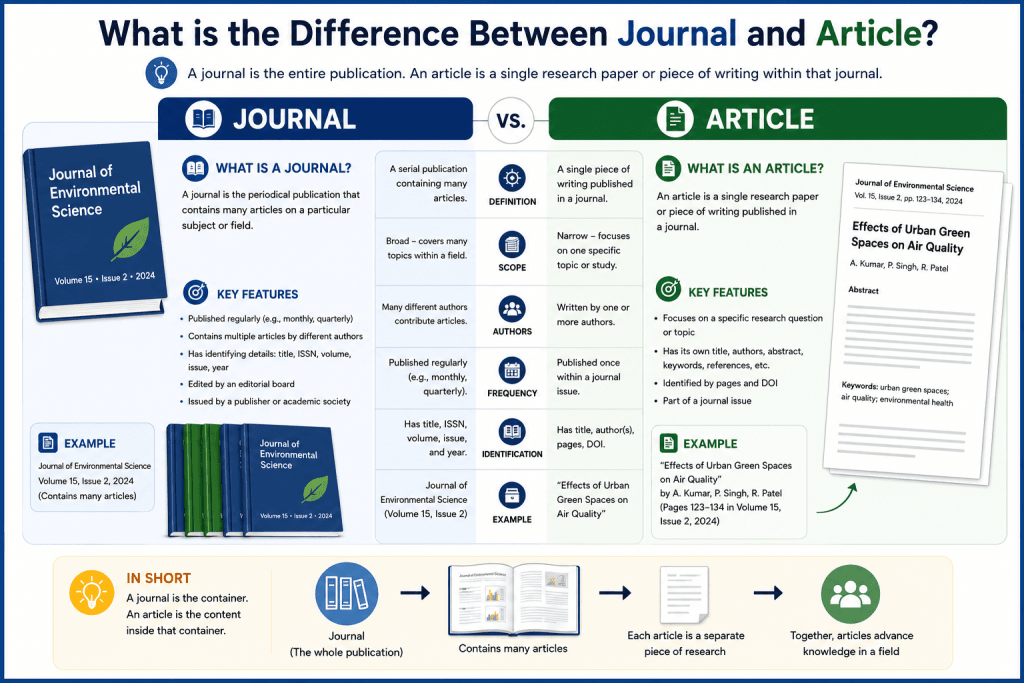
Here’s the simplest way to think about the difference between journal and article:
- A journal is a publication — a container. It’s a collection of articles, usually published on a regular schedule (monthly, bi-monthly, or quarterly), that focuses on a specific field or discipline. Think of a journal the way you’d think of a magazine issue: it holds multiple pieces of writing inside it.
- An article is a single piece of writing — one contribution within that container. It’s the individual paper, essay, or study that appears inside a journal, magazine, or newspaper.
So when someone talks about a “journal article,” they’re actually referring to one specific article that was published inside a journal. The journal article is the unit of content; the journal is the vehicle that delivers it.
Breaking Down the Core Difference Between Journal and Article
To make the difference between journal and article even clearer, here’s a point-by-point breakdown:
- Journal = the whole publication. Example: The New England Journal of Medicine is a journal. It’s published weekly and contains dozens of articles across each issue — clinical trials, case studies, editorials, and book reviews all bundled together.
- Article = one piece inside that publication. Example: A single research article inside that same issue, such as a study on a new treatment for diabetes, is just one article — one contribution out of many.
- A journal is ongoing; an article is a finished piece. Journals continue publishing new issues over the years (some scholarly journals have been running for over a century), while an individual article is a static piece of writing tied to one specific publish date.
- A journal has an editor and editorial board; an article has an author (or authors). The journal’s editor oversees the entire publication and its editorial process, while the article itself carries the author names of the researcher or researchers who wrote it.
- A journal covers a broad field; an article covers a narrow topic. For instance, the Journal of Applied Psychology covers the specific discipline of workplace psychology broadly, but a single article inside it might focus narrowly on one topic — say, how remote work affects team communication.
Why This Difference Between Journal and Article Actually Matters
This isn’t just a semantic exercise. Understanding the difference between journal and article has real, practical consequences:
- Citing sources correctly. When you cite a source for a research project, you typically cite the article, but you also need to reference the journal it came from (its name, volume, issue number, and page range). Mixing these up in a citation can cost you points on academic work.
- Searching a database effectively. If you’re using a library database to find sources, knowing whether you’re searching for a journal (a title, like Nature) or an article (a specific piece of writing on a topic) changes how you structure your search.
- Evaluating credibility. Not every journal is peer-reviewed, and not every article inside a peer-reviewed journal underwent the same level of scrutiny (editorials and book reviews, for example, often skip peer review even in scholarly journals). Knowing the difference helps you evaluate whether a source is authoritative enough for your work.
- Understanding academic publishing as a whole. Once you grasp that a journal is a collection of articles, the entire structure of scholarly publishing — from submission to peer review to final publish date — starts to make a lot more sense.
In short: a journal is the publication; an article is the piece of writing inside it. Once that distinction clicks, everything else about academic research — from using a library catalog to reading a citation — becomes much easier to navigate.
What is a Journal? Understanding Scholarly Publications
A journal is a periodical publication — meaning it’s released at regular intervals — that focuses on a specific field or discipline and is made up of a collection of articles contributed by different researchers, scholars, or experts in the field. Journals are the backbone of academic publishing, and understanding what a journal actually is helps clarify the broader difference between journal and article.
Key Characteristics of a Journal
- Published on a regular schedule. Most scholarly journals are published quarterly, monthly, or bi-monthly, though some come out weekly (like major science journals) or even annually. This regularity is part of what separates a journal from a one-off publication like a book.
- Focused on a specific discipline. A journal usually centers on one specific field — psychology, chemistry, economics, literature, and so on. For example, the Journal of Marketing focuses exclusively on marketing research, while Cell focuses on cellular and molecular biology.
- Made up of multiple articles. Each issue of a journal is essentially a collection of articles — research papers, reviews, case studies, and sometimes book reviews or editorials — all bundled together under one cover or one digital issue.
- Overseen by an editor and editorial board. A journal has an editor (or team of editors) who manages the editorial process, decides what gets published, and coordinates peer review. This adds a layer of quality control that distinguishes scholarly journals from other types of publications.
- Often peer-reviewed. Many academic journals require that submitted articles go through peer review, where other experts in the field evaluate the research before it’s approved for publishing. This process boosts the credibility of the journal as a source.
- Identified by volume and issue numbers. Journals are typically organized by volume (often corresponding to a year) and issue (each release within that year), which helps researchers and librarians catalog and cite them accurately.
Real Examples of Journals
- The Lancet — a leading medical journal that publishes clinical research, reviews, and commentary on global health topics.
- American Economic Review — a top-tier journal in the field of economics, publishing peer-reviewed research articles quarterly.
- Journal of Personality and Social Psychology — a psychology-focused academic journal known for publishing rigorous, peer-reviewed studies.
- Nature — one of the most cited scientific journals in the world, covering a broad range of topics within science but maintaining a consistently high editorial standard.
Why Journals Matter for Research
For any researcher, journals are often the primary source of current, credible findings in their specific field. A librarian or subject-matter expert will usually point students toward scholarly journals first when starting a serious research project because the content has typically been vetted through a rigorous editorial process — something that isn’t guaranteed with other types of publications like blogs or general-interest magazines. This is a major part of what separates a journal in the academic sense from other forms of periodicals, and it’s central to understanding the difference between journal and article as concepts.
What is an Article? Defining a Single Piece of Content
If a journal is the container, an article is what’s inside it. An article is a single, self-contained piece of writing — it could be a research article, a review article, an essay, a news piece, or a feature story — that stands on its own even though it was published as part of a larger collection, like a journal, magazine, or newspaper.
Key Characteristics of an Article
- A standalone piece of writing. An article covers one specific topic, question, or finding. It has a clear beginning, middle, and end, and it’s designed to be read (and cited) independently of the rest of the publication it appeared in.
- Has one or more authors. Every article carries author names — the researcher, journalist, or writer (or team of writers) responsible for the content. This is different from a journal, which doesn’t have a single “author” but rather an editor overseeing many contributors.
- Covers a narrow topic within a broader field. While a journal might cover an entire specific discipline, an individual article usually zooms in on one narrow topic. For example, within an issue of a psychology journal, one article might explore a very specific topic, like how sleep deprivation affects decision-making in teenagers.
- Often includes an abstract. Especially in scholarly and research articles, the piece typically opens with an abstract — a short summary of the study’s purpose, methodology, and findings — so readers can quickly decide if the full article is relevant to their work.
- Follows a specific format. Research articles usually follow a structured format: introduction, methodology, results, discussion, and references. News articles and magazine articles follow looser formats but still have consistent structure (headline, byline, body, and sometimes a conclusion).
- Can appear in different types of publications. An article isn’t exclusive to journals — you’ll find articles in magazines, newspapers, and even on digital platforms and blogs.
Types of Articles
Understanding the different types of articles helps clarify the difference between journal and article even further:
- Research articles — original studies where a researcher shares their methodology, findings, and conclusions. Common in scholarly journals.
- Review articles — pieces that summarize and analyze existing findings on a topic, rather than presenting new research.
- News articles — pieces covering current events, common in newspapers and online news platforms.
- Feature articles — longer, more narrative-driven pieces often found in magazines, like a profile piece in The New Yorker.
- Editorials and opinion articles — pieces that share a perspective or argument rather than objective findings.
- Book reviews — a specific type of article, common in academic journals, that critically evaluates a recently published book in a specific field.
A Real Example
Consider a single article titled “The Effects of Social Media Use on Adolescent Mental Health.” That article is one piece of writing — it has a specific author, a specific topic, and a specific publish date. It might appear inside the Journal of Adolescent Health (the journal), sitting alongside a dozen other unrelated articles in the same issue. The article is the content; the journal is where it lives.
Academic Writing & Research Support Need Help With Research Papers, Manuscripts, Editing, or Proofreading? At Scholarly Work , we provide professional academic writing support for researchers, students, and professionals. From drafting manuscripts to refining final submissions, we ensure clarity, accuracy, and publication-ready quality. Get Manuscript Writing Help
Journal vs. Magazine vs. Newspaper: Key Distinctions, with Examples
Because journals, magazines, and newspapers are all periodicals made up of a collection of articles, it’s easy to blur the lines between them. But each type of publication has a distinct purpose, audience, and editorial process — and understanding these distinctions builds directly on the difference between journal and article.
Journals
- Purpose: To share original research, findings, and scholarly analysis within a specific field.
- Audience: Primarily researchers, academics, students, and experts in the field.
- Editorial process: Usually peer-reviewed — meaning other experts evaluate an article before it’s approved for publishing.
- Frequency: Often quarterly or monthly, though this varies.
- Example: Journal of Clinical Oncology — publishes peer-reviewed research articles on cancer treatment, aimed at oncologists and medical researchers.
- Tone and format: Formal, technical, structured (introduction, methodology, results, discussion), and typically includes citations and a reference list.
Magazines
- Purpose: To inform, entertain, or explore culture, lifestyle, or general-interest topics for a broader audience.
- Audience: General public, often with a specific interest (fashion, science, politics, business).
- Editorial process: Reviewed by an editor, but generally not peer-reviewed in the academic sense.
- Frequency: Often weekly or monthly.
- Example: The New Yorker — publishes feature articles, essays, cultural commentary, and fiction, aimed at a general educated readership rather than researchers in a specific discipline. Another example: National Geographic, which blends science journalism with photography for a broad audience.
- Tone and format: More narrative and accessible than a journal article; written to engage general readers rather than present raw research findings.
Newspapers
- Purpose: To report on current events, breaking news, and local or global happenings.
- Audience: The general public, often within a specific region or country.
- Editorial process: Edited by a newspaper’s editorial team; articles are typically written and fact-checked quickly, without the extensive peer review process journals use.
- Frequency: Daily or weekly.
- Example: The New York Times — publishes daily news articles, opinion pieces, and investigative journalism written by journalists rather than academic researchers.
- Tone and format: Concise, timely, written in journalistic style (inverted pyramid structure — most important information first), and focused on current events rather than long-term research findings.
Side-by-Side Comparison
| Feature | Journal | Magazine | Newspaper |
|---|---|---|---|
| Main purpose | Scholarly research | General interest/culture | Current events |
| Written by | Researchers/experts | Journalists/staff writers | Journalists |
| Review process | Peer-reviewed | Editorial review | Editorial review |
| Frequency | Quarterly/monthly | Weekly/monthly | Daily/weekly |
| Example | The Lancet | The New Yorker | The New York Times |
| Typical article length | Long, structured | Medium, narrative | Short, concise |
Why This Comparison Matters
- Not all “articles” carry equal weight. An article from a peer-reviewed journal generally carries more academic authority than an article from a magazine or newspaper, simply because of the rigor of the editorial process behind it.
- Different sources for different purposes. If you’re writing a research paper, a scholarly journal article is usually your best bet. If you want a current events summary, a newspaper article is more appropriate. If you’re after a well-written narrative on a specific topic, a magazine feature might be exactly what you need.
- The core difference between journal and article still applies across all three. Whether it’s a journal, magazine, or newspaper, the publication itself is the collection, and the article is the individual piece within it.
How to Identify Peer-Reviewed and Academic Sources
Once you understand the difference between journal and article, the next step — especially for a research project — is figuring out how to tell if a source is genuinely academic, scholarly, and peer-reviewed. Not everything that looks like a journal actually meets that bar, so here’s how to check.
Signs You’re Looking at a Peer-Reviewed, Academic Source
- Check for an abstract. Scholarly research articles almost always open with an abstract summarizing the purpose, methodology, and findings. If there’s no abstract, it may not be a formal research article.
- Look for a clear methodology section. Academic articles explain how the research was conducted — the methodology, sample size, and data analysis approach. Magazine and newspaper articles rarely include this level of detail.
- Check the author names and credentials. Peer-reviewed articles list the researcher(s) along with their institution — a university, hospital, or research center. If no author or institution is listed, be cautious.
- Look at the reference list. Scholarly articles cite prior research extensively, usually with a formal reference list at the end. A lack of citations is a red flag that the piece isn’t academic.
- Search the journal’s name. If you’re unsure whether a journal is legitimate, search its name along with “peer-reviewed” or check it against your library’s database — most academic databases only include peer-reviewed scholarly journals.
- Ask a librarian. Librarians are trained to help identify credible, peer-reviewed sources, and many university libraries maintain LibGuides — curated resource guides — specifically to help students figure out what counts as a legitimate academic source in their specific discipline.
- Check the publisher. Reputable academic publishers (like Elsevier, Springer, Wiley, or university presses) are generally a good sign. Predatory journals — which charge authors to publish with little to no actual editorial process — have become an increasing concern in academic publishing.
Databases That Filter for Peer-Reviewed Content
- JSTOR — a widely used database of scholarly journals, books, and primary sources across many disciplines.
- PubMed — focused on medical and life sciences research articles.
- Google Scholar — a search engine specifically for scholarly literature, including journal articles, theses, and book reviews (though it includes some non-peer-reviewed content too, so double-check).
- EBSCOhost — commonly used through university libraries, with filters to narrow results to peer-reviewed journals only.
A Quick Checklist
When evaluating whether a source is a legitimate, peer-reviewed academic article, ask:
- Does it have an abstract and a formal methodology?
- Are the author names and their institution clearly listed?
- Does it include a substantial reference list citing other research?
- Is it published in a journal recognized within its specific field?
- Can you find it in an academic database used by your library?
If you can check most of these boxes, you’re very likely looking at a credible, peer-reviewed article — a much stronger source for a research project than a general magazine or newspaper piece.
Journal Articles
Want to go deeper on journal articles? Explore more guides from our Journal Articles collection below.
-
What Is a Scientific Journal?
-
How to Write a Journal Article
-
Journal vs. Article: What’s the Difference?
-
How to Find an Article’s Issue Number
-
Citing a Journal Article in Chicago Style
-
APA Journal Article Citation Guide
-
What Is an SCI Journal?
-
Scientific Journal Examples
-
Sample Journal Article
-
How to Write an Article Summary
-
Chemistry Journals for Short Articles & Notes
-
Publishing in Nurse Practitioner Journals
Where to Find and Access Journals and Articles
Knowing the difference between journal and article is only useful if you also know where to actually find these sources. Whether you need a specific journal or a single article on a narrow topic, here’s where to look.
University and Public Libraries
- Library databases. Most university libraries subscribe to academic databases (like JSTOR, EBSCOhost, or ProQuest) that give students free access to thousands of scholarly journals and articles that would otherwise require a paid license to read.
- LibGuides. Many institutions build subject-specific LibGuides — curated pages that point students toward the best journals, databases, and search strategies for a specific discipline, whether that’s biology, history, or business.
- Ask a librarian. A librarian can help you locate a specific journal, track down a hard-to-find article, or point you toward the right database for your specific field of study. This is one of the most underused resources available to researchers.
- Interlibrary loan. If your library doesn’t have access to a particular journal, most institutions offer interlibrary loan services to request the article from another library.
Online Databases and Search Engines
- Google Scholar — a free, searchable platform for finding journal articles, theses, and citations across nearly every specific discipline. It also shows how many times an article has been cited, which is a useful indicator of its influence in the field.
- JSTOR — offers access to a huge collection of academic journals, though full access often requires an institutional login or individual license.
- PubMed Central — a free, searchable database specifically for biomedical and life sciences research articles.
- ResearchGate — a platform where researchers share their own published articles, sometimes making them accessible even outside of a paywall.
- DOAJ (Directory of Open Access Journals) — a database of journals that are freely available, often published under a Creative Commons license, meaning readers can access and share the content without a paid subscription.
Open Access and Free Resources
- Open access journals — an increasing number of scholarly journals now publish under open access models, meaning anyone can read the articles for free, often under a Creative Commons license that outlines exactly how the content can be reused.
- Preprint servers — platforms like arXiv (for physics, math, and computer science) let researchers share findings before they’ve completed the full peer review process, which can be useful for staying current, though these aren’t always fully vetted yet.
- Publisher websites — many journal publishers offer limited free access to select articles, especially older issues or specific highlighted research.
Tips for Efficient Searching
- Search by topic, not just by journal name. If you’re looking for research on a specific topic, start with a keyword search in a database rather than trying to guess which journal might have covered it.
- Use filters. Most databases let you filter results by peer-reviewed status, publish date, and specific discipline, which saves significant time.
- Check the citation trail. If you find one strong article, look at its reference list — it will often lead you to other relevant journals and articles on the same topic.
- Don’t skip the library homepage. University library websites usually list every database they subscribe to, organized by specific field, making it much easier to find the right source instead of relying on a general web search.
- University of California, San Francisco (UCSF) – Scientific Writing and Scholarly Publishing: Article Writing – https://guides.ucsf.edu/writingpublishing/articles
- George Washington University – Writing and Publishing a Scientific Article Guide – https://libguides.gwu.edu/sciencepublishing
- University of North Carolina at Chapel Hill – Writing and Citing Resources: How to Write Scientific Papers – https://guides.lib.unc.edu/writing-citing
- University of Illinois at Chicago – Scientific Writing: Journal Articles Guide – https://researchguides.uic.edu/ScientificWriting/JournalArticles