What Makes Chemistry Journals That Publish Short Articles Like Notes Different from Standard Journal Articles
When chemists talk about chemistry journals that publish short articles like notes, they are describing a very specific publishing category that sits apart from the traditional full-length research paper. Understanding this distinction matters before you even think about where to submit your work.
- Length and scope are fundamentally different. Standard journal articles, often called full-length articles or research articles, typically run 6,000–10,000 words and cover an entire research program from start to finish. Chemistry journals that publish short articles like notes, on the other hand, are built for compact reporting — usually 2,000–4,000 words — where a chemist presents a single, well-defined finding without needing to build an exhaustive narrative around it.
- The purpose of the research is narrower and sharper. A technical note or short communication exists to report one clear result: a new synthesis route, an unusual spectroscopic observation, a small but meaningful improvement to an existing method, or a preliminary finding that deserves rapid dissemination. Chemistry journals that publish short articles like notes are designed around this exact need — publishing focused, high-value results without forcing authors to pad the manuscript with additional experiments just to reach a word count.
- Publication speed is a major differentiator. Because notes and short communications are shorter, the peer-review process tends to move faster. Editors can assign reviewers more quickly, reviewers can evaluate the manuscript in less time, and the publication process from submission to article published can be significantly shorter than for full-length research articles. This is one of the biggest reasons chemists actively look for chemistry journals that publish short articles like notes when they have time-sensitive findings.
- The review criteria shift slightly. While peer review still asks whether the science is sound, reviewers evaluating a note or technical note usually focus more tightly on whether the result is novel, whether the experimental methods should be described in sufficient detail to allow reproduction, and whether the significance of the research is clearly stated — rather than judging the completeness of an entire research program.
- Presentation format is more compact. Many journals limit notes to a fixed number of figures, tables, and references, and expect essential supporting information to be moved into supplementary files rather than the main text. This keeps the published paper lean while still preserving the research data a reader might need to verify the work.
- The audience expectation is different, too. Readers turn to short notes for quick, digestible updates rather than deep literature reviews. This is why chemistry journals that publish short articles like notes are especially valuable for early-career chemists and research groups who want to establish original work in the scientific community without the time investment of a full paper.
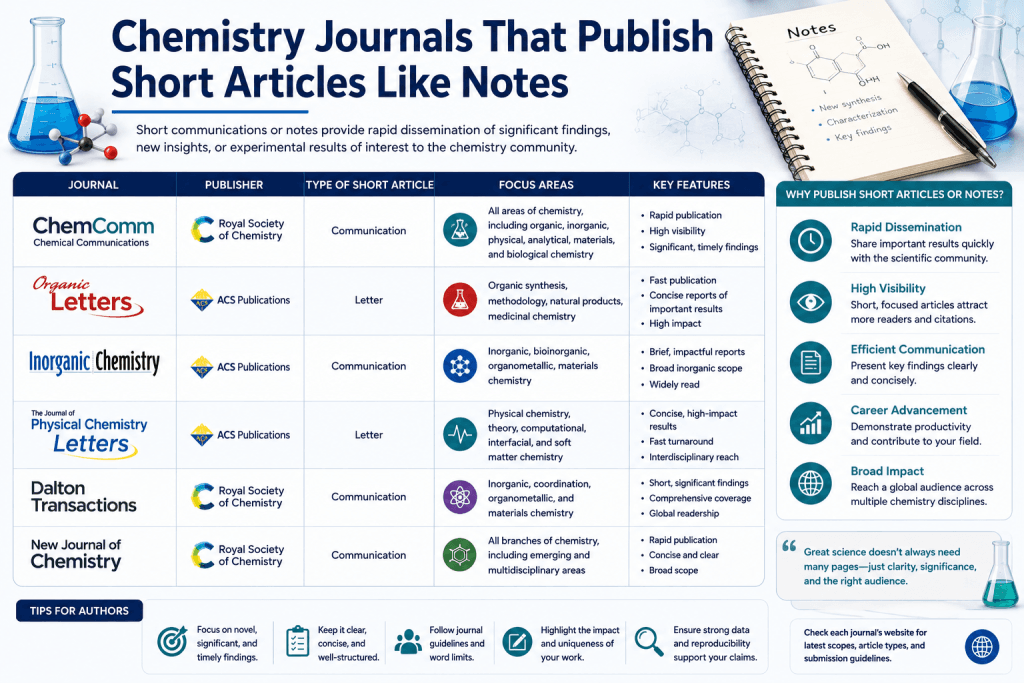
Top Chemistry Journals for Short Notes: Examples Across Inorganic, Materials, and Bioorganic Chemistry
Finding the right home for a short manuscript means knowing exactly which chemistry journals that publish short articles like notes match your subfield. Below are real, practical examples organized by discipline.
General and Multidisciplinary Chemistry
- European Journal of Chemistry is one of the most accessible chemistry journals that publish short articles like notes, with an open access model that lets authors reach a broad international audience quickly. It accepts research articles, review articles, and short communications across organic chemistry, inorganic chemistry, analytical chemistry, and physical chemistry, making it a flexible choice for chemists working across sub-disciplines.
- Chemical Communications, published by the Royal Society of Chemistry, is built almost entirely around short papers. It is widely regarded as one of the fastest peer-reviewed journal outlets for urgent, high-impact findings across the chemical sciences.
- Tetrahedron Letters, an Elsevier title, has long served as a go-to option for short communications in organic and bioorganic chemistry, prioritizing novel synthetic methodology and rapid publication.
Inorganic Chemistry
- Inorganic Chemistry Communications (Elsevier) is dedicated specifically to short reports in inorganic chemistry, covering coordination compounds, organometallics, and solid-state inorganic systems. Authors submitting crystallographic data to this journal are often required to deposit structures with the Cambridge Crystallographic Data Centre before the manuscript is accepted for publication.
- Dalton Transactions (Royal Society of Chemistry) also publishes shorter communications alongside full-length articles, giving inorganic chemists another established, peer-reviewed journal option.
Materials Chemistry
- Materials Chemistry Frontiers and Journal of Materials Chemistry (both RSC titles) regularly feature short communications alongside longer research articles, allowing materials chemistry researchers to report new material syntheses, characterization breakthroughs, or device performance data without committing to a full-length manuscript.
- Materials Letters (Elsevier) is explicitly structured around short papers, making it a strong option when a materials chemistry finding is compact but significant.
Bioorganic and Medicinal Chemistry
- Bioorganic & Medicinal Chemistry Letters (Elsevier) is one of the most recognized chemistry journals that publish short articles like notes in the bioorganic chemistry space, focusing on structure-activity relationships, synthetic intermediates, and early-stage drug discovery findings.
- ACS Medicinal Chemistry Letters, published by the American Chemical Society, similarly accepts short, timely reports rather than exhaustive full studies.
Organic and Analytical Chemistry
- The Journal of Organic Chemistry, published by the American Chemical Society, accepts “Notes” as a distinct submission category alongside full-length articles, specifically for concise but complete synthetic or mechanistic findings.
- Analytical Chemistry (ACS) occasionally publishes short technical notes covering new instrumentation approaches, including advances involving mass spectrometry and other analytical techniques, where the finding is narrow but methodologically important.
Across all of these examples, the throughline is the same: chemistry journals that publish short articles like notes exist in every major subfield, from inorganic chemistry to materials chemistry to bioorganic chemistry, and choosing the right one depends on matching your finding’s discipline and depth to the journal’s established short-format category.
Understanding the Scope of the Journal Before You Submit a Note
Before you get anywhere near the submission system, it is worth slowing down and genuinely evaluating the scope of the journal. This single step prevents more rejected manuscripts than any formatting issue ever will.
- Read the “Aims and Scope” page carefully. Every reputable chemistry journal publishes a scope of the journal statement on its website, usually outlining which subfields — organic chemistry, inorganic chemistry, physical chemistry, analytical chemistry, materials chemistry, or bioorganic chemistry — it accepts. Chemistry journals that publish short articles like notes often narrow this even further, specifying that notes must report a discrete, novel result rather than a broad survey.
- Check whether the journal explicitly accepts short-format submissions. Not every chemistry journal has a “Notes,” “Short Communications,” or “Technical Note” category. Some journals only publish full-length articles and review articles. Skimming a few recent issues, or searching the submission system’s manuscript-type dropdown, quickly confirms whether a given title belongs among the chemistry journals that publish short articles like notes.
- Look at recently article published examples in your subfield. If you work in bioorganic chemistry, browse the journal’s last few issues for bioorganic chemistry notes. If your work sits in materials chemistry, look for materials chemistry short communications. This tells you not just whether the journal fits your scope, but also how deep or preliminary your data needs to be for that section of the journal.
- Confirm the journal isn’t already considering your data under review elsewhere. Nearly every peer-reviewed journal requires authors to confirm the manuscript is not under consideration for publication elsewhere. Submitting a note that overlaps significantly with previously published work — even your own — can trigger an ethics inquiry, so authors must check this carefully before submission.
- Match your audience to the journal’s readership. A note on a new mass spectrometry technique will resonate more in an analytical chemistry-focused journal than in a broad multidisciplinary title. The European Journal of Chemistry, for example, explicitly welcomes short communications across multiple chemistry subfields, which makes it a flexible fit for chemists whose work doesn’t sit neatly in one narrow category.
- Watch for subject-specific exclusions. Some journals state they will not consider purely computational studies, or won’t accept notes without accompanying crystallographic data, or require a minimum amount of original research data. These scope details are almost always mentioned in the author guidelines, and ignoring them is one of the most common reasons manuscripts are returned before even reaching peer review.
Getting the scope of the journal right isn’t a bureaucratic formality — it’s the difference between an efficient submission process and months of wasted review time at the wrong outlet.
Academic Writing & Research Support Need Help With Research Papers, Manuscripts, Editing, or Proofreading? At Scholarly Work , we provide professional academic writing support for researchers, students, and professionals. From drafting manuscripts to refining final submissions, we ensure clarity, accuracy, and publication-ready quality. Get Manuscript Writing Help
How Peer Review Works for Peer-Reviewed Short Articles and Notes
Peer review is the backbone of scientific journals, and understanding how it functions for shorter formats helps authors set realistic expectations for chemistry journals that publish short articles like notes.
- The submission process starts the same way as any other manuscript. Authors upload their manuscript through the journal’s online submission system, provide a full list of authors, disclose any conflicts of interest, and often submit a graphical abstract summarizing the work visually. Even short papers are expected to include this material, since it helps editors and reviewers quickly assess relevance.
- An editor performs an initial screening. Before a manuscript ever reaches peer review, an editor checks whether it fits the scope of the journal, whether the formatting matches the journal’s style guide, and whether the science appears sound enough to justify sending it out. Notes and technical notes that clearly fall outside the journal’s scope are often desk-rejected at this stage without formal peer review.
- Reviewers are selected based on subject expertise. For a submission in inorganic chemistry, editors typically invite reviewers with direct expertise in coordination chemistry or organometallics. For bioorganic chemistry notes, reviewers are usually chosen from medicinal or biological chemistry backgrounds. This ensures the peer-review process remains rigorous even for shorter submissions.
- Reviewers assess several core elements, even in a condensed note:
- Whether the purpose of the research is clearly and immediately stated
- Whether the experimental methods should be described in sufficient detail to allow another chemist to reproduce the work
- Whether the interpretation of the results is scientifically justified by the research data presented
- Whether the finding is genuinely novel or simply confirms existing literature
- Whether all research data, including any crystallographic data, is properly deposited or made available
- The peer-review process for short communications is typically faster, but not less rigorous. Reviewers are simply evaluating a narrower scope of claims. A note claiming a new catalytic method still needs supporting evidence, but reviewers aren’t expected to evaluate an entire body of exploratory chemistry — just the single, sufficiently supported claim.
- Revisions are common, even for notes. Reviewers may ask authors to clarify a mechanism, add missing analytical chemistry data, include additional mass spectrometry confirmation, or better contextualize the significance of the research relative to previously published work. Authors are expected to respond point-by-point before a manuscript is accepted for publication.
- Ethical review checkpoints still apply. If the work involves biological testing — common in bioorganic chemistry notes — authors must inform the editor of any ethics committee approval relevant to the study. Peer reviewers and editors are trained to check for this disclosure even in short-format submissions.
- Final decisions typically fall into familiar categories: accept, minor revision, major revision, or reject. Because chemistry journals that publish short articles like notes are evaluating a narrower claim, “minor revision” is a more common outcome than for lengthy full-length articles, since there’s simply less material to scrutinize.
- Once accepted, the manuscript moves toward proofing. Authors typically receive a PDF file of the typeset version of the paper to check before the article is formally published at the discretion of the editor, who confirms all revisions and formatting requirements have been satisfied.
Peer review for short notes is, in short, the same rigorous, evidence-based system used for full-length research — just calibrated to a tighter, more focused claim.
Open Access, Creative Commons, and Citation Considerations for Peer-Reviewed Articles
Open access publishing has reshaped how chemists find and share research, and this is especially relevant to chemistry journals that publish short articles like notes, where speed and accessibility often matter as much as prestige.
- Open access means the article published is available free of charge. Unlike subscription-based scientific journals, open access chemistry journals — including the European Journal of Chemistry — make the full version of the paper available to anyone, without requiring institutional access. This dramatically increases how many researchers actually read and cite a short communication.
- Creative Commons licensing determines how others can reuse the work. Most open access journals publish under a Creative Commons license, commonly CC BY. In practice, this means the journal publishes each accepted manuscript as “an open access article distributed under the terms of the Creative Commons Attribution License, which permits unrestricted use, distribution, and reproduction in any medium, provided the original work is properly cited.” This single condition — that the original work is properly cited — is the core mechanism that lets research spread rapidly while still crediting the original authors.
- Citation practices matter even more for short notes. Because notes and technical notes are compact, readers rely heavily on accurate citation to trace back to the underlying research data, crystallographic data, or spectroscopic evidence supporting a claim. Every source mentioned in the text should be properly referenced according to the journal’s citation style, whether that follows an ACS format, an RSC format, or a journal-specific style guide.
- Chemical Abstracts Service (CAS) indexing adds credibility. Many chemists specifically look for chemistry journals that publish short articles like notes and are indexed by the Chemical Abstracts Service, since CAS indexing signals that the journal is recognized within the broader scientific community and that published articles will be discoverable through standard chemistry literature searches.
- Publisher policies vary meaningfully. Major publishers like Elsevier, the American Chemical Society, and the Royal Society of Chemistry each maintain their own open access options, often offering a choice between traditional subscription publishing and a paid open-access route (sometimes called a hybrid model) for individual articles. Understanding your chosen publisher’s specific open-access and Creative Commons terms before submission avoids surprises after a manuscript is accepted for publication.
- Authors must check licensing carefully if reusing figures or data. If a note references or reuses a figure from previously published work, authors must obtain appropriate permissions, even under open access norms, unless the original material was also released under a compatible Creative Commons license.
- Discoverability is a real practical benefit. An open access, peer-reviewed article gets cited more easily because researchers using search engines and databases don’t hit paywalls. For chemists deciding between several chemistry journals that publish short articles like notes, the open access status can be just as important as impact factor when the goal is maximizing readership of a focused, timely finding.
- Version control matters for citation accuracy. Readers and future authors should always cite the final, published version of the paper, not a preprint or accepted-manuscript version, since page numbers, DOIs, and even minor textual details can change during proofing.
Altogether, the combination of open access availability, clear Creative Commons terms, and disciplined citation practices is what allows short notes published in chemistry journals to circulate widely and contribute meaningfully to the scientific community.
Journal Articles
Want to go deeper on journal articles? Explore more guides from our Journal Articles collection below.
-
What Is a Scientific Journal?
-
How to Write a Journal Article
-
Journal vs. Article: What’s the Difference?
-
How to Find an Article’s Issue Number
-
Citing a Journal Article in Chicago Style
-
APA Journal Article Citation Guide
-
What Is an SCI Journal?
-
Scientific Journal Examples
-
Sample Journal Article
-
How to Write an Article Summary
-
Chemistry Journals for Short Articles & Notes
-
Publishing in Nurse Practitioner Journals
Formatting Your Note: Style Guide Tips with Real Journal Examples
Even the strongest research can be delayed or rejected over formatting missteps. Following each journal’s style guide closely is essential when submitting to chemistry journals that publish short articles like notes.
- Always download the official author guidelines before formatting anything. Every publisher — Elsevier, the American Chemical Society, the Royal Society of Chemistry — maintains a distinct style guide, and formatting a manuscript for the wrong journal’s rules is one of the most common, avoidable submission errors.
- Word and reference limits are strict for notes. For example, The Journal of Organic Chemistry’s Notes category enforces a defined word limit and a capped number of references and figures, reflecting the compact nature of the format. Similarly, Inorganic Chemistry Communications restricts short reports to a few pages, expecting extended data to move into supplementary materials rather than the main text.
- A graphical abstract is often mandatory. Many chemistry journals, including several RSC and Elsevier titles, require a graphical abstract summarizing the key finding visually — this helps readers scanning the table of contents quickly judge relevance.
- Supplementary information carries a heavier load in short formats. Since the main text is limited, supporting spectra, crystallographic data, and expanded experimental methods are typically placed in supplementary files. Reviewers still expect this material to be presented in sufficient detail to allow full evaluation of the manuscript, even though it isn’t in the primary PDF file.
- Follow exact citation and reference formatting. ACS-style journals (like Journal of Organic Chemistry and Analytical Chemistry) use a distinct numbered or author-date citation format, while RSC journals like Dalton Transactions follow their own house style. Getting this wrong won’t cause outright rejection, but it does slow down the submission process.
- Include all required declarations. Most submission systems now require a statement confirming the work is original research, not under consideration for publication elsewhere, along with any ethics committee approval details and a complete list of authors with affiliations.
- Proofread against the journal’s specific checklist. The European Journal of Chemistry, for instance, provides a submission checklist outlining exact formatting expectations for short communications — from margin sizes to reference style — before a manuscript can even be considered for publication.
Following the target journal’s style guide precisely — down to word counts, citation format, and supplementary requirements — is often what separates a smooth submission process from a manuscript bounced back for revisions before it’s even sent for peer review.
- University of California, San Francisco (UCSF) – Scientific Writing and Scholarly Publishing: Article Writing – https://guides.ucsf.edu/writingpublishing/articles
- George Washington University – Writing and Publishing a Scientific Article Guide – https://libguides.gwu.edu/sciencepublishing
- University of North Carolina at Chapel Hill – Writing and Citing Resources: How to Write Scientific Papers – https://guides.lib.unc.edu/writing-citing
- University of Illinois at Chicago – Scientific Writing: Journal Articles Guide – https://researchguides.uic.edu/ScientificWriting/JournalArticles