
How to Cite a Journal Article Chicago Style: The Basics
Learning how to cite a journal article Chicago style doesn’t have to feel overwhelming, even if you’ve never opened the Chicago Manual of Style before. Once you understand the core building blocks, you’ll be able to apply them to almost any journal article citation you come across. Here’s what you need to know before you start writing your bibliography entry or footnote.
- Chicago style has two citation systems, and you must pick one. Before you can figure out how to cite a journal article Chicago style with full confidence, you need to know that the Chicago Manual of Style offers two distinct citation styles: the notes and bibliography style and the author-date style. Both are acceptable under Chicago citation rules, but they look very different on the page. History, literature, and the arts typically favor notes and bibliography, while the sciences and social sciences lean toward author-date. Check with your instructor, journal, or style guide requirements before choosing, because mixing the two within one paper is a common and easily avoidable mistake.
- Every journal article citation needs the same core elements, regardless of style. Whether you’re using notes and bibliography or author-date, a complete article citation for a journal article requires: the author’s name (or author names, if there are multiple authors), the article title, the journal title, the volume and issue number, the publication date, the page range or specific page number you’re referencing, and — for anything found online — a DOI or URL. Learning to identify these elements on the article itself is the first real skill in mastering how to cite a journal article Chicago style, and it’s a skill that carries over into every citation you write afterward.
- The article title always goes in quotation marks. This is one of the most consistent rules across both Chicago citation styles. The article title is placed in quotation marks, while the journal title is italicized. This distinction matters because in Chicago style, italics are typically reserved for larger standalone works (books, journals, websites), while quotation marks are used for shorter works that live inside those larger works (chapters, articles, essays). Getting this backward is one of the most frequent errors students make when they’re first learning how to cite a journal article Chicago style, so it’s worth double-checking every entry before submitting your paper.
- Capitalization follows headline-style rules. When you write out an article title or journal title, Chicago citation style asks you to capitalize the major words — that means nouns, pronouns, verbs, adjectives, adverbs, and the first and last word of the title and subtitle. Minor words like “a,” “an,” “the,” “and,” “but,” “or,” “for,” “nor,” and prepositions are lowercase unless they start the title. So “The Role of Memory in Political Persuasion” is correctly capitalized, while “the role of memory in political persuasion” is not.
- Punctuation is not optional — it’s structural. Chicago citation style relies heavily on commas and periods to separate different pieces of information within a bibliography entry or footnote. A misplaced comma or period can make an entry technically incorrect even if all the right information is present. For example, in a bibliography entry, elements are typically separated by periods, while in a footnote, elements are usually separated by commas. This is one of those small but important details that research guides and library guides always emphasize when explaining how to cite a journal article Chicago style, because it affects how easily a reader can locate your source.
- The volume and issue number identify exactly where the article sits within a journal’s publishing history. Most academic journals publish multiple issues within one volume, usually organized by year. The volume number refers to the full year (or sometimes multi-year cycle) of publication, while the issue number refers to the specific installment within that volume — for example, Volume 45, Issue 2. When you’re citing journal articles, both the volume and issue number should typically appear, formatted as “45, no. 2” in most Chicago citation formats.
- Page numbers pinpoint your source material. If you’re citing a direct quotation or specific idea, you’ll often need a specific page number rather than the full page range. However, in a full bibliography entry, you’ll usually list the complete page range of the article — for instance, 112–130 — so readers know exactly how long the piece is and where it falls within the journal issue.
- Digital sources add another layer: the DOI or URL. Because so many journal articles are now accessed online, Chicago citation style requires you to include either a DOI (Digital Object Identifier) or a stable URL at the end of your citation. A DOI is preferred whenever one is available because it doesn’t change even if the article’s web address does, unlike a regular URL, which can become a dead link over time — this is a small but essential piece of how to cite a journal article Chicago style correctly.
- Consistency across your entire document matters as much as accuracy. One of the underlying philosophies of the Chicago Manual of Style method is that a reader should be able to predict the format of every citation once they’ve seen a few. That means if you’re citing journal articles throughout your paper, they should all follow the same structure — same punctuation, same capitalization rules, same treatment of author names — from the first footnote to the last bibliography entry.
- Use trusted research guides to double-check your work. Even experienced writers reference library guides, especially official ones like the Purdue University Online Writing Lab (Purdue OWL), when working through document formatting and citation questions. These research guides break down the Chicago manual of style method into digestible examples, which is especially helpful when you’re dealing with tricky source types like translated works or personal communication.
Understanding these fundamentals is the true foundation of how to cite a journal article Chicago style, and it sets you up to tackle the more detailed formatting differences between the two citation systems, which is exactly what we’ll walk through next.
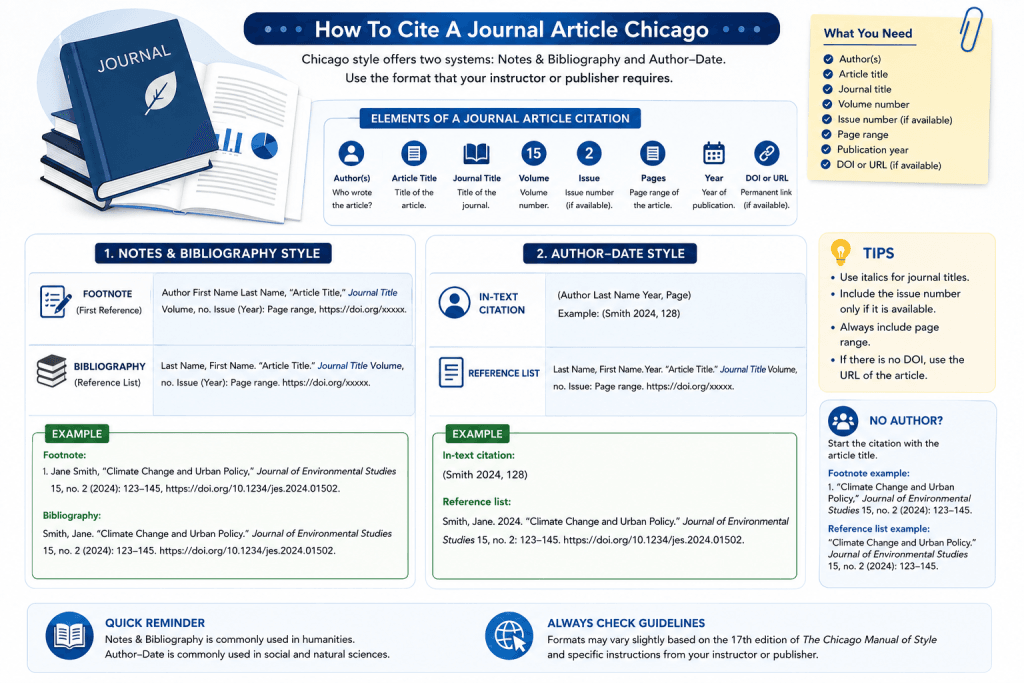
Chicago Style Author-Date vs. Notes-Bibliography: Citing an Article
Now that you understand the basics, it’s time to look closely at how the two Chicago citation systems actually differ when you’re working out how to cite a journal article Chicago style in practice. This is often where confusion sets in, because the same journal article citation can look almost unrecognizable depending on which system you’re using.
- Notes and bibliography style relies on footnotes plus a bibliography page. In the notes and bibliography system, every time you reference a source in your text, you insert a superscript number that corresponds to a footnote (or endnote) at the bottom of the page or end of the document. At the end of your paper, you also include a full bibliography entry for every source cited. This system is popular in the humanities because it allows writers to add commentary within the footnote itself, not just source information.
- Author-date style relies on in-text parenthetical citations plus a reference list. This is the second accepted method for how to cite a journal article Chicago style, and in the author-date style, instead of footnotes, you place the author’s last name and publication date directly in the text, inside parenthesis — for example, (Smith 2020). At the end of the document, a reference list (similar to a bibliography, but formatted slightly differently) provides the complete citation for each source. This is the preferred style method of document formatting in the sciences and social sciences, where concise in-text attribution is valued.
- Footnote format for a basic journal article citation. In notes and bibliography style, a footnote showing how to cite a journal article Chicago style typically looks like this:
- John Smith, “The Role of Memory in Political Persuasion,” Journal of Political Psychology 45, no. 2 (2020): 118.
- Bibliography entry format for the same journal article. When that same source appears in the bibliography, the format shifts: Smith, John. “The Role of Memory in Political Persuasion.” Journal of Political Psychology 45, no. 2 (2020): 112–130. Here, the author’s name is inverted (last name first) for alphabetical order purposes, and the full page range is included instead of a single page. This is a critical distinction: the footnote and the bibliography entry for the exact same article will not look identical, and that’s expected under Chicago citation style.
- Author-date in-text citation format. If you’re using author-date style, citing an article within your text looks much simpler: (Smith 2020, 118) The author’s last name, the publication date, and the specific page number all sit inside parenthesis, directly after the information you’re referencing or the quotation you’re using.
- Author-date reference list entry format. The corresponding reference list entry, however, carries more detail and looks noticeably different from a notes-bibliography entry: Smith, John. 2020. “The Role of Memory in Political Persuasion.” Journal of Political Psychology 45 (2): 112–130. Notice that the publication date moves right after the author’s name, rather than sitting near the end of the citation as it does in notes and bibliography style. Also note that the issue number here appears in parenthesis without “no.” before it — a small formatting difference that trips up a lot of writers switching between styles.
- Shortened footnotes for repeated citations. One advantage of the notes and bibliography system is that after your first full footnote for a source, subsequent references to that same journal article citation can be shortened. For example, instead of repeating the entire footnote, you can simply write: Smith, “Role of Memory,” 122. This shortened form still gives the reader the author’s name, an abbreviated article title, and a specific page number.
- Alphabetical order applies to both bibliography and reference lists. Regardless of which citation style you choose, your final list of sources — whether it’s called a bibliography or a reference list — should be organized in alphabetical order by the first author’s last name. This makes it easy for readers to scan and locate any journal article citation quickly.
- Multiple citations from the same author in author-date style. If you’re citing journal articles by the same author published in different years, author-date style distinguishes between them using the date. If two works were published in the same year, you’d add a lowercase letter (2020a, 2020b) to differentiate them, both in-text and in the reference list.
- Choosing between the two comes down to discipline and instruction. When deciding how to cite a journal article Chicago style for your paper, if your school, journal, or instructor hasn’t specified a preference, notes and bibliography is generally considered the more traditional and flexible option, especially if you want to include explanatory notes alongside your citations. Author-date is more streamlined and is often required for lab reports, scientific papers, or any writing where interrupting the text with lengthy footnotes would be distracting.
- Both styles ultimately point back to the same core information. Even though the formatting differs, both systems are built to answer the same questions: who wrote this, what is it called, where was it published, when, and where can a reader find it. Once you internalize that principle, switching between the notes and bibliography style and the author-date style becomes far less intimidating.
Understanding these structural differences is essential groundwork for anyone learning how to cite a journal article Chicago style, because from here, we’ll apply both systems to real, detailed examples — starting with the most common scenario: a basic journal article in print with multiple authors.
Academic Writing & Research Support Need Help With Research Papers, Manuscripts, Editing, or Proofreading? At Scholarly Work , we provide professional academic writing support for researchers, students, and professionals. From drafting manuscripts to refining final submissions, we ensure clarity, accuracy, and publication-ready quality. Get Manuscript Writing Help
Citing a Basic Journal Article in Print with Multiple Authors
Multiple authors are extremely common in academic publishing, and Chicago citation style has clear rules for handling them. Here’s exactly how to cite a journal article Chicago style when more than one person contributed to the work, whether that’s two co-authors or a dozen contributors.
- Two to three authors are listed in full, in both systems. When a journal article in print has two or three authors, you list all of the author names, separating them appropriately. In a bibliography entry, only the first author’s name is inverted (last name first); every other author’s name stays in normal order. For example: Bibliography entry (notes and bibliography style): Nguyen, Maria, and David Okafor. “Climate Adaptation in Coastal Communities.” Journal of Environmental Studies 32, no. 4 (2019): 205–224. Footnote (notes and bibliography style):
- Maria Nguyen and David Okafor, “Climate Adaptation in Coastal Communities,” Journal of Environmental Studies 32, no. 4 (2019): 210.
- Three authors follow the same pattern, just with an added name. For example: Nguyen, Maria, David Okafor, and Priya Raman. “Climate Adaptation in Coastal Communities.” Journal of Environmental Studies 32, no. 4 (2019): 205–224. Notice the comma before “and” preceding the final author’s name — this is standard Chicago citation style punctuation for a list of three or more items.
- Four to ten authors are all listed in the bibliography, but shortened in footnotes. This is a detail many writers miss. If a basic journal article has, say, six authors, the Chicago manual of style requires all six authors to be listed in the full bibliography entry. However, in the footnote, you can list only the first author’s name followed by “et al.” For example: Bibliography entry: Rossi, Anna, James Wu, Fatima Al-Sayed, Thomas Becker, Lin Chen, and Rachel Adams. “Urban Heat Islands and Public Health Outcomes.” Journal of Urban Planning 28, no. 1 (2021): 45–67. Footnote:
- Anna Rossi et al., “Urban Heat Islands and Public Health Outcomes,” Journal of Urban Planning 28, no. 1 (2021): 52.
- More than ten authors get abbreviated in the bibliography too. If a journal article has more than ten authors, Chicago style says to list only the first seven author names in the bibliography entry, followed by “et al.” to represent the rest. This rule exists because some scientific journal articles have dozens of contributors, and listing every single one would make the bibliography unreadable.
- Author-date style follows a nearly identical multiple-author pattern. For author-date style, the same rules about inverting only the first author’s name and using “et al.” for four or more authors apply, but the publication date shifts to sit right after the author’s name: Nguyen, Maria, and David Okafor. 2019. “Climate Adaptation in Coastal Communities.” Journal of Environmental Studies 32 (4): 205–224. In-text: (Nguyen and Okafor 2019, 210) With six or more authors: (Rossi et al. 2021, 52)
- Order of authors matters and should not be changed. Always list author names in the exact order they appear on the original journal article, since this order often reflects each contributor’s role or level of involvement in the research. Rearranging author names, even alphabetically, is considered inaccurate under Chicago citation style, and it’s a mistake that undermines an otherwise correct grasp of how to cite a journal article Chicago style.
- Page ranges vs. specific pages still apply the same way with multiple authors. Just like with a single-author basic journal article, your bibliography entry should show the full page range of the article, while your footnote or in-text citation should point to the specific page or pages you’re actually referencing or quoting.
- Volume and issue number formatting doesn’t change based on author count. Regardless of how many authors are involved, the volume and issue number are formatted the same way: the volume number stands alone, followed by “no.” and the issue number in notes-bibliography style, or the issue number in parenthesis in author-date style.
Mastering these multiple-author rules means you can confidently handle nearly any journal article in print, whether it has one contributor or twelve, and it rounds out your grasp of how to cite a journal article Chicago style for print sources. Next, we’ll shift from print to digital sources, where DOIs, database names, and URLs come into play.
Citing an Article Online: DOI, Database Name, and URL
Most researchers today access journal articles online rather than flipping through bound print volumes, so knowing how to cite a journal article Chicago style for digital sources is essential, and it’s a skill that comes up in nearly every research paper. Here’s how the format changes once a DOI, database, or URL enters the picture.
- Always include a DOI when one is available. This step is central to how to cite a journal article Chicago style online, and a DOI, or Digital Object Identifier, is a permanent alphanumeric string assigned to many academic articles specifically so they can always be located online, even if the journal’s website changes over time. Chicago citation style strongly prefers a DOI over a regular URL whenever both are available, because the DOI or URL requirement exists to ensure long-term access to your source.
- Format the DOI as a clickable link. In both notes-bibliography and author-date style, the DOI is typically formatted as a full URL starting with “https://doi.org/” followed by the identifier string. For example: Bibliography entry: Nguyen, Maria, and David Okafor. “Climate Adaptation in Coastal Communities.” Journal of Environmental Studies 32, no. 4 (2019): 205–224. https://doi.org/10.1234/jes.2019.0032.
- Use a stable URL only when no DOI exists. If the journal article you’re citing doesn’t have a DOI, Chicago citation style allows you to include the article’s URL instead — but it should be a stable URL, meaning a permanent link, not one that will expire or change. You can typically find this by checking the address bar for a “permalink” or “stable link” option, rather than copying whatever appears after navigating through several pages — a habit worth building whenever you’re figuring out how to cite a journal article Chicago style for an online-only source.
- Include the database name when the article was accessed through one. If you accessed the journal article through a library database like JSTOR, ProQuest, or EBSCO, Chicago style often asks you to include the name of the database, especially if the article doesn’t have a DOI and the database’s URL isn’t public or stable. For example: Smith, John. “The Role of Memory in Political Persuasion.” Journal of Political Psychology 45, no. 2 (2020): 112–130. JSTOR. Many research guides and library guides note that when citing articles from JSTOR specifically, you often don’t need the full URL if you include the database name, since JSTOR is widely recognized and searchable by title.
- Access dates are usually optional, but check your requirements. Older Chicago Manual of Style editions sometimes recommended including an access date, but the 18th edition generally considers this unnecessary for formally published journal articles, since they’re considered stable, dated publications. However, some instructors or research guides still request an access date for online sources, especially for less formal website content, so it’s worth confirming before you omit it.
- Author-date style for an article online follows the same additive pattern. The DOI or URL simply gets added to the end of the reference list entry: Nguyen, Maria, and David Okafor. 2019. “Climate Adaptation in Coastal Communities.” Journal of Environmental Studies 32 (4): 205–224. https://doi.org/10.1234/jes.2019.0032. In-text citation remains unchanged: (Nguyen and Okafor 2019, 210).
- Footnotes for online articles include the DOI or URL at the very end. For example:
- John Smith, “The Role of Memory in Political Persuasion,” Journal of Political Psychology 45, no. 2 (2020): 118, https://doi.org/10.1234/jpp.2020.0045.
- Don’t confuse a journal’s homepage URL with the article’s specific URL or DOI. A common mistake is linking to the general journal website instead of the specific article page. Always locate the direct link or DOI or URL for the individual journal article you’re citing, not the broader publication.
- Formatting stays otherwise identical to print journal article citation rules. Every other element — author names, article title in quotation marks, italicized journal title, volume and issue number, and page range or specific page number — stays exactly the same whether the article was accessed in print or online. The DOI, database name, or URL is simply an added final piece of information for citing an article online, which means the core skill of how to cite a journal article Chicago style doesn’t really change between formats.
Once you’re comfortable citing journal articles both in print and online, it’s helpful to understand how these rules relate to other periodical types, which we’ll cover next.
Academic Writing & Research Support Need Help With Research Papers, Manuscripts, Editing, or Proofreading? At Scholarly Work , we provide professional academic writing support for researchers, students, and professionals. From drafting manuscripts to refining final submissions, we ensure clarity, accuracy, and publication-ready quality. Get Manuscript Writing Help
Related Citations: Magazine, Newspaper, and Social Media Content
While learning how to cite a journal article Chicago style is the primary focus here, it’s also worth understanding how related source types are handled, since research papers often combine several kinds of periodical sources.
- Magazine article citations share a similar structure but drop volume and issue details. A magazine article is typically cited without a volume and issue number, since most magazines are simply identified by their publication date. For example: Bibliography entry: Alvarez, Carla. “Rethinking Renewable Energy Policy.” The Atlantic, March 2022. Notice there’s no volume and issue number here — just the magazine title, italicized, followed by the date of publication. This is a key difference from a basic journal article citation, where the volume and issue number are essential.
- Newspaper article citations often omit page numbers entirely. Because a newspaper article might appear in different places across different print runs or editions, Chicago citation style typically doesn’t require a specific page number for a newspaper article. Instead, you focus on the date of publication: Bibliography entry: Chen, Michael. “City Council Approves New Transit Plan.” New York Times, June 15, 2023. https://www.nytimes.com/example-article. For a newspaper article accessed online, including the URL is standard, similar to citing an article online for a journal.
- In-text and footnote citations for newspaper articles are often woven into the sentence. Because newspaper articles are frequently referenced in passing, the Chicago manual of style permits mentioning the newspaper article directly within your sentence, sometimes without a formal footnote at all, especially for very well-known or widely accessible newspaper articles — though a full citation is still preferred in academic writing.
- Social media content requires its own distinct format. As social media content has become a more common source in academic and professional writing, the Chicago manual of style (18th edition) added specific guidance for citing it. A social media citation typically includes the author’s name (or username if the real name isn’t available), the content of the post (often shortened and placed in quotation marks), the platform name, the date of publication, and a URL. For example: Bibliography entry: Patel, Ravi (@ravipatel). “New research shows a direct link between urban green space and reduced stress levels.” Twitter/X, April 3, 2023. https://twitter.com/example-post.
- Shortened citations for social media content in footnotes. Because the full text of social media content can be lengthy or informal, footnotes often just cite the author’s name, platform, and date, without necessarily reproducing the full post text.
- Periodical is the umbrella term connecting all of these source types. Journal articles, magazine articles, and newspaper articles all fall under the broader category of periodical sources — meaning they’re published on a regular, recurring schedule. Understanding this relationship helps explain why their citation formats share a similar backbone (author, title in quotation marks, publication title italicized) while differing in the specific details each format requires, like volume and issue number for journals versus just a date for magazines and newspapers — a distinction that becomes second nature once you’ve practiced how to cite a journal article Chicago style a few times.
- Consistency across periodical types strengthens your bibliography or reference list. Just as with journal article citations, magazine, newspaper, and social media citations should follow the same notes-bibliography or author-date system you’ve chosen for the rest of your document. Switching formats halfway through a paper — even for a different type of periodical — creates confusion and looks inconsistent to readers and instructors alike.
- When in doubt, consult official research guides for periodical-specific rules. Library guides and research guides from university writing centers, including Purdue University’s OWL, maintain updated examples for magazine, newspaper, and social media citations, which is especially useful since platforms and publishing formats change more quickly than journal publishing practices do.
With periodicals covered, let’s move into a few special and often confusing citation scenarios that don’t fit neatly into the standard journal article citation format.
Journal Articles
Want to go deeper on journal articles? Explore more guides from our Journal Articles collection below.
-
What Is a Scientific Journal?
-
How to Write a Journal Article
-
Journal vs. Article: What’s the Difference?
-
How to Find an Article’s Issue Number
-
Citing a Journal Article in Chicago Style
-
APA Journal Article Citation Guide
-
What Is an SCI Journal?
-
Scientific Journal Examples
-
Sample Journal Article
-
How to Write an Article Summary
-
Chemistry Journals for Short Articles & Notes
-
Publishing in Nurse Practitioner Journals
Special Cases: Book Review, Thesis or Dissertation, Translated Book, and Personal Communication
Not every source you’ll cite fits neatly into the standard “journal article” mold, even once you’ve mastered how to cite a journal article Chicago style. Here’s how to handle a few special cases that frequently come up alongside journal article citations in academic writing.
- Book review citations require both the review and the book being reviewed. This is a close cousin of how to cite a journal article Chicago style, since when you’re citing a book review that was published within a journal, you need to include the reviewer’s name, the review’s title (if it has one), and then a “review of” statement identifying the book being reviewed, followed by standard journal article citation details. For example: Bibliography entry: Harris, Lena. “A New Lens on Colonial History.” Review of Empire and Memory, by Daniel Osei. Journal of Historical Studies 40, no. 3 (2021): 301–305. This format acknowledges that a book review is essentially a hybrid source — it’s published in a journal like any other journal article, but it also directly references a separate book.
- Thesis or dissertation citations follow their own distinct pattern. Unlike how to cite a journal article Chicago style, a thesis or dissertation is not a journal article, so it isn’t italicized or placed in quotation marks the same way — instead, the title goes in quotation marks, and you include the degree type, institution, and year. For example: Bibliography entry: Osei, Daniel. “Colonial Legacies in Modern Governance.” PhD diss., University of Toronto, 2020. If you accessed the thesis or dissertation through a database, you’d add that database name at the end, similar to citing an article online through JSTOR or ProQuest.
- Translated book citations require crediting both the author and the translator. Although this differs from how to cite a journal article Chicago style, when citing a translated book, Chicago citation style asks you to include the translator’s name after the title, using “trans.” as an abbreviation. For example: Bibliography entry: Marquez, Elena. Shadows of the Coast. Translated by Robert Klein. New York: Norton, 2018. This is different from a basic journal article citation because books, translated or not, include the publisher and place of publication rather than a volume, issue number, or page range for the whole work.
- Personal communication is cited differently from published sources entirely. Personal communication includes things like emails, phone calls, private messages, or in-person interviews that aren’t published or publicly accessible. Chicago citation style generally recommends citing personal communication only in a footnote, not in the bibliography, since readers can’t access the source themselves. For example: Footnote: 3. Maria Nguyen, email message to author, September 14, 2022. Because personal communication can’t be independently verified or located by a reader, it’s treated as informal supporting evidence rather than a formal, citable source.
- Author-date style handles personal communication similarly, with a small adjustment. In author-date style, personal communication is usually cited only in the text itself, in parenthesis, rather than in the reference list: (Maria Nguyen, email message to author, September 14, 2022). Since there’s no published date of publication to reference, this citation stays entirely in-text.
- Omit unavailable information rather than guessing. Across all of these special cases, if a piece of information isn’t available — say, a thesis or dissertation doesn’t list a specific advisor, or a translated book doesn’t credit an editor — Chicago style guidance is to simply omit that element rather than inventing or guessing at it. A citation with missing elements omitted is far more accurate than one with incorrect information filled in.
- These special cases still borrow structural rules from the standard journal article citation. Notice that the article title (or equivalent title) still generally uses quotation marks, larger standalone works like books are still italicized, and specific page numbers versus full page ranges still follow the same logic as a basic journal article citation. Once you understand how to cite a journal article Chicago style, these related source types become much easier to navigate, because they draw from the exact same foundational rules.
- When you’re unsure, cross-reference multiple research guides. Because special cases like book reviews, dissertations, translated works, and personal communication come up less frequently than a standard journal article citation, it’s worth double-checking your formatting against more than one library guide or research guide, since small institutional differences sometimes exist even within official Chicago citation style guidance.
Between the core basics, the two citation systems, multiple-author formatting, digital sourcing, related periodicals, and these special cases, you now have a complete, practical framework for how to cite a journal article Chicago style — and for handling nearly every related citation challenge that comes up alongside it. Bookmark this guide and refer back to it any time you need a refresher on how to cite a journal article Chicago style for your next paper.
- University of California, San Francisco (UCSF) – Scientific Writing and Scholarly Publishing: Article Writing – https://guides.ucsf.edu/writingpublishing/articles
- George Washington University – Writing and Publishing a Scientific Article Guide – https://libguides.gwu.edu/sciencepublishing
- University of North Carolina at Chapel Hill – Writing and Citing Resources: How to Write Scientific Papers – https://guides.lib.unc.edu/writing-citing
- University of Illinois at Chicago – Scientific Writing: Journal Articles Guide – https://researchguides.uic.edu/ScientificWriting/JournalArticles