What Is an Article Summary? Essential Basics Before You Start
Before you sit down to write a summary, it helps to know exactly what an article summary is and why it matters.
- Definition first. An article summary is a condensed, written-in-your-own-words version of a longer piece — whether that’s a journal article, a research article, an essay, or even a news feature. The goal is to capture the main idea, the key points, and the author’s argument without repeating the original article word for word. A good summary is always much shorter than the original, often just a fraction of the length, yet it still communicates the essential message clearly.
- Why article summaries matter. Summarization is an important skill in academic, professional, and everyday settings. Students use article summaries to demonstrate they’ve understood a research paper for an assignment. Professionals condense long reports into a quick overview for colleagues. Even outside formal writing, people summarize podcasts, transcripts, and chapters to share findings efficiently. If you can summarize an article accurately, you save your reader time while still giving them the substance of the original.
- What a summary is not. A common misconception is that an article summary is simply a shortened copy-paste job. It isn’t. You should never lift full sentences or paragraphs directly from the original article — that veers into plagiarism and defeats the purpose of summary writing. Instead, you’re expected to identify the core argument, the methodology (if it’s a research article), and the implications, then phrase them in your own words. A summary also isn’t a critique — that’s the job of an analytical response or a critique essay, not a summary.
- The purpose of the article should guide your summary. Every summary should reflect the topic of the article and the purpose of the article as the author intended. Ask yourself: What research question is being answered? What is the author trying to prove or explore? Your summary needs to mirror that objective, not your own opinion about it.
- Length and structure basics. As a general rule of thumb, an article summary should be roughly 10–25% of the original article’s length, though this can vary depending on the assignment or the complexity of the original article. A summary is typically written as one or several paragraphs, sometimes with a brief heading, and follows academic writing conventions like using the author’s name and citing the source.
- Who needs to write article summaries. Students, researchers, journalists, and professionals all rely on article summaries in different ways. A student might need an article summary for a literature review; a researcher might summarize a research article to build a case for a new study; a professional might summarize a report for a meeting. Regardless of context, the goal of any article summary stays the same: convey the essential message accurately and concisely.
- The takeaway. Writing an article summary well requires you to read the full article, identify the key points, and condense them with accuracy and brevity. It’s an essential skill you’ll use repeatedly, so understanding the basics now sets you up for success in the step-by-step outline ahead.
How to Write an Article Summary, with Examples: A Step-by-Step Outline
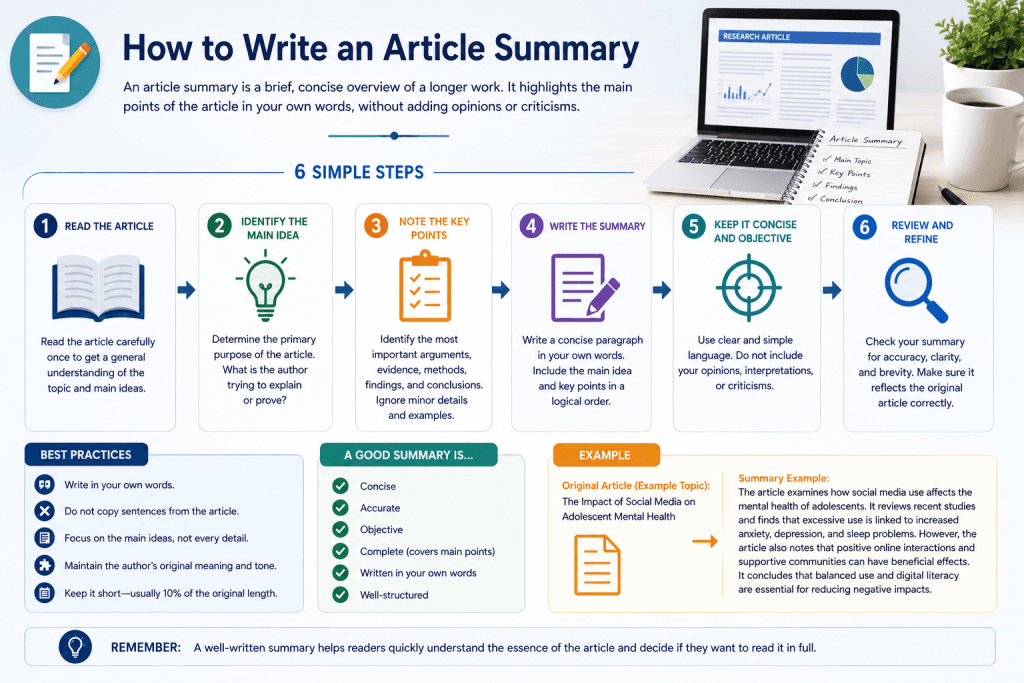
Writing an article summary doesn’t have to be complicated once you break it down step by step. Below is a five-step outline you can follow every time you need to summarize an article, along with a running example based on a hypothetical research article about workplace productivity.
Step 1: Read the full article carefully — more than once.
- Don’t skim. To write an article summary that’s accurate, you need to read the full article at least twice: once for a general overview, and a second time to identify key points, evidence, and structure.
- On your second read, take notes on the main idea of each section, paying close attention to the introduction and the discussion or conclusion, since these usually contain the article’s core argument and its implications. This is the foundation of any good summary — skip it, and your article summary will likely miss something essential.
- If you’re working from a transcript rather than a traditional article — say, an interview or a lecture recording — the same principle applies. Read (or watch) the full transcript twice before you begin summary writing, since spoken content often buries its main idea in the middle rather than the introduction.
- Example: Suppose you’re summarizing a research article titled “Remote Work and Employee Productivity: A Longitudinal Study.” On your first read, you’d note it’s about whether remote work increases or decreases output. On your second read, you’d flag the specific findings — for instance, a 12% productivity increase among remote employees over six months.
Step 2: Identify the main idea and key points.
- Every article summary hinges on correctly identifying the main idea — the single sentence that captures what the entire article is about. If you can’t state the main idea in one sentence, you likely need to reread the original article before moving forward.
- List the key points that support that main idea — these are the main points of the article. For a research article, this usually includes the research question, the methodology, the main findings, and the implication of those findings. For an essay, the key points are usually the author’s central argument and the supporting evidence used across each paragraph.
- Don’t confuse a key point with a minor detail. A useful test: if removing a piece of information would change how a reader understands the article’s argument, it belongs in your summary; if not, leave it out.
- Example: For our productivity study, the main idea might be: “Remote work arrangements are associated with measurable productivity gains when paired with clear communication structures.” The key points would include the study’s sample size, its methodology (a 12-month survey of 500 employees), and its central finding.
Step 3: Write a draft summary in your own words.
- This is where writing an article summary actually happens. Using only your notes (not the original article open in front of you), draft a paragraph that states the topic of the article, the author’s purpose, the methodology if relevant, and the main findings.
- Avoid copying phrases directly from the original article. Paraphrase using your own terminology while still representing the author’s argument accurately.
- Example draft: “In their study, Chen and Alvarez (2024) examine the relationship between remote work and employee productivity. Drawing on a 12-month survey of 500 employees across three industries, the authors find that remote workers demonstrated a 12% increase in output compared to their in-office counterparts, particularly when supported by structured check-ins.”
Step 4: Revise for accuracy, brevity, and flow.
- Compare your draft against the original article to check for accuracy — did you misrepresent any finding or argument? This step is essential to ensure your article summary reflects the source faithfully.
- Trim unnecessary detail. A summary should stay concise, cutting anything that isn’t central to the main idea. If a sentence doesn’t help illustrate the article’s core argument, cut it. This is often where a first draft of an article summary shrinks by a third or more.
- Check that your summary flows as a coherent paragraph rather than a list of disconnected facts. Read it aloud — if it sounds choppy, add transition phrases between key points.
- Double-check terminology. If the original article used a specific technical term, make sure you’ve used it correctly and consistently in your summary rather than substituting a vaguer synonym.
- Example: You might revise the draft above to tighten the phrasing: “Chen and Alvarez’s (2024) 12-month study of 500 employees found that remote work correlates with a 12% productivity increase, especially when supported by structured communication.”
Step 5: Add a citation and proofread.
- Always cite the original article using the appropriate citation style (APA, MLA, or Chicago, depending on your assignment). This distinguishes your summary from plagiarism and gives credit to the scholar whose work you’re condensing.
- Proofread for clarity, grammar, and terminology accuracy — make sure any technical terms from the original article are used correctly.
- Example citation (APA): Chen, L., & Alvarez, R. (2024). Remote work and employee productivity: A longitudinal study. Journal of Organizational Behavior, 45(2), 112–130.
Following these five steps consistently is the most reliable way to summarize an article, whether it’s a journal article, a research paper, an essay, a book chapter, or even a transcript from an interview or podcast you need to condense into a briefly written overview. Once you’ve practiced this step-by-step outline a few times, writing an article summary becomes far less intimidating — and far faster.
Academic Writing & Research Support Need Help With Research Papers, Manuscripts, Editing, or Proofreading? At Scholarly Work , we provide professional academic writing support for researchers, students, and professionals. From drafting manuscripts to refining final submissions, we ensure clarity, accuracy, and publication-ready quality. Get Manuscript Writing Help
Writing an Article Summary Introduction and Paragraph Structure
The introduction of your summary sets the tone for everything that follows, so it’s worth spending extra time getting it right.
- What belongs in the introduction. The introduction to your article summary should immediately identify the original article by title and author, followed by a brief statement of the topic of the article and the purpose of the article. Many students make the mistake of diving straight into findings without this context — but your reader needs to know what they’re about to read a summary of.
- Example introduction: “In ‘Remote Work and Employee Productivity: A Longitudinal Study,’ authors Chen and Alvarez investigate how remote work arrangements affect employee output over time, using survey data collected from 500 employees across three industries.”
- The ideal paragraph structure for a summary. A well-structured article summary typically follows this pattern:
- Opening sentence — names the article, the author, and the research question or topic of the article.
- Methodology sentence (for a research article) — briefly describes how the study or analysis was conducted.
- Main findings — the heart of the summary, covering the key points and results.
- Implication or conclusion — what the findings mean, according to the author’s argument.
- This four-part structure keeps your summary organized and ensures nothing essential is left out, whether you’re summarizing a single journal article or comparing multiple article summaries for a broader essay.
- One paragraph or several? For shorter articles, a single paragraph summary is usually sufficient. For longer or more complex research articles — especially ones with multiple studies or analyses — you may need two or three paragraphs, with each paragraph addressing a distinct section (e.g., one paragraph for methodology, one for findings, one for implications).
- Using topic sentences effectively. Each paragraph within your summary should open with a topic sentence that signals what that paragraph covers. This mirrors the structure of academic writing and helps your reader follow your summary without needing to reference the original article.
- Example topic sentence for a findings paragraph: “The study’s central finding was a measurable productivity gain among remote employees, particularly those with structured communication routines.”
- Maintaining objectivity. A summary should remain objective — represent the author’s argument as written, without inserting your own opinion or critique. Save analysis or evaluation for a separate section if your assignment calls for it.
- Adapting structure for different article types. Not every article summary follows the exact same paragraph structure. A summary of a research article typically needs a methodology sentence, while a summary of an essay or opinion piece can skip straight from the topic of the article to the author’s main argument. Learning to adapt your paragraph structure to the type of original article you’re working with is part of what makes a good summary feel natural rather than formulaic.
- Transitioning between ideas. Use clear transition phrases (“The authors also found…,” “Building on this, the study concludes…”) to keep your summary flowing naturally, rather than reading like a disconnected list of key points.
- Closing the summary. End your summary with a sentence on the broader implication of the article’s findings — why this matters, according to the original article. Avoid introducing new information the article summary hasn’t already covered.
- Full example paragraph: “In ‘Remote Work and Employee Productivity: A Longitudinal Study,’ Chen and Alvarez investigate whether remote work arrangements influence employee output. Using a 12-month survey of 500 employees across three industries, the authors found a 12% increase in productivity among remote workers, particularly when paired with structured check-ins. They conclude that organizations adopting remote work should prioritize clear communication frameworks to sustain these productivity gains.”
This kind of introduction and paragraph structure works well as a model for writing the summary of nearly any journal article, research paper, or essay you’re asked to condense.
Article Summary Examples: How to Summarize a Journal Article
Journal articles come with their own conventions — abstracts, methodology sections, and discussion sections — so summarizing one requires a slightly more academic approach. Below are article summary examples to illustrate how this works in practice.
- Start with the abstract, but don’t rely on it alone. Most journal articles include an abstract, which is itself a short overview of the article. It’s tempting to just paraphrase the abstract and call it a summary, but a good summary of a journal article should reflect your own reading of the full article, including details from the discussion section that the abstract may not cover.
- Identify the research question and methodology. Every research article is built around a research question. Your summary needs to state this clearly, along with a brief description of the methodology — was it a survey, an experiment, a meta-analysis of existing research?
- Example 1 — Summarizing a psychology research article: Original article: A study examining whether mindfulness meditation reduces workplace stress, based on an eight-week trial with 200 participants. Summary example: “Patel et al. (2023) explore whether an eight-week mindfulness meditation program reduces self-reported workplace stress. Using pre- and post-intervention surveys with 200 employees across four companies, the researchers found a 23% reduction in reported stress levels among participants who completed the program. The authors argue that even brief, structured mindfulness interventions can meaningfully improve employee wellbeing, though they note the findings may not generalize to high-stress industries like healthcare.”
- Example 2 — Summarizing a scientific research article: Original article: A biology journal article on the effects of rising ocean temperatures on coral reef bleaching. Summary example: “In their research article, Nomura and Diaz (2022) analyze the relationship between rising ocean temperatures and coral bleaching across the Pacific reef system. Drawing on ten years of satellite temperature data and diver-collected reef samples, the study finds that reefs exposed to temperatures 1.5°C above historical averages experienced bleaching rates three times higher than unaffected areas. The authors conclude that without significant intervention, current warming trends threaten the long-term survival of these reef ecosystems.”
- Highlight the discussion and implications. A journal article’s discussion section usually explains what the findings mean and what future research might explore. Your summary should briefly touch on this implication, since it often reflects the true purpose of the article.
- Watch your terminology. Research articles often use field-specific terminology. When you summarize an article from an unfamiliar academic discipline, take time to understand each term before using it in your own summary, so you represent the findings accurately rather than guessing at meaning.
- Keep citation practices consistent. Whether you’re citing one research article or comparing several article summaries in a literature review, use a consistent citation style throughout, and always cite the original source directly beneath or within your summary.
- A note on essays versus journal articles. If you’re summarizing an essay rather than a research article, the same core process applies — identify the main idea, the author’s argument, and the key points — but you can skip the methodology step, since essays don’t typically involve empirical research.
- Comparing multiple article summaries. If your assignment involves summarizing several sources — for example, a literature review that requires article summaries of five different research articles — keep each summary focused on that one article’s unique findings, rather than blending them together. It often helps to draft each summary separately before weaving them into a broader discussion, so you don’t accidentally attribute one scholar’s finding to another’s research article.
- Example 3 — Summarizing a transcript-based research article: Some research articles are built from analyses of interview transcripts rather than surveys or experiments. Original article: A sociology research article analyzing 40 interview transcripts with first-generation college students about their academic experiences. Summary example: “Drawing on transcript analyses from 40 interviews with first-generation college students, Reyes (2023) identifies a recurring theme of financial stress shaping academic decision-making. The research article highlights those students frequently chose majors based on perceived job security rather than personal interest. Reyes argues that universities should expand financial counseling to help first-generation students make choices aligned with their academic strengths rather than financial anxiety alone.”
Journal Articles
Want to go deeper on journal articles? Explore more guides from our Journal Articles collection below.
-
What Is a Scientific Journal?
-
How to Write a Journal Article
-
Journal vs. Article: What’s the Difference?
-
How to Find an Article’s Issue Number
-
Citing a Journal Article in Chicago Style
-
APA Journal Article Citation Guide
-
What Is an SCI Journal?
-
Scientific Journal Examples
-
Sample Journal Article
-
How to Write an Article Summary
-
Chemistry Journals for Short Articles & Notes
-
Publishing in Nurse Practitioner Journals
These summary examples show that no matter the discipline, summarizing a journal article comes down to the same fundamentals: understand the research question, condense the methodology and findings accurately, and phrase everything in your own words.
Common Mistakes When You Summarize an Article (Plus Tips for Writing the Summary)
Even experienced writers slip into a few common mistakes when writing an article summary. Here’s what to watch for, along with practical tips to make your summary writing stronger.
- Mistake 1: Copying phrases directly from the original article. This is the most frequent error. A summary must be written in your own words — lifting sentences from the original article, even briefly, risks plagiarism.
- Tip: Close the original article while drafting, and rely only on your notes. Then check your draft against the source afterward for accuracy, not phrasing.
- Mistake 2: Including too much detail. New writers often try to cram every finding, statistic, and quote into their summary, forgetting that a summary should be concise and much shorter than the original.
- Tip: Before writing, list only the two or three key points that are essential to the article’s main idea, and build your summary around those alone.
- Mistake 3: Inserting personal opinion or critique. A summary’s job is to represent the author’s argument, not evaluate it. Mixing in critique confuses the reader about what’s the author’s view versus your own.
- Tip: If your assignment requires analysis, keep it in a clearly separate section from the summary itself.
- Mistake 4: Misrepresenting the findings. Rushing through the original article can lead to inaccurate summaries — misquoting a statistic or misstating the research question.
- Tip: Always do a final accuracy check, comparing your summary sentence by sentence against the original article’s findings.
- Mistake 5: Forgetting the citation. Skipping the citation, even in an informal assignment, is a common oversight that can look like plagiarism.
- Tip: Add your citation as the first step of your draft, not an afterthought, so it’s never missed.
- Mistake 6: Losing the flow. Some summaries read like a bullet-point list rather than a cohesive paragraph, which makes them harder to follow.
- Tip: Use transition phrases between key points and read your summary aloud to check that it flows naturally.
- Mistake 7: Treating every article the same way. A summary of a chapter, a summary of a research article, and a summary of a transcript each carry slightly different conventions and expectations. Applying a rigid, one-size-fits-all template to every article summary can make it feel forced.
- Tip: Adapt your approach based on the type of original article — add a methodology sentence for research articles, skip it for essays, and note the speaker or context first when summarizing a transcript.
- Final tips for writing the summary well:
- Always identify the main idea before you start writing.
- Keep your summary objective and grounded in the original article.
- Adapt your tone to match academic writing conventions if it’s for a research paper or assignment.
- Reread your summary once more for clarity and brevity before submitting.
Mastering these tips takes practice, but avoiding these common mistakes will make every article summary you write clearer, more accurate, and more useful to your reader. Whether you’re drafting your first article summary or your fiftieth, going back to these fundamentals is the fastest way to keep your summary writing sharp and reliable.
- University of California, San Francisco (UCSF) – Scientific Writing and Scholarly Publishing: Article Writing – https://guides.ucsf.edu/writingpublishing/articles
- George Washington University – Writing and Publishing a Scientific Article Guide – https://libguides.gwu.edu/sciencepublishing
- University of North Carolina at Chapel Hill – Writing and Citing Resources: How to Write Scientific Papers – https://guides.lib.unc.edu/writing-citing
- University of Illinois at Chicago – Scientific Writing: Journal Articles Guide – https://researchguides.uic.edu/ScientificWriting/JournalArticles