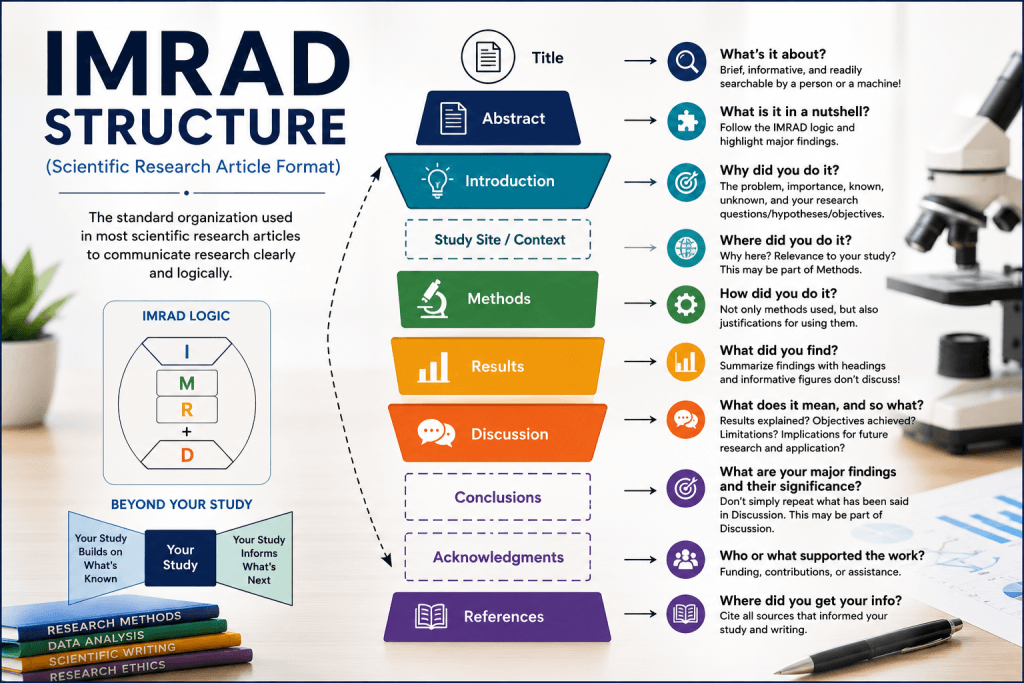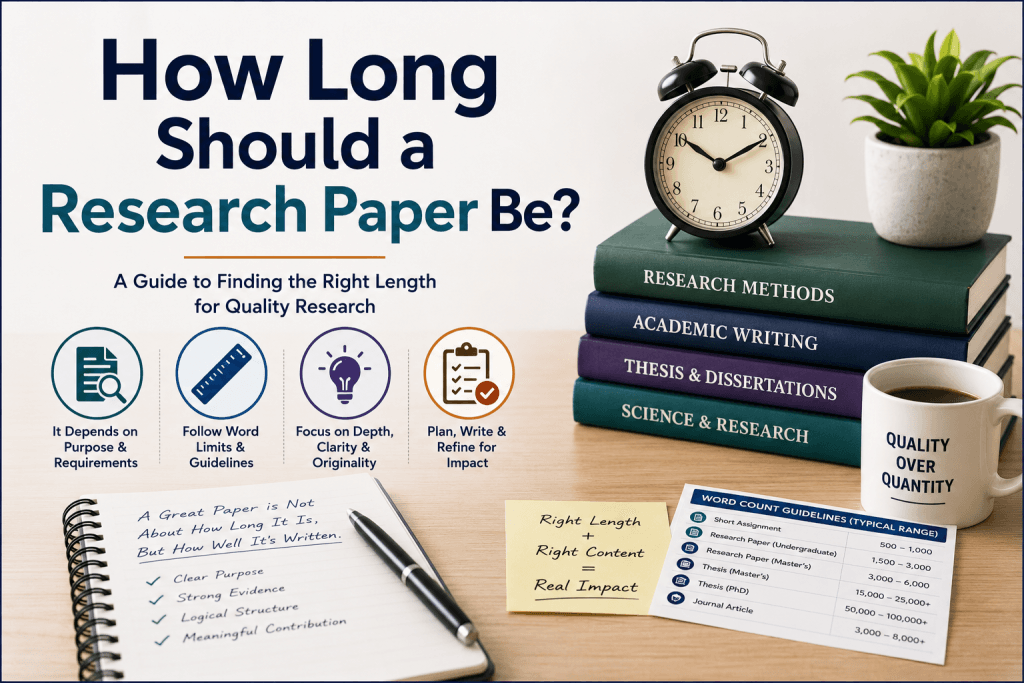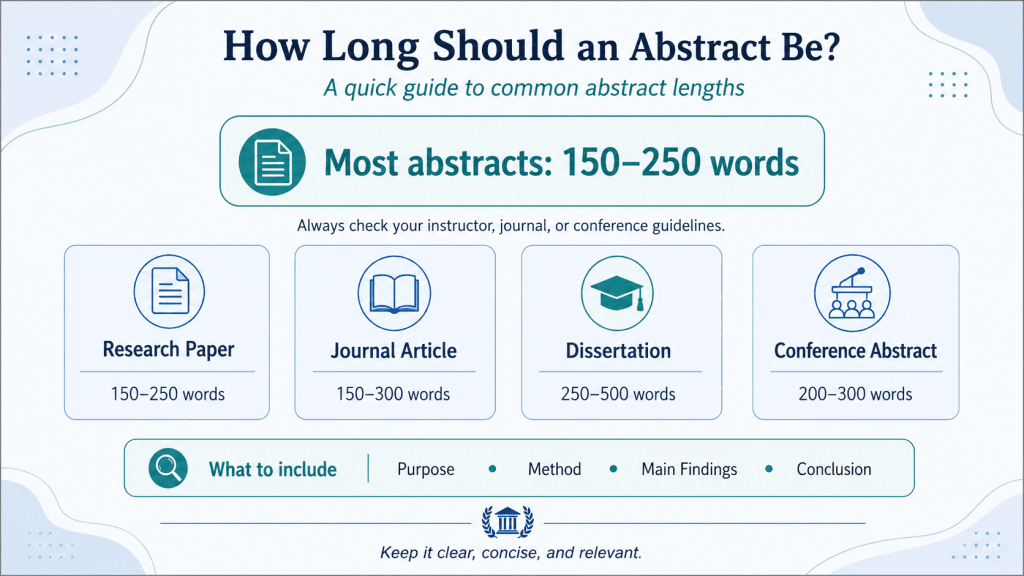
What Is APA Research Paper Format? (7th Edition APA Style Basics)
- APA research paper format is the official set of formatting and citation rules created by the American Psychological Association to standardize how academic papers look and how sources are cited.
- It covers everything from font choice and spacing to how you build your reference list and cite sources in the text.
- The goal is consistency — when every paper follows the same paper format, readers can focus on the content instead of guessing where to find the author’s name or the publication date.
- The current standard is APA style 7th edition, often just called APA 7 or 7th ed., published by the American Psychological Association in the publication manual of the American Psychological Association.
- This 7th edition of the APA manual replaced the 6th edition and introduced several key changes that make APA research paper format easier to apply, especially for students.
- If you’re wondering whether to use the older rules or the newer ones, always default to APA style 7th edition unless your instructor specifically asks for something else.
- One of the biggest updates in the edition of the APA publication manual is the introduction of two distinct paper types:
- Student papers — used for coursework, theses, and dissertations.
- Professional papers — used for research reports, journal submissions, and publications intended for a wider academic audience.
- Each has its own title page requirements, which we’ll break down in the next section.
- At its core, APA research paper format requires:
- Double-spaced text throughout the entire document, with no extra spacing before or after paragraphs.
- 12-point Times New Roman as the recommended font, though the manual now allows some flexibility (more on this below).
- One-inch margins on all sides of every page.
- A consistent page header and page number on every page.
- Consistent indent rules for paragraphs and reference entries.
- The APA publication manual also standardizes:
- How to write an in-text citation.
- How to build a reference list or reference page.
- How to format apa headings for different sections of your paper.
- How to handle table and figure placement and labeling.
- Why does this matter so much? Because using the correct citation style isn’t just about looks — it’s about giving proper credit to your sources, avoiding plagiarism, and helping readers locate the sources cited in the text if they want to explore your research topic further.
- Whether you’re writing a short class assignment or a lengthy research paper in APA format for publication, understanding these basics before you start writing will save you hours of reformatting later. Once you learn APA research paper format, applying it becomes second nature — and most word processors even offer templates to help format a paper in APA from the very first page.
- In short, APA research paper format is not a single rule but a complete system: font, spacing, headings, citations, and references all working together. Mastering APA research paper format early in your academic career means every future assignment — from a short essay to a full research paper in APA format for publication — takes far less time to prepare.
APA Format Title Page: Student Paper vs. Professional Paper
- The APA title page is the very first impression your paper makes, and getting it right sets the tone for the rest of your APA research paper format.
- Under the 7th edition of the APA publication manual, there are two distinct title page formats — one for student papers and one for professional papers. Knowing which one to use is essential.
- Student paper title page should include:
- Title of the paper, centered and bolded, positioned in the upper half of the page.
- Author’s name (or names, if multiple authors), listed below the title.
- The institutional affiliation (your college or university).
- Course number and name — this is a requirement unique to student paper format.
- Instructor name.
- Due date, typically written in the day-month-year format (e.g., 5 March 2026).
- Notably, a running head is not required for student papers unless your instructor specifically requests one — this is a major change from the 6th edition.
- Professional paper title page should include:
- Title of the paper, centered and bolded, same as the student version.
- Author’s name(s).
- Institutional affiliation for each author.
- An author note, which typically includes ORCID iDs, disclosures, and contact information.
- A running head in all capital letters, aligned to the left in the page header — this element is required for professional papers, unlike student papers.
- A page number, aligned to the right in the same header.
- Some key formatting rules that apply to both title page types:
- The title of your paper should be concise, ideally no longer than 12 words, and should not contain unnecessary abbreviations.
- Avoid using quotation marks or italics for the title unless referencing another work within it.
- Everything on the title page remains double-spaced, just like the rest of your paper.
- The title page counts as the first page, so page number “1” appears here regardless of paper type.
- A quick comparison to help you decide which version applies to you:
- If you’re submitting coursework, a thesis, or a dissertation — use the student paper format.
- If you’re submitting to a journal, conference, or preparing a manuscript for publication — use the professional paper format.
- Getting the title page right from the start ensures the rest of your APA research paper format stays consistent, since many formatting choices (like whether you need a running head) carry through the entire document. This distinction is one of the most useful updates in APA style 7th edition, as it removes unnecessary complexity for students while keeping full rigor for professional papers.
- In practice, the title page you choose shapes every page that follows, so it’s worth spending a few extra minutes confirming your APA research paper format matches the requirements of your assignment or submission before you move on to the body of your paper.
Academic Writing & Research Support
Need Help With Research Papers, Manuscripts, Editing, or Proofreading?
At Scholarly Work, we provide professional academic writing support for researchers, students, and professionals. From drafting manuscripts to refining final submissions, we ensure clarity, accuracy, and publication-ready quality.
Get Manuscript Writing Help
How to Format Your Paper in APA: Page Header, Running Head & Page Number
- Once your title page is set, the next step in APA research paper format is making sure every page that follows is formatted consistently.
- This section covers the technical backbone of APA research paper format — the details that apply to every page after your title page.
- Font requirements for the body of your paper:
- The APA publication manual recommends 12-point Times New Roman, but the 7th edition of the APA guidelines also permit several alternatives, including:
- 11-point Calibri
- 11-point Arial
- 11-point Georgia
- 10-point Lucida Sans Unicode
- Whichever font you choose, use it consistently throughout the paper — never mix fonts between sections.
- The APA publication manual recommends 12-point Times New Roman, but the 7th edition of the APA guidelines also permit several alternatives, including:
- Getting spacing right is one of the fastest ways to signal correct APA research paper format at a glance, since inconsistent spacing is one of the first things reviewers notice.
- Line spacing rules:
- The entire paper should be double-spaced, including the title page, abstract, body text, block quotes, and the reference list.
- Do not add extra blank lines between paragraphs or sections — spacing should remain uniform throughout the paper.
- Margins (another fixed rule within APA research paper format):
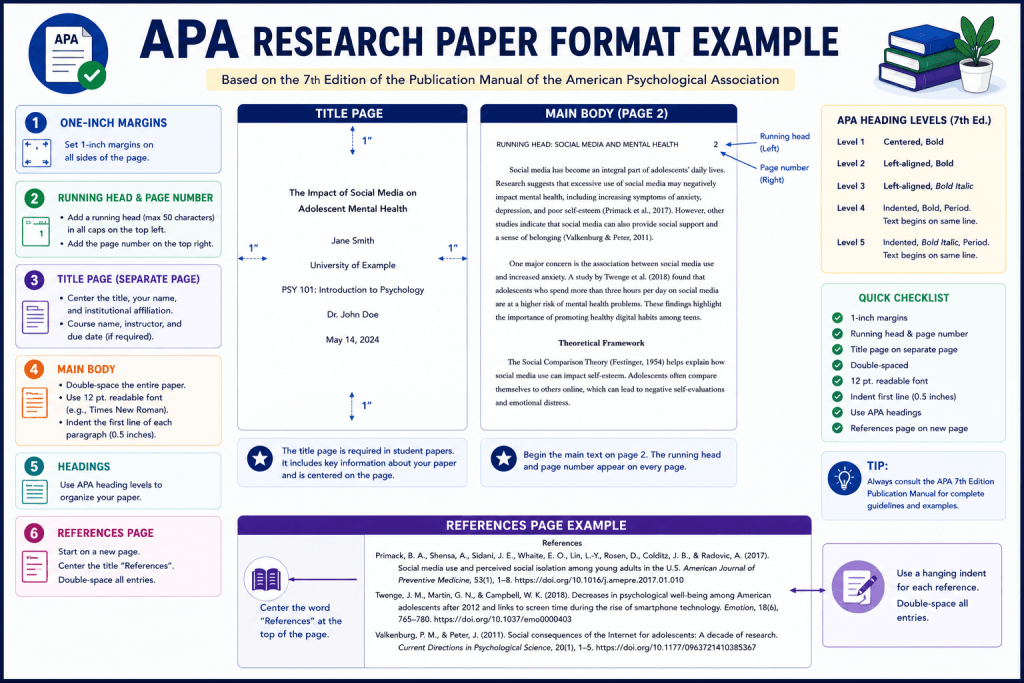
- Use a one-inch margin on all four sides of the page — top, bottom, left, and right.
- This applies consistently to student papers and professional papers alike.
- Page header basics (a small but essential piece of APA research paper format):
- Every page includes a page header, positioned within the top margin.
- For professional papers, the header includes the running head in capital letters aligned to the left, and the page number aligned to the right.
- For student papers, the header typically only needs the page number in the top right corner, since a running head is required for student papers unless the instructor says otherwise.
- Understanding the running head:
- A running head is a shortened version of your paper’s title, no more than 50 characters including spaces and punctuation.
- It appears in all capital letters at the top left of every page in professional papers.
- On the title page, it’s sometimes preceded by the words “Running head:” in older formatting — but this label was removed in APA 7, simplifying things further.
- Even though many student papers skip this element, it’s still good practice to understand it, since you may transition to writing professional papers later in your academic career.
- Page number placement:
- The page number appears in the top right corner of every page, starting with “1” on the title page and continuing sequentially through the reference page and any appendices.
- This is one of the more consistent rules across both student papers and professional papers, and it should never be skipped.
- Indent rules for paragraphs:
- The first line of each paragraph should be indented 0.5 inches from the left margin (roughly one press of the tab key).
- This applies consistently throughout the body of your paper, including under every heading and subheading.
- APA headings structure, another core element of APA research paper format:
- Level 1 headings are centered, bolded, and use title case.
- Level 2 headings are left-aligned, bolded, and use title case.
- Level 3 headings are left-aligned, bolded, italicized, and use title case.
- Level 4 and 5 headings are indented like a paragraph, bolded (and italicized for Level 5), end with a period, and the text begins on the same line.
- Using these heading levels correctly helps organize longer papers and keeps your APA research paper format easier to navigate for readers moving section to section.
- Following these formatting details closely is what separates a polished, professional-looking document from one that looks rushed. Once you’ve mastered how to format your paper in APA, applying the same rules to future assignments becomes fast and intuitive.
- These small details — the page header, the running head, the page number, and consistent indent rules — are what most people notice first when reviewing a paper’s APA research paper format, so it pays to get them right before you move on to citations and references.
APA Reference Page & Reference List: Hanging Indent and Citation Rules
- The APA reference page — sometimes called the reference list — is where you provide full details for every source you cited in the body of your paper, and it’s one of the sections instructors scrutinize most closely when checking APA research paper format.
- Basic setup for the reference page, which follows its own rules within APA research paper format:
- Start the reference list on a new page after the body of your paper.
- Title the page “References,” centered and bolded, at the top.
- Keep the entire section double-spaced, with no extra space between entries.
- Organize entries alphabetically by the first author’s last name.
- The hanging indent rule is one of the most distinctive features of APA reference formatting:
- The first line of each entry starts flush with the left margin.
- All subsequent lines after the first line are indented 0.5 inches, creating what’s known as a hanging indent.
- This visual structure makes it easy for readers to scan down the reference list and quickly locate each source, since the lines are indented consistently across every entry.
- Most word processors let you apply this formatting automatically through paragraph settings, rather than manually pressing tab for each line.
- Structuring individual reference entries correctly is central to accurate APA research paper format:
- Author’s name — written as last name, followed by first and middle initials (e.g., Smith, J. A.).
- Publication year, in parentheses.
- Title of the paper or work, in sentence case (only the first word, the first word after a colon, and proper nouns are capitalized).
- Source information — this varies depending on whether you’re citing a journal article, book, website, or other source type.
- DOI or URL, when applicable, formatted as a hyperlink.
- Example structure (without reproducing exact wording from any real source):
- Author, A. A. (Year). Title of the work in sentence case. Source Name, Volume(Issue), page range. URL or DOI
- In-text citation rules that connect to your reference list:
- Every in-text citation should correspond directly to an entry in your reference page — no source should appear in one without appearing in the other.
- The basic APA citation format includes the author’s name and year, such as (Smith, 2024) or Smith (2024) argued that…
- When quoting directly, include a page number: (Smith, 2024, p. 15).
- For paraphrased ideas, the year is required, and a page number is encouraged but not mandatory.
- Common citation examples and variations:
- One author: (Smith, 2024)
- Two authors: (Smith & Jones, 2024)
- Three or more authors: (Smith et al., 2024)
- Organization as author: (American Psychological Association, 2020)
- Multiple sources in one citation: (Smith, 2024; Jones, 2023)
- Tips for keeping your reference list accurate and consistent:
- Double-check that every source cited in the text of your paper also appears in the reference list, and vice versa.
- Use italics for titles of standalone works like books or journal names, but not for article titles.
- Avoid using quotation marks around titles within your reference entries — this differs from how some other citation style guides handle titles.
- Keep formatting consistent — margins, font, and spacing should match the rest of your paper.
- Following the hanging indent and citation rules precisely is one of the clearest signs of a well-formatted APA research paper, and it reflects the apa guidelines set out in the APA publication manual for maintaining clarity and academic integrity across student and professional papers alike.
- Since the reference page is often the last thing writers check before submitting, it’s also the most common place where small APA research paper format errors slip through — so give it one final read-through before you consider your paper complete.
Academic Writing & Research Support
Need Help With Research Papers, Manuscripts, Editing, or Proofreading?
At Scholarly Work, we provide professional academic writing support for researchers, students, and professionals. From drafting manuscripts to refining final submissions, we ensure clarity, accuracy, and publication-ready quality.
Get Manuscript Writing Help
Formatting Tables and Figures in APA Research Paper Format
- Tables and figures are common in research reports, and APA research paper format provides clear rules for presenting them cleanly and consistently.
- Getting tables and figures right rounds out your understanding of APA research paper format, since visual data needs the same attention to detail as your headings and citations.
- General table and figure guidelines within APA research paper format:
- Both tables and figures should be labeled with a number (Table 1, Figure 1) and a brief, descriptive title placed above the table or figure itself.
- Titles should be italicized and written in title case, positioned directly below the label number.
- Keep numbering sequential throughout the paper — don’t restart numbering in each section.
- Formatting a table:
- Use a simple, clean design with horizontal lines only — avoid vertical lines and heavy borders, since the APA publication manual discourages excessive shading or gridlines.
- Column headings should be centered and bolded where appropriate, though this depends on your specific data layout.
- Keep the table itself double-spaced or single-spaced depending on space constraints, but remain consistent throughout the paper.
- Align the table within the standard one-inch margins, and avoid letting a table run into the left margin.
- Formatting a figure:
- Figures include charts, graphs, photographs, and illustrations relevant to your research topic.
- Like tables, figures need a number and title above the image, followed by the visual content itself.
- Any necessary explanatory text goes below the figure, not above it.
- Table and figure notes:
- Notes appear directly below the table or figure and explain abbreviations, symbols, or statistical significance used within it.
- General notes come first, followed by specific notes (linked to particular elements with superscript letters), followed by probability notes if relevant.
- Notes should be left-aligned and in a smaller font size than the body text, though still consistent with the rest of your paper format.
- Placement considerations:
- APA recommends placing tables and figures as close as possible to the point in the text where they’re first mentioned, rather than clustering them all at the end of the paper.
- However, for some student papers, instructors may prefer figures and tables be placed at the end — always confirm this with your specific assignment guidelines.
- Never repeat the same data in both a table and a figure; choose the format that best represents your information.
- Referencing tables and figures in your text:
- Always refer to a table or figure by its number (e.g., “As shown in Table 2…”) rather than saying “the table below” or “the figure above,” since placement can shift once a document is formatted or printed.
- These rules apply consistently whether you’re formatting a short class assignment or a lengthy research paper in APA format intended for submission to an academic journal, and following them closely improves the overall readability of your APA research paper.
- Tables and figures are a small part of the overall page, but getting them wrong is one of the quickest ways to make an otherwise solid APA research paper format look inconsistent, so treat them with the same care as your headings and references.
Sample Paper: APA 7th Edition Template to Help Format Your Research Paper in APA
- One of the fastest ways to master APA research paper format is to study a sample paper that follows the APA 7th edition guidelines from start to finish, since seeing correct APA research paper format applied in full context makes every rule easier to remember.
- What a good sample paper or APA format template typically includes, reflecting proper APA research paper format throughout:
- A correctly formatted title page, matching either the student paper or professional paper style.
- An abstract (for professional papers, and sometimes required for advanced student papers), summarizing the research paper in 150–250 words.
- Properly leveled APA headings throughout the body.
- Correct in-text citation examples embedded naturally within the text.
- A fully formatted reference page with proper hanging indent styling.
- Consistent page header, page number, and (where required) running head elements on every page.
- Where to find a reliable sample paper that models correct APA research paper format:
- The American Psychological Association provides official sample paper downloads directly through their style website, covering both student papers and professional papers.
- Many university writing centers and your college library also provide APA format template files that instructors have already reviewed for accuracy.
- Some word processing programs include built-in APA format template options, though it’s wise to double-check these against the official 7th edition guidelines, since templates aren’t always updated promptly.
- How to use a sample paper effectively:
- Open the sample paper alongside your own draft and compare each formatting element side by side — title page, headings, spacing, and the reference list.
- Pay close attention to small formatting and citation details, like whether the first line of each reference is flush left and whether the following lines after the first line are indented properly.
- Use the sample as a checklist: title page, header, indent, spacing, and reference formatting should all match.
- Common APA research paper format mistakes people fix once they consult a sample paper:
- Using the wrong title page version (mixing up student paper and professional paper requirements).
- Forgetting the hanging indent in the reference list.
- Inconsistent font use — switching between 12-point Times New Roman and other fonts mid-document.
- Skipping the page number on the title page, forgetting that the title page is the first page and should be numbered accordingly.
- Incorrect in-text citation punctuation or missing page numbers for direct quotes.
- Building your own APA format template for consistent APA research paper format:
- Once you understand the apa guidelines, save your correctly formatted document as a personal APA format template for future assignments.
- This saves significant time on your next research paper, since your fonts, margins, spacing, and heading styles are already in place.
- Just remember to update the title page information — author’s name, course number and name, instructor name, and due date — for each new assignment.
- Final tips for consistent formatting and citation:
- Always cross-check your finished paper against the APA publication manual or a trusted sample paper before submission.
- Keep your citation style consistent — mixing APA with another citation style is one of the most common errors reviewers catch.
- If you’re ever unsure how to format a paper in APA, resources like your college library, writing center staff, or official APA guides can offer help format your document accurately.
- With a solid sample paper as your reference point and a clear understanding of the 7th edition of the APA publication manual, formatting your research paper in APA format becomes a straightforward, repeatable process — one you’ll be able to apply confidently to every research paper you write from here on out.
- Ultimately, learning APA research paper format once and applying it consistently is far easier than relearning it for every new assignment. Keep a trusted sample paper on hand, follow the APA research paper format rules step by step, and every future research paper in APA format you submit will meet the standard expected by instructors and journals alike.
References
- George Mason University Writing Center – Scientific (IMRaD) Research Reports: Overview – https://writingcenter.gmu.edu/writing-resources/imrad/writing-an-imrad-report
- Utah Valley University Writing Center – Scientific Writing: IMRaD – https://www.uvu.edu/writingcenter/handouts/scientific-writing.html
- Brigham Young University Research & Writing Center – Scientific Writing: IMRAD Format – https://rwc.byu.edu/00000188-e4bc-d222-a7ea-eefd769e0000/scientific-writing-imrad-format-pdf