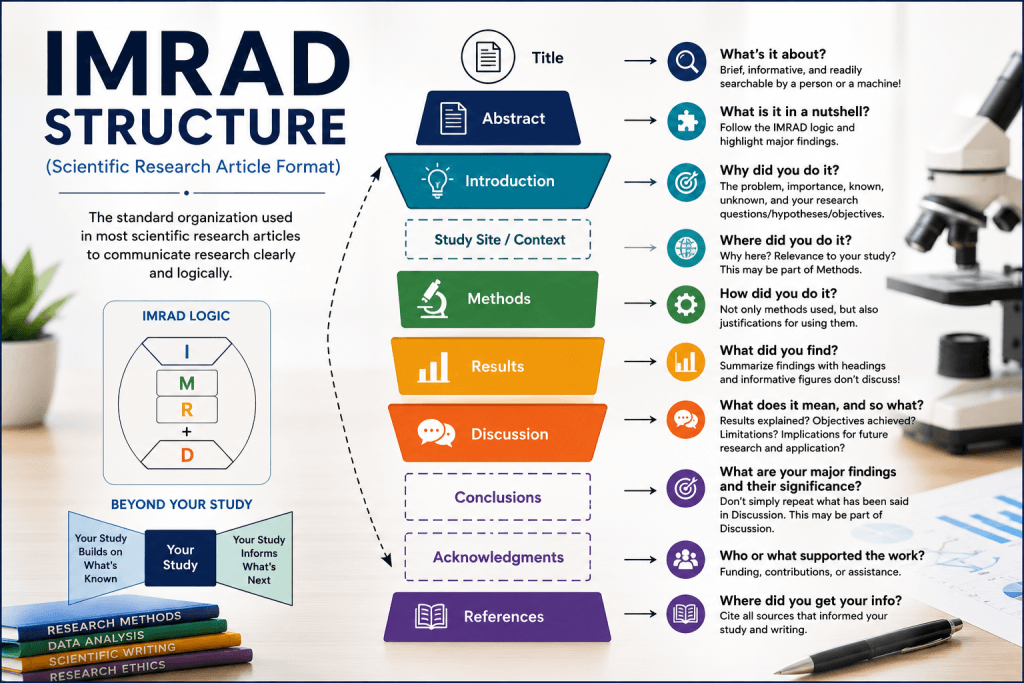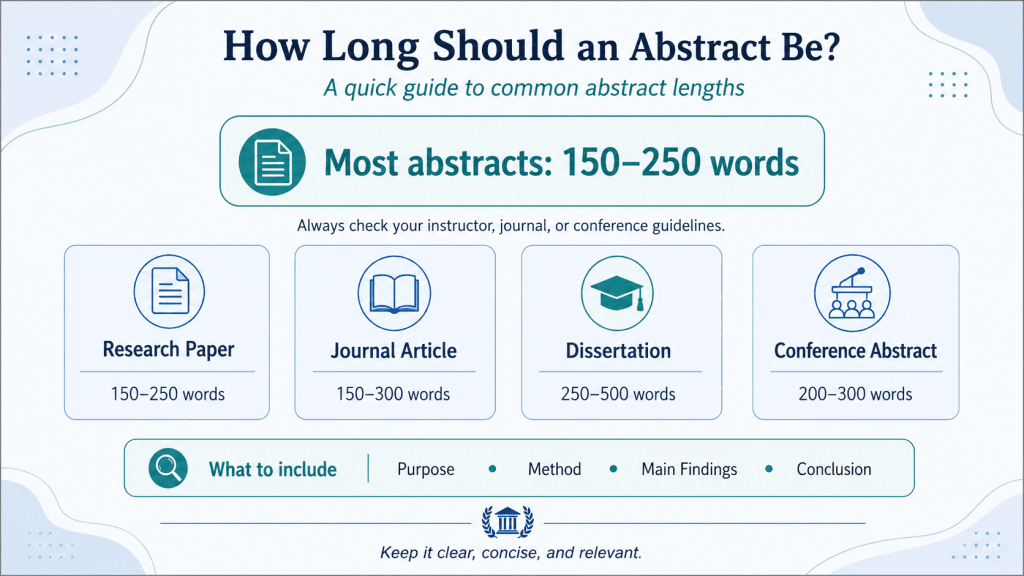
What Is a Methodology Section and Why It Matters in a Research Paper?
- The methodology section is the part of a research paper that explains how a study was carried out. If you have ever wondered how to write the methodology section of a research paper, the first thing to understand is that this section is not about your results — it is about your process. It provides an overview of the research design, the data collection methods, and the reasoning behind every choice you made as a researcher.
- A good methodology section describes the “how” and the “why” of a study. It walks the reader through the research process step by step, from the research question to the specific research methods used to answer it. This section describes what you did, in what order, and why those choices were the most appropriate for your research problem.
- The methodology chapter builds trust with your reader. When you clearly explain your research design, sample size, and data collection methods, you allow readers to evaluate the reliability and validity of your findings. Without this transparency, even strong research findings can be dismissed because no one can verify how they were produced.
- It separates a scientific paper from an opinion piece. A methodology section of a research paper turns personal claims into evidence-based conclusions by showing the systematic steps taken to reach them. This is true whether you’re working in the social sciences, natural sciences, or any other field.
- Understanding how to write the methodology section of a research paper is essential for both a thesis or dissertation and shorter academic papers. Whether you’re conducting a systematic review, survey research, or an experimental study, this section proves your study was conducted in an ethical, logical, and replicable way — allowing others to repeat the study if needed.
- It applies across disciplines. Regardless of whether you are in business, education, health sciences, or engineering, knowing how to write the methodology section of a research paper is a transferable skill you’ll use again and again throughout your academic and professional career.
- It saves you time in the long run. Once you understand how to write the methodology section of a research paper, you’ll find that future papers, theses, and dissertations become faster to draft, because the underlying structure rarely changes.
In short, learning how to write the methodology section of a research paper isn’t just an academic requirement — it’s the backbone that gives your entire research paper credibility. Mastering how to write the methodology section of a research paper early in your academic journey will make every subsequent research paper easier to produce.
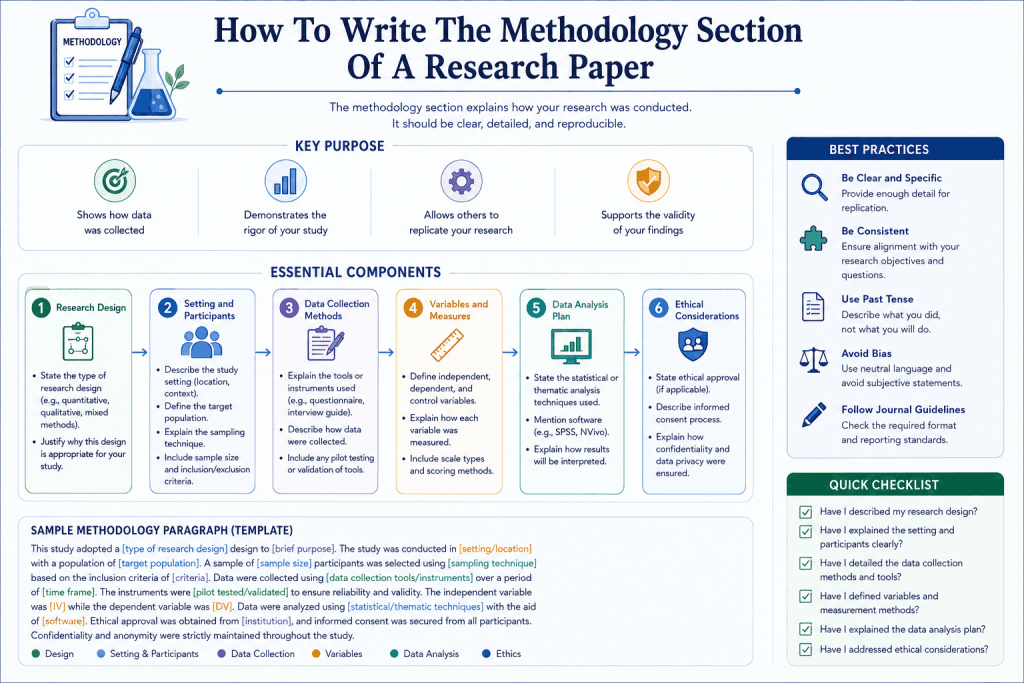
How To Write the Methodology Section of a Research Paper: Step-by-Step Guide
Knowing how to write the methodology section of a research paper becomes much easier when you break it down into manageable steps. Below is a step-by-step guide covering the 5 steps you need to follow.
Step 1: Restate Your Research Problem and Research Question
- Before diving into your methods, briefly reconnect the methodology section to your research problem. This connection to the research helps readers understand the rationale behind your chosen methods.
- Explain, in one or two sentences, what gap in the literature review your study addresses.
- State your research question clearly, since every methodological choice that follows should map directly back to it.
- This step sets up the “why” before you explain the “how,” which is a key part of the methods section of a research paper.
Step 2: Describe Your Research Design and Type of Research
- Identify the type of research you conducted — qualitative, quantitative, or mixed methods — and explain why this approach best suits your research question.
- If your study is qualitative research, describe whether you used interviews, focus groups, or case studies.
- If your study is quantitative research, explain your use of surveys, experiments, or existing data sets.
- Describe your overall research philosophy and research design, including whether the study is exploratory, descriptive, or explanatory.
- This part of the methods section should include a rationale — a clear explanation of why this research design was selected over alternatives.
Step 3: Explain Your Data Collection Methods
- List and explain your data collection methods in detail. Common examples include:
- Surveys (online, paper-based, or multiple choice)
- Interviews (structured, semi-structured, unstructured)
- Observations
- Existing data or secondary sources
- For each method, describe the procedures you used to gather information, including timelines and tools.
- Include primary and secondary data sources if applicable, and explain how each contributed to answering your research question.
- Describe your sample size and the inclusion and exclusion criteria used to select participants.
- If your study involved human subjects, you must include a statement about informed consent and any approval received from an institutional review board.
Step 4: Describe Your Data Analysis Process
- Explain how you plan to analyze or how you analyzed the raw data collected during the study.
- If you used statistical analysis, name the specific statistical tests applied (e.g., t-tests, regression analysis, ANOVA) and explain why these tests were relevant to the study.
- For qualitative data, describe your coding process or thematic analysis approach.
- This part of the methodology section also explains how you plan to interpret the findings once data analysis is complete.
- Remember to write the methods section in past tense, since you’re describing steps you took, not steps you are currently taking.
Step 5: Address Validity, Reliability, and Limitations
- Discuss the overall validity and reliability of your chosen methods — this shows readers you’ve considered the strengths and weaknesses of your approach.
- Mention any techniques used to identify and reduce bias, such as triangulation or pilot testing.
- Briefly note any limitations of your research design and how they might affect your research findings.
- This step demonstrates good methodology by showing self-awareness and academic honesty rather than overselling your results.
Bonus Tip: Draft, Then Refine
- Once you’ve worked through all 5 steps, read your draft back and check that each part connects logically to the next. A common trick researchers use when figuring out how to write the methodology section of a research paper is to ask a colleague to read the section and see if they could repeat the study using only your description.
- If they can, you’ve successfully answered the question of how to write the methodology section of a research paper for your specific study.
Following these 4 to 5 steps consistently is the most reliable answer to how to write the methodology section of a research paper, regardless of your field of study. Whether you’re working on a short assignment or a full thesis or dissertation, this step-by-step approach to how to write the methodology section of a research paper will keep your writing organized and thorough.
Key Elements of a Good Methodology: Research Methods, Design, and Statistical Analysis
A good methodology is built from several essential elements working together. If you’re still figuring out how to write the methodology section of a research paper, understanding these building blocks will make the process far more intuitive. In fact, most guides on how to write the methodology section of a research paper start with these exact elements.
- Research Design
- Your research design is the overall strategy that ties your research question to your data collection and analysis.
- It should be relevant to the study and clearly justified — readers should understand why you chose an experimental, correlational, or descriptive design over other options.
- Research Methods
- Research methods refer to the specific tools and techniques used for the study, such as surveys, interviews, or experiments.
- Different methods suit different goals: qualitative research methods explore meaning and experience, while quantitative research methods measure and test relationships between variables.
- A well-written methodology section clearly matches each method used in the study to a specific purpose within the research.
- Data Collection and Analysis
- This element explains both how data was collected and how it was analyzed.
- It should include enough detail that another researcher could, in theory, repeat the study using the same procedures.
- Data collection and analysis sections should mention any software or tools used, such as SPSS or NVivo, for statistical analysis or qualitative coding.
- Statistical Analysis and Interpretation
- Statistical analysis is central to quantitative studies and should be described with precision — including the specific tests used and the reasoning behind them.
- Even qualitative studies often include some form of analysis process that should be explained with equal clarity.
- Ethical Considerations
- A good methodology always addresses ethics, including informed consent, confidentiality, and, where relevant, institutional review board approval.
- Coherence Across Elements
- Every strong answer to how to write the methodology section of a research paper shows how these elements connect: the research design informs the research methods, the research methods shape the data collection process, and the data collection process determines what statistical analysis is possible.
- When one element doesn’t align with another, readers notice — so revisit your draft and confirm each part supports the next.
When these elements — research design, research methods, data collection, and statistical analysis — are combined thoughtfully, you get a methodology section of a research paper that is both rigorous and easy to follow. This is ultimately what it means to understand how to write the methodology section of a research paper at a professional standard.
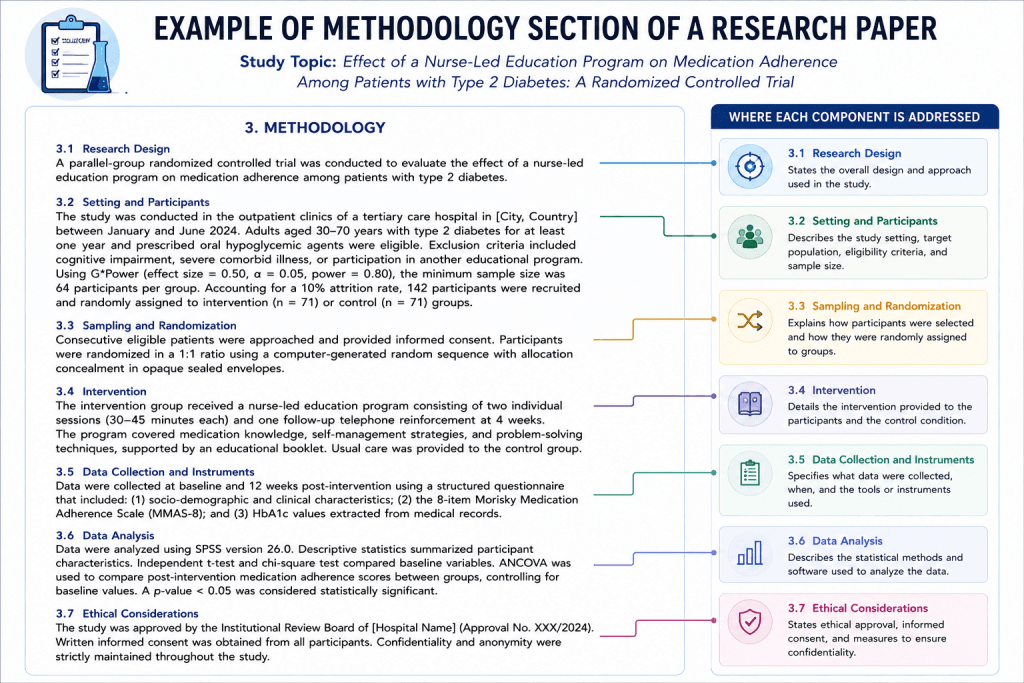
Methodology Section vs. Methods Section: Understanding the Difference
Many students search for how to write the methodology section of a research paper without realizing that “methodology” and “methods” aren’t always the same thing. Understanding this difference is a key part of writing the methods section of a research paper correctly.
- Methodology refers to the broader research philosophy and approach.
- The methodology section describes the reasoning behind your overall research approach — why you chose qualitative research over quantitative research, for example, or why a particular method suited your research problem better than another.
- It often includes theoretical justification and connects your study to existing academic conversations found in your literature review.
- The methods section describes the practical, specific steps taken during the study.
- The methods section of a research paper focuses on the actual procedures: how participants were recruited, what tools were used for data collection, and how the data was analyzed.
- It’s more concrete and procedural, while the methodology section is more conceptual and justificatory.
- In shorter papers, they’re often merged.
- Many scientific papers combine both into a single “Methodology” or “Methods” section, especially in the natural sciences, where journal guidelines are strict about word count.
- In a longer thesis or dissertation, however, the methodology chapter is often separate from the methods section, with the methodology chapter covering research philosophy and design, and the methods section covering execution.
- Both sections describe the research process, but from different angles.
- Methodology answers “why,” while methods answer “how” and “what.”
- When you understand this difference, learning how to write the methodology section of a research paper becomes far less confusing, since you know exactly what content belongs where.
- Consistency matters more than terminology.
- Whichever term your institution or journal prefers, the key is that the section describes your research process with enough detail for readers to evaluate the reliability and validity of your work.
- Why this distinction matters for your writing process.
- Once you separate methodology from methods, learning how to write the methodology section of a research paper becomes a matter of organizing two related but distinct types of content, rather than cramming everything into one confusing block of text.
- This clarity is especially useful for anyone tackling how to write the methodology section of a research paper for the first time, since it removes the guesswork about what belongs where.
Common Mistakes to Avoid When Writing Your Methodology Chapter
Even researchers who understand how to write the methodology section of a research paper in theory often stumble in execution. Here are the most common mistakes to avoid when you sit down to actually apply how to write the methodology section of a research paper to your own work.
- Being too vague about research methods
- A frequent mistake is failing to provide enough detail about the methods used in the study. Readers should never be left guessing how data was collected or analyzed.
- Always describe your procedures with enough specificity that another researcher could replicate the study.
- Forgetting to justify your choices
- Simply listing your research methods without explaining the rationale behind them weakens your methodology section.
- Always connect your chosen methods back to your research question and research problem.
- Mixing up methodology and methods
- As covered above, confusing these two terms can make the section of your research paper feel disorganized.
- Keep the conceptual reasoning (methodology) separate from the practical steps (methods) where possible.
- Ignoring ethical considerations
- Failing to mention informed consent, institutional review board approval, or how human subjects were protected is a serious oversight, especially in social sciences research.
- Using inconsistent verb tense
- The methodology section should typically be written in past tense, since it describes steps you took, not ongoing actions. Switching tenses mid-section is a common but easily avoidable error.
- Overlooking limitations
- Some writers avoid discussing the limitations of their research design, fearing it weakens their argument. In reality, acknowledging limitations strengthens your credibility and demonstrates good methodology.
- Skipping the connection to sample size and data collection
- Failing to explain how the sample size was determined, or omitting inclusion and exclusion criteria, leaves gaps that undermine the overall validity and reliability of your findings.
- Copy-pasting a generic template
- Every research paper provides a unique context, so a formulaic template rarely reflects the actual steps taken. Tailor the methodology section of your paper to your specific research question and research design.
- Rushing the final review
- Many researchers finish drafting and submit without a careful review. Take time to re-read your section with fresh eyes, checking that it fully answers how to write the methodology section of a research paper for your specific study and audience.
Avoiding these mistakes is just as important as knowing how to write the methodology section of a research paper correctly in the first place — both go hand in hand in producing credible research. Every mistake above is avoidable once you internalize the core principles of how to write the methodology section of a research paper.
Learning How to Write the Methodology Section of a Research Paper the Right Way, with Examples
The best way to master how to write the methodology section of a research paper is to study real examples and see how the structure translates into practice.
Example 1: Quantitative Survey Research
- A study exploring employee satisfaction might begin with an overall description of the research design: a cross-sectional survey using multiple choice and Likert-scale questions.
- The methodology section would explain the survey research approach, describe the sample size (e.g., 250 employees across three departments), and detail the data collection methods used to gather responses, such as an online survey platform.
- The data analysis portion would describe statistical analysis techniques like regression analysis, explaining how the researcher analyzed relationships between job satisfaction and productivity.
- This example shows how to write the methodology section of a research paper when the study relies on numerical, quantitative data.
Example 2: Qualitative Case Study
- A qualitative research paper exploring classroom dynamics might describe interviews and observations as its main data collection methods.
- The methodology section here would explain the research philosophy behind choosing qualitative research — namely, the need to capture nuanced, descriptive insight rather than numerical data.
- The section describes coding procedures used during data analysis, along with steps taken to maintain validity, such as member-checking with participants.
- This is a strong example of how to write the methodology section of a research paper when depth of understanding matters more than statistical generalizability.
Example 3: Mixed Methods Dissertation Chapter
- In a thesis or dissertation, the methodology chapter often combines both quantitative and qualitative research methods.
- For instance, a dissertation on remote work productivity might use surveys for quantitative research methods and follow-up interviews for qualitative insight — a mixed methods design.
- The methodology chapter would provide an overview of both data collection methods, the statistical tests used, and the sampling strategy, while also addressing informed consent and institutional review board approval.
What These Examples Teach Us
- Every strong example follows a similar structure: research question, research design, data collection methods, data analysis, and validity and reliability considerations.
- Each example describes the research methods clearly, provides a rationale for chosen methods, and shows how the methodology section connects logically to the results section that follows.
- Across disciplines — whether it’s a systematic review in the natural sciences or action research in education — the core principles of how to write the methodology section of a research paper remain consistent: clarity, justification, and enough detail for replication.
Putting It All Together
- Each of these examples reflects a different discipline and research design, yet all of them follow the same underlying logic for how to write the methodology section of a research paper.
- If you take away one lesson from these examples, let it be this: how to write the methodology section of a research paper always comes back to clarity, justification, and transparency about the steps taken.
By studying different methods, disciplines, and formats, you’ll see that how to write the methodology section of a research paper isn’t about following a rigid formula — it’s about clearly and honestly describing the research process so your findings can be trusted and, if necessary, reproduced. With practice, how to write the methodology section of a research paper will become second nature, and your future research papers will benefit from the same clarity and rigor demonstrated in these examples.
- George Mason University Writing Center – Scientific (IMRaD) Research Reports: Overview – https://writingcenter.gmu.edu/writing-resources/imrad/writing-an-imrad-report
- Utah Valley University Writing Center – Scientific Writing: IMRaD – https://www.uvu.edu/writingcenter/handouts/scientific-writing.html
- Brigham Young University Research & Writing Center – Scientific Writing: IMRAD Format – https://rwc.byu.edu/00000188-e4bc-d222-a7ea-eefd769e0000/scientific-writing-imrad-format-pdf