How Long Should a Research Paper Be? Understanding Word Count Expectations
- There is no single number that answers how long should a research paper be for every student or every assignment. It varies depending on your academic level, subject, and the type of research you’re conducting. Still, a reasonable word count range for a standard research paper falls between 4,000 and 6,000 words, or roughly 15 to 20 pages — though your actual paper might be shorter or longer depending on your research question.
- Word count is not the real goal — content quality is. When people ask how long should a research paper be, they’re often looking for a shortcut to “enough,” but instructors are grading whether you’ve answered your research problem thoroughly, not whether you hit a specific number of words. A concise paper that fully explores its research question is always better than a padded one stuffed with filler words just to reach a target. Wordiness is easy to spot, and it rarely earns extra credit.
- Different disciplines expect different lengths. Humanities papers tend to run longer, relying on interpretation and extensive literature review. Science papers are often shorter and more compressed, since the methods section, results section, and discussion section are expected to be direct and data-driven. So when you ask how long should a research paper be, first ask what type of research you’re doing and what your discipline typically expects.
- If you only remember one thing from this comprehensive guide, let it be this: how long should a research paper be is a question best answered by your specific assignment, not by a generic internet rule.
- Assignment guidelines almost always override general rules. If your professor or journal has given you specific guidelines — even something as simple as “1,500 to 2,000 words” — that instruction takes priority over any general advice you find online, including this one. Always read the assignment guidelines closely before you start your writing process, since many instructors specify not just total word count but also formatting rules, citation style, and section requirements.
- Word count typically includes the main body but may exclude certain sections. Many students don’t realize that title pages, reference lists, and appendices are usually not counted toward the total word count. This means your entire research, including the introduction, literature review, methodology, results, and discussion, is what’s measured — not the supplementary material. Always double-check whether your appendix and reference pages are included, since this affects how you plan your paper length.
- When people search how long should a research paper be, they usually want confidence, not a rulebook. It helps to remember that the number itself is a guide for pacing your writing process, not a pass/fail line — the real measure is always whether your paper fully covers your research topic.
- Shorter isn’t always easier, and longer isn’t always better. A ten-page paper that lacks a clear thesis statement and jumps around without structure will score worse than a focused eight-page paper that stays on topic. Likewise, an overly long paper with repetitive analysis can frustrate the reader and dilute your argument. The goal is always enough content to support your claims, not a specific number for its own sake.
- Consider your audience when estimating length. If you’re writing for a general course requirement, your paper might be shorter and more introductory. If you’re preparing a paper for publication in a journal article, expect stricter and often longer requirements, since research reports intended for publication typically need a more comprehensive guide to the current research, a more detailed review article, and deeper engagement with existing scholarship.
- First-time writers often overestimate or underestimate length. If this is your first research paper, it’s common to either pad your paper with unnecessary sections or cut it short because you’re unsure how much detail is expected. A good strategy is to look at published papers in your field with a similar research topic and note their general structure and length as a benchmark, while still following your own assignment guidelines.
- In short, how long should a research paper be depends on the topic, the assignment, and the depth of research required — but as a general guideline, most academic papers fall in the 4,000–6,000 word range, with some running much shorter or much longer based on complexity.
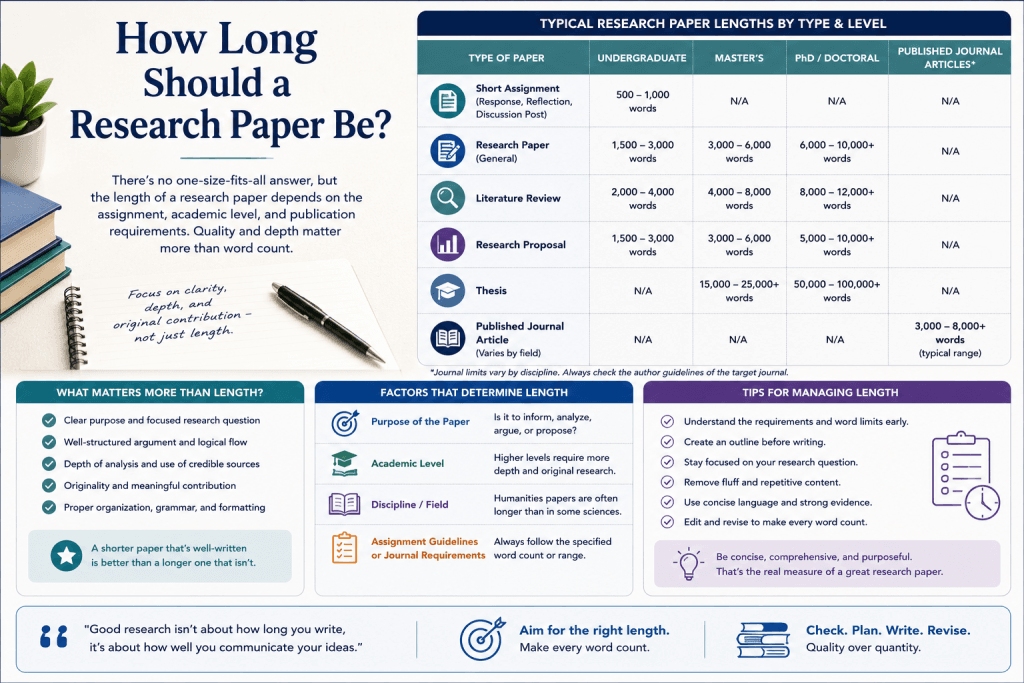
How Long Should a Research Paper Be by Academic Level and Assignment Type
- Answering how long should a research paper be starts with identifying your academic level. A high schooler, an undergraduate, and a doctoral candidate are all asking the same question, but the expected answer looks completely different at each stage.
- High school research papers are typically the shortest. At this level, a research paper might run between 1,500 and 2,500 words, or about 5 to 7 pages. The focus here is on learning the writing process itself — how to formulate a research question, organize a literature review, and reach a conclusion section — rather than producing exhaustive academic papers. Teachers are mostly evaluating structure, clarity, and whether the thesis statement is supported.
- Undergraduate research papers expand in scope. For undergraduate coursework, a paper might run 3,000 to 5,000 words, though this varies depending on the course level and subject. Introductory courses often expect shorter, more concise papers, while upper-level or capstone courses may require closer to 6,000–8,000 words, especially if the assignment includes an independent research question and a more developed methods section.
- Graduate-level research papers are longer and more rigorous. Master’s-level papers commonly range from 6,000 to 10,000 words. At this stage, instructors expect a much deeper literature review, a clearly defined research gap, and a discussion section that meaningfully connects your findings to current research in the field. The overview of the research also becomes more detailed, since graduate work is meant to demonstrate command of the subject. At this stage, how long should a research paper be is less about hitting a minimum and more about proving mastery of the literature.
- Dissertations and theses are in a category of their own. A full dissertation is by far the longest form of academic writing, often ranging from 15,000 to 20,000 words for a master’s thesis, and 60,000 to 100,000+ words for a doctoral dissertation. These works include multiple chapters — introduction, literature review, methodology, results and discussion, conclusion — each functioning almost like its own mini research paper. If you’re wondering how long should a research paper be when it’s actually a dissertation, expect it measured in chapters, not pages.
- Journal articles have their own conventions. A typical journal article ranges from 4,000 to 8,000 words, depending entirely on the journal’s specific guidelines. Some journals cap articles at 3,000 words for concise research reports, while others in medicine or social science allow much longer research articles requiring a fuller methods section and results section.
- Research proposals are usually shorter than the final paper. Because a research proposal is meant to outline your intended research topic, research question, and methodology — not present results — it typically runs 500 to 2,000 words. This is one of the more common places students get confused about how long should a research paper be, since a proposal is not the same as the finished product and shouldn’t be judged by the same word count range.
- Class assignments versus independent research differ significantly. A short in-class research paper tied to a single unit might only need 1,000–1,500 words, while an independent or semester-long project could require 4,000+ words. Always check your assignment guidelines, since instructors calibrate paper length to the amount of time and research effort the assignment is meant to represent — this is a case where how long should a research paper be genuinely depends on the scale of the assignment itself.
- Review articles differ from original research articles. A review article, which synthesizes existing literature rather than presenting new data, is often longer because it must summarize and evaluate a wide swath of current research — anywhere from 5,000 to 12,000 words, depending on the target journal’s specific guidelines.
- The bottom line: academic level and assignment type are the two biggest variables. Whether you’re in high school, college, or graduate school — and whether you’re writing a class paper, a proposal, a journal article, or a dissertation — how long should a research paper be will always come back to matching the expected depth of that particular assignment.
Academic Writing & Research Support
Need Help With Research Papers, Manuscripts, Editing, or Proofreading?
At Scholarly Work, we provide professional academic writing support for researchers, students, and professionals. From drafting manuscripts to refining final submissions, we ensure clarity, accuracy, and publication-ready quality.
Get Manuscript Writing Help
How Long Should a Research Paper Be: APA Formatting and Paper Length Guidelines
- A lot of students land on this question specifically because of formatting: how long should a research paper be once it’s formatted in APA style? The formatting rules themselves don’t dictate length, but they do change how that length is displayed and measured on the page.
- APA format doesn’t set a universal word limit, but it does shape how length is measured. The American Psychological Association (APA) style is one of the most common formats for academic papers, particularly in the social sciences, and its formatting rules affect how your paper length is calculated and presented, even though APA itself doesn’t mandate a specific total word count.
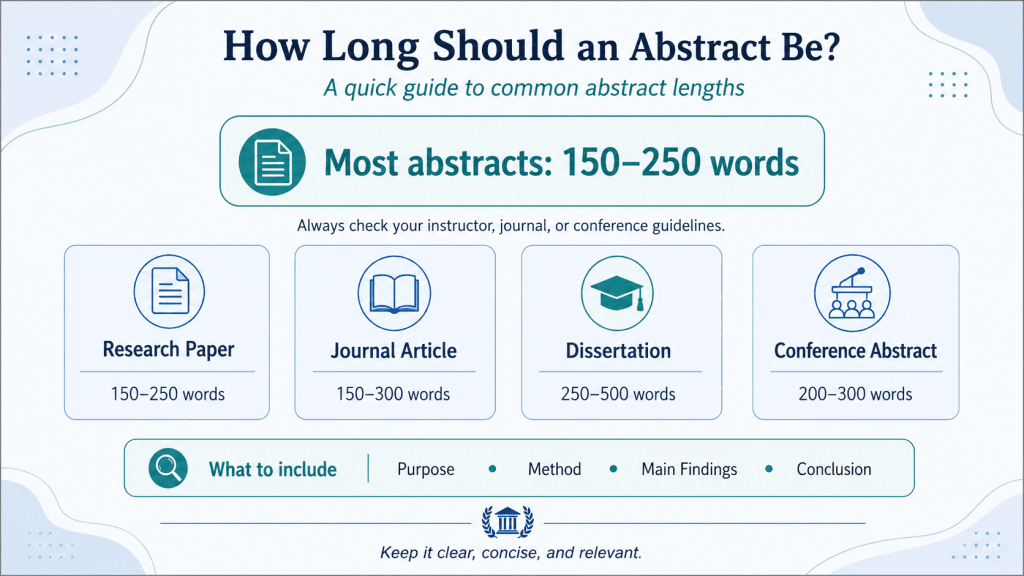
- Standard APA formatting includes specific structural elements that count toward length. A paper in APA format typically includes a title page, an abstract (150–250 words), the main body (introduction, methods section, results section, discussion section), and a reference list. When professors specify paper length, they’re almost always referring to the main body, not the title page or references.
- APA recommends double spacing, 1-inch margins, and 12-point font — all of which affect how “long” a paper looks versus how many words it contains. This is an important distinction: two papers with the same word count can look very different in terms of number of pages depending on spacing and font choices. So if your assignment guidelines say “10 pages,” ask whether they mean 10 pages in APA format specifically, since this could translate to roughly 2,500–3,000 words.
- Page numbers and headers are required in APA but are not part of the word count. Every page should include a page number in the top right corner, and if the paper is a professional (non-student) submission, a running head is also required. These formatting elements matter for polish and grading but have nothing to do with how long should a research paper be in terms of substance.
- The abstract is a separate, self-contained summary and should not be padded to increase perceived length. In APA format, the abstract concisely summarizes the research problem, methodology, and key findings in one paragraph, generally under 250 words. Inflating it to make the paper feel longer is a common mistake — reviewers notice when an abstract restates the introduction instead of summarizing the entire research.
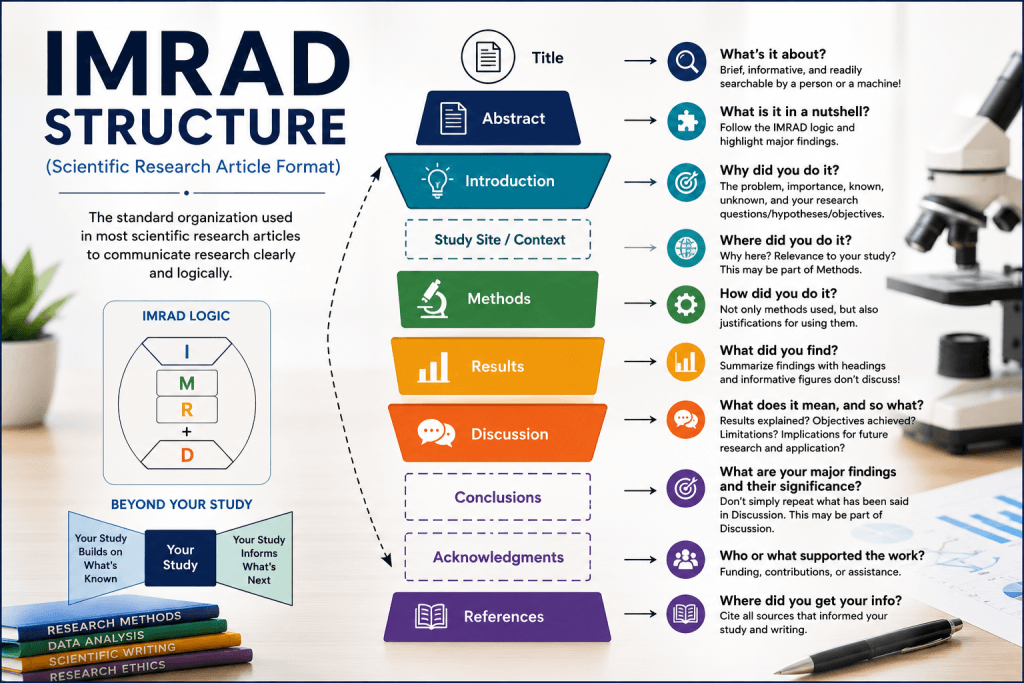
- APA-style research papers typically follow a predictable structure that indirectly guides length. Introduction (roughly 10–15% of total word count), literature review (15–20%), methods section (10–15%), results section (15–20%), discussion section (15–20%), and conclusion (5–10%). Knowing these rough proportions can help you gauge how long should an introduction be relative to the rest of your paper — generally, if your total word count target is 5,000 words, your introduction should land somewhere around 500–750 words, not several pages. Breaking the question down this way makes how long should a research paper be feel far less overwhelming, since each section has its own smaller target.
- Recommended length varies by institution even within APA format. Some universities specify a strict page range (e.g., “12–15 pages, APA format, excluding references”), while others give a word count range instead. Always confer with your specific guidelines rather than assuming APA format alone tells you how long should a research paper be — APA governs style and citation, not length.
- Formatting consistency matters more than stretching for extra pages. Reviewers and instructors can easily tell when someone has manipulated margins, font size, or spacing to artificially inflate paper length. This kind of padding is generally penalized rather than rewarded, since it doesn’t add real content or move your research question forward.
- In short, APA formatting tells you how to format a research paper, not exactly how long should a research paper be — but understanding the structure it imposes (title page, abstract, body, references) makes it much easier to estimate and plan your total word count accurately.
How Many Pages Is a Research Paper: Breaking Down the Draft, Results Section, and Appendix
- Thinking in pages instead of words can be a more intuitive way to answer how long should a research paper be. As a general guideline, one double-spaced page in 12-point font contains roughly 250–275 words. So a 5,000-word paper is approximately 18–20 pages, while a 2,000-word paper is closer to 7–8 pages. Keep in mind this conversion changes with single spacing, different fonts, or smaller margins. Thinking in pages is often the fastest way to translate an abstract sense of how long should a research paper be into something you can actually plan against on a calendar.
- Your first draft will almost never match your final page count. When you sit down to write a research paper, your initial draft is meant to get your ideas and evidence onto the page — it’s normal for a draft to run shorter or longer than your target. Many experienced writers draft first and trim (or expand) later, once they can see the full shape of their argument and identify any gaps in their literature review. Only after that first pass can you really judge how long should a research paper be for your specific topic.
- The results section tends to be one of the more variable sections in terms of length. If your research involves quantitative data, your results section might be fairly short in terms of prose but include tables, figures, and charts that take up additional pages — and these visuals are typically not counted in the total word count. If your research is qualitative, your results section may run longer as you present themes, quotes, and interpretive analysis. This is another reminder that how long should a research paper be shifts depending on your research design, not just your topic.
- The methods section is usually one of the most consistent in length regardless of paper type. Because its job is to describe your research design, participants, materials, and procedure clearly enough for someone else to replicate your study, the methods section tends to stay fairly concise — often 10–15% of your total word count — no matter how long or short the rest of the paper is.
- The discussion section often runs close to or slightly longer than the results section. This is where you interpret your findings, connect them back to your research question and the existing literature review, acknowledge limitations, and suggest directions for future research. Because it requires more analysis and argumentation, the discussion section can meaningfully affect overall paper length.
- Appendices are supplementary and generally excluded from paper length requirements. Raw data, survey instruments, interview transcripts, extended tables, and supporting documents typically belong in the appendix rather than the main body. This keeps your core research paper concise while still preserving important supporting material for readers who want to dig deeper. When your professor specifies a required paper length, it’s safe to assume the appendix doesn’t count unless stated otherwise, so don’t let a large appendix throw off your sense of how long should a research paper be.
- Subsections help manage length within longer papers. Especially in longer research papers, dissertations, and journal articles, breaking the literature review or discussion section into clearly labeled subsections (e.g., by theme or variable) makes a long paper more digestible and easier to navigate, without necessarily changing the total word count.
- A useful gut-check: does each section have enough content to justify its own space? If your results section is one short paragraph but your discussion section stretches across many pages restating the same three points, that’s usually a sign of imbalance rather than genuine depth. A well-proportioned paper distributes its total word count sensibly across the introduction, methods section, results section, discussion section, and conclusion section, rather than front-loading or back-loading one part.
- When you’re estimating how many pages is a research paper, always calculate from your required word count, not the other way around — figure out your total word count target first, then let the page count follow naturally from your formatting choices. In other words, settle how long should a research paper be in words before worrying about pages.
Academic Writing & Research Support
Need Help With Research Papers, Manuscripts, Editing, or Proofreading?
At Scholarly Work, we provide professional academic writing support for researchers, students, and professionals. From drafting manuscripts to refining final submissions, we ensure clarity, accuracy, and publication-ready quality.
Get Manuscript Writing Help
How Long Should a Research Paper Be When You Start to Write a Research Paper
- The moment you start to write a research paper is exactly when the question of how long should a research paper be becomes real, not theoretical. Planning ahead turns a vague word count range into a concrete, section-by-section roadmap.
- Before you write a single sentence, write an outline. One of the most effective strategies and techniques for managing paper length is planning it out in advance. Break your research paper into its expected sections — introduction, literature review, methods section, results section, discussion section, and conclusion — and assign each one a rough word count based on your total word count target. This turns an intimidating word count range into a series of manageable smaller goals.
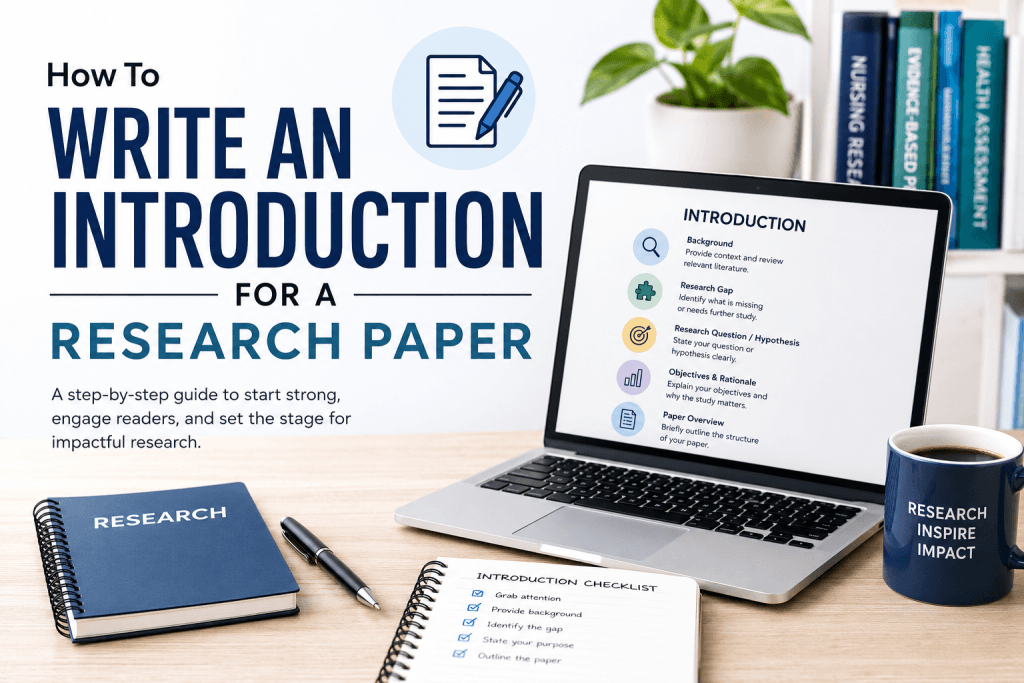
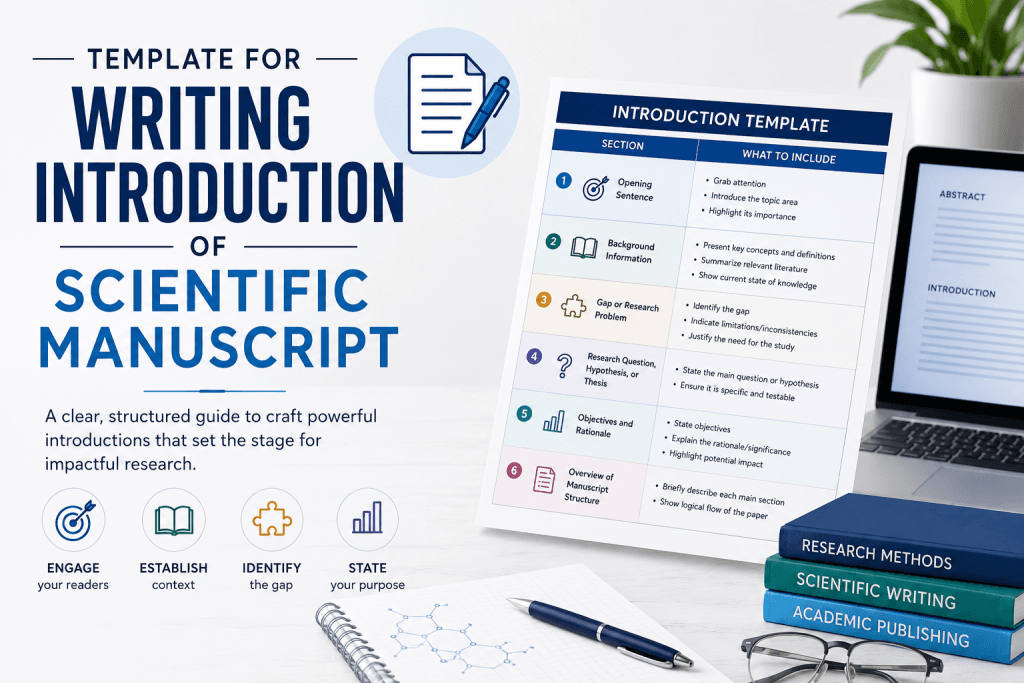
- Writing the introduction sets the tone and scope for the rest of the paper. A common early question is how long should an introduction be — generally, it should run about 10–15% of your total word count. It needs to introduce your research topic, state your research problem, and end with a clear thesis statement or research question, without spilling over into literature review territory.
- Establishing your research question early prevents scope creep. A well-defined research question acts as a filter: if a piece of evidence or argument doesn’t help answer it, it probably doesn’t belong in the paper. This is one of the best ways to naturally control paper length, since vague or overly broad research questions tend to produce bloated, unfocused papers — and a tightly scoped question makes how long should a research paper be much easier to predict.
- The literature review should identify a research gap, not just summarize everything you’ve read. A strong literature review doesn’t try to cover every possible source — it selectively discusses the most relevant academic papers to establish what’s already known and where your research fits in. This keeps the literature review focused and appropriately sized rather than turning into an exhaustive annotated bibliography.
- Draft first, edit for length second. During the writing process, it’s tempting to obsess over hitting an exact word count as you go, but this often disrupts your flow and leads to filler words. Instead, write a full draft focused on clearly presenting your ideas, then revise specifically for concise, clear language once you can see the whole paper.
- Match your depth to the type of research you’re conducting. A quantitative study with a straightforward methods section and results section may naturally produce a shorter overview of the research than a qualitative study built around interviews, coding, and thematic analysis. Recognizing this early helps you set a realistic word count range instead of comparing your paper to one that follows a completely different research design, since how long should a research paper be will always shift with the type of research behind it.
- Revisit your assignment guidelines throughout the writing process, not just at the start. It’s easy to drift from the original brief as you get deeper into your literature review or discussion section. Checking back against the specific guidelines periodically helps make sure your paper length stays aligned with what was actually asked for, especially if you’re several thousand words in and starting to wonder, again, how long should a research paper be at this stage of a first research paper.
- Leave room for revision passes before you consider the paper finished. Your first full draft is rarely your final one. Plan your writing process so that you finish the draft with enough time left to revise for clarity, trim wordiness, and confirm your total word count fits within the expected word count range for your assignment or target journal article.
- Ultimately, starting to write a research paper with a plan for section-by-section length takes the guesswork out of the process — you’ll naturally land closer to an appropriate total word count if you build the paper piece by piece rather than writing freely and hoping it comes out the right length.
Final Tips on How Long Is a Research Paper: Title Page, Word Count, and Draft Revisions
- By the time you reach revisions, you should have a much clearer sense of how long should a research paper be for your specific draft. These final checks are about confirming that sense, not guessing at it from scratch.
- Don’t count your title page toward your word count. The title page is a formatting requirement, not content — it typically includes your title, name, institution, course, and date (or, in APA format, a running head and page number). When students ask how long is a research paper and start counting from the title page, they often end up with an inaccurate sense of their actual progress.
- Track your total word count section by section, not just at the end. Instead of writing the entire paper and then panicking about whether it meets the required length, check in after finishing each section — introduction, literature review, methods section, results section, discussion section, and conclusion section — to see whether you’re roughly on pace with your planned word count range.
- Trim wordiness ruthlessly during revision. Common culprits include filler words (“in order to,” “due to the fact that,” “it is important to note that”), redundant phrases, and overly long sentences that repeat a point already made. Cutting these doesn’t just help you hit a word limit — it makes your academic writing noticeably more concise and easier to read, which reviewers and instructors both appreciate. This step often does more to answer how long should a research paper be than any amount of upfront planning.
- Always have someone else read your paper before final submission. A second reader — a classmate, writing center tutor, or advisor — can spot sections that feel padded, repetitive, or thin far more easily than you can, since you’re too close to your own work. Having someone else read your paper is one of the simplest ways to catch places where paper length doesn’t match content quality.
- Check page numbers and formatting one final time. Confirm that page numbers appear correctly throughout, that your title page follows the required format, and that your reference list, results and discussion sections, and appendix are all formatted according to your specific guidelines. Small formatting errors can distract from otherwise strong academic writing.
- Remember that recommended length is a guideline, not a rigid law — unless your instructor says otherwise. Many instructors state a recommended length with some flexibility (e.g., “approximately 3,000 words”), while others enforce a strict word limit, especially for journal article and research proposal submissions. Always clarify which situation you’re in before you finalize your draft, since it changes how strictly you should treat how long should a research paper be for that particular submission.
- Compare your paper to published papers in your field as a final sanity check. Looking at how long is a research paper in the recent research reports or research article examples from your discipline can help confirm that your paper length is reasonable, especially if you’re unsure whether your draft has enough content or needs further development.
- Don’t sacrifice a good research paper for the sake of hitting a number. If you’ve thoroughly answered your research question, supported your thesis statement with solid evidence, and covered your research topic with an appropriate literature review, a paper that’s slightly under or over the suggested word count is rarely a serious problem — content quality outweighs a strict number in nearly every academic writing context.
- Final check before submission: does the paper feel complete, or does it feel stretched or rushed? If sections feel thin, revisit your research gap and see whether additional analysis, evidence, or discussion would genuinely strengthen the paper — not just add length. If sections feel bloated, look for repeated points, unnecessary summarizing, or tangents that drift from your central research question.
- In the end, how long should a research paper be comes down to one simple test: it should be exactly as long as it needs to be to thoroughly and clearly answer your research question — no more padded than necessary, and no more rushed than your topic deserves.
References
- George Mason University Writing Center – Scientific (IMRaD) Research Reports: Overview – https://writingcenter.gmu.edu/writing-resources/imrad/writing-an-imrad-report
- Utah Valley University Writing Center – Scientific Writing: IMRaD – https://www.uvu.edu/writingcenter/handouts/scientific-writing.html
- Brigham Young University Research & Writing Center – Scientific Writing: IMRAD Format – https://rwc.byu.edu/00000188-e4bc-d222-a7ea-eefd769e0000/scientific-writing-imrad-format-pdf