
What Is IMRAD? An Overview of the Acronym
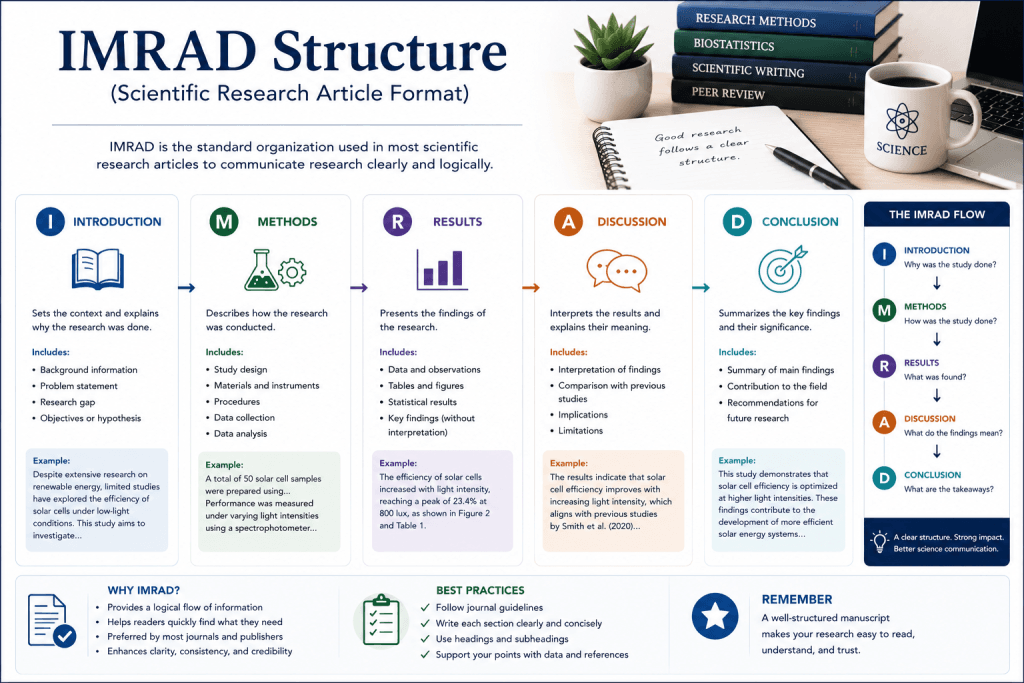
- IMRAD is an acronym that stands for Introduction, Methods, Results, And Discussion — the four core sections that make up the standard structure of a scientific paper.
- Some writers spell it IMRD (dropping the “and”), but IMRAD and IMRD refer to the same underlying structure used across scientific journals worldwide.
- The IMRAD format isn’t just a stylistic preference — it’s the dominant structure required by most scientific journals, academic institutions, and journal editors because it mirrors the natural flow of the research process itself.
- Every IMRAD article walks the reader through a logical sequence:
- Introduction – Why was this study done? What’s the hypothesis?
- Methods (Materials and Methods) – How was the study conducted?
- Results – What did the researcher find?
- Discussion – What do these findings mean?
- This structure supports clarity, transparency, and reproducibility — three pillars of credible scientific writing.
- Understanding the IMRAD acronym is the first step toward writing a research paper that meets the expectations of scientific communities, peer reviewers, and academic publishing standards.
- Whether you’re working on a clinical trial, an observational study, or a qualitative research project, the IMRAD structure gives you a reliable outline to organize your findings from start to finish.
The IMRAD Format Explained: Structure of a Scholarly Research Paper
- The IMRAD format is best understood as a narrative arc for scientific writing — it takes the reader on a journey from question to answer.
- Here’s how the structure breaks down within a typical journal article:
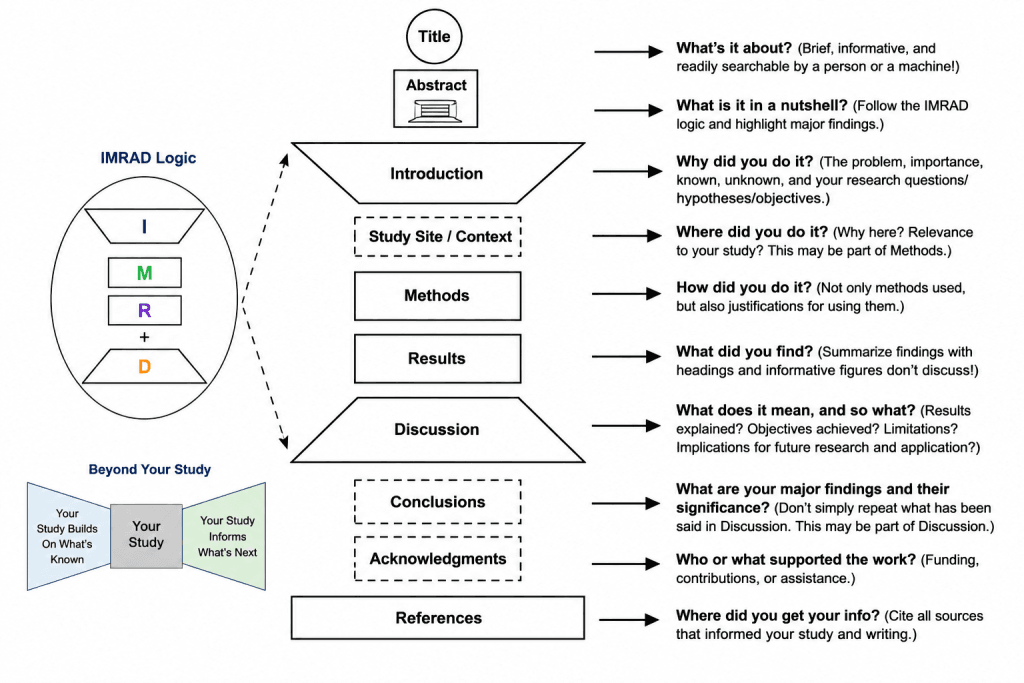
- Title and Abstract – A brief overview of the entire study, often the only part many readers will see.
- Introduction – Establishes the background, relevance, and hypothesis of the research.
- Materials and Methods – Describes the methodology, study population, interventions, and tools used.
- Results – Presents the dataset and findings without interpretation.
- Discussion – Interprets the results, explores implications, and suggests future research.
- Conclusion – Sometimes a standalone section, sometimes folded into the discussion.
- References/Appendix – Supplementary materials, citations, and sometimes a DOI (Digital Object Identifier) for the published paper.
- This structure isn’t arbitrary. It reflects how the scientific method itself unfolds — question, method, observation, interpretation.
- Many scientific journals, including BMJ and PLOS, require submissions to follow this format closely, often providing a checklist to ensure compliance with their editorial guidelines.
- While IMRAD is considered close to universal in scientific writing, the format can be slightly adapted depending on the discipline or field of study. For example, systematic reviews may include additional subsections, while case reports may condense certain parts.
- Despite these variations, the core logic of IMRAD — introduction, methods, results, and discussion — remains consistent, which is why researchers across disciplines rely on it to structure their manuscripts before submission to journal editors.
Introduction: The First Section of the IMRAD Article, with Examples
- The introduction is the opening section of any IMRAD research paper, and its job is to answer one core question for the reader: why does this study matter?
- A strong introduction typically includes:
- Background context – A summary of existing scientific literature relevant to the topic.
- The research gap – What hasn’t been answered yet by prior studies?
- The hypothesis or research question – A clear, testable statement of what the researcher expects to find.
- The purpose of the study – A direct statement of the study’s objective.
- Because the introduction sets the tone for the entire IMRAD article, it needs to move from broad context to a narrow, specific focus — a structure often described as an “inverted triangle.”
- Example structure:
- Sentence 1–2: Broad scientific context (e.g., “Cardiovascular disease remains a leading cause of mortality worldwide.”)
- Sentence 3–5: Narrowing to the specific gap (e.g., “However, limited research has examined the relationship between X and Y in adolescent populations.”)
- Final sentences: The hypothesis and purpose statement (e.g., “This study hypothesizes that X is associated with Y and aims to evaluate this relationship among a sample of 200 respondents.”)
- A well-written introduction should:
- Cite relevant, credible sources from the scientific literature.
- Avoid overstating the significance of the research.
- Clearly justify why the study was necessary.
- Preview the methodology briefly, without going into full detail (that belongs in materials and methods).
- Common mistakes to avoid in this section of the IMRAD structure:
- Writing an introduction that’s too broad and never narrows down to a specific hypothesis.
- Failing to establish the relevance of the study to current scientific research.
- Overloading the section with literature review content that belongs elsewhere.
- Ultimately, the introduction of any research article should leave the reader with a clear understanding of the study’s purpose and enough curiosity to continue into the methods section.
- It also helps to think of the introduction as a bridge between existing scientific literature and the new contribution your study is about to make — this framing keeps the writing focused and prevents the section from drifting into an unfocused literature review.
- Many experienced researchers draft the introduction last, after the results and discussion are complete, since it’s often easier to justify a study’s relevance once the findings are already known. This is a common practice in academic writing, even though the introduction appears first in the finished IMRAD article.
- Additional example: “Despite growing interest in telehealth interventions, few studies have examined patient adherence rates among rural populations. This study addresses that gap by evaluating adherence patterns among 300 respondents across five rural clinics, hypothesizing that access barriers significantly predict lower adherence.”
Academic Writing & Research Support
Need Help With Research Papers, Manuscripts, Editing, or Proofreading?
At Scholarly Work, we provide professional academic writing support for researchers, students, and professionals. From drafting manuscripts to refining final submissions, we ensure clarity, accuracy, and publication-ready quality.
Get Manuscript Writing Help
Materials and Methods: Building the Core of Your IMRAD Structure, with Examples
- The materials and methods section (often just called “methods”) is where the researcher explains, in detail, exactly how the study was conducted. This section is critical to the credibility of any scientific paper because it allows other researchers to replicate the study.
- A complete methods section in the IMRAD structure typically includes:
- Study design – Was it a clinical trial, observational study, survey, or qualitative research project?
- Study population – Who or what was studied? This includes sample size, demographics, and inclusion/exclusion criteria for respondents.
- Materials and tools – What equipment, instruments, surveys, or software were used to collect data?
- Procedures – A step-by-step account of what was actually done, in enough detail that another researcher could repeat it.
- Data analysis methods – What statistical tests, coding frameworks, or analytical tools were applied to the dataset?
- Ethical considerations – Approval from ethics boards, informed consent procedures, and compliance with research regulations.
- Example (clinical trial):
- “A total of 150 respondents were recruited from three outpatient clinics and randomly assigned to either the intervention group or the control group. The intervention consisted of a 12-week exercise program, while the control group received standard care. Data were analyzed using a two-tailed t-test with a significance threshold of p < 0.05.”
- Example (qualitative research):
- “Semi-structured interviews were conducted with 25 participants selected through purposive sampling. Interviews were transcribed verbatim, and each transcript was coded using thematic analysis to identify recurring patterns related to the study’s central research question.”
- Best practices for writing this section of your IMRAD article:
- Use the past tense, since the methods have already been carried out.
- Be precise about quantities, timeframes, and measurement tools — vague language undermines transparency.
- Include enough detail for reproducibility, which is a cornerstone of evidence-based medicine and scientific rigor.
- Organize the section with clear subheadings if the methodology is complex (e.g., “Participants,” “Materials,” “Procedure,” “Data Analysis”).
- Avoid including any interpretation of findings here — that belongs strictly in the results and discussion sections.
- Why this section matters so much in the IMRAD format:
- It builds trust with readers and reviewers by demonstrating methodological rigor.
- It allows other researchers in the same field of study to replicate or build upon the research process.
- It’s often the section journal editors and peer reviewers scrutinize most closely, since flaws in methodology can undermine the validity of the entire study.
- A well-documented materials and methods section can also serve as a diagnostic tool for readers trying to judge whether a study’s conclusions are applicable to their own clinical practice or research context.
- Common pitfalls to avoid:
- Omitting details about how missing data or dropouts were handled.
- Failing to describe how variables were operationally defined.
- Not stating whether the study followed a specific reporting checklist required by the target scientific journal.
- In short, materials and methods is the backbone of any scholarly research paper — it’s where scientific claims are either supported by rigorous methodology or exposed as weak and unreplicable.
- Many researchers also use this section to establish transparency around funding sources, conflicts of interest, and how the study population was recruited — details that increasingly matter to journal editors evaluating a manuscript for publication.
- For systematic reviews specifically, the materials and methods section often includes a description of the search strategy, databases searched, and inclusion and exclusion criteria for the studies reviewed — a slightly different application of the same IMRAD principle.
- Additional example (survey-based research): “An online questionnaire was distributed to 400 respondents recruited through professional networks. The survey included 25 items measuring job satisfaction, using a five-point Likert scale. Data were analyzed using descriptive statistics and multiple regression to identify predictors of satisfaction.”
- Regardless of discipline, the guiding principle behind materials and methods remains the same across the IMRAD structure: give readers everything they need to evaluate, trust, and potentially reproduce your research process.
Results and Discussion: Presenting Findings in IMRAD Format, with Examples
- The results section is where the researcher presents what was actually found — without interpretation, opinion, or speculation. This is a strictly descriptive section within the IMRAD structure.
- Key components of an effective results section:
- Data presentation – Using tables, figures, and charts to summarize the dataset clearly.
- Narrative summary – A written explanation that walks the reader through the most important findings, without repeating every number found in a table.
- Statistical outcomes – Reporting p-values, confidence intervals, effect sizes, or other relevant statistical measures.
- Order of presentation – Findings should generally follow the same order as the questions or hypotheses introduced earlier in the paper.
- Example (quantitative results):
- “Of the 150 respondents, 78% in the intervention group demonstrated a statistically significant improvement in mobility scores (p = 0.002), compared to 34% in the control group. No significant differences were observed in secondary outcome measures.”
- Example (qualitative results):
- “Three major themes emerged from the interview transcripts: (1) a perceived lack of institutional support, (2) increased confidence following the intervention, and (3) ongoing concerns about long-term sustainability.”
- Best practices for the results section:
- Report all findings, including those that don’t support the original hypothesis — selective reporting undermines scientific integrity.
- Use clear, labeled tables and figures rather than dense blocks of text.
- Avoid interjecting interpretation; save “why” questions for the discussion.
- Reference each table or figure directly in the text (e.g., “As shown in Table 2…”).
- The discussion section is where the researcher shifts from what was found to what it means. This is arguably the most interpretive part of the entire IMRAD article.
- A strong discussion section typically covers:
- Interpretation of results – What do the findings suggest in relation to the original hypothesis?
- Comparison to existing literature – How do these results align with or differ from previous scientific research on the topic?
- Implications – What are the practical, clinical, or theoretical implications of the findings for the broader field of study?
- Limitations – An honest account of the study’s weaknesses, such as small sample size, potential bias, or a narrow study population.
- Future research – Suggestions for what should be studied next to build on the current findings.
- Example discussion excerpt:
- “These findings suggest that structured exercise interventions may meaningfully improve mobility outcomes in older adults, aligning with prior research in this field. However, the relatively short follow-up period limits our ability to assess long-term effects, highlighting a clear direction for future research.”
- Why results and discussion are sometimes combined:
- Some scientific journals — particularly in fields with smaller or more descriptive datasets — allow authors to combine results and discussion into a single, integrated section to improve narrative flow and avoid repetition.
- This combined approach can make an IMRAD article easier to read, especially for systematic reviews or papers with complex, layered findings.
- Tips for writing a compelling discussion section:
- Avoid overstating conclusions beyond what the data actually supports.
- Address alternative explanations for the results.
- Tie the discussion back to the introduction’s original hypothesis to create a cohesive narrative arc across the IMRAD structure.
- Be transparent about any unexpected or contradictory findings rather than omitting them.
- Together, results and discussion form the analytical heart of the IMRAD format — this is where raw data is transformed into meaningful scientific knowledge that can inform clinical practice, policy, or further scientific research.
- When writing this part of an IMRAD article, it’s worth keeping the intended audience in mind — a discussion written for a specialized clinical journal may go deeper into diagnostic nuance, while one written for a broader scientific audience may prioritize accessible language and broader context.
- It’s also good practice to explicitly revisit the hypothesis stated in the introduction. Stating clearly whether the data supported, partially supported, or failed to support the original hypothesis gives the entire IMRAD structure a strong sense of narrative closure and helps readers evaluate the study’s overall contribution.
- Additional example (results and discussion combined): “Respondents in the intervention group reported a 22% increase in self-reported confidence scores compared to a 4% increase in the control group. This suggests the intervention had a measurable psychological benefit, consistent with prior research, although the modest sample size warrants cautious interpretation and further replication in larger, more diverse study populations.”
- Because this section often carries the most scientific weight, it’s the part of the manuscript most likely to be flagged for edit requests by journal editors and peer reviewers, so precision, honesty about limitations, and clear alignment with the data are essential.
Academic Writing & Research Support
Need Help With Research Papers, Manuscripts, Editing, or Proofreading?
At Scholarly Work, we provide professional academic writing support for researchers, students, and professionals. From drafting manuscripts to refining final submissions, we ensure clarity, accuracy, and publication-ready quality.
Get Manuscript Writing Help
Writing an Effective Conclusion for Your IMRAD Research Paper, with Examples
- The conclusion brings the entire IMRAD article full circle, connecting back to the hypothesis introduced at the very beginning of the paper.
- While some journals fold the conclusion into the discussion section, many scholarly research papers include it as a distinct, standalone section for added clarity.
- A strong conclusion in the IMRAD structure typically includes:
- A restatement of the study’s purpose – A brief reminder of what the research set out to investigate.
- A summary of key findings – The most important takeaways from the results, stated concisely.
- The broader significance – Why these findings matter to the scientific community, clinical practice, or a specific field of study.
- Practical implications – How the findings might be applied in real-world settings.
- A call for future research – Identifying unanswered questions or next steps for other researchers.
- Example conclusion:
- “This study provides evidence that structured exercise interventions can meaningfully improve mobility outcomes among older adults. Given the study’s limitations, including a modest sample size, future research should explore these effects across larger, more diverse populations and over extended follow-up periods. These findings offer a foundation for evidence-based recommendations in clinical practice.”
- Best practices for writing this section:
- Keep it concise — the conclusion shouldn’t introduce new data or arguments not already covered in the results and discussion.
- Avoid simply repeating the abstract word-for-word; instead, synthesize the paper’s key contributions.
- Make sure the conclusion is proportional to the strength of the evidence — don’t overreach.
- End with a forward-looking statement that positions the research within the broader trajectory of the field.
- Why the conclusion matters:
- It’s often, along with the abstract, one of the most-read sections of a scientific paper — many readers skim the introduction and conclusion before deciding whether to read the full article.
- A clear, well-crafted conclusion helps journal editors and peer reviewers judge the overall contribution of the manuscript.
- It reinforces the reader’s understanding of how the study’s findings connect back to the original research question, closing the loop of the IMRAD structure.
- Common mistakes to avoid:
- Introducing new results or citations that weren’t discussed earlier in the paper.
- Making broad claims that aren’t supported by the study’s actual scope or dataset.
- Failing to acknowledge limitations, which can raise questions about the researcher’s transparency and rigor.
- A well-written conclusion doesn’t just summarize — it leaves the reader with a clear sense of the study’s contribution to the broader field of study and the direction future research should take.
IMRAD Structure FAQs
What does IMRAD stand for?
- IMRAD stands for Introduction, Methods, Results, And Discussion — the four essential sections of a standard scientific research article.
Is IMRAD the same as IMRD?
- Yes. IMRD is simply a shortened version of the same acronym, referring to the identical four-part structure used in scientific writing.
Why do scientific journals require the IMRAD format?
- The IMRAD format promotes clarity, consistency, and reproducibility. It allows readers, peer reviewers, and journal editors to quickly locate specific information — whether they’re checking the hypothesis, reviewing the methodology, or evaluating the study’s implications.
Does every research paper follow the IMRAD structure exactly?
- Not always. While IMRAD is the most common structure for original research, some papers — such as systematic reviews, case studies, or qualitative research — may adapt the format slightly to suit their content, sometimes combining results and discussion or adding supplementary sections.
Where does the abstract fit into the IMRAD format?
- The abstract typically appears before the introduction and offers a condensed overview of the entire study, including the purpose, methodology, key results, and conclusion. It’s not technically one of the four IMRAD sections, but it usually mirrors their order.
What’s the difference between the results and discussion sections?
- The results section presents findings descriptively, without interpretation. The discussion section interprets those findings, compares them to existing scientific literature, and explores their implications for the field of study.
Can the materials and methods section be too detailed?
- It’s rare for a methods section to be “too detailed,” since the goal is reproducibility. However, it should stay focused on procedural information — avoid including interpretation or results within this section.
Is the conclusion required in every IMRAD article?
- Not always as a separate section. Some journals prefer conclusions folded into the discussion, while others — especially in clinical and health sciences — require a distinct conclusion section. Always check the target journal’s author guidelines or checklist.
How long should each IMRAD section be?
- Section length varies by discipline and journal, but generally, the introduction and conclusion are shorter, while materials and methods and results and discussion are more detailed, since they carry the bulk of the study’s technical content.
Where can I find a DOI for a published IMRAD paper?
- The DOI (Digital Object Identifier) is typically listed on the journal’s website alongside the published article, often near the title, abstract, or citation information.
Do all scientific disciplines use IMRAD?
- Most empirical, quantitative, and clinical research follows IMRAD, but some disciplines in the humanities or theoretical sciences use different structures better suited to their type of scholarship and argumentation style.
Is IMRAD only used in original research articles?
- No. While IMRAD is the default structure for original research, many systematic reviews, meta-analyses, and even some case reports adapt the format, often expanding the methods section to describe search and selection strategies in greater depth.
How does IMRAD help journal editors during the review process?
- Because the structure is so widely recognized, journal editors and peer reviewers can quickly locate the specific section they need to evaluate — whether checking the hypothesis in the introduction, scrutinizing the methodology, or assessing whether the discussion’s implications are properly supported by the results. This consistency speeds up the editorial process and improves overall compliance with journal submission standards.
Should I follow a checklist when writing an IMRAD paper?
- Yes. Many scientific journals provide their own checklist or author guidelines to ensure a manuscript meets formatting and reporting requirements before submission. Following a checklist can help catch missing details in the methods section, ensure the results are reported completely, and confirm the discussion appropriately addresses limitations and future research directions.
References
- George Mason University Writing Center – Scientific (IMRaD) Research Reports: Overview – https://writingcenter.gmu.edu/writing-resources/imrad/writing-an-imrad-report
- Utah Valley University Writing Center – Scientific Writing: IMRaD – https://www.uvu.edu/writingcenter/handouts/scientific-writing.html
- Brigham Young University Research & Writing Center – Scientific Writing: IMRAD Format – https://rwc.byu.edu/00000188-e4bc-d222-a7ea-eefd769e0000/scientific-writing-imrad-format-pdf