What Is the Template for Writing Introduction of Scientific Manuscript?
- A template for writing introduction of scientific manuscript is a repeatable framework that tells you what information goes where, in what order, so the opening section of your paper does its job without you having to reinvent the wheel every time you sit down to start writing.
- Think of it as a funnel shape: you open broad with background information, narrow down through the literature review, and end on the specific research question or hypothesis that your study addresses.
- This funnel structure is sometimes called the “general to specific” approach, and it’s the backbone of almost every strong introduction section you’ll find in scientific literature.
- Once you internalize this shape, applying a template for writing introduction of scientific manuscript to a new project becomes far less intimidating.
- Using a template for writing introduction of scientific manuscript isn’t about being formulaic for its own sake — it’s about helping the reader to understand why your work matters before you ask them to follow you through your materials and methods section.
- Journals across the biological sciences, chemistry, physics, and social sciences all expect this same underlying logic, even if the specific wording and emphasis shift slightly by field.
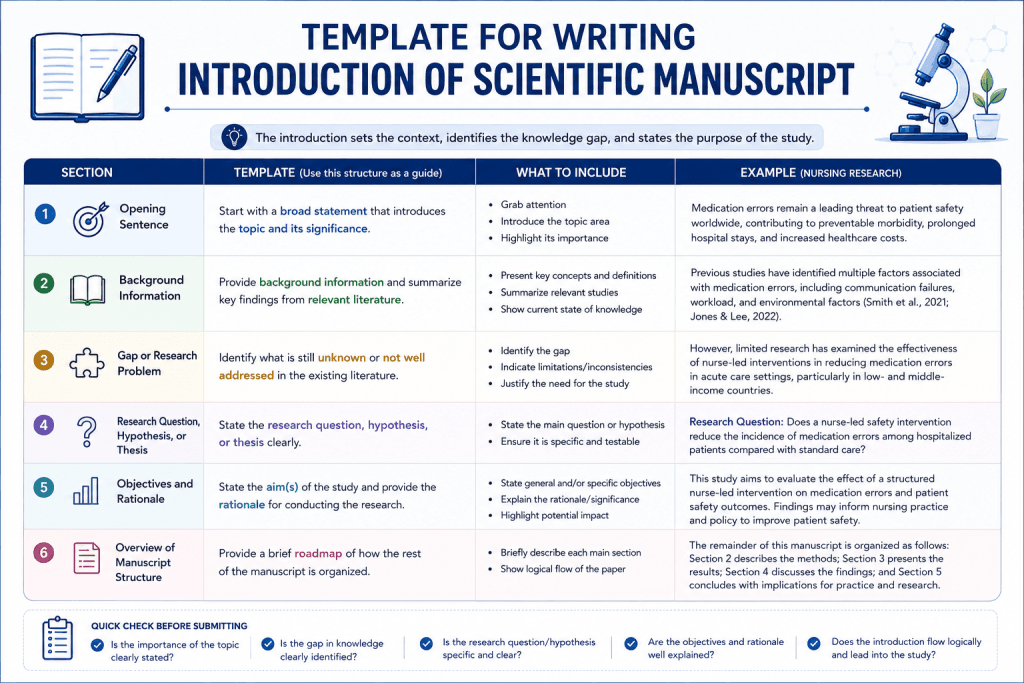
- A good template for writing introduction of scientific manuscript typically includes four building blocks: the broad context, the existing knowledge on the topic, the gap in that knowledge, and your specific aim or hypothesis.
- Why does this matter for scientific writing specifically?
- Because unlike a novel or an essay, a scientific paper doesn’t have room for a slow build — reviewers and readers expect to know the purpose of the introduction within the first few sentences.
- A template for writing introduction of scientific manuscript gives you a checklist to follow so nothing essential gets left out, and so you’re not staring at a blank page wondering how to begin writing an introduction from scratch.
- In short, this template for writing introduction of scientific manuscript is less a rigid formula and more a scaffold — one you can adapt to your research topic, your model system, and the expectations of your target journal, while still hitting every logical step a reviewer expects to see.
Why the Introduction Section Matters in a Scientific Paper
- The introduction section is the first real chance you get to convince a reader — and often a reviewer or editor — that your research manuscript is worth their time, which is exactly why a solid template for writing introduction of scientific manuscript matters so much.
- Papers that follow a consistent template for writing introduction of scientific manuscript tend to move faster through peer review, simply because reviewers can find the information they expect in the order they expect it.
- Many readers decide within the first paragraph whether they’ll keep reading the rest of the paper, so the first sentence and the paragraphs that follow carry a disproportionate amount of weight.
- This is true whether you’re submitting original research to a specialized journal or a broad, multidisciplinary one.
- A well-built introduction does several jobs at once, and understanding these jobs is part of why a template for writing introduction of scientific manuscript is so useful:
- It orients the reader by supplying background information on the research topic.
- It demonstrates that you know the relevant scientific literature through a targeted literature review.
- It identifies the gap in existing knowledge that your study addresses.
- It states your research question, hypothesis, or objective clearly, setting up the experimental design that follows.
- The introduction section of a scientific paper also sets the tone for how the rest of the manuscript will be read.
- If your introduction is unclear or disorganized, readers may approach your results section and discussion section with less confidence in your conclusions, even if the underlying experimental work is sound.
- Conversely, a well-structured introduction builds trust and makes the methods and results that follow easier to interpret.
- From an editorial standpoint, many journals use the introduction as a quick filter during initial screening.
- Editors often skim the opening paragraphs to judge whether the significance of your findings is likely to matter to their readership before sending the manuscript out for full review.
- This means that a strong template for writing introduction of scientific manuscript isn’t just a writing convenience — it can directly affect whether your paper gets past the first editorial gate.
- Finally, the introduction matters because it’s where you frame the importance of the work and the broader implications of your study, which readers will refer back to when they reach the end of the paper and the discussion of your key findings.
Key Elements to Include Before You Write the Introduction Section
Before you even open a blank document, it helps to gather the raw materials that any solid template for writing introduction of scientific manuscript depends on. Skipping this prep stage is one of the biggest reasons writers get stuck mid-paragraph, and it’s a stage that a good template for writing introduction of scientific manuscript should never let you skip.
- A clear research question.
- You should be able to state your research question in one or two sentences before you begin writing an introduction.
- If you can’t summarize it simply, it’s worth revisiting your experimental design and your hypothesis and methods until the question is sharp enough to build an entire manuscript around.
- A completed or near-complete literature search.
- A thorough literature search ensures you’re not missing key research articles that already address parts of your research topic.
- This step protects you from an awkward situation where a reviewer points out that your “gap” in existing knowledge was already filled by a paper you didn’t cite.
- A working understanding of your target journal’s expectations.
- Some journals — for example, a regional or specialty title like a Canadian journal in a particular subfield — have their own house style for introduction section length, tone, and word count.
- Checking author guidelines before you start writing saves you from having to cut a carefully built introduction section of your manuscript down after the fact.
- A rough outline of your background information.
- List out, in bullet form, the two or three broad concepts a reader needs before they can appreciate your specific study.
- This becomes the backbone of your opening paragraph and keeps your background to your research from wandering off-topic.
- Knowledge of your model system or experimental system.
- Whether you’re working with a cell line, an animal model, a survey population, or a computational dataset, your reader needs enough context about your model system to follow your later experimental approach.
- Deciding how much detail belongs in the introduction versus the materials and methods section is a judgment call, but generally: broad rationale goes in the introduction, technical specifics go in methods.
- A shortlist of your key citations.
- Identify the handful of sources you absolutely must cite — landmark studies, recent reviews, and any papers that directly contradict or support your hypothesis.
- Organizing these ahead of time makes it much easier to structure the literature review portion of your introduction without last-minute scrambling.
- A one-line statement of significance.
- Draft a single sentence describing the significance of your findings or the anticipated impact of your study.
- Even if this sentence changes later, having it in front of you helps every other part of the introduction stay aligned with the same goal.
- Awareness of the IMRAD structure.
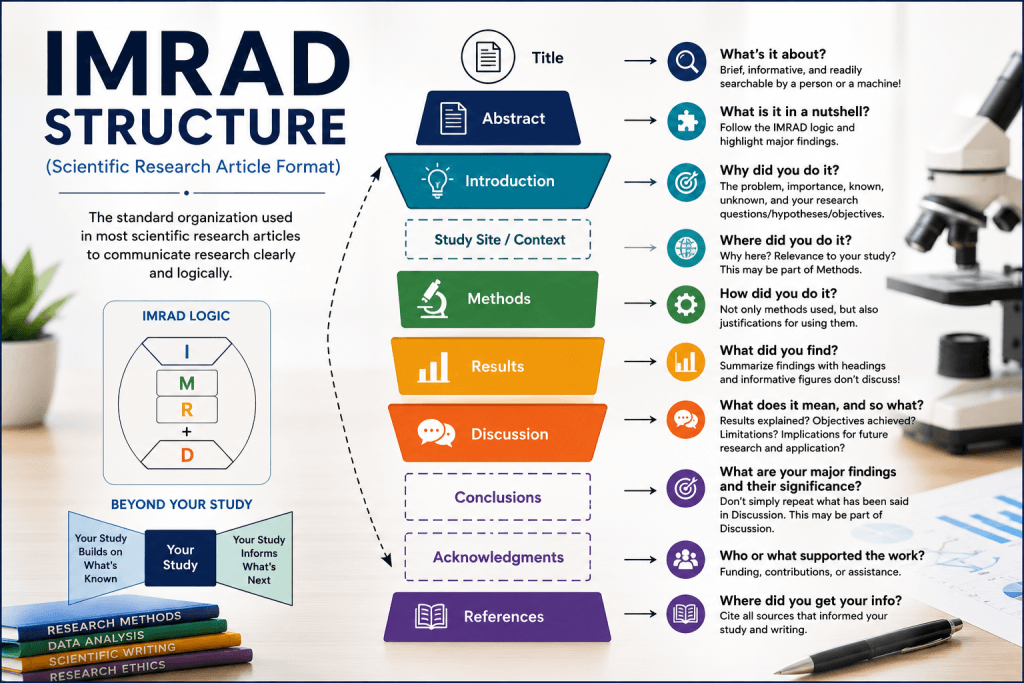
- Most scientific papers follow the IMRaD format — Introduction, Methods, Results, and Discussion — and understanding how these different sections relate to each other helps you avoid duplicating content.
- Anything that belongs in the results section or discussion section should be left out of the introduction, even if it feels relevant while you’re writing.
Gathering these elements before you write means your template for writing introduction of scientific manuscript becomes something you fill in with confidence rather than something you fight against. Skipping this prep is often why a template for writing introduction of scientific manuscript feels harder to use than it should.
Key Steps in Creating a Template for Writing Introduction of Scientific Manuscript
Here is a practical, five-step template for writing introduction of scientific manuscript that you can reuse across projects. Each step corresponds to roughly one paragraph in a typical introduction section, though longer or more complex manuscripts may need two paragraphs for a single step. This is the core of the template for writing introduction of scientific manuscript, so it’s worth working through slowly the first few times you apply it.
Step 1: Open with the broad background and importance of the field.
- Your first sentence should establish the general research topic in a way that’s accessible to a reader who isn’t a specialist in your narrow subfield.
- Avoid opening with an overly technical claim — save that detail for later paragraphs. Instead, describe why this broad area matters to biological sciences, medicine, environmental science, or whichever discipline you’re writing in.
- This opening paragraph should be concise: two to four sentences that establish scope without overwhelming the reader with citations.
- A common mistake here is spending too much time on general background information and delaying the research question until page two — resist that urge.
Step 2: Narrow the focus with a targeted literature review.
- Move from the broad field into the specific area of existing knowledge relevant to your study.
- This is where most of your cite-worthy sources belong. Summarize what previous research articles have shown, using your own words rather than long quotations.
- Group related studies together rather than listing them one after another; a paragraph that reads “Smith found X, Jones found Y, Lee found Z” without synthesis is harder to follow than one that identifies a shared theme across those findings.
- Keep this section proportionate — a literature review that’s too long can overshadow the rest of your introduction section, while one that’s too short may make it look like you haven’t done your homework.
Step 3: Identify the gap or unresolved question in the field.
- After summarizing what’s known, pivot to what’s still unknown, unclear, or contested.
- Common transition phrases include “however,” “despite this,” or “little is known about,” which signal to the reader to understand that you’re about to introduce the problem your study solves.
- This gap-identification step is often the single most important logical step in the entire template for writing introduction of scientific manuscript, because it’s what justifies your research question in the first place.
- Writers who skip this step often produce an introduction that reads well sentence-by-sentence but doesn’t actually explain why the study needed to happen — a common failure point in an otherwise decent template for writing introduction of scientific manuscript.
- Be specific about the gap — vague statements like “more research is needed” are weaker than precise ones like “no study has yet examined X under Y conditions.”
Step 4: State your research question, hypothesis, and objective.
- This is the heart of the introduction, where you tell the reader exactly what your study set out to do.
- State your hypothesis and methods in brief, connecting your experimental approach to the gap you just described.
- Many writers find it helpful to explicitly write, “In this study, we…” or “Here, we test the hypothesis that…” — direct language that leaves no ambiguity about your research question.
- Keep this paragraph tight. You’re not describing your full experimental design yet (that belongs in the materials and methods section) — you’re stating your aim clearly enough that a reader could summarize it back to you in one sentence.
Step 5: Preview your approach and, if appropriate, your key findings.
- Close your introduction section with a brief preview of how you addressed the research question — your general experimental approach or model system — and, in some fields, a short forecast of your key findings.
- Not all journals or disciplines expect a findings preview in the introduction; some prefer to save that for the results section or discussion section, so check your target journal’s conventions.
- This final paragraph acts as a bridge, helping the reader transition smoothly from the introduction into the methods and results that follow.
- End on a concise, confident note rather than trailing off — this is your last chance to lead your reader into the body of the manuscript with clear expectations.
Following these five steps consistently is what turns a one-off writing exercise into a genuine, reusable template for writing introduction of scientific manuscript — one you can apply to your next research manuscript with far less friction than the first time around. The more often you use this template for writing introduction of scientific manuscript, the faster your writing process becomes.
How to Cite Sources and Structure the Introduction Section of Your Scientific Manuscript
- Match your citation style to your target journal.
- Every template for writing introduction of scientific manuscript needs to account for citation formatting, since different journals require different systems — numbered, author-date, or superscript styles are all common.
- A flexible template for writing introduction of scientific manuscript should leave room for these style differences rather than locking you into one citation format.
- Check the journal’s author guidelines before you start writing, since reformatting dozens of citations after the fact is tedious and easy to get wrong.
- Include references strategically, not exhaustively.
- You don’t need to include references for every claim you make; focus on the sources that directly support your background information, your literature review, and the gap you’re identifying.
- Over-citing can clutter a paragraph and distract from your argument, while under-citing can make claims look unsupported.
- Cite primary sources over secondary ones where possible.
- When you cite a finding, try to reference the original research articles rather than a review article that summarizes it, unless you’re specifically discussing the state of the field as a whole.
- This practice strengthens the credibility of your introduction section and shows reviewers you’ve engaged directly with the scientific literature, which is exactly the kind of detail a careful template for writing introduction of scientific manuscript reminds you to check.
- Structure citations to build your argument, not just to list sources.
- Rather than tacking citations onto the end of sentences as an afterthought, use them to actively structure your argument — grouping several studies together when they support the same point, and separating them when they represent competing views.
- This kind of intentional structure helps the reader to understand the shape of the debate in your field.
- Keep your literature cited section consistent with your in-text citations.
- Every source mentioned in your introduction should appear in your literature cited list at the end of the paper, and vice versa — mismatches here are a common and easily avoidable error.
- Reference management software can help keep this consistent throughout your writing process.
- Use headings and paragraph breaks to reinforce structure.
- While most journals don’t use a subheading for the introduction itself, using clear paragraph breaks that follow the five-step template for writing introduction of scientific manuscript outlined above makes your introduction section of your manuscript far easier to skim. This is one of the simplest ways a template for writing introduction of scientific manuscript improves readability without adding extra work.
- Each paragraph should have a clear function: background, literature review, gap, research question, and approach — readers should be able to sense the shift between them.
- Keep formatting aligned with the rest of your manuscript.
- Your introduction should use the same tense, terminology, and model system naming conventions you’ll use later in the materials and methods section, results section, and discussion section, so the whole scientific manuscript reads as one coherent piece of academic writing.
Common Mistakes to Avoid When Using a Template for Writing Introduction of Scientific Manuscript
Even with a solid template for writing introduction of scientific manuscript in hand, certain habits can undercut an otherwise strong introduction section. Knowing these pitfalls in advance is part of using any template for writing introduction of scientific manuscript well. Here are the mistakes to watch for:
- Starting too narrowly.
- Opening with highly technical detail before establishing broader context can lose readers who aren’t already experts in your research topic.
- Fix this by making sure your first sentence and opening paragraph speak to a wider audience before you narrow down.
- Writing an overly long literature review.
- It’s tempting to summarize every relevant paper you found during your literature search, but an introduction section that reads like a full literature review article loses its purpose of the introduction as scene-setting.
- Keep the review focused on studies directly relevant to your research question, and save more exhaustive discussion for the discussion section if needed.
- Failing to clearly state the gap in existing knowledge.
- Some manuscripts move from background straight into methods without ever explaining why the study was necessary.
- Reviewers look specifically for this gap-statement, and its absence is one of the most common reasons an introduction feels weak, even when the experimental work itself is strong.
- Burying the research question.
- If your research question or hypothesis is vague or appears too late in the introduction, readers may finish the section without understanding what your study actually set out to do.
- A well-structured introduction states the objective clearly, usually in its own dedicated paragraph.
- Overlapping too much with the discussion section.
- Previewing your key findings is fine in moderation, but discussing implications, limitations, or detailed interpretation belongs in the discussion section, not the introduction.
- Keep your introduction focused on setting up the study, not analyzing it.
- Neglecting the target journal’s specific guidelines.
- Ignoring word count limits, formatting rules, or citation style specific to many journals can lead to unnecessary revisions.
- Always check journal-specific author instructions, whether you’re submitting to a major international title or a smaller Canadian journal, before finalizing your introduction section of your scientific manuscript.
- Using overly dense or jargon-heavy language.
- Scientific writing should still be readable; a template for writing introduction of scientific manuscript doesn’t help if every sentence is packed with unnecessary jargon.
- Aim to summarize complex ideas in concise, plain language wherever possible, saving technical precision for the materials and methods section.
- Forgetting to proofread for flow and consistency.
- Because the introduction is often written and revised multiple times, it’s easy to end up with repetitive phrasing or inconsistent terminology across paragraphs.
- Always proofread the finished introduction section aloud or with fresh eyes to check that it flows logically from broad background to specific research question.
- Not connecting the introduction to the rest of the manuscript.
- An introduction that doesn’t set up expectations for the materials and methods section, results section, and discussion section leaves the reader feeling disoriented later in the paper.
- Make sure your final paragraph acts as a genuine bridge, not just a stopping point.
- Treating the template as rigid rather than adaptable.
- While a template for writing introduction of scientific manuscript provides essential information and a reliable order of operations, it’s still meant to flex around your specific research topic, model system, and field norms. Treating the template for writing introduction of scientific manuscript as a checklist rather than a script keeps your writing natural.
- Use it as a logical step-by-step guide rather than a strict formula, and your introduction will read as natural scientific communication rather than a fill-in-the-blank exercise.
Avoiding these pitfalls, while following a clear, five-step template for writing introduction of scientific manuscript, will help you produce an introduction that’s concise, well-cited, and genuinely useful to anyone reading your scientific article — from a first-time author working on their first research manuscript to an experienced scientist refining their writing process for original research in the biological sciences and beyond. With practice, this template for writing introduction of scientific manuscript becomes second nature, and writing a scientific paper’s opening section stops feeling like a hurdle at all.
- George Mason University Writing Center – Scientific (IMRaD) Research Reports: Overview – https://writingcenter.gmu.edu/writing-resources/imrad/writing-an-imrad-report
- Utah Valley University Writing Center – Scientific Writing: IMRaD – https://www.uvu.edu/writingcenter/handouts/scientific-writing.html
- Brigham Young University Research & Writing Center – Scientific Writing: IMRAD Format – https://rwc.byu.edu/00000188-e4bc-d222-a7ea-eefd769e0000/scientific-writing-imrad-format-pdf