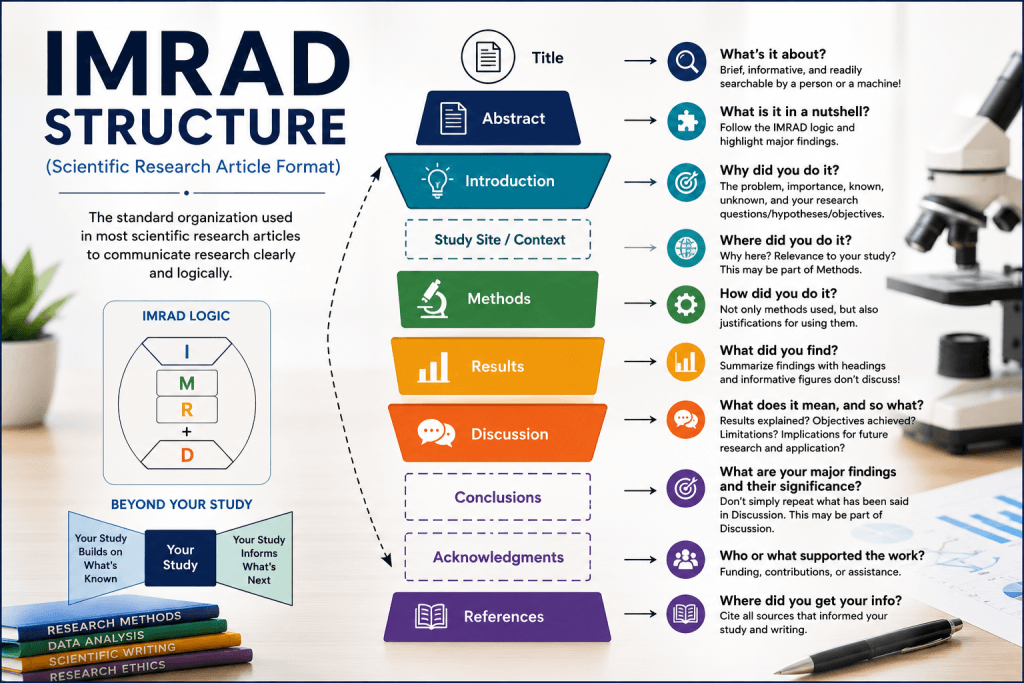
What Is the Discussion in Research Paper Writing?
- The discussion in research paper writing is the section where you explain what your results actually mean, rather than simply restating them.
- This is different from the results section, which only reports numbers, statistics, and observations without interpretation.
- The discussion section of a research paper takes those raw study results and connects them back to your original research question and hypothesis.
- Understanding the discussion in research paper structure starts with knowing its core purpose:
- To explain whether your results prove or disprove your hypothesis.
- To discuss the implications of what you found for your field.
- To situate your study in the context of previous studies and existing literature.
- Many students confuse the results and discussion sections, or even combine them into a results and discussion section.
- In a combined results and discussion section, you still need to clearly separate “what we found” from “what it means.”
- Some academic writing formats also use a discussion and conclusion section, where final takeaways are folded into the closing paragraphs of the discussion in research paper writing.
- A well-written discussion in research paper typically includes several elements of the discussion:
- A summary section that restates the main findings in plain language.
- An explanation of what the results mean in relation to the research question.
- A discussion of limitations, strengths of the study, and possible explanations for unexpected results.
- Suggestions for future research and unresolved questions.
- In short, the discussion section of a research paper is your chance to demonstrate critical thinking, not just data reporting. It is where the “so what?” of your research results gets answered for readers, reviewers, and future researchers alike — and mastering this section is central to producing a genuinely strong discussion in research paper writing.

Why Learning to Write an Effective Discussion in Research Paper Matters
- Knowing how to write an effective discussion in research paper writing is one of the most valuable academic writing skills you can develop, especially if you are early career and still building your research portfolio.
- A strong discussion in research paper writing can be the difference between a paper that gets accepted and one that gets sent back for major revisions.
- Reviewers often say the discussion section of a research paper is where they judge whether a researcher truly understands their own study findings.
- Here’s why an effective discussion matters so much:
- It shows you understand your own results. A good discussion in research paper writing doesn’t just summarize key findings; it explains what the results mean in the context of your research question and hypothesis.
- It connects your work to the bigger picture. By referencing prior studies, previous literature, and existing knowledge, you show how your research results agree with, contradict, or extend what’s already known.
- It strengthens your credibility during peer review. A reviewer reading a vague or overstated discussion will quickly lose confidence in your findings. Strong discussions are precise, honest about potential limitations, and careful not to overstate the findings.
- It guides future research. When you clearly outline unresolved questions and make recommendations, you help other researchers build on your work instead of repeating it.
- Learning to write the discussion section well also protects you from common pitfalls:
- Confusing statistical differences with the real-world importance of the study.
- Failing to acknowledge confound variables or potential bias in your study design.
- Overreaching on generalizability when your sample or scope was limited.
- There’s also a practical, career-focused reason to master the discussion in research paper writing: it’s often the section editors and reviewers scrutinize most closely during the review process.
- A weak discussion section can trigger requests for major revisions even when the underlying study results and data are sound.
- A polished discussion in research paper writing, on the other hand, signals to reviewers that the author understands both the strengths of the study and its limitations.
- For anyone pursuing academic writing seriously — whether it’s your first study or your fiftieth — mastering how to write the discussion in research paper writing is a career-long investment. It shapes how your work is read, cited, and trusted within your field. Journals and published studies consistently show that papers with clear, well-structured discussion and results sections are read and cited more often, simply because readers can immediately grasp the meaning of the results without confusion. In other words, taking the time to write the discussion in research paper writing carefully pays off well beyond a single publication.
How to Write the Discussion Section: 5 Easy Steps
Learning how to structure and write the discussion section of a research paper doesn’t have to be overwhelming. Breaking the discussion in research paper writing process down into five manageable steps makes it much easier to write a discussion section that is clear, convincing, and publication-ready.
Step 1: Summarize Key Findings
- The first paragraph of your discussion section should summarize key findings without repeating the results section word-for-word.
- Think of this as your summary section: a brief, high-level restatement of your main findings.
- Focus only on the major findings that directly relate to your research question — don’t rehash every statistic from the results section.
- Practical tips for this step:
- Write one to two sentences per major finding, focusing on meaning rather than method.
- Use the first sentence of the discussion to clearly state whether your results support or challenge your hypothesis.
- Avoid introducing new data here; this is a summary, not a second results section.
- A clear statement in this opening section helps readers immediately understand the direction the rest of your discussion in research paper writing will take.
Step 2: Discuss the Implications
- Once you’ve summarized the study findings, the next step is to discuss the implications of what those results actually mean.
- Ask yourself: why do these results matter? Who benefits from knowing this?
- This is where you explain the larger implications for your field, practice, or theory within the discussion in research paper writing.
- When highlighting implications while not overstating them:
- Use cautious, evidence-based language such as “these findings suggest” rather than “these findings prove.”
- Tie every implication back to your actual data — don’t speculate beyond what your study design supports.
- Consider both theoretical and practical implications of the findings where relevant.
Step 3: Connect Results to Existing Academic Writing
- A strong discussion section situates your study in the context of previous studies, prior studies, and existing knowledge.
- Explain whether your results agree or disagree with previous literature.
- If your findings contradict earlier research studies, offer possible explanations rather than ignoring the discrepancy.
- To do this well:
- Reference three to five of the most relevant previous studies, not an exhaustive list.
- Explain specifically how your research results add to, refine, or challenge existing knowledge.
- Avoid simply listing prior studies — always tie them back to your own results and their meaning, since this is a core part of good academic writing.
Step 4: Acknowledge Limitations and Future Research
- No study is perfect, and reviewers expect a thorough discussion in research paper writing to acknowledge potential limitations honestly.
- Discuss potential bias, confound variables, or weaknesses in your study design.
- Be upfront about generalizability — can your findings apply broadly, or only to a specific population or setting?
- This step should also include:
- A dedicated subsection or paragraph addressing future research directions.
- Clear suggestions on how future research could resolve the unresolved questions your study raised.
- Honest reflection on the strengths of the study alongside its limitations, so the section doesn’t read as purely negative.
Step 5: Prepare Your Discussion Section for Peer Review
- Before submission, read your discussion section as if you were the reviewer.
- Does every claim connect back to your actual study results?
- Have you avoided overstating the findings or making claims your data can’t support?
- Final peer review preparation tips for your discussion in research paper writing:
- Check that your overall conclusion logically follows from the evidence you’ve presented throughout the discussion.
- Make sure transitions between paragraphs are smooth so the entire section flows naturally.
- Have a colleague or mentor read your discussion in research paper draft and flag anything unclear or unsupported.
Common Mistakes to Avoid When You Write the Discussion
- Simply repeating the results section. One of the most frequent mistakes when writing the discussion in research paper writing is treating it as a second results section.
- The results section states what happened; the discussion section explains what it means.
- If you find yourself listing numbers again without interpretation, stop and ask what the results mean for your research question.
- Overstating the findings. Reviewers are quick to flag language that goes beyond what the data supports, and this is one of the fastest ways to undermine an otherwise solid discussion in research paper writing.
- Avoid words like “proves” or “confirms” unless your study design truly allows for that level of certainty.
- Instead, use measured language that reflects the actual strength of your evidence.
- Ignoring statistical differences that aren’t practically meaningful. A statistically significant difference doesn’t always mean a practically important one.
- Always explain the real-world importance of the study results, not just whether a statistically significant difference was found.
- Clarify what the results mean in practice, not only in numbers.
- Failing to address limitations. Skipping potential limitations or potential bias makes your discussion in research paper writing look incomplete or overly confident.
- Every study has constraints — sample size, study design, measurement tools, or generalizability issues.
- Address these honestly rather than hoping reviewers won’t notice.
- Not connecting to existing literature. A discussion section written in isolation, without reference to previous studies or existing knowledge, misses a key opportunity.
- Readers want to know how your research results agree with or diverge from prior studies.
- Skipping this step makes your discussion in research paper writing seem disconnected from the broader academic writing conversation.
- Vague or generic conclusions. Ending with a bland overall conclusion that doesn’t tie back to your specific study findings weakens the entire section.
- Make sure your final paragraph offers a clear, specific takeaway rather than a generic statement.
- Disorganized structure. Jumping between key findings, implications, and limitations without clear organization confuses readers.
- Use a logical structure: summarize, interpret, contextualize, acknowledge limitations, and conclude.
- This structure and write approach makes it far easier for both readers and reviewers to follow the reasoning in your discussion in research paper writing.
- Forgetting the research question. It’s easy to drift away from your original research question as you write.
- Continually think about the research question as you draft each subsection to keep your discussion in research paper writing focused and relevant.
- Writing two sections that don’t connect. When the results and discussion feel like two sections stitched together rather than a continuous argument, readers lose the thread of your reasoning.
- Make sure the discussion section clearly builds on the results section it follows, rather than repeating it or ignoring it entirely.

How Long Should the Discussion Section Be in a Scientific Manuscript?
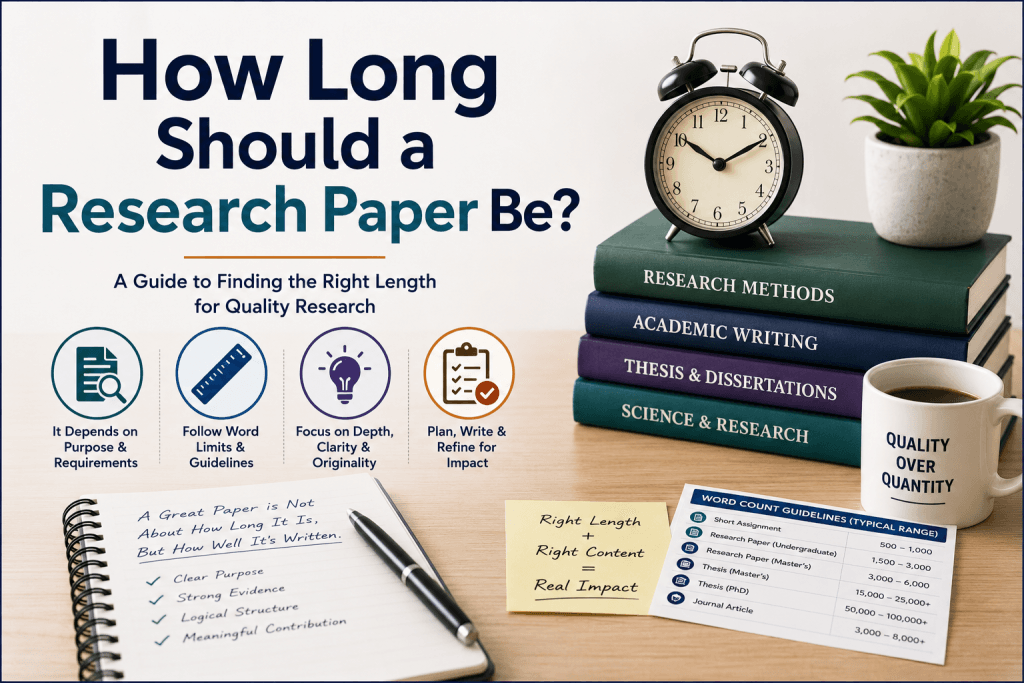
Most Discussion sections run 800–1,500 words, or about 15–20% of the total manuscript, spread across 4–8 paragraphs.
Typical length by journal type
- High-impact journals (Nature, Science, Cell): ~500–1,000 words — dense, no filler
- Standard specialty/field journals: ~1,000–1,500 words — most common range
- Case reports: ~300–600 words — brief, focused
- Review articles: 2,000+ words — broader scope justifies length
What actually determines the right length
- Journal’s stated word limit (check author guidelines — this always overrides general rules)
- Number of key findings you need to interpret
- Field norms (clinical journals = tighter; mechanistic/basic science = more room)
- How much existing literature your results need to engage with
The 7-part structure that keeps length in check
- Opening summary — 2–3 sentences restating your main finding(s), no new data
- Interpretation paragraphs — one per major finding; explain what it means
- Mechanism paragraph — why you likely got this result
- Literature comparison — how your results agree or clash with prior studies
- Limitations — honest and concise, 3–5 sentences, not defensive
- Implications — clinical, practical, or theoretical significance
- Conclusion — 2–4 sentences, no new information, ties back to your study aim
Mistakes that quietly inflate (or gut) your word count
- Restating Results in detail — that belongs in the Results section, not here
- Over-citing — engaging with every tangentially related paper instead of the most relevant few
- Padding the Limitations paragraph with irrelevant caveats
- Repeating the Introduction’s literature review almost verbatim
- Sneaking in new data or analyses that weren’t shown in Results
Simple rules of thumb
- Aim for roughly one paragraph per key finding
- If your Discussion is longer than your Introduction + Results combined, it’s probably bloated
- If it’s under 500 words for a full original research article, you likely haven’t gone deep enough on interpretation
Before you finalize
- Always check the target journal’s “Instructions for Authors” for exact word or page limits
- Skim 2–3 recently published papers in that journal to calibrate typical length and tone
- Remember: journals care more about substance per word than hitting a specific number — a tight, well-argued 900-word Discussion beats a rambling 1,800-word one every time
Bottom line: there’s no single “correct” length — but if you’re writing a standard original research article and landing outside the 800–1,500 word range, it’s worth asking whether you’re under-explaining your findings or over-padding with unnecessary detail.
Final Tips to Write the Discussion in Research Paper Like a Pro
- Reread your research question before you start. Before you write the discussion section, take a moment to think about the research question and hypothesis that guided your study. Every paragraph of your discussion in research paper writing should trace back to this foundation.
- Draft the summary section first, then build outward. Start with a concise summary of key findings, then expand into implications, context, and limitations. This structure and write method keeps your discussion in research paper writing organized from the very first sentence.
- Use subheadings or clear paragraph breaks for each element. Even if your journal doesn’t require formal subsection headers, mentally separating your discussion into distinct elements of the discussion — summary, implications, literature connection, limitations, conclusion — keeps your writing focused.
- Always tie results back to meaning. Every time you mention a number or statistic, ask: what does this result mean for my research question? This habit is what separates a good discussion in research paper writing from a purely descriptive one.
- Be honest about limitations of your study. Reviewers respect honesty far more than false confidence. Address the limitations of your study directly rather than glossing over them.
- Avoid overstating the findings, even when results are exciting. It can be tempting to inflate the importance of your first study or a novel result, but restraint builds credibility. Focus on highlighting implications while not overstating them.
- Reference previous studies thoughtfully. Don’t just cite prior studies for the sake of it — explain specifically how your research results agree with, extend, or challenge previous literature and existing knowledge.
- Make concrete recommendations. A strong discussion in research paper writing doesn’t just identify unresolved questions; it should make recommendations for how future research can address them.
- Read your discussion section out loud. This simple trick helps you catch awkward transitions, repetitive phrasing, and places where the logic doesn’t flow naturally between paragraphs.
- Get a second opinion before submission. Ask a mentor, colleague, or peer reviewer to read your discussion in research paper draft. Fresh eyes often catch overstated claims or unclear reasoning you might miss.
- Keep your overall conclusion tight and specific. End with a clear statement that reinforces the importance of the study without repeating everything you’ve already said.
- Practice makes it easier. The more research papers you write, the more natural it becomes to write an effective discussion. Even researchers early in their careers can produce a strong discussion in research paper writing by following a consistent structure every time they write a discussion section.
- Ultimately, learning to write the discussion in research paper writing well is a skill built through repetition, feedback, and careful attention to how your study results connect to the broader body of research. With these five steps and these final tips, you’re well equipped to write a discussion in research paper writing that stands up to peer review and makes a genuine contribution to your field.
- George Mason University Writing Center – Scientific (IMRaD) Research Reports: Overview – https://writingcenter.gmu.edu/writing-resources/imrad/writing-an-imrad-report
- Utah Valley University Writing Center – Scientific Writing: IMRaD – https://www.uvu.edu/writingcenter/handouts/scientific-writing.html
- Brigham Young University Research & Writing Center – Scientific Writing: IMRAD Format – https://rwc.byu.edu/00000188-e4bc-d222-a7ea-eefd769e0000/scientific-writing-imrad-format-pdf