What Is an Academic Journal?
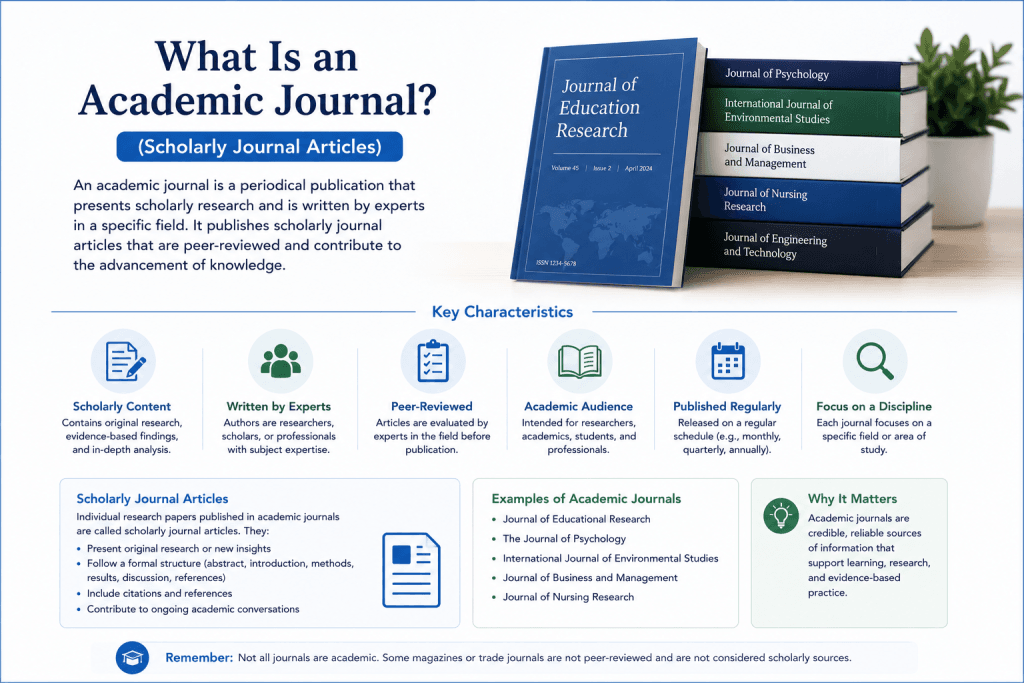
- The simple definition: What is an academic journal? People searching for what is an academic journal are usually looking for a clear, no-jargon answer, so here it is: at its core, an academic journal is a periodical publication where scholars, researchers, and experts share original research, essays, and review articles within a specific discipline. Unlike a general-interest magazine, an academic journal exists to advance scholarship and disseminate high quality research to a specialized audience.
- Who writes for an academic journal? Contributors are typically university faculty, scientists, graduate students, and other experts who conduct original research and want to publish in journals recognized by their academic community. Writing for a scholarly journal is often tied to academic credentials, tenure decisions, and career advancement within academia.
- What is an academic journal used for? Academic journals serve as the primary vehicle for the dissemination of new findings across every discipline — from the social sciences to the hard sciences. When a scholar completes a study, publication in a scholarly journal allows that research to reach other experts, be scrutinized, and contribute to the broader body of scholarship.
- The structure of a typical journal article: Most articles in academic journals follow a recognizable format:
- An abstract that provides a concise summary of the research
- An introduction outlining the research question
- A methodology section describing how the study was conducted
- Results and discussion sections presenting findings
- A conclusion and list of references
- Why the format matters: This structure helps other scholars quickly assess whether a journal article is relevant to their own research, making academic journals searchable and easy to navigate within a library or database.
- How often are journals published? An academic journal is typically released on a set schedule — monthly, quarterly, or biannually — with each edition called an “issue.” Some journals date back to their first issue centuries ago, while others are the product of the proliferation of new fields and emerging areas of study.
- Digital vs. print: While many journals started as print periodicals, most scholarly journal content today is available through open access platforms, university libraries, or subscription-based databases like Scopus. So when people ask what is an academic journal in the modern context, the answer increasingly includes its digital, searchable format alongside its traditional print roots.
- Journals versus periodicals in general: Every academic journal is technically a periodical, but not every periodical is a scholarly journal. A periodical is simply any publication released at regular intervals — magazines, newsletters, and journals all qualify. What is an academic journal, then, within that broader category? It’s the subset of periodicals dedicated specifically to peer-reviewed, discipline-specific scholarship rather than general-interest content.
- The scholar’s perspective: For a working scholar, the question of what is an academic journal isn’t abstract — it’s a practical one tied to where they submit their next research paper, which specific journal fits their subfield, and which publication will give their work the best visibility among other experts in their discipline.
- In short: If you’re still wondering what is an academic journal — or want a quick refresher on what is an academic journal before diving into the rest of this guide — think of it as the formal record of scholarship — a trusted publication where researchers submit, revise, and eventually publish findings that shape entire fields of study.
Academic Journal vs. Magazine: Key Differences
- Purpose and audience: A magazine is generally written for the general public, focusing on entertainment, lifestyle, or broad current events. An academic journal, by contrast, is written for scholars, researchers, and students within a specific discipline — which is a major part of answering what is an academic journal versus a magazine, and it’s the first thing worth clarifying when someone asks what is an academic journal at all.
- Authorship: Magazine articles are usually written by staff journalists or freelance writers. Journal articles are written by experts, scholars, or researchers who have direct experience conducting research in their field. This distinction alone helps clarify what is an academic journal for readers unfamiliar with academic publishing.
- The review process: This is one of the most important differences:
- Magazines are reviewed by editors for style, clarity, and general appeal.
- Academic journals undergo a rigorous peer-review process, where other experts in the discipline evaluate the research articles before publication.
- This peer-review process ensures reliability, accuracy, and academic rigor that a typical magazine simply doesn’t require.
- Content and depth: Magazine articles tend to be short, accessible, and written in a conversational tone. Journal articles are longer, denser, and packed with data, citations, and quantitative analysis. If you’re comparing content depth, this is a clear answer to what is an academic journal — it’s built for depth, not casual reading.
- Citations and references: Academic journal articles always include a bibliography or reference list citing prior research papers, often with a DOI (Digital Object Identifier) for easy tracking. Magazines rarely include formal citations.
- Publisher and distribution:
- Magazines are often published by commercial publishers focused on advertising revenue and circulation numbers.
- Scholarly journals are frequently published by university presses, professional organizations, or academic publishers like Wiley, and are distributed through library databases rather than newsstands.
- Longevity and archive value: A journal article is archived permanently in academic databases and remains part of the scholarly record indefinitely. A magazine issue, while occasionally archived, isn’t typically treated as part of the formal literature within a discipline.
- Advertising and revenue models: Magazines typically rely on advertising and subscriptions to generate revenue, which can influence editorial decisions about what gets covered. Scholarly journals, on the other hand, are driven by the goal of advancing a field of study, with revenue coming from institutional subscriptions, submission fees, or open access publishing charges rather than advertisers.
- Editorial boards versus editorial staff: A magazine typically has an editorial staff focused on tone, layout, and reader engagement. An academic journal is overseen by an editorial board made up of scholars and other experts in the discipline, whose job is to uphold academic rigor rather than commercial appeal.
- Bottom line: When people ask what is an academic journal in comparison to a magazine, the short answer is that one prioritizes rigorous, peer-reviewed scholarship, while the other prioritizes broad appeal and readability.
Academic Writing & Research Support
Need Help With Research Papers, Manuscripts, Editing, or Proofreading?
At Scholarly Work, we provide professional academic writing support for researchers, students, and professionals. From drafting manuscripts to refining final submissions, we ensure clarity, accuracy, and publication-ready quality.
Get Manuscript Writing Help
The Peer Review Process Explained
- What is peer review? Peer review is the quality-control system that separates an academic journal from a magazine article or even other publications. Before a research paper is published, it’s sent to other experts — peers in the same discipline — who evaluate the submission for accuracy, originality, and academic rigor.
- Why peer review matters: Understanding peer review is essential to understanding what is an academic journal, because peer-reviewed status is often the single biggest signal of credibility for research articles. A peer-reviewed article has already survived scrutiny from other scholars before it ever reaches a reader.
- Step-by-step: how the peer-review process works:
- Submission: A researcher submits their manuscript to a specific journal that matches their discipline (e.g., a chemistry study submitted to a science journal, or a sociology paper submitted to a social sciences journal).
- Initial editorial screening: Journal editors first check whether the article in a journal fits the scope, format, and standards of the publication. Many submissions are rejected at this stage without even reaching reviewers.
- Assigning reviewers: If the article passes initial screening, editors select two or three outside experts — typically scholars with published research in the same area — to review the paper.
- Blind review: Most journals use a “blind” or “double-blind” system, where reviewers don’t know the author’s identity (and sometimes authors don’t know the reviewers’ identities either). This protects against bias and keeps the review process objective.
- Review and critique: Reviewers evaluate the research methodology, the validity of the data, the originality of the findings, and whether the conclusions are supported by evidence. They then submit detailed feedback to the journal editors.
- Revise and resubmit: It’s rare for a paper to be accepted outright. Most authors are asked to revise their manuscript based on reviewer feedback — sometimes multiple times — before the paper is considered ready to publish.
- Final decision: Once the journal editors are satisfied with the revisions, the paper is formally accepted for publication and scheduled for an upcoming issue.
- Types of peer review:
- Single-blind review: Reviewers know the author’s identity, but the author doesn’t know who reviewed their work.
- Double-blind review: Neither party knows the other’s identity, which is common in the social sciences and humanities.
- Open review: Reviewer names and comments are published alongside the article for full transparency.
- How long does peer review take? Depending on the journal, the number of submissions it receives, and the availability of qualified reviewers, the peer-review process can take anywhere from a few weeks to over a year. High-demand journals with heavy submission volumes often have longer review timelines.
- The role of journal editors: Editors act as gatekeepers throughout this entire process. They select reviewers, mediate disagreements between authors and reviewers, and make the final call on whether a paper is published in journals under their editorial scope.
- Peer review and predatory journals: Not every publication claiming to be an academic journal follows a genuine peer-review process. Some “predatory journals” charge submission or publication fees while skipping rigorous review altogether, which damages the reliability of the research they publish. Knowing what is an academic journal — and what isn’t — often comes down to verifying whether real peer review occurred.
- Why this process protects readers: For students, professionals, and other scholars, peer review offers a level of trust. When you read a peer-reviewed article, you know it has already been scrutinized by other experts, making it far more reliable than content that hasn’t been through this review process.
- Peer review across disciplines: The specifics of peer review can vary depending on the discipline. In the hard sciences, reviewers often focus heavily on quantitative data and experimental design. In the social sciences and humanities, reviewers may spend more time evaluating theoretical framing, argumentation, and the interpretation of qualitative evidence. Regardless of the field, the underlying goal stays the same: answering what is an academic journal worth publishing in by holding every submission to a consistent standard.
- The takeaway: Peer review is the backbone of scholarly publishing. It’s the mechanism that ensures published in journals means something — it signals that the research articles you’re reading have met a rigorous academic standard, which is central to answering what is an academic journal in any complete way.
Types of Content Found in Scholarly Journals
- Original research articles: These are the most common type of content, presenting new findings from a study the author conducted. They typically include an abstract, methodology, results, and discussion, and represent the primary way new research papers enter academic discourse.
- Review articles: Rather than presenting new data, review articles summarize and synthesize existing research papers on a particular topic. They’re incredibly useful for students and researchers trying to get a broad overview of recent research within a discipline without reading dozens of individual studies.
- Review articles often highlight gaps in current research, pointing scholars toward areas that need further study.
- They’re frequently among the most-cited pieces in any academic journal, because they offer a comprehensive summary in a single article.
- Case studies: Common in fields like medicine, psychology, and business, case studies analyze a specific instance, patient, organization, or event in detail. These articles offer real-world context that pure theoretical research sometimes lacks.
- Short communications or brief reports: These are condensed research articles, often used to quickly share preliminary findings or urgent discoveries before a full-length paper is ready. They allow findings to be published in journals faster than the standard, more rigorous review process for a full research paper.
- Editorials and commentary: Written by journal editors or invited experts, editorials offer perspective, opinion, or commentary on trends within a discipline. While not peer-reviewed in the same way as research articles, editorials still carry weight because of the expertise of their authors.
- Letters to the editor: These allow other scholars to respond to previously published research, raise questions, or point out errors or alternative interpretations. This ongoing dialogue is part of what keeps a scholarly journal a living, evolving publication rather than a static archive.
- Book reviews: Some scholarly journals include reviews of newly published academic books relevant to the discipline, helping readers decide whether a book is worth adding to their own research or reading list.
- Systematic reviews and meta-analyses: These go a step further than a standard review article by using a systematic, often quantitative, method to combine and analyze data from multiple studies. They’re considered some of the highest-value content in scientific and medical journals because they synthesize large volumes of research papers into a single, statistically rigorous conclusion.
- Essays and think pieces: Particularly common in humanities and social sciences journals, essays allow scholars to explore ideas, theories, or arguments in a more interpretive way than a strict empirical research paper.
- Special issues: Occasionally, a journal will dedicate an entire issue to a single theme, publishing a collection of research papers, review articles, and essays all related to one topic. These special issues are often guest-edited by leading experts in that specific area.
- Conference proceedings: Some scholarly journals publish papers originally presented at academic conferences, giving those findings a permanent, citable home in the published literature.
- Corrections and retractions: When errors are found after publication, journals issue formal corrections, or in more serious cases, retract the article altogether. This transparency is part of what maintains trust in the scholarly journal system.
- Discipline-specific formats: The exact mix of content varies by field. A science journal may lean heavily toward original research articles and short communications reporting new experimental data, while a humanities journal may favor essays, review articles, and book reviews. Recognizing these differences is another piece of understanding what is an academic journal within any given field of study.
- Why this variety matters: Understanding the range of content is central to grasping what is an academic journal in practice. It’s not just a container for a single research paper — a scholarly journal is a collection of many different article types, each serving a different function in the dissemination of knowledge across a discipline.
Academic Writing & Research Support
Need Help With Research Papers, Manuscripts, Editing, or Proofreading?
At Scholarly Work, we provide professional academic writing support for researchers, students, and professionals. From drafting manuscripts to refining final submissions, we ensure clarity, accuracy, and publication-ready quality.
Get Manuscript Writing Help
How to Find and Access Research Papers
- Start with your university library: Most universities provide access to major academic databases through their library, giving students and faculty free access to journal articles that would otherwise sit behind a paywall. A librarian can also help point you toward the right database for your specific discipline.
- Use academic databases: Several platforms index research papers and academic articles across disciplines:
- Scopus — one of the largest databases of peer-reviewed literature, widely used to track citations and journal rankings.
- Google Scholar — a free, broad search engine for scholarly articles, theses, and research papers across nearly every field.
- JSTOR — particularly strong for humanities and social sciences research.
- PubMed — the go-to database for medical and life sciences research.
- Web of Science — another major citation database used to evaluate the impact of published research.
- Look for open access journals: Open access publishing has changed how people find and access research papers. Instead of sitting behind a subscription paywall, open access articles are freely available to anyone, often published under a Creative Commons license that defines how the work can be reused or redistributed.
- Open access has made it significantly easier for independent researchers, students without institutional access, and the general public to read peer-reviewed research.
- Many major publishers now offer a hybrid model, where individual open access articles exist within an otherwise subscription-based scholarly journal.
- Search by DOI: Every published journal article typically has a unique DOI (Digital Object Identifier), which acts like a permanent link to that specific piece of research. If you already have a citation, searching the DOI is often the fastest way to locate the exact article.
- Check the publisher’s website directly: Academic publishers, including Wiley and other major publishers, host their own searchable databases where you can browse by discipline, specific journal, or keyword.
- Use interlibrary loan services: If your library doesn’t have access to a particular journal, most academic libraries offer interlibrary loan systems that can request a copy of the article or research paper from another institution.
- Explore institutional repositories: Many universities maintain their own open archive of faculty research, theses, and dissertations, which is often searchable and free to access even for people outside the university.
- Set up database alerts: Most academic databases let you save searches or set alerts for new research within your area of interest, helping you stay current with recent research as soon as it’s published.
- Evaluate credibility before you cite: Not every source calling itself a journal is legitimate. Before relying on a research paper, check that:
- It was published in journals with an established editorial board.
- It went through an actual peer-review process, not just a submission fee.
- It’s indexed in reputable databases like Scopus rather than only appearing through a basic web search.
- Ask a librarian when in doubt: A skilled librarian can often save hours of searching by pointing you directly to the right database, the right specific journal, or the correct search terms for your topic. This is especially useful for students who are still getting familiar with what is an academic journal and how scholarly databases are organized.
- The takeaway: Learning how to access research effectively is just as important as understanding what is an academic journal in theory. Between university libraries, databases, and the growing open access movement, high quality research papers are more reachable today than ever before.
Why Publication in a Scholarly Journal Matters
- It validates research through expert scrutiny: Because of the peer-review process, publication in a scholarly journal signals that a study has been examined and approved by other qualified experts — something no other type of publication guarantees in the same way.
- It supports academic careers: For faculty members, published research is often directly tied to tenure, promotion, and hiring decisions. The phrase “publish or perish” exists because career advancement in academia is closely linked to a scholar’s record of publication in respected journals.
- It builds a permanent, citable record: Once an article is published in journals and indexed in major databases, it becomes part of the permanent scholarly record. Other researchers can cite it, build on it, or challenge it in their own research papers for years — sometimes decades — afterward.
- It drives the dissemination of high quality research: Academic journals exist specifically to spread new findings across a discipline. Without this system of publication, breakthroughs in medicine, technology, and the social sciences would spread far more slowly, if at all.
- It contributes to a discipline’s collective scholarship: Every article in an academic journal adds to a larger, ongoing conversation. Researchers build on prior studies, challenge outdated conclusions, and refine theories — a cycle that depends entirely on scholars having a reliable place to publish and access each other’s work.
- It offers credibility that self-publishing can’t match: Anyone can publish a blog post or an essay online, but that content hasn’t been vetted by other experts. Publication in a peer-reviewed academic journal carries a level of trust and reliability that’s difficult to replicate outside of formal scholarly publishing.
- It supports funding and institutional reputation: Universities and research institutions often use faculty publication records — including where research is published and how often it’s cited — to secure funding, attract top scholars, and build their overall academic reputation.
- It connects scholars across the globe: A journal article published by a scholar in one country can be read, cited, and built upon by researchers anywhere in the world, making scholarly journals one of the most effective tools for global collaboration in research.
- It shapes how new scholars enter a field: For graduate students and early-career researchers, getting a first article accepted answers what is an academic journal from a very personal angle — it’s often their formal entry point into a discipline’s professional community, alongside conferences and professional organizations.
- It preserves knowledge for future scholarship: Because journal articles are archived in databases and library systems, they remain accessible for future scholars long after the original research was conducted, ensuring that today’s findings can still inform tomorrow’s questions.
- Final thoughts: At the end of the day, understanding what is an academic journal — and why publishing in one matters — comes down to recognizing its role as the trusted backbone of scholarship. From the rigorous peer-review process to the open access movement expanding who can read it, the academic journal remains the most reliable home for research papers, review articles, and the ongoing dissemination of knowledge across every discipline.
References
- American College of Education (ACE) – Scholarly Writing Guide – https://ace.edu/blog/a-guide-to-scholarly-writing/
- George Washington University – Faculty Scholarly Publications – https://scholarship.law.gwu.edu/faculty_publications/73/
- Walden University Writing Center – Scholarly Writing Resources – https://academicguides.waldenu.edu/writingcenter/scholarly
- Florida State University College of Law – Scholarly Writing Guide – https://guides.law.fsu.edu/scholarlywriting